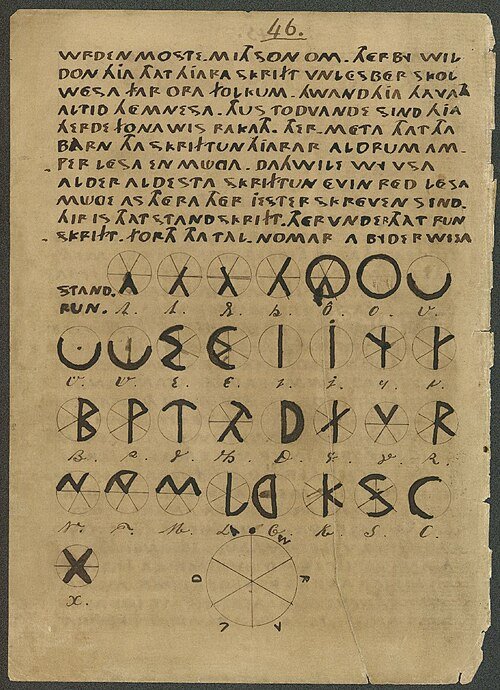
Page 48 of the nineteenth-century Oera Linda manuscript. A reproduction of the actual manuscript, not evidence that its claimed ancient history is authentic. Image credit: Tresoar collection / manuscript authorship uncertain. Public domain.
Listen to the Oera Linda Story
In 1867, a shipwright in the Dutch naval town of Den Helder had a manuscript that he said had come down through his family. Its strange letters told of an ancient Frisian society governed by women. Someone had given the story a history of its own, complete with ancestral voices and the appearance of an old script. For at least one learned reader, the effect was convincing.
The Oera Linda Book is a nineteenth-century literary forgery. Its invented history tells of Frya’s people, their laws and the destruction of a land called Atland. The historical puzzle is how the manuscript emerged, how it persuaded readers and who took part in making it.
The Manuscript That Arrived With a Ready-Made Legend
Cornelis over de Linden worked as a shipwright at the naval dockyard in Den Helder. He said he had inherited the manuscript through his family. Historian Goffe Jensma traces the story to over de Linden’s aunt in Enkhuizen, while distinguishing the inheritance claim from the actual date of the text.
The family name did part of the work. The purported chroniclers bore a name that echoed the man who owned the pages. A reader encountering the manuscript as an heirloom had a ready explanation for where it had been before anyone outside the family saw it.
The chronicle’s claims went far beyond a family history. It described leaders called “Mothers,” laws and a catastrophe that destroyed Atland. In the story, the Frisians were ancestors of a civilization whose influence extended well beyond their homeland. These are the manuscript’s inventions, not established events in ancient Europe.
What the Oera Linda Book Actually Claimed
Part of the book’s staying power comes from how ambitious its claims were. The Oera Linda Book did not offer one odd legend or one disputed king. It offered a full worldview.
- It claimed the Frisians were an ancient, foundational people whose influence reached far beyond the Netherlands.
- It described a matriarchal order led by revered “Mothers” who preserved wisdom, law, and spiritual authority.
- It presented Atland as a lost homeland destroyed in a catastrophe, sending survivors outward.
- It implied that accepted ancient history was incomplete or wrong, with mainstream civilization arriving after a deeper and largely forgotten one.
- It blended myth, language, identity, and destiny in a way that made the manuscript feel less like a record and more like a national origin story.
The text sets out laws, names rulers and describes an ancestral homeland. A reader can follow its succession of events without accepting them as evidence about early Europe. Those details come from the book itself, whose nineteenth-century publication made them available to a wider audience.
Timeline of the Oera Linda Book Mystery
- 1867: The manuscript comes to attention in the possession of Cornelis over de Linden in Den Helder.
- Late 1860s to early 1870s: The text begins drawing attention as scholars attempt to translate and interpret it.
- 1872: Jan Gerhardus Ottema publishes the text with a Dutch translation and argues for its authenticity.
- 1876: William Sandbach’s English translation brings the purported chronicle and its claims to another audience.
- By the late 19th century: many scholars conclude the Oera Linda Book is a modern fabrication rather than an ancient source.
- 20th and 21st centuries: the manuscript survives anyway, not as accepted history, but as a fascinating hoax, fringe text, and cultural artifact that keeps finding new believers.
When the Cracks Started Showing
The text resembles Old Frisian at first glance, but the Fries Museum describes its language as an invention. The script borrows the appearance of runes. Those are different tests of authenticity. A writer can devise unfamiliar letters while composing sentences that belong to a much later linguistic world.
Ottema’s introduction shows how a reader could be persuaded. He described his initial doubts, then recalled being convinced of the manuscript’s age by examining facsimiles. He compared the letters with ancient writing and constructed an argument about the paper. These were claims made in defence of the manuscript; they were not independent proof that its supposed medieval copyist had existed.
The University of Groningen’s account of Jensma’s research identifies more specific problems: artificially yellowed paper, letters that resemble Roman capitals, and a language he interpreted as distorted Dutch. Those observations move the discussion from whether the book looks impressive to how its apparent antiquity was produced.
What Doesn’t Add Up in the Claim of Antiquity
- The script looked mysterious, but mystery alone is not proof of age or authenticity.
- The language resembled older Frisian forms, yet many critics argued it resembled a modern attempt to imitate antiquity rather than an untouched ancient source.
- The grand historical claims lacked archaeological support. There was no matching material record for the sweeping civilization the book described.
- The worldview aligned too neatly with later ideological desires. National identity, lost wisdom, and hidden origins made the manuscript useful to believers for reasons beyond scholarship.
- The printed book documents the hoax’s reception. A published translation establishes that the text circulated, without authenticating its account of ancient events.
The makers behind the manuscript
The Fries Museum presents the book as a practical joke that acquired a life beyond its creators’ intentions. Jensma’s research connects the minister and writer François Haverschmidt with its creation. That reconstructs a nineteenth-century literary circle. It does not turn the language of the purported ancient chroniclers into testimony.
Jensma’s attribution is a scholarly reconstruction. The nineteenth-century origin is much firmer than a precise division of responsibility for composing, copying and publicising the book.
Why the Debate Refused to Die
Ottema’s endorsement gave the work a public advocate. The English edition preserved the claimed chain of inheritance alongside the story it was supposed to authenticate. A reader today can examine both, and can see how neatly each seems to support the other until independent evidence is sought.
Sandbach’s 1876 preface also shows that translation was an act of advocacy. He acknowledged a controversy over authenticity, but argued that the narrative remained plausible. He supplied photographs of manuscript pages and printed the purported Frisian beside the English. The reader was being offered the text and an argument for taking it seriously at the same time.
What the Authorship Question Changes
Jensma’s interpretation gives the authorship question a particular setting. In his reconstruction, Haverschmidt used the invented chronicle to challenge literal readings of religious texts. The University of Groningen identifies Eelco Verwijs and Cornelis over de Linden as collaborators in that reconstruction. The intended recognition of the joke failed when Ottema continued to believe.
That interpretation explains why authorship matters without reopening the question of ancient authenticity. It asks what a nineteenth-century writer was trying to do and why a learned reader responded differently. The surviving printed editions let readers examine that disagreement through the arguments actually offered, rather than through a generic claim that people wanted to believe.
Ottema helped move a private manuscript into print. Sandbach carried it into another language. Their introductions remain beside the invented history: a record of how the book acquired authority, even though its account of ancient Friesland did not deserve it.
FAQ
What is the Oera Linda Book?
The Oera Linda Book is a manuscript presented in the Netherlands in 1867 and claimed to be an ancient Frisian chronicle. It describes a lost civilization, a matriarchal social order, and a forgotten version of early European history.
Is the Oera Linda Book real or a hoax?
It is a real nineteenth-century manuscript containing an invented ancient chronicle. The Fries Museum describes the imitation language and script and treats the work as a literary hoax.
What did the Oera Linda Book claim?
It claimed that the Frisians descended from a powerful ancient civilization linked to a lost land called Atland, and that this civilization shaped later history in ways mainstream scholarship failed to recognize.
Who may have written the Oera Linda Book?
Historian Goffe Jensma linked François Haverschmidt to the project. The precise contribution of each participant is less certain than the manuscript’s modern origin.
Why does the Oera Linda Book still matter?
The manuscript and its published defences preserve a documented encounter between literary invention and historical belief. Studying that encounter does not require treating its ancient chronicle as authentic.
Sources & References
The following resources were consulted to verify and update this article.
- Goffe Jensma, De gemaskerde god, University of Groningen — Investigates the 1867 appearance, Den Helder shipwright and family provenance claim, the purported chronicle and the Haverschmidt attribution.
- Fries Museum, Oera Linda Boek — Explains the literary joke, invented language and imitation script in their nineteenth-century Frisian context.
- The Oera Linda Book, William Sandbach’s 1876 English edition — Makes the translated narrative and its nineteenth-century defence available for comparison. It documents the authors’ claims and reception.
- University of Groningen, Jensma’s 2004 research findings — Summarizes the evidence of fabrication and his attributed authorship and religious-satire interpretation.
Related stories
- The ancient disc whose symbols still refuse to speak clearly
- The buried treasure record that reads like a map from another age
- The Antikythera mechanism and its surviving gears
- The quarry and temples that help date the Great Sphinx
Explore this topic
- The Unsolved Mysteries Archive — Signals, Sky Anomalies, Vanishing Ships, Impossible Manuscripts, and the Cases That Keep Reality Slightly Open
- View all Unsolved Mysteries stories ->
Watch the Oera Linda Book Investigation
Follow the manuscript’s nineteenth-century journey, the arguments for its supposed antiquity and the evidence behind its modern origin. Watch the full story on YouTube.