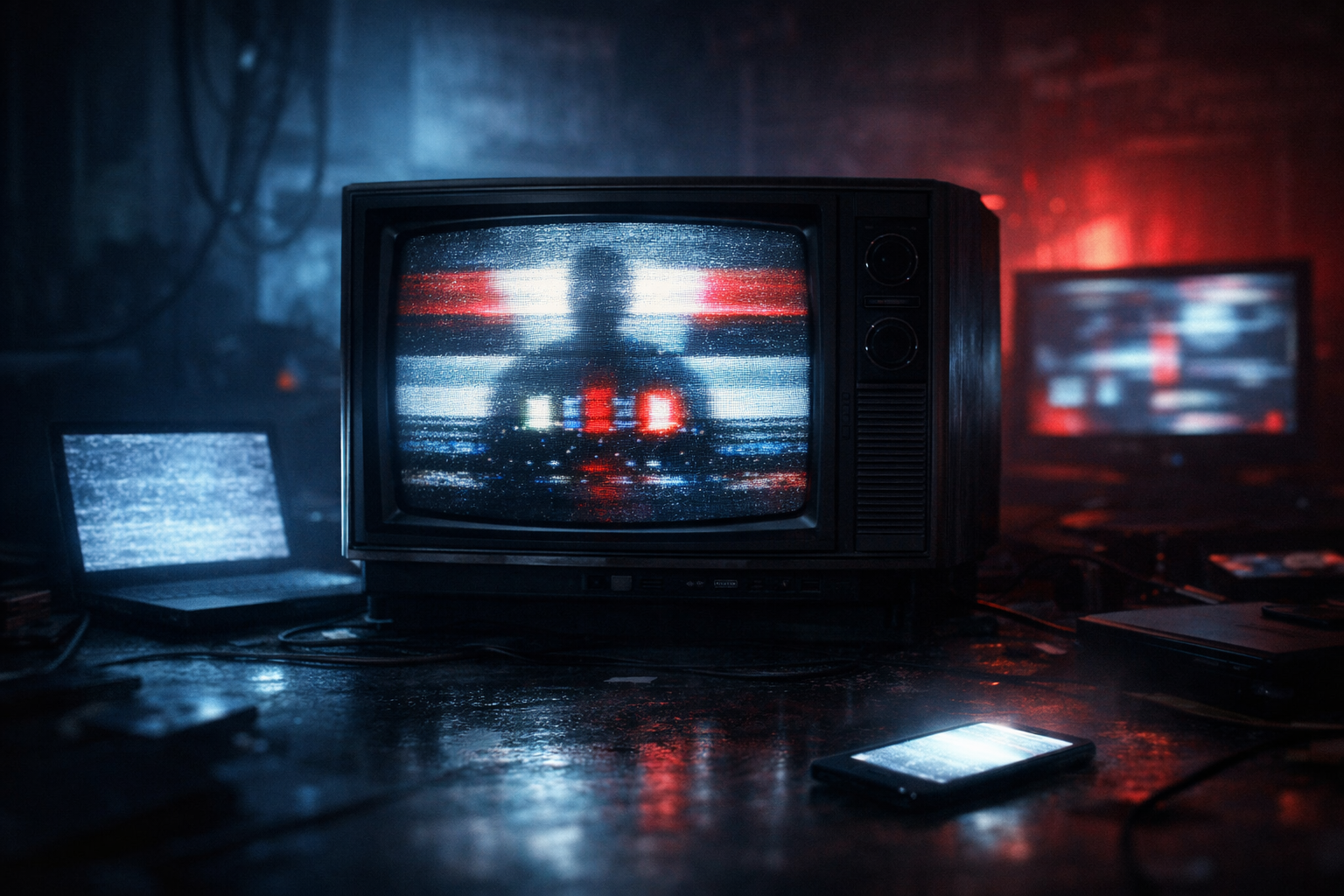
A creepy screen mystery works because it invades a place that is supposed to feel controlled. Your TV, your phone, your browser, your feed — these are ordinary objects until one strange interruption makes them feel hostile. These broadcast hijacks, eerie channels, and unexplained uploads did exactly that, turning passive viewers into witnesses who still are not sure what they were looking at.
When a Broadcast Stops Feeling Safe
Most mysteries begin with a strange place or a dangerous person. Broadcast mysteries begin with something more intimate: a screen already sitting in your home. That is what makes them so unnerving. A normal signal suddenly breaks. A face appears where it should not. A message slides in with no clear sender. Cases like the Wyoming Incident broadcast hack and the bizarre Max Headroom invasion still hit hard because they attack the ordinary rhythm of watching something familiar and safe.
That loss of control matters. A haunted house is easy to avoid. A hijacked channel is different. It says the system itself can be entered, twisted, and used to make strangers uneasy for reasons no one fully understands. That is where these stories start to feel bigger than pranks. They become tiny demonstrations of how fragile the line is between signal and intrusion.
The TV Hijacks That Felt Like Someone Was Playing With Reality
The most famous cases in this category share one thing: they feel almost stupid at first, until you sit with them. A weird mask. Distorted audio. A sudden interruption. Then your brain starts asking the dangerous questions. Who did this? How did they get in? Why this station? Why this message? Max Headroom remains legendary because it looked like nonsense and sabotage at the same time, while the Wyoming Incident survives because it hit people with imagery that felt half-joke, half-nightmare.
And once a hijack becomes folklore, it changes shape. People remember the feeling more than the technical facts. That is why these cases keep spreading long after the original signal died. They are not just media events anymore. They are campfire stories with static in the background.
YouTube Mysteries: When a Video Exists but the Motive Does Not
The internet took the old broadcast mystery and made it more personal. You no longer had to wait for a station to be hijacked. Now anyone could upload something unsettling directly into the bloodstream of the web. That is why cases like Webdriver Torso, I Am Sophie, and the YouTube mystery nobody can solve became so sticky. The videos were available, replayable, and dissected frame by frame — but that did not make them easier to explain.
In fact, replay often makes things worse. On television, a strange interruption can become blurry memory. Online, the clip keeps living. Every pause invites a theory. Every odd detail becomes evidence. Sometimes that leads to an answer. Sometimes it just creates a deeper maze of guesses, ARG theories, hoaxes, and genuine unease.
Webdriver Torso and the Fear of Meaningless Signals
Part of what made Webdriver Torso so effective was how little it gave people to work with. No obvious confession. No easy villain. Just an endless procession of clipped videos that looked mechanical, sterile, and wrong. It triggered a very modern fear: what if the thing on your screen was not intended for you at all, yet still felt impossible to ignore?
That is a different kind of creepy from a masked intruder hijacking a TV feed. It is colder. More machine-like. It suggests that some of the internet’s strangest artifacts are disturbing precisely because no human emotion is visible inside them. If a mystery looks like it was made by no one and for no one, people start filling the silence with their own worst ideas.
Performances, Personas, and the Problem of I Am Sophie
Then there are video mysteries that seem intensely human on the surface. I Am Sophie pulled people in because it felt like a person was reaching through the screen while also performing for it. That combination can be more unsettling than a pure glitch or code mystery. A fake-looking person can still be a real problem. A real-looking person can still be a carefully built trap.
That is why online persona mysteries explode so easily. Viewers are not just asking what a video means. They are asking whether the person inside it is acting, confessing, marketing, or signaling something darker. Once those possibilities mix together, even a short upload can feel unstable.
Cases That Still Have No Answers
Some of these mysteries endure because the technical trail is weak. Old broadcasts were not preserved cleanly. Upload records vanish. Accounts disappear. Metadata gets scrubbed or misread. And once a case becomes famous, bad information rushes in and wraps itself around the original facts. That is part of what keeps Mortis.com, the unsolved YouTube mystery, and the major broadcast-hijack legends alive. The core event exists, but the edges are crowded with noise.
Mysteries like these rarely die from one clean debunk. More often, they rot into half-truths. A few details get explained. A few remain open. The result is frustrating in the most addictive way possible: enough clarity to prove something happened, not enough closure to stop people digging.
Similar Cases Solved Years Later
Occasionally, a creepy media mystery does get an ordinary explanation. A project turns out to be art. A viral account turns out to be staged. A disturbing pattern turns out to be a backend process or test content. Webdriver Torso is the perfect reminder that a mystery can feel sinister for years and still resolve into something more mundane than the internet hoped. But even solved cases do not really lose their power.
Why? Because the feeling came first. Long before the explanation arrived, viewers had already experienced the unease. They had already watched the clip at midnight, turned the brightness up, and wondered whether they were looking at evidence, performance, or bait. A late explanation can settle the facts, but it rarely erases the original chill.
From Television to TikTok, the Pattern Never Really Changed
What changed from old broadcast hijacks to newer internet mysteries was not the core fear. It was the speed. A weird TV interruption once spread by word of mouth and grainy copies. Now something like the TikTok time traveler mystery can reach millions instantly, with every viewer joining the investigation in real time. That makes modern mysteries louder, but not necessarily better understood.
In both eras, the same ingredients keep showing up: a signal out of place, a source that feels slippery, and just enough ambiguity to leave viewers arguing after the clip ends. Whether the platform is analog television, YouTube, a strange website, or a short-form app, the hook is identical. Something appeared where it should not have been, and nobody can fully agree what it meant.
In the end, the creepiest broadcast and video mysteries are not always the bloodiest or the most dramatic. They are the ones that make ordinary technology feel suddenly untrustworthy. A channel cuts out. A clip keeps looping. A website seems wrong in a way that is hard to prove. And once a screen stops feeling neutral, every viewer is pulled into the same uneasy thought: if this got in once, what else could? That is why these cases keep returning. The hardware changes. The platforms evolve. But the fear of an unexplained signal breaking through never really goes away.
🔎 Explore more deep-dive investigations like this: