Sometimes the sky does something so strange that even experts can only shrug, collect more data, and admit they still do not have a clean answer. These are the sky mysteries that refuse to stay solved — from flickering lights and impossible signals to a blast over Siberia so violent it flattened a forest and still left no clear culprit behind.
When the Sky Starts Looking Wrong
Most people can handle a mystery on the ground. A locked room. A missing person. A strange set of footprints that stop in the dirt. But sky mysteries hit differently, because the sky is supposed to be the one stable thing overhead. It is supposed to behave. And when it does not, even calm witnesses start talking like they saw reality glitch for a second. That feeling runs straight through this breakdown of strange sky phenomena and the account of a night when the sky seemed to start acting wrong.
What makes these reports so sticky is not just that people saw something odd. It is that the odd thing often refuses to fit neatly into a normal category. Not a plane. Not weather. Not a simple atmospheric trick anyone can dismiss in one sentence. And once you strip away the usual answers, you are left with the most uncomfortable possibility of all: maybe something real happened, but we still do not understand what kind of real it was.
Strange Lights That Refuse to Behave Like Aircraft or Stars
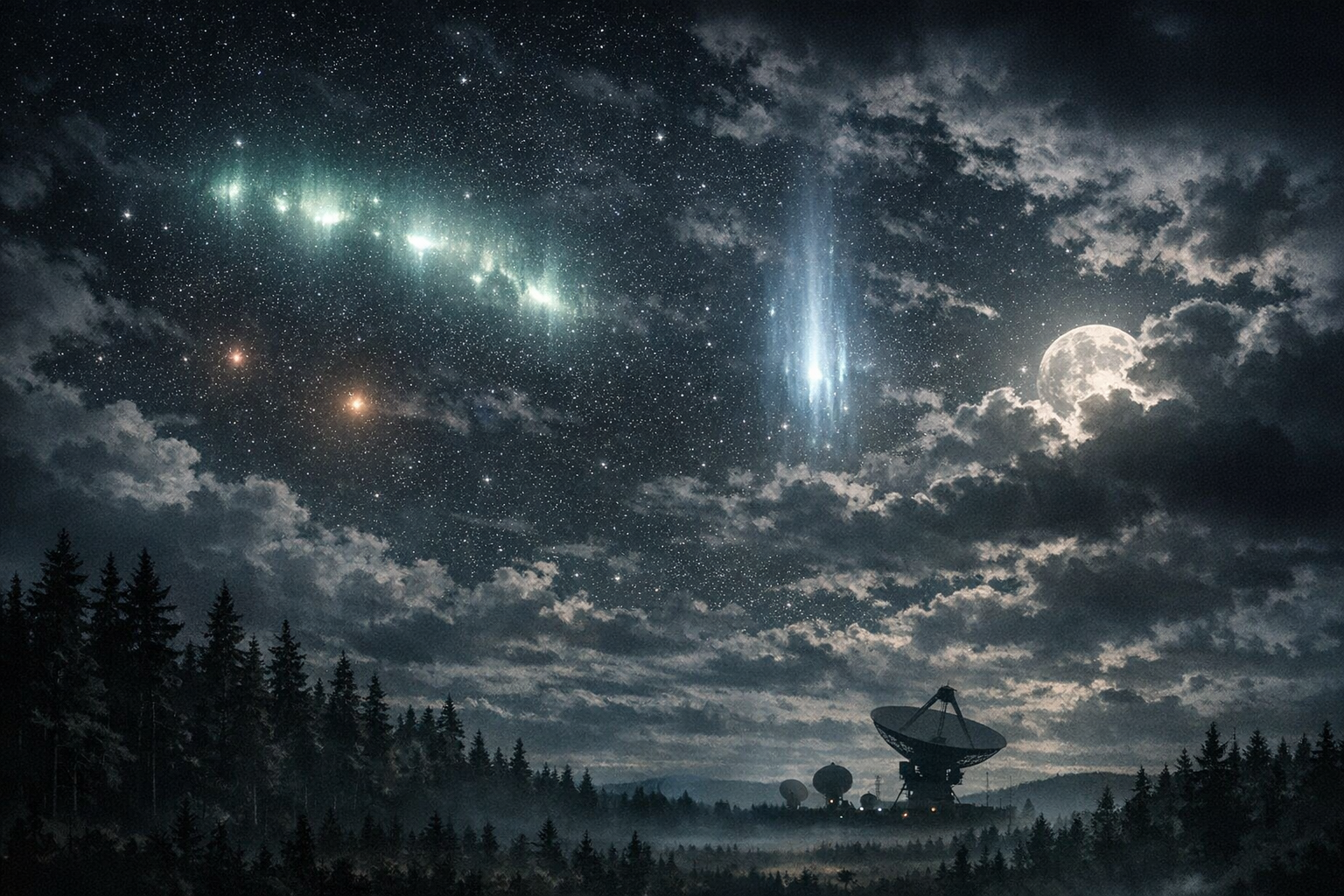
Unexplained lights are one of the oldest sky mysteries on record, but they stay interesting because the details keep changing. Some are seen hovering when they should be moving. Some move in ways that seem too abrupt or too silent. Some appear in clusters, vanish, and then return. This look at strange lights in the sky pulls together the cases that keep surviving easy explanations, while the mystery of Earth’s recent sky anomalies leans into a newer fear — that the weirdness may not be isolated at all.
Skeptics are right to point out how often lights in the sky turn out to be satellites, drones, atmospheric effects, or bad estimates of speed and distance. But that is not the whole story. The reason these cases stick around is that a small percentage keep punching through those explanations. Not because they prove aliens or some grand theory, but because they remain stubbornly incomplete. In mystery terms, incomplete is dangerous. It keeps the case alive.
Signals From Space That Sound Like Somebody Meant Something
Visual mysteries are unsettling, but audio and signal mysteries may be even worse because signals feel intentional. A light can be random. A burst of sound, a repeating pattern, or a narrow-band transmission feels like a message, even when scientists warn that pattern-hungry humans are built to overread coincidence. That tension drives this roundup of mysterious signals from space and the deeper look at unexplained deep-space voices and transmissions.
The history of space research is full of moments where a signal seems to carry a shape or logic that should not be there. Then researchers test instruments, revisit assumptions, and find a natural cause. But not every case closes so cleanly. Some fade into the archive with question marks attached. And that may be the most unnerving category of all — not solved, not disproved, just sitting there like a locked recording nobody has fully translated.
The 72 Seconds That Still Feed the Biggest Question
Few sky mysteries hit the imagination harder than the possibility that somebody, somewhere, finally heard a message that did not come from Earth. That is why the famous 72-second burst often treated as our first possible message from aliens still gets dragged back into conversation. Seventy-two seconds is nothing. Barely enough time to boil water or miss an exit. But in mystery terms, it is forever. Long enough to suggest meaning. Short enough to never settle the argument.
The real power of a case like this is not proof. It is restraint. It gives just enough to make the mind lean forward and then cuts off before certainty arrives. Scientists can argue over interference, statistical rarity, or the limits of the equipment. Believers can hear intention in the pattern. Everyone walks away unsatisfied. And unsatisfied mysteries tend to last the longest.
Tunguska: The Blast That Hit Hard Enough to Rewrite a Landscape
Then there is Tunguska, which feels less like a sky mystery and more like a warning shot from the universe. In 1908, something exploded over Siberia with such force that it flattened millions of trees across a huge area. Yet for all the destruction, investigators never found the neat smoking crater people expected. The Tunguska mystery remains one of the strongest examples of an event that was clearly real, massively destructive, and still weirdly unresolved at the edges.
Most researchers lean toward an airburst caused by a meteoroid or comet fragment. That is the mainstream explanation, and it answers the biggest question. But the reason Tunguska still belongs in roundups like this is because the event sits right at the boundary between explained and haunting. We know enough to sketch the broad shape of what happened. We do not know enough to make it feel ordinary. And ordinary is what people want after the sky tears down a forest.
Cases That Still Have No Answers
A lot of sky mysteries survive because they live in the gap between witness experience and scientific proof. The witness says the light changed direction too fast. The camera is blurry. The radar data is partial. The astronomer says the signal was unusual. The follow-up data is missing. Nobody is necessarily lying. Nobody necessarily has enough. That is a perfect formula for a mystery that never fully dies.
And unlike many crimes or disappearances, sky mysteries are hard to revisit in a satisfying way. There may be no suspect, no confession, no body, no recovered weapon, no final archive release. Just reports, instrument data, and the nagging feeling that a real event brushed past us and kept going. That is why these stories keep recycling across decades: each new case makes the old ones feel unfinished again.
Similar Cases Solved Years Later — and Why That Rarely Ends the Fascination
Every so often, one of these mysteries does get dragged back into the daylight and explained. A weird light becomes a launch test. A signal becomes interference. A panic over strange motion becomes human depth perception doing what it always does at night. Those resolutions matter, because they keep the field honest. But they also create a strange side effect: by proving that some mysteries were misread, they make the remaining cases feel even more selective and durable.
That is the pattern worth paying attention to. The sky produces constant noise, but only a small set of stories refuse to go away. When a case survives ridicule, better instruments, and years of reanalysis, it earns a different kind of gravity. Not proof of aliens. Not proof of conspiracy. Just proof that the oldest human instinct still works exactly as it always has: we look up, something does not make sense, and we cannot stop trying to name it.
In the end, the sky’s most enduring mysteries are not the ones with the wildest theories attached to them. They are the ones that leave behind just enough evidence to prove something happened, but never enough to close the case with confidence. Lights drift where they should not. Signals arrive and disappear. A forest falls under a blast from above, and more than a century later people are still asking the same basic question: what, exactly, did we just see? And that may be why sky mysteries never really go away. The moment the heavens stop feeling predictable, every person under them feels a little smaller — and a lot more curious.
🔎 Explore more deep-dive investigations like this:
- Roundups of unsolved cases that still resist clean answers
- True events so strange they still sound impossible
- Mysteries that only made sense years later
- Other deep-dive mystery collections from the site
- Creepy Broadcast and Video Mysteries — The Signals, Channels, and Uploads That Terrified the Internet
- Government Conspiracies That Turned Out to Be Real – MKUltra, Paperclip, Blue Book, and the Secrets That Made People Distrust Everything Else