
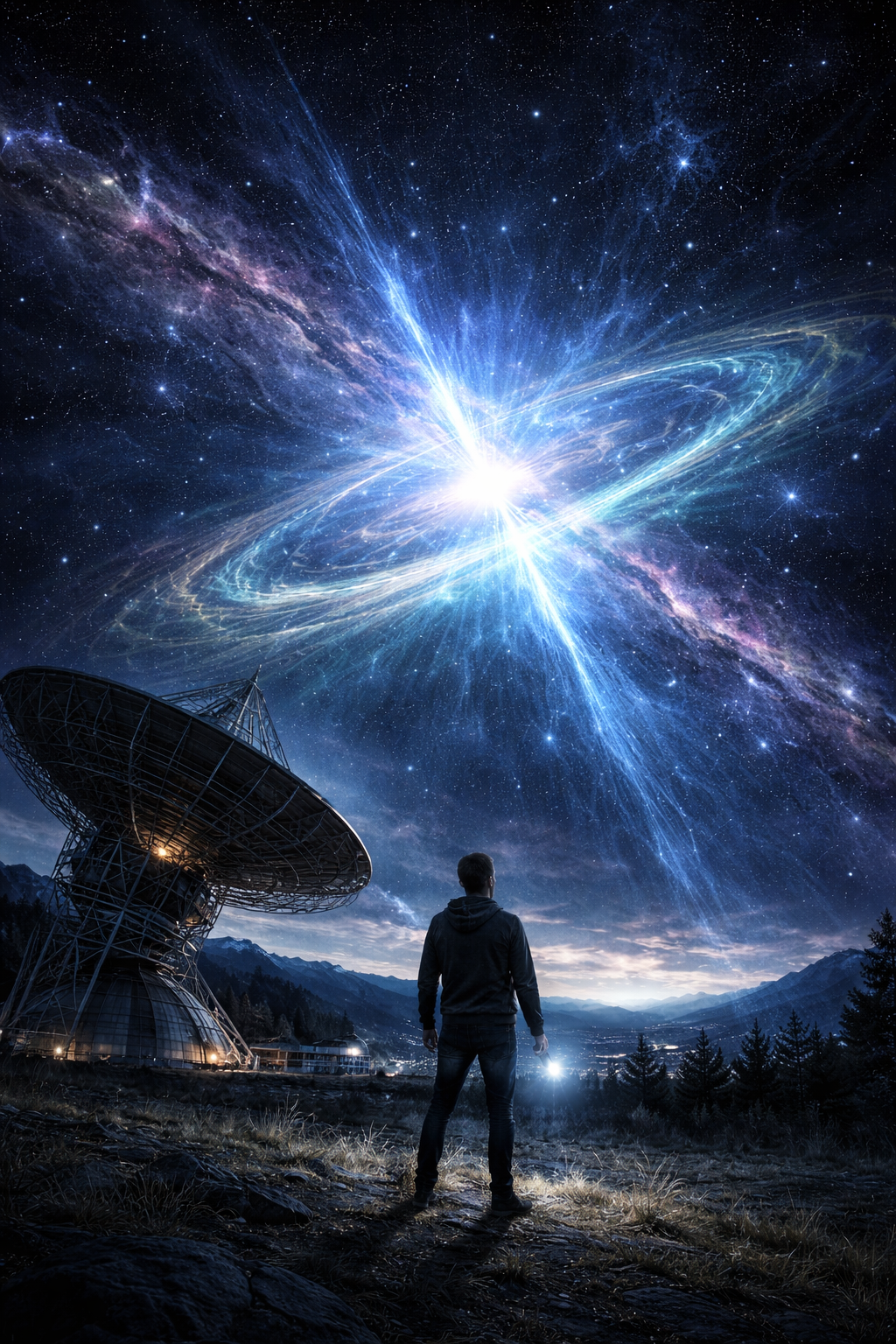
The first clue did not look dramatic. It looked like a machine stumbling over a line of data it was never supposed to see.
Somewhere in the static pouring down from the dark, a radio telescope caught a signal so clean, so oddly narrow, and so briefly perfect that an astronomer reviewing the printout stopped cold, circled the numbers in red ink, and wrote one stunned word in the margin: Wow!
For seventy-two seconds, the universe sounded less like weather and more like intention.
Mysterious signals from space still grip scientists and ordinary readers because they live in that dangerous middle ground between data and meaning. The Wow! signal, later fast radio bursts, and other deep-space anomalies matter not because they prove aliens are calling, but because they keep showing how much of the sky can still surprise the people listening to it.
If this kind of evidence-first cosmic mystery pulls you in, the site’s Unsolved Mysteries Archive opens into the branch of signal, sky, and anomaly cases that keep refusing a neat last page.
On the night of August 15, 1977, the Big Ear radio telescope at Ohio State University was doing what good instruments do best: patiently collecting far more information than any one human being could emotionally process in real time. Days later, astronomer Jerry Ehman sat down to review the computer printout. Most of it was routine. Most of it was the long, familiar language of background noise. Then one sequence jumped out: 6EQUJ5.
To anyone outside radio astronomy, that string looks meaningless. To the people trained to read it, it meant the intensity had surged far above the surrounding static. Not gradually. Not vaguely. Sharply. Enough to feel like a real event rather than a smudge of interference. Enough that Ehman, in one of those rare moments where science and instinct collide, wrote “Wow!” beside it.
That note did more than name the event. It preserved the feeling of the discovery. The printout did not say proof. It did not say message. It said something simpler and more haunting: this was strange enough that even the person trained not to be romantic about data immediately understood he was looking at something outside the ordinary rhythm.
The details only made the unease stronger. The signal lasted the full seventy-two seconds that Big Ear could observe a fixed point as Earth rotated. It appeared near the hydrogen line, a frequency long considered interesting in SETI discussions because hydrogen is the most common element in the universe and the line is one any technologically advanced civilization might reasonably know. And then, just as suddenly as it arrived, the signal was gone.
That vanishing act is what gave the case its permanent shape. If the Wow! signal had repeated, astronomers could have locked onto it, compared it, localized it, and started stripping away the mystery layer by layer. Instead, the event left behind something much harder to live with: a strong signal that behaved just enough like an intentional transmission to ignite the imagination, but not reliably enough to become a solved case.
Timeline of the Signals That Changed the Story
- August 15, 1977: Big Ear records the Wow! signal, later noticed by Jerry Ehman during data review.
- Late 1970s onward: Repeated follow-up searches fail to recover the same signal from the same region.
- 2007: The Lorimer Burst helps introduce the world to fast radio bursts, showing that extremely brief, powerful radio events are not limited to one legendary case.
- 2010s: More FRBs are detected, including repeaters, making it clear that the universe produces short radio flashes through mechanisms still being worked out.
- 2020s: Better instruments continue finding new bursts, new patterns, and new reasons to think the sky is stranger than early models allowed.
For years, the Wow! signal stood almost alone in the public imagination. It was the case people referenced whenever the conversation drifted toward extraterrestrial radio contact. But astronomy did not stop in 1977. Better instruments, bigger surveys, and more patient monitoring slowly revealed something both reassuring and destabilizing: the sky produces more abrupt radio weirdness than scientists once realized.
That is where the story deepens. The mystery is no longer only about one famous burst of suspicion from the Cold War era. It is also about what later discoveries did to the emotional meaning of that first case. When astronomers began identifying deep-space signals we still can’t fully explain, especially the class now known as fast radio bursts, the conversation shifted. Suddenly the universe did not look silent with one theatrical exception. It looked active in ways human beings had only just begun to measure.
Fast radio bursts, or FRBs, are usually much shorter than the Wow! signal and are now widely treated as real astrophysical phenomena rather than one-off curiosities. They can release astonishing amounts of energy in incredibly brief windows. Some repeat. Some do not. Some seem tied to violent environments and intense magnetic fields, with magnetars often discussed as leading candidates in at least part of the FRB story. That is important because it gives science a firmer footing than the public myth sometimes allows. The sky can produce bursts that feel impossible without requiring extraterrestrial intent.
But that does not actually make the emotional tension disappear. It changes it.
The old version of the mystery asked a dramatic question: Was the Wow! signal a message? The newer version is harder and, in some ways, more interesting: How many kinds of powerful radio events are out there that we still do not fully understand, and how often do we mistake unfamiliar nature for impossible design?
That is why this topic belongs alongside stories like strange lights in the sky scientists can’t explain and The Night the Sky Started Acting Wrong. The connective tissue is not “aliens did it.” The connective tissue is narrower and more honest than that. Human beings keep building better tools, and those tools keep revealing that the atmosphere above us and the space beyond it are more disorderly, more dynamic, and more resistant to clean explanation than earlier generations liked to believe.
Still, the Wow! signal remains different from the average unresolved radio oddity for one simple reason: it looked tidy. It did not feel like a storm of data. It felt like a narrowband event in the exact sort of frequency neighborhood that had long fascinated SETI researchers. That is the detail that keeps the case alive after decades of skepticism. Not certainty. Shape.
What Doesn’t Add Up
- It fit the telescope’s observation window too neatly. The signal lasted the full seventy-two seconds Big Ear could observe that point, which made it feel like a genuine celestial event rather than a random local glitch.
- It appeared unusually narrowband. That made it more intriguing than ordinary broadband noise and closer to what researchers had imagined an artificial transmission might resemble.
- It never repeated. This is the single most frustrating fact in the whole case. Strong mysteries become science when they can be tested again. This one refused that transition.
- Natural explanations exist, but none closed the file cleanly. Ideas involving interference, reflection, or comet-related hydrogen never fully satisfied everyone who studied the event.
- Later discoveries made the universe look stranger, not simpler. FRBs helped explain that short powerful radio events can happen naturally, but they did not retroactively turn the Wow! signal into an obvious solved case.
That is where the case gets its staying power. The signal sits between two unsatisfying poles. On one side is the romantic answer people want too quickly: a transmission from intelligence beyond Earth. On the other is the flattening answer skeptics want too quickly: some ordinary noise people got carried away with. Later discoveries reduced the exotic feel of the event without fully explaining it, and the Wow! signal still resists both extremes.
Key Evidence and Clues
- The “6EQUJ5” printout: the intensity code that made Ehman stop and mark the event.
- The hydrogen-line neighborhood: often discussed in SETI because of its universal astronomical significance.
- The full seventy-two-second duration: consistent with Big Ear’s observing geometry.
- The lack of recurrence: the detail that prevented confirmation and turned an event into a legend.
- The FRB era: later detections of powerful radio bursts proved the sky can produce shocking radio behavior, even when the exact mechanisms remain under investigation.
There is also a deeper emotional clue beneath the technical ones. Mysterious space transmissions linger because they speak the language modern people trust most: data. They give us numbers, equipment, and a printed record, then remind us that a record is not the same thing as an explanation.
That is why later cosmic anomalies keep feeding this story instead of replacing it. Every new unexplained burst from the dark suggests the universe may have been stranger all along, and that we were simply listening with instruments too blunt, for too little time, while expecting the unknown to behave politely enough to be cataloged.
Why This Case Still Gets Attention
The reason people keep coming back to mysterious signals from space is not only the extraterrestrial angle. It is the unfinished feeling. The best unresolved cases ask not just, “What was that?” but, “How close did we come to understanding something important without realizing it in time?”
The Wow! signal carries that feeling perfectly. One telescope. One printout. One burst that never came back. Years later, astronomers realized the cosmos throws off other violent radio signatures too.
That is why the topic also brushes against cases outside astronomy, like the Voynich Manuscript. The surface subjects are different, but the pressure is similar: a real artifact, a real record, a clear sign of structure, and no final agreement on what we are actually looking at.
And beneath all the science is the hardest part to shake: not the fantasy that someone was calling, but the realization that the universe keeps producing events that still look unfinished to us.
FAQ
What was the Wow! signal?
The Wow! signal was a strong narrowband radio signal detected by Ohio State University’s Big Ear telescope on August 15, 1977. It lasted seventy-two seconds, appeared unusual enough to attract immediate attention, and became famous after astronomer Jerry Ehman wrote “Wow!” beside the printout.
Was the Wow! signal ever explained?
Not completely. Scientists have proposed several natural and technical explanations over the years, but none has closed the case in a way that ended debate. The biggest obstacle is that the signal never repeated, which made follow-up confirmation impossible.
Are fast radio bursts the same thing as the Wow! signal?
No. Fast radio bursts are their own class of extremely brief, powerful radio events, and many researchers treat them as astrophysical phenomena with likely natural causes such as magnetars in at least some cases. They help prove the universe can produce startling radio behavior, but they do not neatly solve the Wow! signal.
Why do mysterious signals from space still matter?
They matter because they reveal the limits of both human instruments and human confidence. Every unexplained burst forces researchers to separate true anomaly from overreaction, and every solved case teaches us how much stranger nature can be than older models allowed.
Do scientists think these signals are aliens?
Most scientists do not treat extraterrestrial intelligence as the default explanation. They start with astrophysical causes, interference checks, and observational limits. But when a signal is strong, unusual, and incomplete, the possibility keeps surviving in public imagination because the case remains unfinished.
🔎 If this story stayed with you, the author suggests these real cases next:
- The deep-space transmissions that sounded less like noise and more like a pattern we still can’t hold onto
- The strange lights overhead that made the sky feel like it was breaking its own rules
- The night the heavens stopped looking distant and started feeling unstable
- The larger archive of unresolved signal, sky, and anomaly cases that never settle cleanly
Explore more Unsolved Mysteries stories here: