
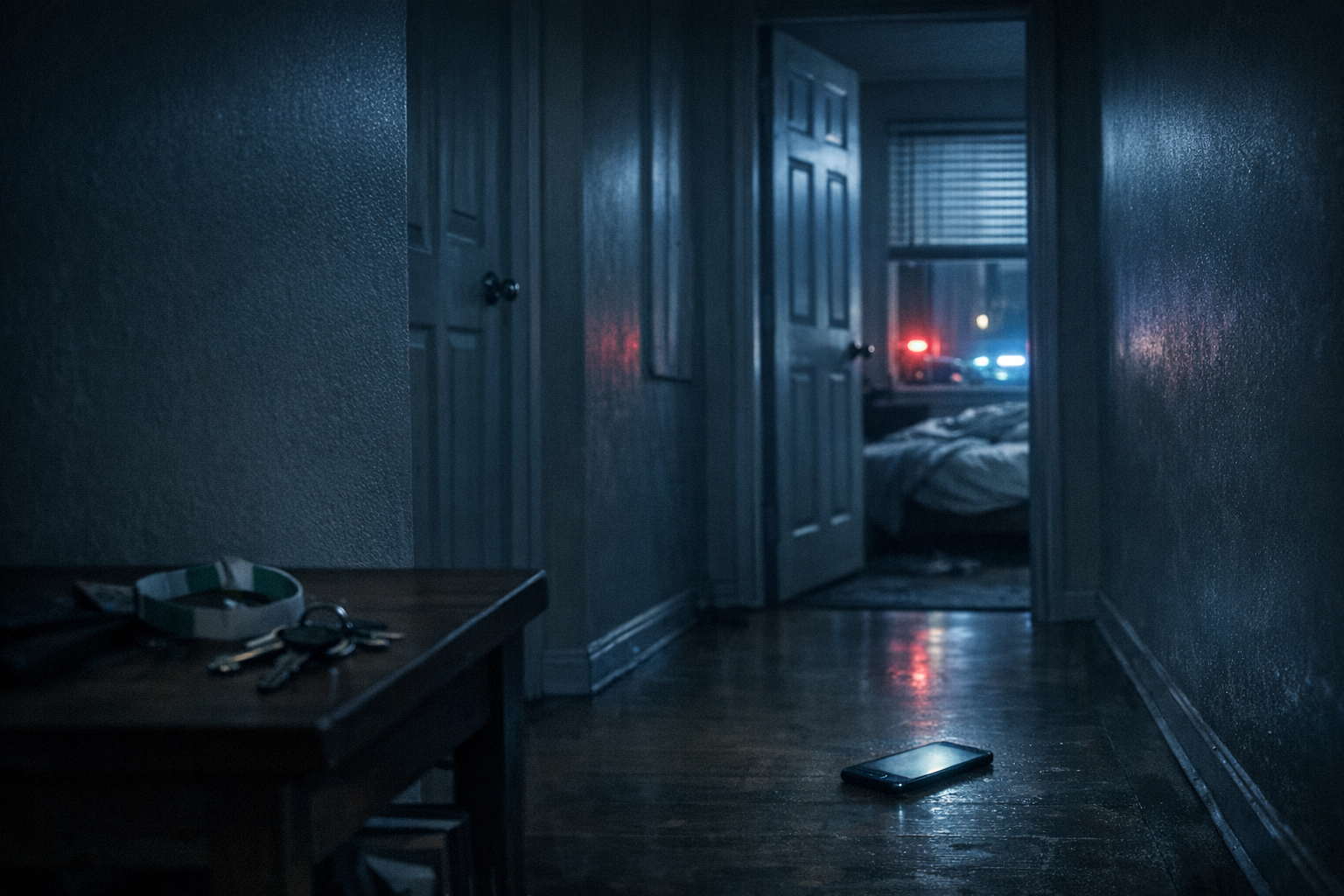
Faith Hedgepeth was found dead in her off-campus apartment late in the morning of September 7, 2012. Her roommate had left during the early hours; the exact sequence of the killing remained a question for investigators.
The nineteen-year-old UNC student’s death left physical evidence and a much-debated voicemail. The recording should not be treated as an account of her final moments: police disputed that interpretation.
That is still what makes this story hard to shake. Not just the violence. Not just the apartment scene. It is the feeling that the case left behind one object that sounded like it should explain everything, and yet somehow only made the mystery larger.
Faith Hedgepeth and the North Carolina case that still won’t sit still
Faith Hedgepeth was a University of North Carolina student whose killing in Chapel Hill became one of the state’s most closely watched true crime cases. While it was not an unsolved disappearance, the case carried the same obsessive pull as a missing person case: a young woman, a narrow timeline, a final stretch of unanswered minutes, and a piece of evidence people kept replaying because they believed the answer had to be hiding inside it.
More than a decade later, the reason this case still matters is simple: the voicemail, the apartment scene, and the arguments around the evidence never left public memory at the same time. If cases built around one haunting clue get under your skin, the same feeling runs through the Missy Bevers case, where a single piece of recorded evidence seemed like it should have solved far more than it did.
Faith was nineteen and a member of the Haliwa-Saponi Tribe. Her death interrupted her education at UNC and devastated her family and community.
But this story does not stay ordinary for long. It begins tightening the moment Faith and her roommate left the nightclub and went back to the apartment, because from there the timeline becomes both specific and deeply unstable — the kind of timeline that seems detailed on paper and still somehow refuses to feel complete.
Investigators reported that Faith and her roommate visited The Thrill nightclub and returned to their apartment before 3 a.m. The later record includes phone activity, reported thumps and Rosario’s departure around 4:25 a.m.
The voicemail became the symbol. The apartment became the argument.
How the night narrowed into a mystery
Before returning to their apartment, Faith and Karena Rosario visited The Thrill nightclub. Their movements afterward became part of the investigation.
After the two returned from the club, the timeline becomes the kind investigators love on paper and hate in real life. It is full of times, calls, and movements, but the emotional logic is harder to pin down. A neighbor would later report hearing loud noises. There was activity on phones. Texts were sent. Rosario was attempting to contact people in the early hours. Then she left the apartment and got into a car, saying she believed Faith was asleep when she walked out.
Hours later, when Rosario returned with a friend, Faith was found in her bedroom, bloodied and wrapped in a quilt. Investigators said she had suffered blunt force trauma. An empty liquor bottle was identified as the likely weapon. For a case that would later become famous for a voicemail, the physical scene itself was already brutal enough to carry enormous weight.
And that is one reason the voicemail never fully settled the public conversation. People latched onto it because it was eerie and replayable, but the apartment scene kept insisting that this was also a case about access, timing, and the terrible gap between what should have been heard, seen, or noticed — and what apparently was not.
Timeline of Events
- Night of September 6–7, 2012: Faith and her roommate visit The Thrill nightclub.
- After midnight: Faith and her roommate go out to The Thrill nightclub in Chapel Hill.
- Before 3 a.m.: Investigators report that they return to the apartment.
- Roughly 3 a.m.: They are back at the apartment; a downstairs neighbor later reports hearing heavy thumping noises.
- Early morning: Texts sent from Faith’s phone become part of the investigation; who sent them is disputed.
- About 4:25 a.m.: Rosario leaves the apartment, saying she believed Faith was asleep inside.
- Late morning, September 7: Rosario returns with a friend and Faith is found dead in her bedroom.
- September 16, 2021: Police announce Salguero-Olivares’s arrest.
- October 7–13, 2026: Opening statements and testimony take place; the trial is ongoing at this update.
The voicemail that took over the case
If you ask why Faith Hedgepeth’s case still feels so culturally alive, the shortest answer is that one recording changed the way the public remembered it.
The voicemail was timestamped at 1:23 a.m., when police believed Faith was at the nightclub. ICT reported that police did not consider it a recording of her final moments. Audio analyst Arlo West and her father interpreted it differently; their interpretations were disputed, not established facts.
The voicemail did not simply become evidence. It became the emotional center of the case. It gave people something to hold on to when the larger picture still would not lock into place. And once that happens in a major case, the artifact starts shaping memory more than the timeline does. People stop saying, “What happened in that apartment?” and start saying, “What does the voicemail mean?”
But that shift can distort things. The recording matters, yet it can also pull attention away from the harder, less cinematic question: who had access, what happened in those hours inside the apartment, and how do the physical details fit with the movements investigators reconstructed later?
What doesn’t add up
- The contradiction between one haunting clue and the whole scene: The voicemail sounds important because it is eerie, but no single recording can carry the full weight of what happened in the apartment.
- The late-night phone activity: Texts sent from Faith’s phone in the early morning remain one of the most scrutinized pieces of the timeline because they raise questions about who was awake, who was communicating, and why.
- The narrow access window: The apartment was not a remote place. That makes the timeline feel tighter, but not cleaner.
- The gap between noise and intervention: A downstairs neighbor reported hearing loud thumps, yet the violence inside was not interrupted.
- The long life of public doubt: Even after major investigative developments, the case continued to generate argument because the most memorable clues still seemed open to competing interpretations.
Those contradictions are why the case kept surviving each new headline. The public was not just following a murder investigation. They were following an unresolved argument about what kind of clue matters most. The physical scene? The recording? The DNA? The witness timeline? The answer kept shifting depending on what part of the case people thought was most trustworthy.
On September 16, 2021, police announced Miguel Enrique Salguero-Olivares’s arrest on a first-degree murder charge after a reported DNA match. A charge is an allegation, not proof of guilt.
Key evidence and clues
- The apartment scene: Faith was found in her bedroom, wrapped in a quilt, after suffering blunt force trauma.
- The likely weapon: Investigators identified an empty liquor bottle as the probable murder weapon.
- Early-morning texts: Messages sent from Faith’s phone became central to reconstructing the final hours.
- The voicemail: Police disputed claims that the 1:23 a.m. recording captured the killing. Its public prominence does not establish what its indistinct voices said.
- DNA evidence: Biological evidence from the scene remained one of the most important investigative tracks and later played a major role when an arrest was announced.
Even listed that way, the case still feels unfinished in a very specific sense. Not because there were no leads. Not because nothing was found. But because the evidence seemed to point in several emotional directions at once. Some clues felt intimate. Some felt forensic. Some felt almost theatrical. And when a case contains all three, the public rarely lets it go.
That is why Faith’s case still gets grouped mentally with other evidence-heavy stories where one object or one strange piece of media seems to carry the whole emotional charge. The Black Dahlia case works that way too, though in a very different era and under very different circumstances: a scene so extreme that every detail becomes part of the myth. On ReadTheRealStory, the site’s broader unsolved true crime collection exists for exactly these stories — cases where evidence is abundant, but closure still feels slippery.
Why this case still gets attention
Some cases remain famous because they are old. Some because they are horrifying. Faith Hedgepeth’s case stayed alive because it felt replayable. People could enter it through different doors and still come away convinced the answer was just one more review away.
You could enter through the voicemail and hear threat, panic, or confusion.
You could enter through the timeline and focus on who was where during the smallest, most important window of the night.
You could enter through the forensic evidence and treat the case as a puzzle waiting for the right laboratory breakthrough.
Or you could enter through Faith herself — a young woman with a future, a family, a community, and a life so clearly in motion that the violence done to her never stopped feeling especially cruel.
That is what gives the case its staying power. It is not only a question of who did it. It is the feeling that the story should have snapped into focus much sooner than it did, and yet each major clue seemed to create a fresh layer of argument instead of ending one.
The case after the headlines
As of October 13, 2026, Salguero-Olivares’s trial was ongoing in Durham County. Opening statements had been delivered October 7. Prosecutors argued that DNA connected him to the crime; defense lawyers challenged the evidence. Those arguments are not a verdict, and he remains presumed innocent.
And that answer goes back to the same place it always has: the voicemail made people think they were listening to the case itself. In reality, they were listening to one fragment from a much larger and more difficult story.
Faith Hedgepeth’s name still carries weight because the case became a lesson in how public memory works. One clue becomes the symbol. The symbol becomes the story. Then the real story — the one made of timelines, access, violence, and evidence — has to fight to be heard underneath it.
That is why this North Carolina case still feels one clue away, even to people who know better. Not because no progress was made. Because the most famous piece of the case never stopped sounding like it was about to reveal more than it ever actually did.
Research Sources
The following resources were consulted to verify and update this article.
- ICT — Chilling Voicemail in Hedgepeth Murder Case Made Public
Interviews document the family’s interpretation and police disagreement: the 1:23 a.m. timestamp placed the call before the presumed killing. - The 9th Street Journal — Faith Hedgepeth case: 10 unanswered questions ahead of trial
Pretrial reporting sets out the apartment timeline, contested texts and the difference between evidence and speculation. - Spectrum News — Arrest made in UNC Chapel Hill student cold case killing
Reporting from the September 2021 police announcement records the arrest and the reported DNA match. - Chapelboro — Faith Hedgepeth Murder Trial: Opening Statements Complete, Prosecution Begins Witness Testimony
October 7, 2026 courtroom reporting describes opposing opening arguments; these are allegations, not findings. - ABC13 / WTVD — Live updates: Murder trial enters second week for man accused of killing UNC student Faith Hedgepeth
October 13, 2026 live coverage establishes that trial testimony was continuing at this update.