There is a certain kind of true-crime case that never really ends.
The headlines stop. Detectives retire. The crowd moves on to the next catastrophe. But somewhere, in an evidence room, in a family scrapbook, in a stack of archived clippings, the story keeps breathing.
It survives because one detail still will not settle. A letter that sounds too confident. A witness statement that bends under pressure. A crime scene that explains almost everything except the one thing that matters most: who did it.
That is why some cases do not fade into history. They harden into atmosphere. They become the crimes people revisit late at night, certain that this time the missing piece will finally show itself.
These unsolved true crime cases still have no answers, and each one endures for a different reason: taunting messages, broken timelines, vanished suspects, or evidence that only made the mystery more complicated. If you want the wider rabbit hole after this page, the site’s true crime archive is the natural next stop.
Cases where the killer seemed to enjoy the chase
Some crimes stay open because the offender did not just commit violence. He also shaped the story people would remember.
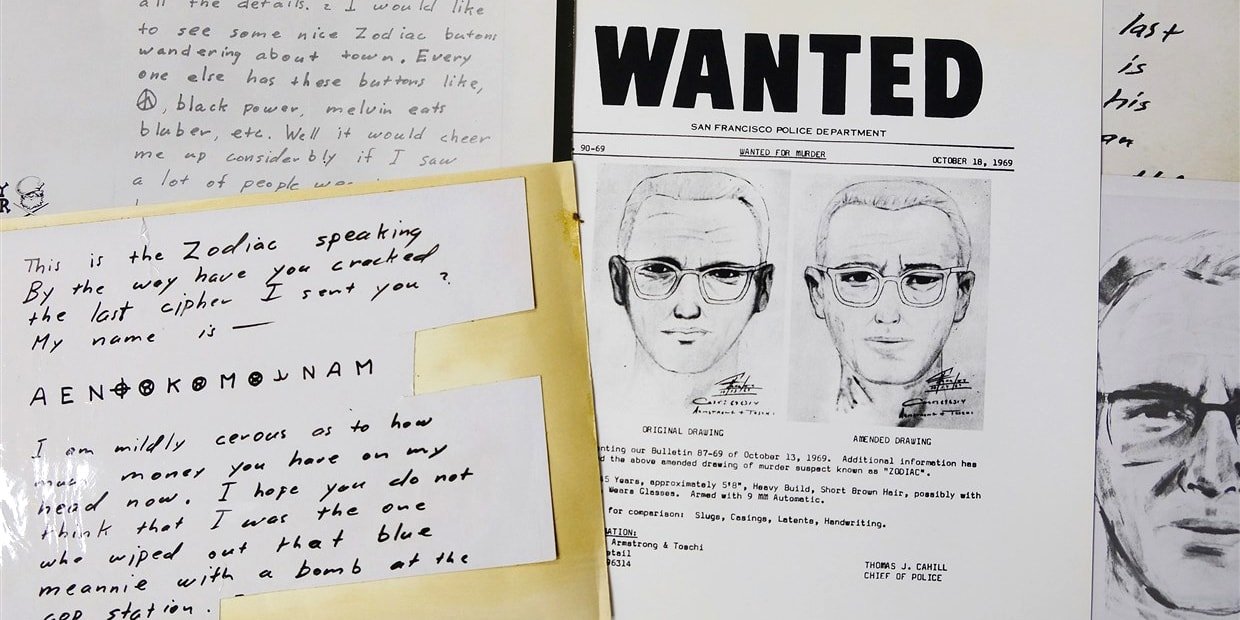
That is why the Zodiac Killer still hangs over American true crime like an unfinished code. The murders were terrifying on their own, but the letters and ciphers changed everything. They turned an investigation into a public duel. The killer was not hiding quietly. He was performing. Every new message widened the mystery, and every failed attempt to identify him made the case feel less like a file and more like a wound that never closed.
What makes Zodiac so durable is not just the body count. It is the unnerving sense that the killer understood attention as well as violence. He built a legend while law enforcement struggled to build certainty.
Why it still gets searched: people are not only asking who he was. They are asking how someone could step that close to public view and still stay just beyond proof.
Jack the Ripper survives for a similar reason, even though the case belongs to another century. Whitechapel gave the world one of the earliest modern crime panics: a killer, a brutal series of murders, a fearful city, and a press machine ready to turn terror into myth. Over time, the lack of resolution became part of the case’s power. Every suspect theory promises certainty. None has truly delivered it.
The Ripper story also shows how unsolved crime changes once it enters folklore. Evidence becomes thinner with time, but fascination grows. The case no longer lives only in police history. It lives in public imagination, which is much harder to close.
Why it still gets searched: because people keep hoping that one old witness account, one document, or one overlooked contradiction might finally break a mystery that should have gone cold generations ago.
Cases where the crime scene raised more questions than it answered
Some investigations never recover because the first hours create too many paths at once.
The JonBenét Ramsey case remains one of the clearest examples. A child was found dead inside her own home. A ransom note was already in the house. Suspicion moved in several directions almost immediately, and from that moment forward, the case seemed to split instead of narrow. Every major theory has defenders. Every theory also carries problems that keep it from settling into fact.
What keeps this case alive is the collision between intimacy and spectacle. It happened inside a private family space, yet it unfolded under relentless public pressure. Once that combination hardens around a case, closure becomes harder, not easier. The investigation is no longer just about evidence. It becomes about competing narratives.
Why it still gets searched: because the case feels as if it should be solvable. People look at the scene and assume the answer must have been near the beginning.
The same unresolved gravity clings to the Black Dahlia. Elizabeth Short’s murder became one of the most famous unsolved crimes in Los Angeles history not only because of its brutality, but because it exposed the machinery of media obsession so early and so clearly. Suspects surfaced, rumors multiplied, and the story grew larger than the investigation itself.
In cases like this, fame is not a side effect. It becomes part of the damage. The more attention the case draws, the more noise surrounds the evidence. That noise can preserve a mystery for decades.
Why it still gets searched: because people are still drawn to crimes where the public spotlight may have made the truth harder to reach rather than easier.
The Villisca Axe Murders endure for a different reason. The horror is almost unbearable in its simplicity: a family home, a sleeping household, and a slaughter that left a town with no clean answer. It is one of those cases that feels frozen in midnight silence. The suspects never produced a finished story. The violence remained, but certainty never did.
Why it still gets searched: because house-of-horror cases do not just frighten people. They make people wonder how something so intimate and catastrophic could happen without a final explanation.
Cases where disappearance and true crime bleed into each other
Some of the most stubborn mysteries sit at the border between disappearance story and criminal case. They are part missing-person file, part true-crime obsession, and that uncertainty is exactly what keeps them alive.
D.B. Cooper belongs in any serious unsolved-crime conversation because the offense itself was spectacular, but the afterstory is what transformed it into legend. A hijacker took ransom money, jumped into darkness, and then seemed to dissolve into the landscape. If he died, where is the proof? If he lived, how did he vanish so cleanly? That split is why the case still feels unfinished.
Why it still gets searched: because people are fascinated by crimes that appear to end in air, water, or wilderness, where the last confirmed fact is also the point where explanation stops.
Elisa Lam remains one of the strangest crossover cases because the final images became almost more powerful than the confirmed facts. The footage from the hotel elevator created an atmosphere people could not shake. Even after official conclusions, many readers and viewers continued to feel that the emotional shape of the story was still unresolved. In other words, the case may have an official ending, but it does not feel finished in the public mind.
Why it still gets searched: because surveillance, confined spaces, and unexplained behavior create the kind of visual mystery people revisit again and again.
Brian Shaffer still unsettles readers for the same reason. A man appears to walk into a crowded bar, and then the story fractures. The case is remembered less as a clean disappearance and more as a challenge to ordinary logic. If someone was there, and then not there, what broke in the timeline?
Why it still gets searched: because cases that seem to violate the expected path from entrance to exit keep people staring at the same missing minutes.
Madeleine McCann and Asha Degree remain especially haunting because both stories begin in ordinary spaces that should have been safe: a holiday apartment, a family home, a familiar route, a sleeping hour. In both cases, the emotional force comes from contrast. Childhood routine meets permanent uncertainty. That contrast is one of the strongest engines of long-term true-crime attention.
Why they still get searched: because missing-child cases do not fade when the central question remains untouched. They become part investigation, part grief archive, part public promise that someone should have seen more than they did.
What these cases have in common
At first glance, these stories look wildly different. A Victorian serial killer. A child murdered inside her home. A hijacker who vanished into the night. A modern surveillance-era disappearance. But the pattern underneath them is surprisingly consistent.
- The first explanation never fully holds. There is always a detail that stays loose.
- The evidence points, but does not land. It creates pressure without finality.
- The public can visualize the critical moment. A letter, a bedroom, a bar entrance, a plane door, a hotel elevator.
- The case invites argument. Competing theories keep it alive long after ordinary attention would have moved on.
- The emotional ending never arrives. Even when authorities issue conclusions, many people still feel the case has not emotionally closed.
That combination is deadly for closure. It means the case can survive every passing year because the unresolved core is still easy to feel.
Why later breakthroughs make older unsolved cases even more haunting
One reason these mysteries keep their grip is that modern forensic wins have changed the way people think about old failures. When a case like the Bear Brook Murders can move after decades of silence, or when the DNA cold case archive shows just how much preserved evidence can reveal years later, every unresolved file starts to feel temporarily unfinished instead of permanently dead.
That shift matters. It creates a strange new tension around unsolved true crime. People no longer look only backward and say, “This will never be solved.” They also look forward and wonder whether a family tree, a better test, a re-read witness statement, or one preserved item in storage could suddenly change everything.
That is why this page should not be read as a museum of permanent mysteries. It is also a record of crimes stuck in limbo. Some may remain there forever. Others may one day move the way older cold cases already have in pages like The Cold Cases Solved Years Later Archive.
The pattern investigators keep running into
In the end, the hardest unsolved cases are rarely the ones with no information at all. They are the ones with too much information pointing in slightly different directions.
That is the trap. People imagine mystery as emptiness, but many lasting true-crime cases are crowded with clues. The problem is that the clues refuse to cooperate. One suggests a suspect. Another weakens that suspect. One supports a timeline. Another bends it. One theory makes emotional sense. Another makes forensic sense. Neither can fully kill the other.
That is why these stories still pull readers in. They are not just horrifying. They are unstable. And human beings hate unstable endings. We keep leaning toward them because unfinished stories create their own gravity.
If that pattern interests you, pages like True Crime Cases Reopened by Appeals, Retrials, and New Evidence and Family Murder Cases Where Ordinary Homes Became Crime Scenes show how often the same pressures return: evidence friction, public obsession, and the terrible gap between suspicion and proof.
FAQ
Why do unsolved true crime cases keep getting attention?
They keep getting attention because they never deliver a stable ending. People can understand the crime, but they cannot fully place the blame, the sequence, or the final truth. That unresolved pressure keeps the story alive.
What makes a true crime case so difficult to solve?
Many of the hardest cases are damaged early by weak evidence, conflicting witness accounts, media pressure, or a scene that points in several directions at once. Even strong investigations can stall when the last decisive piece never appears.
Are any of these famous unsolved cases still active?
Some remain open in a formal sense, while others live on through periodic reviews, public tips, new testing methods, and renewed media interest. A case can go quiet for years and still move again if technology or evidence changes.
Why do DNA breakthroughs matter so much for older cases?
Because modern forensic methods can recover meaning from evidence that older investigators could not fully use. Genetic genealogy and improved testing have already transformed multiple cold cases, which makes other unresolved crimes feel less permanently locked than they once did.
What is the difference between an unsolved murder and a mystery that only feels unsolved?
An unsolved murder lacks a final proven resolution. A case that feels unsolved may have an official explanation, but the public still senses unanswered questions because the timeline, evidence, or behavior never fully settled in people’s minds.
🔎 If this mystery pulled you in, the author suggests these related real cases next:
- The wider true crime archive of unsolved murders, breakthroughs, and cases that still divide readers
- Cold cases that looked dead until DNA, preserved evidence, or one late break changed everything
- Cases reopened by appeals, retrials, and new evidence that refused to stay buried
- Family murder stories where ordinary homes turned into scenes nobody could forget
- Murder cases caught on surveillance footage, where the camera still didn’t give the whole truth
Explore more Blog stories here: