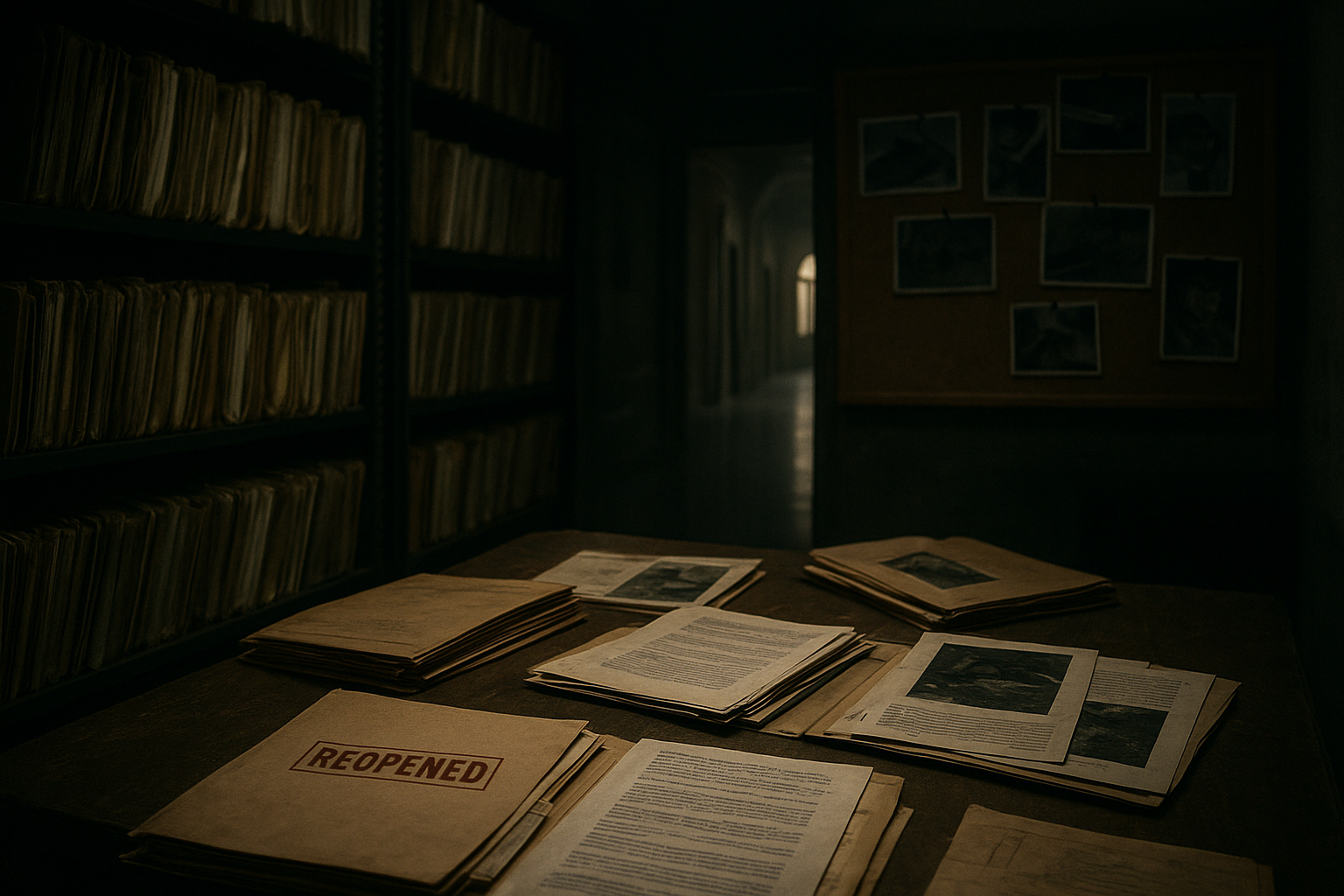
Most true crime stories are supposed to stop moving after the verdict. The files close, the names harden into headlines, and the public is expected to drift away. But some cases refuse that ending. Years later, an appeal is filed, a retrial begins, a conviction collapses, or fresh evidence tears open the old narrative and forces everyone back into the room. That is where these stories live: not in closure, but in the moment closure fails.
This page covers true crime cases that came back because the story itself would not stay buried. Some returned through appeals and resentencing battles. Some came roaring back because new evidence changed what investigators, courts, or the public thought they understood. Others reopened in a more painful way: the official version held for years, then the deeper record exposed how unstable it had been all along. What links them is not simply notoriety. It is reactivation — the moment an apparently finished case starts behaving like live terrain again.
That matters because these cases reveal a different kind of true crime authority. A standard case page asks what happened. A reopened-case page asks what changed later, what pressure was put on the original story, and why people suddenly had to revisit the evidence with fresh eyes. Readers searching for this angle are not looking for a generic roundup of famous crimes. They want the second chapter: the retrial, the reversal, the DNA breakthrough, the collapse of confidence, the new pressure that dragged an old case back into the present tense.
The courtroom pressure in Karen Read Retrial — Why the John O’Keefe Case Is Back at the Center of True Crime, the wrongful-conviction nightmare at the center of Craig Coley Case — 39 Years for a Crime He Did Not Commit, and the appellate return of Lori Vallow Daybell Appeal — Why the Doomsday Mom Case Is Back in the Spotlight all show the same larger truth: a case does not need to be old to be unstable, and it does not need to be officially solved to start breaking open again. That is also why this page sits naturally beside the broader hub True Crime Cases Back in the Spotlight: Retrials, Appeals, and New Evidence That Reopened the Story. It is built around cases where legal review, exoneration, or new evidence forced the story back into circulation.
Cases That Refused to Stay Closed
The Central Park Five
The real documentary tension is not only in the crime, but in the years that followed. The reopened force of the case came from the way the old narrative cracked: confessions were reexamined, public assumptions were challenged, and the system’s claim to certainty looked less like justice and more like damage.
The key mystery point is not who committed the attack anymore. It is how a case could become so publicly fixed in one version of the truth before the truth itself had fully arrived.
Menendez Brothers Resentencing
Menendez Brothers Resentencing — Why the Beverly Hills Murders Still Grip the World is one of the clearest examples of a case returning not because the facts were forgotten, but because the moral meaning of the case never settled. The Beverly Hills murders were already among the most famous family killings in America. Yet resentencing pressure reopened the argument all over again: were Erik and Lyle Menendez simply calculating killers, or was the original public framing too shallow to hold the full reality of what had been happening inside that home?
That makes the case a strong fit for this hub. Resentencing is not just a procedural update. It reactivates the emotional architecture of the story. Readers come back to old testimony, old wounds, and old media caricatures to ask whether the case was ever being read in full depth to begin with.
The key mystery point is whether the system understood the crime correctly the first time — not only legally, but humanly.
Michelle Martinko Murder
Michelle Martinko Murder — The Cold Iowa Case Solved by Family Tree DNA belongs here because some stories reopen through a courtroom fight, while others reopen because evidence waited for better tools. Michelle Martinko’s murder haunted Iowa for decades. The case carried the eerie stillness of a cold-file tragedy until genetic genealogy and family-tree DNA work finally forced the old silence to speak.
The story did not come back because culture randomly remembered it. It came back because science reached backward into the archive and made an old investigation active again. That shift turns a cold case into a live documentary sequence: what was missed, what endured, and what finally became knowable after years of not knowing.
The key mystery point is how long a killer can remain hidden inside a case that already contains the answer in physical form, waiting only for the right century of tools to unlock it.
Houston Lovers’ Lane Murders
Houston Lovers’ Lane Murders — How Cheryl Henry and Andy Atkinson’s 1990 Case Finally Led to an Arrest fits this collection because it shows how a brutal case can re-enter public life once a decades-old investigation finally starts moving again. Cheryl Henry and Andy Atkinson’s murders carried the weight of a classic unresolved nightmare: a young couple, a violent final scene, and years of uncertainty. Then the case reactivated through renewed evidence work and the eventual path to arrest.
This is not simply a retrospective on a notorious crime. It is a story about what happens when a file that looked permanently trapped in the past begins to produce movement again. The emotional power comes from the gap itself — the years between the crime and the break that finally changed the shape of the narrative.
The key mystery point is how close justice may have been sitting all along, and how much time can pass before the case finally acquires the evidence pressure needed to move.
Sherri Papini
That is why it works inside a documentary collection about stories that refused to stay closed. The power lies in the reversal. A case the public thought it understood came back in a different form, and the second life of the story exposed how fragile the first version had been. That kind of collapse is its own form of reopening, because it forces investigators, reporters, and readers to return to the record and ask which signals were misread in real time.
The key mystery point is not only how the false narrative held for so long, but why people were so ready to believe it before the evidentiary floor gave way.
Why These Cases Still Don’t Stay Closed
What these cases have in common is not one victim profile, one legal result, or one era of crime. What they share is pressure against the original story. In one case, that pressure comes from exoneration and the exposure of a wrongful-conviction machine. In another, it comes from resentencing and a renewed argument about how abuse, violence, and guilt should be read together. In another, it comes from new DNA tools turning a cold file into a live accusation. In another, it comes from evidence finally giving a dormant murder investigation a path back toward justice. And in Papini’s case, it comes from the collapse of the narrative itself.
That is why reopened-case pages behave differently from ordinary true crime roundups. Readers do not land here only for horror. They land here for instability. They want the case where the verdict did not end the argument, the file did not stay cold, or the evidence returned years later and changed the emotional weather around the entire story. That is also why related cases like Karen Read Retrial — Why the John O’Keefe Case Is Back at the Center of True Crime and Craig Coley Case — 39 Years for a Crime He Did Not Commit remain so magnetic. They live inside the same reader impulse: if the story came back, what did the first telling miss?
This pattern also exposes something deeper about authority in true crime. Time does not always create closure. Sometimes it preserves doubt. Sometimes it protects a weak theory simply because no better evidence yet exists. Sometimes it lets the public memory flatten a morally complicated case into a simpler headline than it deserves. And sometimes it quietly stores the exact evidence that will later reopen the whole thing, whether through DNA, appellate review, or renewed reporting pressure.
That is why the reopened-story lane matters so much for the cluster. It creates a natural bridge between courtroom cases, wrongful-conviction cases, forensic-breakthrough cases, and stories where the second life of the narrative becomes more revealing than the first. Someone pulled in through the Central Park Five may move next toward Craig Coley and other failures of certainty. A reader fixed on Menendez may keep going into Karen Read, Lori Vallow Daybell, or broader review-focused hubs where the story keeps mutating under public pressure. A reader fascinated by Michelle Martinko or Houston may keep moving into DNA archives and cold-case breakthrough pages because the question is no longer only who did it, but what changed the case later.
Readers looking for appeals, retrials, or new evidence are usually not in the mood for a broad list of notorious crimes. They are looking for procedural friction. They want the part of the story where a conviction is challenged, a sentence is revisited, a confession is questioned, a witness statement ages badly, or a forensic method finally makes an old assumption untenable. In other words, they are looking for a case under pressure. That gives this page a different job than a normal archive. It has to explain not just the crime, but the mechanism that made the crime return.
That mechanism changes how each case is read. In the Central Park Five, the second chapter exposes the dangers of speed, pressure, and narrative certainty in a high-profile investigation. In Menendez, the later chapter forces people to ask whether cultural bias and courtroom framing made the brothers easier to understand as monsters than as sons inside a deeply broken house. In Michelle Martinko, the later chapter belongs to science itself: the evidence did not suddenly appear, but the ability to interpret it finally did. In Houston, the delayed movement makes the original violence feel even heavier because the silence lasted so long. In Sherri Papini, the later chapter is about collapse — how a story once treated as obvious can become almost unrecognizable when the factual foundation gives way.
That range is what makes the theme stronger, not weaker. Appeals and retrials are only one branch of the reopened-case ecosystem. The larger pattern is evidentiary return. Sometimes the court reopens the story. Sometimes technology does. Sometimes a fresh arrest or a new suspect changes the entire emotional meaning of the case. Sometimes a supposedly sympathetic narrative is broken apart by investigators who keep pushing long after public emotion has settled into a convenient shape. Each version teaches the same lesson: stories can keep moving after the public decides they are done.
There is also an uncomfortable reason these stories stay with people. A reopened case confronts the reader with the possibility that the first version of events was never stable. Maybe it was incomplete. Maybe it was culturally distorted. Maybe it was scientifically premature. Maybe it was simply wrong. That realization makes the archive feel alive in a way ordinary closed-case pages do not. The past stops looking settled and starts looking provisional.
It also changes the moral tone of the reading experience. A standard true crime page often asks the reader to absorb a tragedy and its aftermath. A reopened-case page asks the reader to revisit responsibility. Who was believed too quickly? Who was ignored? Which theory was rewarded because it was cleaner or louder than the alternatives? Which evidence waited years for someone to take it seriously? Which legal outcome looked decisive on paper but unstable under a second examination? Those questions give reopened cases a kind of documentary depth that straight chronology alone cannot provide.
Seen together, these five stories show that “reopened” does not mean one thing. It can mean retrial. It can mean resentencing. It can mean exoneration. It can mean a DNA breakthrough. It can mean a false story collapsing under evidence. But every version points to the same truth: some cases return because something essential in the first telling never stopped resisting the frame built around it.
It does not throw unrelated crime stories into a pile. It organizes a recognizable pattern of return: cases where the second life of the investigation became central to why the story still matters.
Conclusion
The true crime stories that grip people longest are often not the ones that ended cleanly. They are the ones that came back. A wrongful-conviction case returns and exposes the cost of certainty. A resentencing battle reopens a national argument. A cold case wakes up because science finally reaches it. A long-dormant murder produces movement after decades. A sensational disappearance story is dragged back into view and rebuilt from the evidence outward.
That is the thread running through these cases. They did not stay where the archive put them. They reopened, reversed, or reignited. And once they did, they showed why second chapters matter so much in true crime: the later pressure often reveals more about the case than the first wave of headlines ever could.
If you want to understand how a story refuses to stay closed, start here. These are the cases where time did not settle the truth. It sharpened it.
🔎 If this story stayed with you, the author suggests these deeper investigations next:
- The True Crime Archive — Unsolved Murders, DNA Breakthroughs, False Narratives, Retrials, and the Cases That Still Divide the Public
- True Crime Cases Back in the Spotlight: Retrials, Appeals, and New Evidence That Reopened the Story
- The DNA Cold Case Archive — Murders Solved by Genetic Genealogy, Family Trees, and Evidence That Waited Decades to Speak
Explore more True Crime stories here: