
Listen to the Hudson Flight Story
Less than two minutes after takeoff, US Airways Flight 1549 encountered Canada geese. The cockpit recorder captured impacts and a change in engine noise. Both engines lost almost all their thrust, leaving the crew to find a landing place while the airplane remained close to the ground.
The Hudson River plane landing, later known around the world as the Miracle on the Hudson, still matters because it was not just a lucky ending. It was a real survival story built out of seconds, training, freezing water, and a decision made under almost impossible pressure. On January 15, 2009, Captain Chesley Sullenberger, First Officer Jeffrey Skiles, the cabin crew, and the passengers were forced into the kind of emergency most people only imagine in nightmares.
Stories like this are part of what makes the site’s plane crash survival collection so hard to shake. The terror is immediate, but what stays with people is how fast an ordinary trip can become a countdown.
Flight 1549 took off from LaGuardia at about 3:25 p.m. EST on a winter afternoon, bound for Charlotte, North Carolina. First Officer Jeffrey Skiles was flying, and Captain Chesley Sullenberger was monitoring the flight. The takeoff and initial climb were uneventful.
Then, less than two minutes after liftoff, the airplane flew directly into a flock of Canada geese. They were big birds, heavy enough to do real damage at that speed, and they struck both engines almost at once. The cockpit recorder captured impacts followed by decreasing engine noise. In the cockpit, the gauges told the story immediately. The engines had lost thrust. The aircraft was no longer really a plane in the usual sense. It was a glider over Manhattan with almost no altitude to spend.
The outcome was not known to the people aboard. The pilots were dealing with an almost total loss of thrust in both engines at low altitude. The airplane remained controllable, but the crew could not restore enough thrust to maintain flight.
In the cockpit, Skiles moved into the emergency checklist while Sullenberger flew the plane. Air traffic control offered choices that sounded reassuring for a moment: return to LaGuardia, divert to Teterboro. But those options were shrinking almost as fast as the altitude. In simulations done later, a return sometimes worked only if pilots reacted instantly, without the normal human delay it takes to understand disaster. Real life does not give you that kind of perfection. Real life gives you seconds full of doubt, calculation, and radio traffic. Sullenberger told the controller he was not sure they could reach any runway at LaGuardia. So he made the call that would define the story: they were going to the Hudson.
Timeline of the Hudson River Landing
- About 3:25 p.m. EST – Flight 1549 takes off from LaGuardia Airport.
- About 3:27 p.m. EST – The Airbus hits a flock of Canada geese at roughly 2,800 feet.
- Immediately after impact – Both engines lose thrust, and the crew begins emergency procedures.
- Moments later – Air traffic control offers a return to LaGuardia and then Teterboro, but the aircraft is descending too quickly.
- 3:31 p.m. – Sullenberger lands the plane on the Hudson River.
- Within minutes – Ferries, commuter boats, and rescue crews reach the floating aircraft.
- Shortly afterward – All 155 people are evacuated and survive.
The flight attendants did not have time to explain much. They moved straight into commands. Brace. Heads down. Stay down. The captain had announced that they should brace for impact. The remaining descent would take them to the river.
The plane touched the Hudson just before 3:31 p.m. The impact caused substantial damage, including damage to the rear fuselage through which water entered the cabin. The aircraft remained afloat, giving those aboard an opportunity to evacuate.
The rear of the plane was taking on water. A flight attendant directed passengers forward and told those able to do so to climb over seats to get away from it. Other flight attendants directed people toward the forward exits. Passengers also escaped through the overwing exits onto the wings and inflatable equipment.
There is a tendency, after a famous rescue, to polish the rough edges off the scene. But the evacuation had real obstacles. At one forward exit, a flight attendant used the manual inflation handle when the slide and raft did not inflate automatically. At the other, an attendant assigned a passenger to hold the door away from the inflatable raft while people escaped beneath his arm. Some passengers entered the river, and others waiting on the wings were exposed to the cold water.
Why the Landing Worked
- Fast but disciplined cockpit response: Skiles worked the restart checklist while Sullenberger focused on flying, which kept the emergency from turning into chaos in the cockpit.
- The right decision under pressure: Returning to an airport sounded safer, but the altitude, distance, and human reaction time made the Hudson the most realistic option.
- Controlled impact attitude: The landing was violent, but the plane hit the water in a way that prevented immediate breakup.
- Cabin crew control: The flight attendants kept giving commands even as the cabin flooded and panic threatened to spread.
- Immediate outside rescue: Ferries and nearby boats reacted in minutes, which mattered because the cold itself was becoming a second emergency.
The rescue clock was brutal. The Hudson in January was cold enough to steal strength quickly and turn survivable injuries into something much worse. That is why the ferries matter so much in this story. The first boats did not arrive after some long, cinematic delay. They came fast, because captains on the river saw the plane go down and turned toward it immediately. The first ferry arrived within about three minutes of the ditching. More ferries, firefighters and Coast Guard crews joined the rescue.
Even then, rescue was dangerous. Big boats had to come close enough to load frightened, soaked passengers without crushing them against the aircraft. Ferry crews and emergency responders brought the occupants aboard their vessels and took them to landing points on both sides of the river. The great miracle of the Hudson was not only the landing. It was the chain that followed it: a cockpit decision, a stable enough impact, a functioning evacuation, and a river full of people close enough and brave enough to finish the job.
What Made This Survival Story So Strange
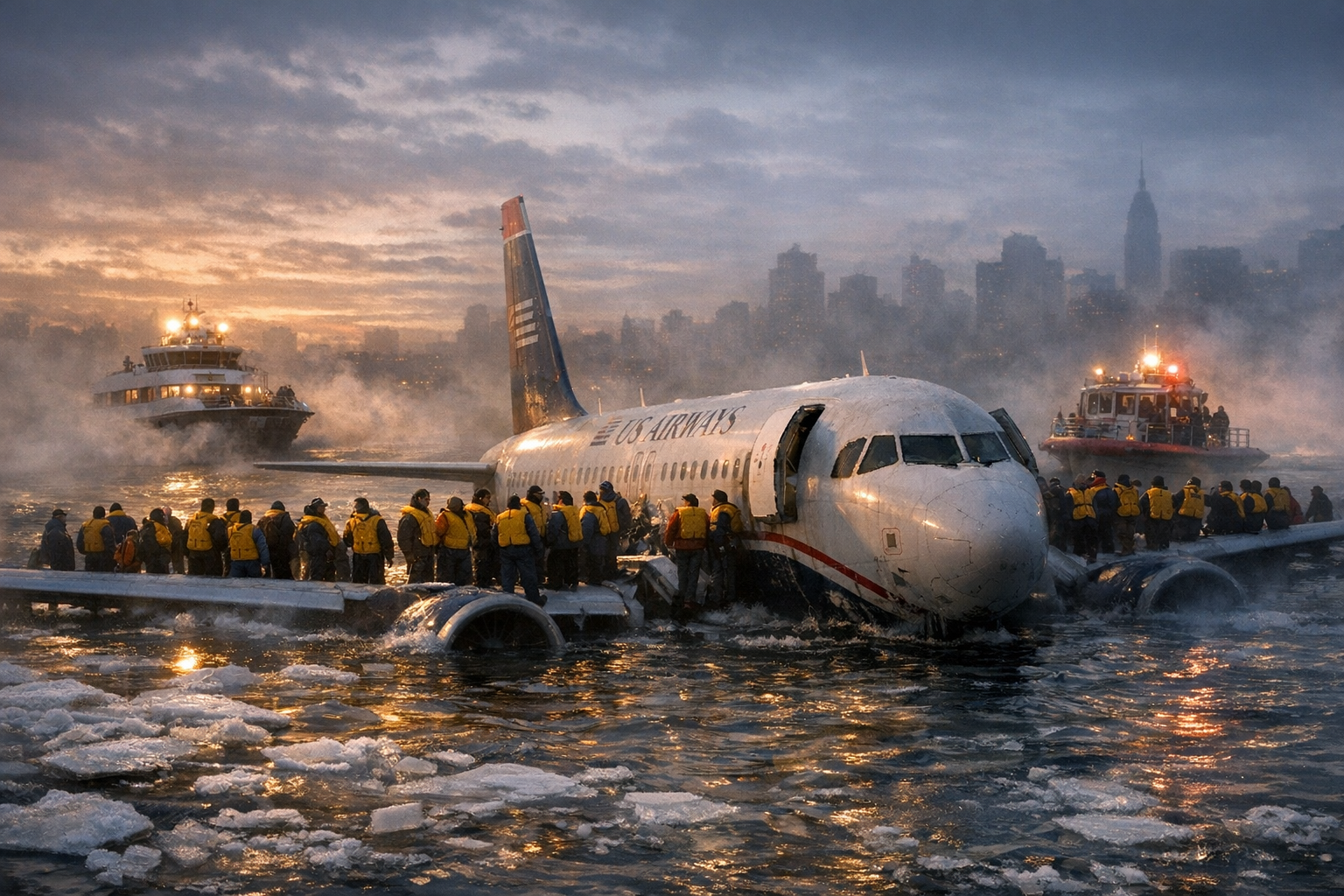
Most aviation disasters are remembered for wreckage. This one is remembered for an image that should not exist at all: a passenger jet floating in the river while human figures stood on its wings waiting to be pulled to safety. That image turned the event into a global vigil almost instantly. People in New York watched from shore. News helicopters captured the scene. Within hours, the world had fixed on the same impossible photograph and asked the same question: how did nobody die?
The answer is not simple, which is part of why the story keeps its hold. It was skill, but not skill alone. It was luck, but not luck alone. It was also the way ordinary people behaved once the system broke. The crew did their jobs with remarkable discipline. Ferry workers became first responders without waiting for permission. Passengers listened, helped, steadied one another, and kept moving when the cold was already eating at them. That is why the story became larger than aviation. It felt like a brief argument against chaos itself.
It also became a global story because people could imagine themselves inside it too easily. This was not a remote mountain crash or a lost-at-sea ordeal happening far from city life. This was New York. This was daylight. This was a routine flight carrying office workers and families. The normality of the beginning made the survival feel even more unreal. For millions of people, the case planted a lasting fear: if disaster can arrive that fast in the middle of a major city, then no ordinary day is as secure as it looks.
And yet the ending remains oddly hopeful. The aircraft was later lifted from the river scarred and waterlogged, but its most lasting image is still alive with human presence: survivors on the wings, boats racing in, a city watching. In other survival stories on this site, like Apollo 13, Juliane Koepcke’s fall into the jungle, and 438 Days at Sea, survival stretches into days or weeks. Here, it all happened in minutes.
By the time the last passenger had been pulled away from the aircraft, the story had already become legend. But legend can flatten reality, and the reality matters more. This was a near-disaster that became a survival story because several different groups did almost everything right while time collapsed around them. The pilots did not have room for ego. The cabin crew did not have room for hesitation. The rescuers did not have room to stand back and wait.
That is why the Miracle on the Hudson still gets attention years later: a plane with nowhere to go, a river in winter, and a chain of decisions that refused to become a tragedy.
FAQ
What happened in the Miracle on the Hudson?
US Airways Flight 1549 struck a flock of Canada geese shortly after takeoff from LaGuardia on January 15, 2009. Both engines lost thrust, and Captain Chesley Sullenberger landed the aircraft on the Hudson River, where all 155 people on board survived.
Why did Sully land in the Hudson instead of returning to the airport?
The pilots were losing height after an almost total loss of thrust in both engines. Some later simulator attempts reached an airport when the turn began immediately. The one attempt with a 35-second delay to account for recognition and decision time failed. The NTSB concluded that choosing the Hudson gave the crew the highest probability of a survivable accident.
Did everyone survive the Hudson River plane landing?
Yes. All 155 passengers and crew members survived. One flight attendant and four passengers suffered serious injuries, and others sustained minor injuries or exposure during the evacuation.
Why is Flight 1549 still remembered so strongly?
It is remembered because the survival happened in full view of New York, because the margin between disaster and rescue was so thin, and because the story combined pilot skill, cabin-crew discipline, passenger courage, and immediate rescue on the river.
Related cases to read next:
- Plane crashes where survival came down to seconds, fire, and impossible landings
- Disaster survival stories where the rescue clock kept getting louder
- The space mission that turned into a survival story after everything started going wrong
- The full survival archive for more real ordeals that should have ended differently
Explore more Survival Stories here:
Research Sources
The following resources were consulted to verify and update this article.
- National Transportation Safety Board — Loss of Thrust in Both Engines After Encountering a Flock of Birds and Subsequent Ditching on the Hudson River — US Airways Flight 1549 (NTSB/AAR-10/03)
The final accident report documents the flight timeline, bird strike, cockpit decisions, evacuation, injuries, and rescue. - Federal Aviation Administration — Airbus SAS A320-214 — US Airways Flight 1549, N106US
The FAA’s accident lesson explains the engine damage, emergency procedures, water landing, and safety lessons. - National Transportation Safety Board — US Airways Flight 1549 — Loss of Thrust in Both Engines After Encountering a Flock of Birds
The investigation summary identifies the probable cause and the crew, equipment, and rescue factors that helped all occupants survive.