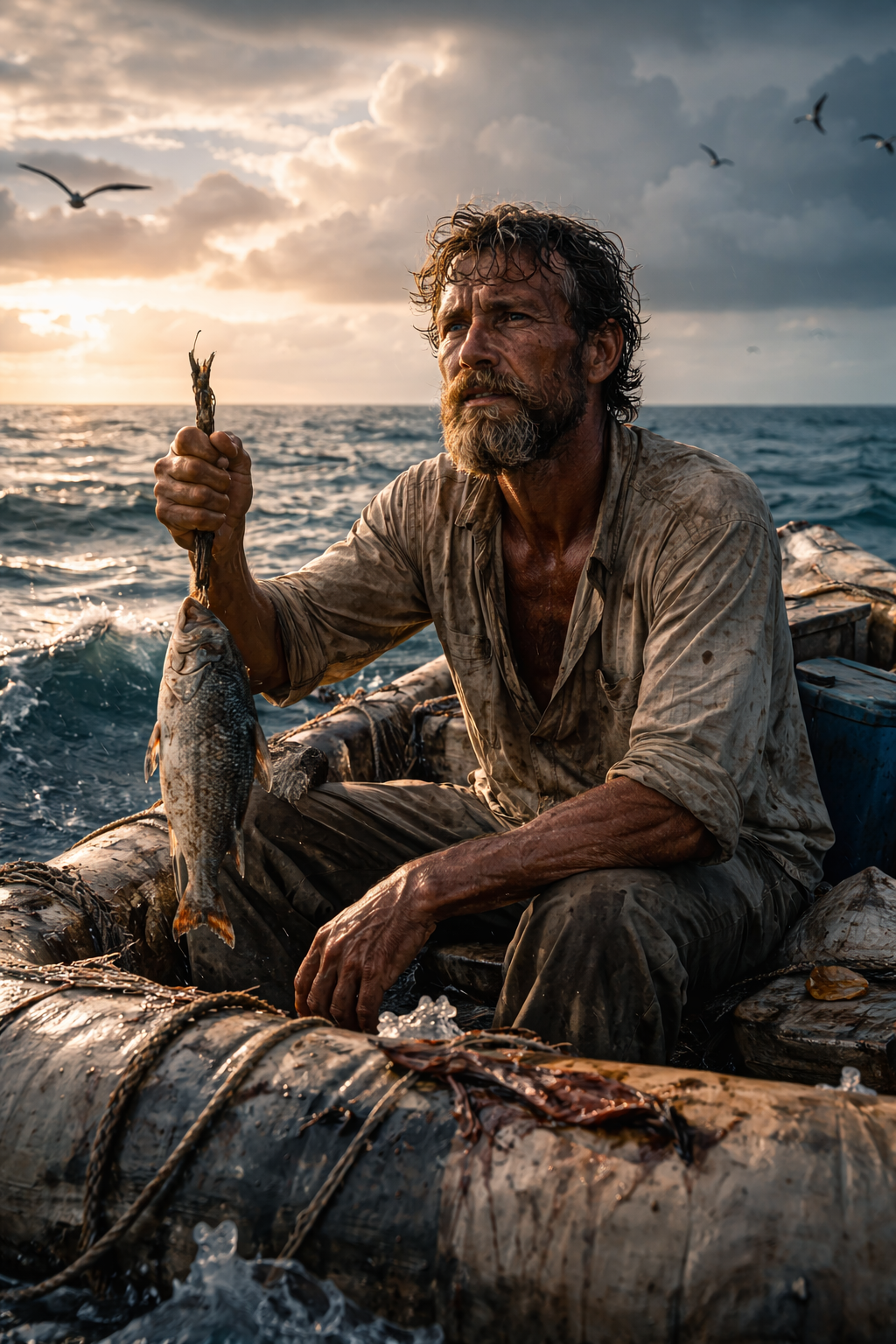
438 Days at Sea — The Full Survival Timeline of Salvador Alvarenga and the Pacific Ordeal That Should Have Ended in Death
9 min readDecember 14, 2025
Before dawn on November 17, 2012, a small fishing boat pushed away from the coast of southern Mexico and slipped into water that looked ordinary enough to trust. Nothing in that gray early light suggested the Pacific was about to erase the map, kill one man, and leave the other drifting so long that survival itself would start to sound made up.
The 438 Days at Sea survival story centers on Salvador Alvarenga, the fisherman who drifted across the Pacific for more than fourteen months after a storm destroyed his return route. It still matters because his ordeal was not just about hunger and weather, but about what happens when the world becomes nothing but water, silence, and one decision repeated every morning: keep going.
Stories like Lost at Sea Survival Stories: Shipwrecks, Drifting Boats, and Ocean Ordeals That Somehow Ended in Survival usually begin after disaster strikes.
Alvarenga was an experienced fisherman working out of Mexico’s Pacific coast. He knew rough water, and he knew that small-boat fishing could turn ugly fast. That morning, he headed out in a fiberglass skiff with a younger deckhand, Ezequiel Córdoba. The plan was simple: run offshore, work the lines, come back. They carried fuel, bait, ice, and supplies meant for a short commercial trip. They were not equipped for the ocean to turn into a second planet.
At first, the danger announced itself the way real danger often does: not with one dramatic moment, but with small changes that arrive too quickly to ignore. The sky darkened. Wind sharpened. Rain thickened until horizon and sea blurred together. Then the storm fully arrived, and with it came the collapse of every assumption built into the trip. Waves hammered the boat. Water poured over the sides. The motor began to fail under strain. Instead of working fish, the men spent their time bailing, turning, correcting, and trying to keep the boat alive long enough to reach shore.
They never got that chance. The engine died. Their communications failed. And when the weather finally loosened its grip, they were no longer navigating back toward Mexico. They were simply adrift in the open Pacific, carried by currents too large to argue with.
November 17, 2012: Salvador Alvarenga and Ezequiel Córdoba leave southern Mexico in a small fishing boat for what should have been a short trip.
Within hours: Bad weather intensifies into a violent storm. The engine fails and the boat loses reliable contact with land.
First days: They drift farther offshore. Food and fresh water disappear fast, forcing them to catch fish, turtles, and birds to survive.
After roughly four months: Córdoba becomes physically and mentally overwhelmed, stops eating, and dies at sea.
Months alone: Alvarenga survives through routine, rainwater collection, and refusal to leave the boat even as isolation begins to distort his sense of time.
January 2014: He drifts onto Ebon Atoll in the Marshall Islands after about 438 days at sea.
In the beginning, both men believed the same thing almost everyone would believe: someone would find them. A boss on shore would notice they were overdue. Searchers would scan the water. A boat this small, with two missing fishermen aboard, would draw attention. But the Pacific is built to make confidence look foolish. A skiff can vanish between swells. A search grid can miss by miles that feel tiny on paper and infinite on the water.
So the situation changed from emergency to adaptation. Alvarenga began catching fish by hand. He grabbed turtles when they came close enough. He collected rain in containers and used whatever the boat still held as storage. Raw fish became food. Turtle blood became hydration when freshwater ran low. It sounds primitive because it was. Survival at sea strips life down to a brutal arithmetic: what can be eaten, what can be saved, what cannot be wasted.
But the deeper horror was not the menu. It was the waiting. Days without rescue turned into weeks, and weeks into a new kind of life that had no room for future plans. The boat became a floating cell. The sky repeated. The horizon repeated. Even hope had to be rationed.
Córdoba, who had less experience and less emotional armor for the ordeal, began to collapse under that pressure. Reports of the story describe Alvarenga trying to keep him engaged, talking to him, urging him to eat, pushing him to hold onto the next rain, the next catch, the next day. But starvation and hopelessness do not negotiate for long. After months adrift, Córdoba stopped taking in what his body needed. He weakened, withdrew, and died there on the boat.
That changed the story from a shared ordeal into something even more psychologically savage. Now Alvarenga was alone with the body of the only other person who had seen every hour of what happened. For a time, he spoke to his dead companion because silence was worse. Then eventually he had to let the body go into the sea. There is no dramatic way to describe that moment without softening it. It was not symbolic. It was not poetic. It was one exhausted man doing the unbearable because there was no one else left to do anything.
What Doesn’t Add Up at First — and Why the Story Was Questioned
When Alvarenga finally reached land, plenty of people reacted the same way: that cannot be real. Four hundred thirty-eight days in a tiny open boat sounded less like reporting and more like folklore. The skepticism focused on a few obvious questions:
Could a person really stay alive that long in an open skiff? On its face, it seems impossible.
Could ocean currents carry the boat that far? The distance from Mexico to the Marshall Islands felt too extreme to many readers.
Could someone survive physically after so much exposure? His condition was severe, but he was alive.
Why didn’t he die after his companion did? That detail especially invited doubt.
What strengthened Alvarenga’s account was that the hardest parts of the story were not left floating as pure legend. Current modeling supported the drift path. Medical observers found his condition consistent with long-term exposure and malnutrition. Journalistic follow-up traced the launch point, the missing trip, and the broad structure of the timeline. That did not make every remembered detail perfect. Few people could recount fourteen months of trauma with mechanical precision. But it did move the case out of the realm of fantasy and into the much stranger category of verified human endurance.
What makes the account credible is that it does not read like a miracle so much as a terrible, repetitive system. He survived on fish, turtles, birds, rainwater, and routine. He woke, scanned the horizon, looked for birds, fished, gathered water when storms allowed it, and kept one rule in place: do not leave the boat. That skiff was both prison and lifeline.
The Pacific plays tricks on scale. A cloud bank can look like land. A reflection can look like a ship. Alvarenga reportedly hallucinated at times and lost his sense of calendar time completely, which is exactly the kind of distortion prolonged isolation can produce. But he did not surrender to the ocean’s most persuasive lie: jump in and try for something closer. In open water, that would likely have ended the story.
That is one reason this case fits so naturally beside The Three Men the Ocean Forgot and Four Days in the Water: The USS Indianapolis. Different disasters, same brutal lesson: the ocean does not need violence every minute to kill you. Sometimes it only needs distance, exposure, and enough empty time for the mind to turn against itself.
How He Stayed Alive When the Ordeal Became Psychological
Most people imagine survival as a contest against weather, thirst, or injury. But after a certain point, the greater threat may have been mental collapse. Isolation warps reality. Silence grows heavy. Repetition erases the sense that progress is possible.
Routine created structure when the outside world had none.
Food gathering created purpose even when rescue seemed unlikely.
Rain collection created urgency because every storm was both danger and opportunity.
Staying on the boat preserved hope in the most practical sense: floating debris is easier to survive on than open water.
That is also why the ending lands so hard. Rescue did not come with helicopters circling overhead or a dramatic search operation locking onto his signal. It came because currents kept carrying him west until birds began appearing in greater numbers and a thin line of land finally stopped being a mirage.
In January 2014, after about fourteen months adrift, Alvarenga washed onto Ebon Atoll in the Marshall Islands, more than 6,000 miles from where he had started. He was sunburned, depleted, and almost ghostlike to the people who first saw him. But he had done the impossible-looking thing. He had outlasted the trip that should have killed him.
Even after land, the story did not become neat. Fame followed. Doubt followed. Grief followed. Surviving is one ending. Living with it is another.
That weight is what keeps this from feeling like an inspirational tale. It is a story about attrition, isolation, and the stubborn promise that carried him through it: not next month, not when rescue comes, just not today.
And that is why 438 Days at Sea still lingers. The storm did not end it. Hunger did not end it. The death of the only other man on board did not end it. The silence almost did. But the Pacific, for all its scale, could not take the one thing Alvarenga kept renewing every morning: the choice to make it through another day.
FAQ
How did Salvador Alvarenga survive 438 days at sea?
He survived by catching raw fish, turtles, and birds, collecting rainwater, conserving energy, and sticking to a daily routine that kept him mentally anchored. Just as important, he refused to abandon the boat, which gave him flotation, shelter of a kind, and his only real chance of reaching land.
Was the 438 Days at Sea story verified?
Yes, the broad account was supported by reporting, physical condition, and ocean-current analysis consistent with the drift from Mexico to the Marshall Islands. Some details were naturally debated, but the overall survival story was treated as credible rather than a myth.
What happened to Ezequiel Córdoba?
Córdoba died during the ordeal after months adrift. Accounts of the case describe him becoming physically weaker and psychologically overwhelmed, eventually refusing food and losing the ability to continue surviving under the same brutal conditions.
Why did this survival story become so famous?
Because the scale feels almost impossible: a small open boat, more than a year at sea, one companion dead, and one survivor drifting across an ocean that should have swallowed the evidence. It sounds invented until you realize it wasn’t.
Why does this case still stay with people?
Because it turns survival into something deeply intimate and frightening. It is not just about weather or endurance. It is about what isolation does to the mind, and how thin the line can be between giving up and choosing one more day.
🔎 If this story stayed with you, the author suggests these real cases next: