By the time Harold Dixon understood they were not going to find the carrier again, the Pacific had already become a sentence.
His plane had been in the air for hours. Fuel was almost gone. Below them there was nothing but dark water, wind, and the long wartime silence they had been ordered to keep. In the back of the Douglas TBD Devastator sat Tony Pastula and Gene Aldrich, two young crewmen who had no reason to believe the rest of their lives were about to shrink to a rubber raft no bigger than a mattress.
Then came the ditching. The impact. The scramble into open water. And the horrifying speed with which the airplane vanished beneath them, dragging almost every useful piece of survival gear into the deep.
One moment they were Navy airmen. The next, they were three men alone in a black ocean, clinging to something that was not even fully a raft yet.
The Three Men the Ocean Forgot is the real survival story of Harold Dixon, Gene Aldrich, and Tony Pastula, three U.S. Navy airmen who spent 34 days adrift in the Pacific in 1942 after their aircraft was forced down at sea. It still matters because this was not a miracle that arrived quickly. It was a slow, brutal ordeal of thirst, sun, hallucinations, and the stubborn decision to stay alive when the war had already moved on without them.
On January 16, 1942, Dixon and his crew took off from the USS Enterprise on an anti-submarine patrol. The Pacific war was still young, and radio silence mattered. Pilots could not casually broadcast for help without risking the carrier’s position. That rule made sense at fleet level. For three men in one aircraft, it would become a death trap.
Somewhere over open water, they realized they had drifted off course. They searched for the carrier. No carrier. No deck lights. No shape on the horizon. Fuel ran lower. The math got uglier by the minute.
Dixon had no dramatic speech for his crew. He had a choice. Keep flying until the engine quit and let the ocean decide the landing, or put the aircraft down while he still had enough control to give them a chance.
He chose the chance.
The Devastator hit the water hard, but all three men survived the impact. That should have been the lucky break. Instead, the plane sank so fast it felt like a trick. The survival equipment they had packed carefully went with it. Food, signaling gear, water, practical tools—gone. What remained was a small rubber raft, a few simple items in their pockets, and the clothes they were already wearing.
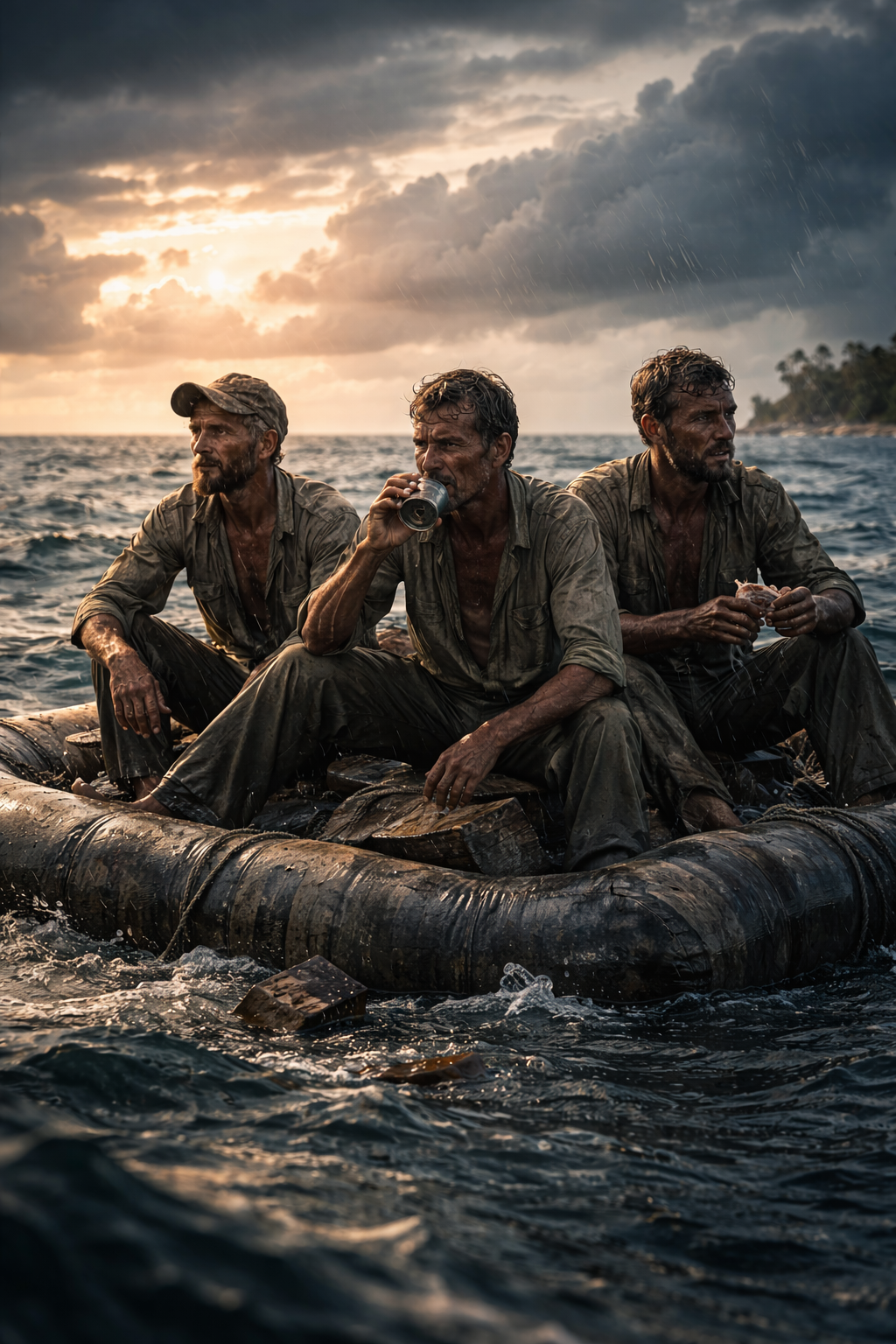
That first night taught them what the next month would feel like. People imagine a life raft as a place of safety. It was not. It was cramped, wet, unstable, and impossible to rest in. Waves slapped it constantly. Saltwater stung their mouths and eyes. Even in darkness the raft kept moving, rocking, jolting, knocking sleep away before it could settle in.
At sunrise they got their first taste of hope, and their first lesson in how cruel the Pacific could be. A plane appeared in the distance. At first it looked like a bird. Then it turned toward them. The men waved shirts, arms, anything they could lift. The aircraft came close enough to feel possible.
And then it kept going.
That moment may have been as important as the ditching itself. Until then, rescue still felt like a delayed appointment. After that, they had to face the real version of the story: no one was coming because no one knew exactly where to look.
Timeline of the Ordeal
- January 16, 1942: Dixon, Aldrich, and Pastula take off from the USS Enterprise on anti-submarine patrol, become lost, and ditch their aircraft in the Pacific.
- First days adrift: They inventory almost nothing useful beyond the raft, a pocketknife, a pistol, pliers, life jackets, patch material, and willpower.
- First week: Heat, exposure, and thirst become the central threat; a search plane fails to spot them.
- Following weeks: They survive on rainwater, small fish, seabirds, and even shark meat while trying to control the raft’s drift.
- Day 33-34: Rough weather drives them toward land; they finally reach Pukapuka Atoll after more than a month at sea.
- After landfall: Island residents help them survive, and U.S. authorities are eventually contacted.
By the third day, thirst had moved to the front of everything. Hunger was miserable, but thirst was frightening in a more immediate way. Their mouths dried out. Swallowing hurt. Thinking clearly began to take effort. Under the tropical sun, their skin burned from above while the sea reflected the heat back upward from below. There was no shade except scraps of clothing laid across heads and shoulders. The raft itself became hot enough to punish bare skin.
Then came rain, the kind of rain that feels ordinary on land and holy at sea. They used what they had to catch it. They drank greedily. For a little while the world widened again. They were filthy, exhausted, and still lost, but they were not yet finished.
Food came in ugly, irregular moments. Fish gathered near the raft, and Aldrich managed to spear one. Later they got an albatross. On another day they brought in a shark. None of this looked heroic from the inside. It looked desperate. They ate what they could because the body eventually stops caring about disgust when calories become the thin wall between thought and collapse.
Dixon, meanwhile, refused to think of the raft as a coffin. He studied wind, current, and direction. He improvised. He tried to guide their drift instead of surrendering to it. That matters because this survival story was not only about endurance. It was also about navigation, discipline, and the mental fight against passivity. The ocean is always trying to turn people into objects. Dixon kept resisting that.
That same hard, waiting-to-break atmosphere is part of what makes the USS Indianapolis Survival Story — Trapped in Shark-Infested Waters After the Ship Went Down so haunting too. In both cases, the worst damage did not happen in one burst. It arrived a little at a time.
Days blurred. Then weeks did. Their bodies thinned out. Skin peeled. Salt sores formed where wet cloth rubbed against raw flesh. Sleep stayed broken and shallow. Hope changed shape. It was no longer rescue by afternoon. It was not rescue by next morning. Eventually it became something smaller and stranger: make it to nightfall, make it to rain, make it to one more bird, one more fish, one more day.
What Kept Them Alive
- Rainwater: Without periodic rain, the ordeal likely ends far earlier.
- Improvised food: Fish, seabirds, and shark meat gave them enough nutrition to keep moving and thinking.
- Dixon’s navigation mindset: He resisted aimless drift and kept looking for a workable direction of travel.
- Training: They were not casual travelers. Naval discipline helped them ration energy and make decisions under pressure.
- Group survival: Three men meant shared labor, shared watchfulness, and fewer chances to give up in silence.
Still, there were moments when even that discipline began to crack. Hallucinations crept in. Distance stopped behaving normally. Things on the horizon looked real and then disappeared. Bodies that are badly dehydrated and sleep-starved do not just weaken; they distort reality. The ocean helped with that. It offered glare, haze, repetition, and no stable point to measure against.
Then, near the end, the story tilted. Rough weather rose. The sea grew violent. Under other circumstances that would have been the final cruelty. Instead, it became the force that pushed them toward land.
At first one of them thought he saw green in the distance. In a story like this, that is almost the most dangerous sentence possible. False hope can waste the last of a survivor’s strength. But this time the green stayed there. What looked like rows of corn or palms slowly resolved into an island: Pukapuka Atoll.
Even then, safety did not arrive gently. Reaching land after weeks at sea can be its own hazard. Surf, reef, and exhaustion can kill people within sight of survival. The raft was battered through rough water, and all three men had to fight their way ashore in a weakened state. But they made it.
Imagine that first feeling. Not triumph. Not cinematic celebration. Just solid ground under a body that had learned to expect movement every second. After 34 days adrift, stillness itself must have felt unreal.
The island did what the ocean had not. It gave them a chance to stop spending every waking second on immediate survival. Local residents helped them, fed them, and made contact that eventually brought rescue within reach. The war had not remembered them first. Human beings did.
What gives this case its staying power is not only the number—34 days, nearly impossible to hear without leaning in. It is the emotional shape of the ordeal. They were not saved by one spectacular twist. They survived by enduring a chain of smaller miseries that could have ended them one by one: thirst, sun, cold nights, hunger, doubt, and the psychological horror of realizing the wider world had probably written them off.
And yet the story does not end in bitterness. It ends in proof that survival is often less dramatic, and more stubborn, than people want it to be. Three men were swallowed by distance, stripped of equipment, reduced to almost nothing, and still found a way to keep choosing the next hour.
That is why this story lingers. Not because the ocean forgot them. Because they refused to disappear inside that forgetting.
FAQ
What happened to the three men the ocean forgot?
Harold Dixon, Gene Aldrich, and Tony Pastula were U.S. Navy airmen whose Douglas TBD Devastator ran out of fuel after they became lost during a 1942 patrol mission. They ditched in the Pacific and survived 34 days on a rubber raft before reaching Pukapuka Atoll.
How long were Harold Dixon and his crew adrift?
They were adrift for 34 days, a period that included severe thirst, tropical sun exposure, little food, rough seas, and the constant uncertainty of whether anyone would ever find them.
How did the three sailors survive at sea?
Strictly speaking they were naval airmen, and they survived through rainwater collection, improvised hunting, careful rationing, navigation discipline, and shared determination. They caught fish and seabirds, ate shark meat, and kept trying to manage their drift rather than surrendering to it.
Where did they finally reach land?
They eventually reached Pukapuka Atoll in the South Pacific. Making landfall did not instantly end the danger, but it gave them the first real break in more than a month of exposure.
Why does this survival story still get attention?
Because it captures the slow, punishing reality of being lost at sea better than most survival stories do. There was no easy rescue, no stocked lifeboat, and no quick turnaround—just three men enduring the kind of silence that usually ends stories much earlier.
🔎 If this story stayed with you, the author suggests these real cases next:
- More ocean ordeals where the horizon never seemed to get closer
- Four days in shark-filled water after a warship disappeared beneath them
- The men who kept knocking from inside a sunken ship
- A wider archive of real people who endured the impossible
Explore more Survival Stories here: