Louis Zamperini Survival Story: The Olympian, the Raft, and the War That Refused to Break Him
9 min readFebruary 14, 2026
The crash did not feel heroic. It felt loud, sudden, and final.
One moment Louis Zamperini was inside a failing Army bomber over the Pacific. The next, the sea came up like a wall, metal tore apart around him, and the world that had held eleven men collapsed into floating wreckage, burning oil, and open water with no edge in sight.
Louis Zamperini’s survival story still gets searched because it did not end with one miracle. He survived a plane crash in the Pacific, 47 days adrift on a raft, and then years of wartime imprisonment that seemed designed to finish what the ocean had started. In the Lost at Sea Survival Stories archive, his ordeal stands out because every phase should have been the end of him, and somehow never was.
On May 27, 1943, Louis was not chasing glory. He was 26, far from Olympic tracks and cheering crowds, aboard a battered B-24 known as the Green Hornet. The aircraft had a reputation. It was old. It was unreliable. But war does not pause just because a machine feels wrong. The crew lifted off from Funafuti on a search mission over one of the largest emptiest spaces on earth.
Somewhere over the Pacific, the plane began to fail. Engines coughed. Control started slipping away. The crew tried to steady it, then tried to turn, then ran out of sky. When the bomber hit the ocean, it did not glide. It shattered. The impact killed most of the men almost immediately.
Louis surfaced in a field of debris with oil in his eyes and salt in his mouth. He called out into a horizon that gave nothing back. Ten men had gone into the water. Only three were still there to answer: Louis, pilot Russell Allen “Phil” Phillips, and Francis “Mac” McNamara. Two life rafts were floating nearby. That was the difference between a death scene and a survival story.
The first hours were almost worse because they still looked survivable. The sea was calm. The sun was high. Rescue felt inevitable. Surely someone would notice the bomber was missing. Surely ships or aircraft would appear before nightfall. That hope lasted just long enough to become dangerous. The Pacific is big enough to make human plans feel childish. By the time the light changed and the first night settled over the rafts, the three men understood something awful: they were not waiting to be found in a busy place. They were disappearing in silence.
At first they had a little food and a little water, which in survival terms meant they had a countdown. Every swallow cost them tomorrow. The sun tore at them by day, the cold came back at night, and saltwater settled into every cut.
Then Mac made a choice that changed everything. Panicked and hungry, he ate the emergency chocolate supply. On land that might sound reckless. In the middle of the Pacific, it was catastrophic. Louis and Phil were furious, but anger could not replace calories.
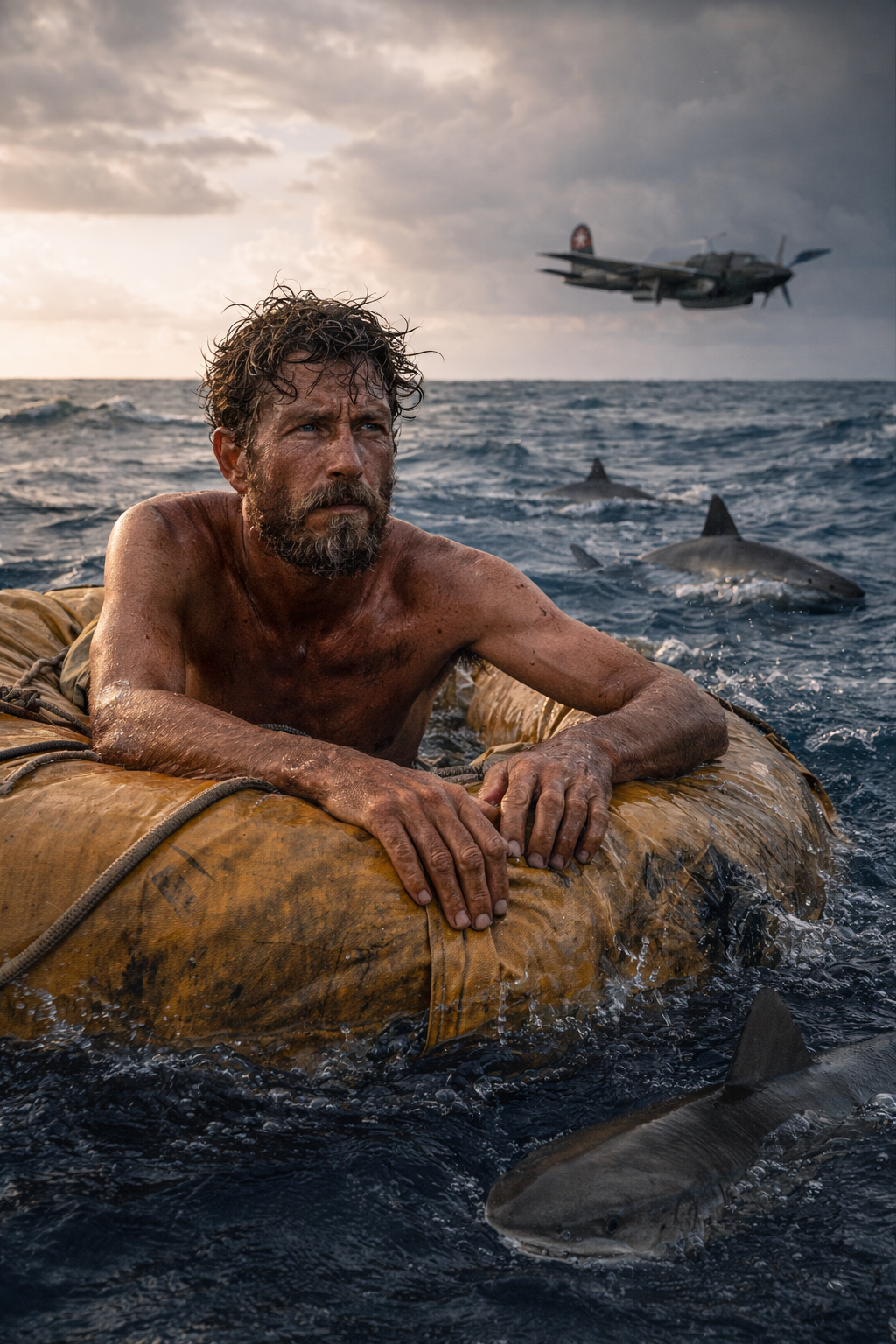
The days began to lose their shape. Hunger flattened everything. Sharks moved under the raft like patient shadows, sometimes bumping it from below, as if testing how long the men could hold on.
Rainstorms became salvation. The men tilted containers, opened their mouths, and tried to catch enough fresh water to keep their organs working. They fished with improvised hooks and bare hands. When seabirds landed close enough, they lunged. They ate what they caught raw because there was no fire, no comfort, and no point in pretending survival should look civilized. The body can get used to almost anything if the alternative is death.
Then the war found them again. At one point a Japanese aircraft spotted the rafts and circled overhead. For a second, being seen felt like rescue. Then the plane opened fire. Louis and Phil plunged into shark-filled water and clung to the rafts while bullets ripped through the surface around them. When the strafing ended, the rafts were punctured and sagging. They patched them as best they could. There is something almost unbearable about that image: men who have already survived a crash, floating half-dead in the Pacific, now kneeling over leaking rubber because if they fail one more time, the ocean gets them after all.
May 27, 1943: The Green Hornet crashes into the Pacific during a search mission.
Immediate aftermath: Louis Zamperini, Russell Phillips, and Francis McNamara reach life rafts and begin drifting.
First weeks adrift: Rations run low, exposure worsens, sharks circle, and rain becomes their only reliable water source.
During the drift: A Japanese aircraft strafes the rafts, forcing the men into the water and damaging their only shelter.
About day 33: Mac dies after prolonged dehydration, starvation, and collapse.
Day 47: Louis and Phil drift into the Marshall Islands and are captured by Japanese forces.
1943–1945: Louis endures captivity, beatings, starvation, and forced labor in prison camps.
1945: Japan surrenders, and Louis is finally freed.
Mac weakened first. He spoke less, moved less, and after 33 days at sea he died. Louis and Phil pushed his body into the water because there was nothing else to do. No grave. No ceremony. Just one more life disappearing into a place already full of loss.
That left two men on the rafts and a silence that felt even larger. They hallucinated ships, meals, and endings that never came. Louis later said uncertainty was one of the hardest parts. Pain has edges. Hunger has rhythms. Uncertainty does not.
And this is the part of the Louis Zamperini survival story that tends to matter most: what kept him alive was not just toughness in the abstract. It was a very specific refusal to let each stage of the ordeal define the next one. He had already learned, long before the war, that endurance often begins in the mind. As a teenager he had been wild, angry, and headed nowhere good. Running gave him shape. Discipline gave him direction. On the raft, that old competitive instinct became something harsher and more useful. He treated each day like something to survive, not something to understand.
What Kept Him Alive
Louis survived because several conditions, choices, and traits lined up just enough to keep the story going:
The rafts held: Even after the crash and later gunfire, the men were not left swimming in open water full time.
Rainwater bought time: Without storms, dehydration likely would have ended the ordeal much earlier.
Improvised food sources mattered: Fish and seabirds were brutal to eat, but they kept calories and protein coming in.
Physical conditioning helped: Louis had been an elite athlete, which did not make him invincible, but gave him a stronger base than many men would have had.
Mental structure mattered just as much: He kept returning to the idea that pain could be endured in pieces, one day at a time.
Phil’s presence mattered too: Survival stories often hinge on companionship. Even one other person can keep despair from becoming total.
On the 47th day, the horizon finally changed. Birds moved differently. The air seemed different. Then land appeared. But this was not the clean emotional payoff survival stories usually promise. Louis and Phil had not drifted into safety. They had drifted into Japanese-controlled territory in the Marshall Islands. The ocean ordeal was over, and a new one began almost immediately.
Capture did not feel like rescue. It felt like being handed from one form of death to another. Louis and Phil were prisoners now. Starved, burned, and weak, they were taken into captivity at the exact moment when their bodies had the least left to give. Louis was moved through prison camps and repeatedly beaten, humiliated, and starved.
One name still hangs over this part of the story: Mutsuhiro Watanabe, the guard known as “The Bird.” He focused on Louis with a cruelty survivors remembered for decades. One of the most infamous moments came when Louis was forced to hold a heavy wooden beam over his head under threat of being shot if he dropped it. It was a demand for surrender as much as labor. Louis did not give it.
That does not mean he floated through captivity untouched. He came out damaged, haunted, and carrying years of anger. It means only that the central pattern of his story held. The plane did not break him. The raft did not break him. The camps did not break him in the neat, final way his captors wanted. That is why his story kept echoing long after the war ended, and why it belongs beside other endurance ordeals like the USS Indianapolis survival story, the cold violence of The Night K2 Went Silent, and the broader Survival Stories Archive.
When the war ended in 1945, Louis came home alive to a family that had already been told he was dead. That reunion sounds like a perfect ending until you remember that survival often continues after the headlines stop. He struggled with nightmares, rage, and trauma. The body can leave danger before the mind does. For years he lived with the camps still inside him.
What gives the story its final emotional weight is not only that he lived, but that he eventually chose not to be ruled by what had been done to him. In 1950, he returned to Japan and forgave several former guards. Watanabe did not meet him, but the act still mattered. It did not erase the beatings or soften the truth of what happened. It simply refused to let cruelty claim the last word.
Late in life, Louis carried the Olympic torch in Japan during the 1998 Winter Games. The image feels almost unreal when set beside the raft and the prison camps: an old man returning to the same country where he had been starved and terrorized, now moving through it in public light instead of darkness. Not because the past had vanished, but because it had not erased him.
That is the real shape of this story. It is not just about surviving the Pacific. It is about surviving the long chain that came after it, each link cruel enough to be its own ending. Plenty of people endure one impossible event. Louis Zamperini endured several in a row. And somehow, through hunger, exposure, fear, captivity, and memory, he kept a part of himself from giving way completely.
FAQ
What happened to Louis Zamperini?
Louis Zamperini survived a 1943 Army Air Forces plane crash in the Pacific, drifted for 47 days on a life raft, and was then captured by Japanese forces and held as a prisoner of war until 1945.
How long was Louis Zamperini lost at sea?
He was adrift for 47 days before reaching the Marshall Islands, where he and Russell Phillips were captured.
Did Louis Zamperini survive the prison camps too?
Yes. After surviving the crash and the raft ordeal, he endured years in Japanese prison camps and was freed when the war ended in 1945.
Why does the Louis Zamperini survival story still resonate?
Because it is not one miracle but several stacked together: a crash, an ocean survival ordeal, brutal captivity, and a difficult emotional aftermath that makes the story feel larger than legend and more human than myth.
🔎 If this story stayed with you, the author suggests these real cases next: