The Green Children of Woolpit: The Summer They Appeared, the Theories That Followed, and Why the Story Still Disturbs Historians
9 min readJuly 24, 2025
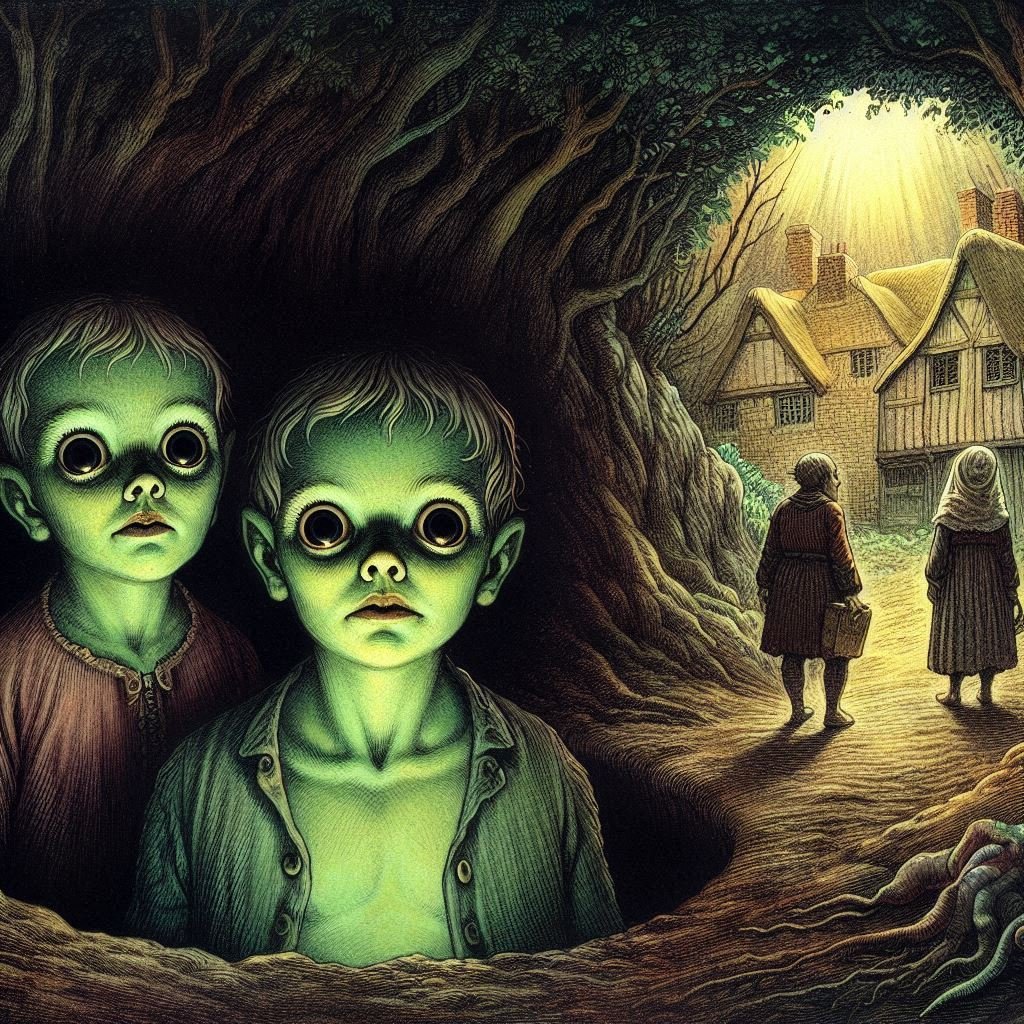
By the time the villagers reached the edge of the wolf pit, the children were already climbing out of it.
Harvest season in medieval Woolpit should have sounded ordinary — tools striking soil, distant voices, carts moving through the fields. Instead, according to later chroniclers, the villagers witnessed something that would outlive everyone who saw it: a boy and a girl in strange clothing, speaking words nobody understood, their skin carrying an unmistakable green tint.
The Green Children of Woolpit remain one of England’s most famous medieval mysteries because the story sits in that uneasy space between history and folklore. Chroniclers recorded it. Real locations anchor it. Yet no explanation fully removes the feeling that something deeply strange happened on the edge of that Suffolk village.
Stories like this survive because they refuse to stay in one category. The Green Children feel part witness account, part historical puzzle, part legend built around a real tragedy — much like the Lost Colony of Roanoke, where a disappearance slowly transformed into centuries of speculation about what people truly saw and failed to understand.
Listen to “The Green Children” on Spreaker.
What keeps the mystery alive is not just the children’s color or the tunnel story told later. It is the way the details refuse to disappear. They would not eat ordinary food. Their green tint reportedly faded over time. The boy died shortly after being found. The girl survived long enough to describe a dim place called St. Martin’s Land. And after centuries, the same question still hangs over Woolpit:
What actually happened there?
The main versions of the story come from two medieval chroniclers: Ralph of Coggeshall and William of Newburgh. Their accounts differ slightly, but both preserve the same core event. During the reign of King Stephen, villagers near Woolpit discovered two children — a brother and sister — near the pits that gave the village its name.
These were not symbolic landmarks or decorative wells. They were wolf traps carved into the landscape. According to the accounts, the children appeared dirty, frightened, and completely unable to communicate with anyone around them.
The villagers brought them to the home of Sir Richard de Calne. At first, the children reportedly refused ordinary food. Bread, meat, and other staples meant nothing to them. Only when they were shown raw broad beans did they finally begin to eat.
Even then, chroniclers focused on one especially strange detail: the children seemed familiar with the beans themselves, but not with how to remove them from the pods.
Over time, the children recovered physically, and their green color supposedly faded. Then the story split in two tragic directions. The boy weakened and died. The girl survived, learned English, and eventually claimed that she and her brother came from a place called St. Martin’s Land — a twilight world where everyone was green and where daylight never fully arrived.
She said they became lost after following the sound of bells through a dark underground passage.
Timeline of the Green Children Mystery
Mid-12th century: The event is generally placed during the reign of King Stephen.
Discovery near Woolpit: Villagers find two children wearing unusual clothing, speaking an unknown language, and reportedly showing green skin.
Taken into local care: The children are connected to the household of Sir Richard de Calne.
Refusal of normal food: They reject ordinary meals but immediately recognize broad beans.
Recovery period: Their strength returns, and the green tint reportedly begins to fade.
The boy dies: He never fully adapts and dies not long after arriving.
The girl learns English: She later describes St. Martin’s Land, the strange twilight, and the underground passage guided by bells.
Medieval chroniclers preserve the case: Ralph of Coggeshall and William of Newburgh record the story, allowing it to survive into modern history.
The timeline survives through medieval testimony rather than modern evidence, which is exactly why the mystery never fully closes.
Why Historians Still Debate the Story
At first glance, the Green Children story sounds like a fairy tale that somehow wandered into a history book. But historians continue discussing it because the chroniclers involved were not simply collecting fantasy stories for entertainment.
Ralph of Coggeshall claimed he heard the account from people connected to Sir Richard de Calne himself. William of Newburgh openly admitted the story sounded extraordinary, yet still considered it worthy of preservation.
That does not automatically make every detail true. Medieval chroniclers could be sincere and still repeat flawed testimony. They preserved rumors, marvels, and secondhand stories because those things shaped how medieval people understood the world.
Still, the case remains difficult to dismiss entirely. It is tied to a real village, a named local figure, and a collection of vivid details repeated across independent accounts.
That uncertainty is what makes the Green Children more compelling than a simple ghost story and less certain than a documented historical event. It belongs to the same uneasy category as the Phaistos Disc or the Mary Celeste — mysteries where the known facts are strong enough to survive scrutiny, but never strong enough to force a final answer.
What Still Doesn’t Add Up
The green skin: Most explanations attempt to account for it, but none remove the detail completely.
The unknown language: If the children were local, why could nobody understand them? If they were foreign, where exactly did they come from?
The broad beans: Their recognition of the beans — but confusion over the pods — remains one of the strangest parts of the story.
St. Martin’s Land: Was it a real place, a misunderstanding, or a memory reshaped through fear and translation?
Every detail has a possible explanation. The problem is that no single theory explains all of them without creating new questions.
The Leading Theory: Lost Flemish Children
The explanation most historians return to is the Flemish orphan theory. In this version of events, the Green Children were not supernatural visitors at all. They were displaced foreign children, possibly Flemish refugees, caught in the instability and violence of 12th-century England.
The theory fits the historical setting surprisingly well. Flemish communities existed throughout eastern England during that period, and conflict could easily have left children separated, malnourished, and terrified.
If the children spoke a Flemish dialect unfamiliar to English villagers, their speech may have sounded completely alien. Their clothing would also have looked unusual to rural witnesses with little exposure to outsiders.
The mysterious name “St. Martin’s Land” may also support the theory. Some historians connect it to Fornham St. Martin, a nearby area associated with Flemish settlement and conflict. Over time, frightened testimony may have transformed a real place into something mystical.
Then there is the green color itself. Most modern explanations point toward malnutrition or illness. Severe nutritional deficiencies can alter skin tone, especially in already weakened children. If the children later recovered after receiving food and care, the fading green tint becomes easier to understand.
But even this grounded explanation leaves rough edges behind.
Why the broad beans? Why the tunnel story? Why the strange descriptions of light and darkness?
The answer may be simpler than people want. Trauma, fear, language barriers, and memory rarely produce clean testimony. Two lost children trying to explain their world to strangers — using a language they barely understood — would leave enormous room for misunderstanding.
The Source Problem That Keeps the Mystery Alive
If the Flemish theory feels convincing, the surviving source material is what keeps the case from fully settling.
We do not possess the children’s own words. We only have what chroniclers claimed they said. That means the most famous parts of the story may already contain layers of interpretation.
Ralph of Coggeshall: Often considered the most valuable source because he appears closest to local testimony.
William of Newburgh: Preserved the story despite openly recognizing how unbelievable it sounded.
Folklore contamination: Stories involving underground worlds, twilight lands, and green-skinned children naturally attract legend over time.
Medieval worldview: Chroniclers did not separate marvel, rumor, and history the way modern historians attempt to.
The survival of the green detail: That single image may suggest there truly was something visually unusual about the children.
The mystery may not be a choice between total fiction and total truth. It may have begun as a real event that quickly became wrapped in the language medieval people used to describe the unknown.
The Most Likely Explanation
The most convincing interpretation is that two real children were found near Woolpit and that much of the strangeness grew from fear, illness, trauma, and misunderstanding.
That explanation accounts for the language barrier, the unfamiliar clothing, the fear, and perhaps even the green tint itself. It also explains why the surviving girl’s story sounded fragmented and dreamlike.
A frightened child forced to describe her past in newly learned English would not produce a clean historical statement. She would produce pieces of memory — darkness, strange light, distant bells, and a place name adults might misunderstand.
And strangely, that explanation may make the story even sadder.
Instead of visitors from another world, the Green Children may have been refugees whose suffering slowly transformed into legend because nobody around them fully understood what they were seeing.
🔎 Related Investigation:
If this case pulled you deeper into the mystery, continue into:
Why the Green Children of Woolpit Still Fascinate People
The Green Children endure because the story never settles comfortably into one explanation. One moment it feels like folklore. The next, it feels like a historical tragedy hidden beneath centuries of embellishment.
That uncertainty is exactly what keeps people returning to it.
The case also fits a larger pattern in historical mysteries. People become obsessed with stories where one surviving detail refuses to disappear — a coded message, an abandoned ship, a vanished colony, an unreadable symbol.
Here, the detail is simple:
Two green children emerging from a wolf pit.
It is an image almost impossible to forget.
FAQ
Were the Green Children of Woolpit real?
No modern historian can prove the story the way a modern investigation could, but the Green Children were recorded by medieval chroniclers Ralph of Coggeshall and William of Newburgh. Most historians believe the story was likely based on a real event, even if later retelling altered some details.
What happened to the Green Children of Woolpit?
According to surviving accounts, a green-skinned boy and girl were discovered near Woolpit in Suffolk, England. They were taken in by villagers, slowly recovered, and eventually learned English. The boy later died, while the girl survived and described a place called St. Martin’s Land.
What is the leading theory behind the Green Children story?
The most widely accepted theory is that the children were displaced Flemish refugees suffering from malnutrition and confusion rather than supernatural beings. Their language, appearance, and behavior may have been misunderstood by local villagers.
Where is Woolpit located?
Woolpit is a real village in Suffolk, England. Its name is linked to the wolf pits that once existed around the settlement and became central to the mystery’s imagery.
Why does the Green Children mystery still get attention?
Because it never resolves cleanly. The story combines real chroniclers, a documented location, and vivid details that feel historical while still carrying the atmosphere of folklore. That balance keeps historians and mystery audiences returning to it centuries later.
🕯️ If this story stayed with you, the author suggests these real mysteries next: