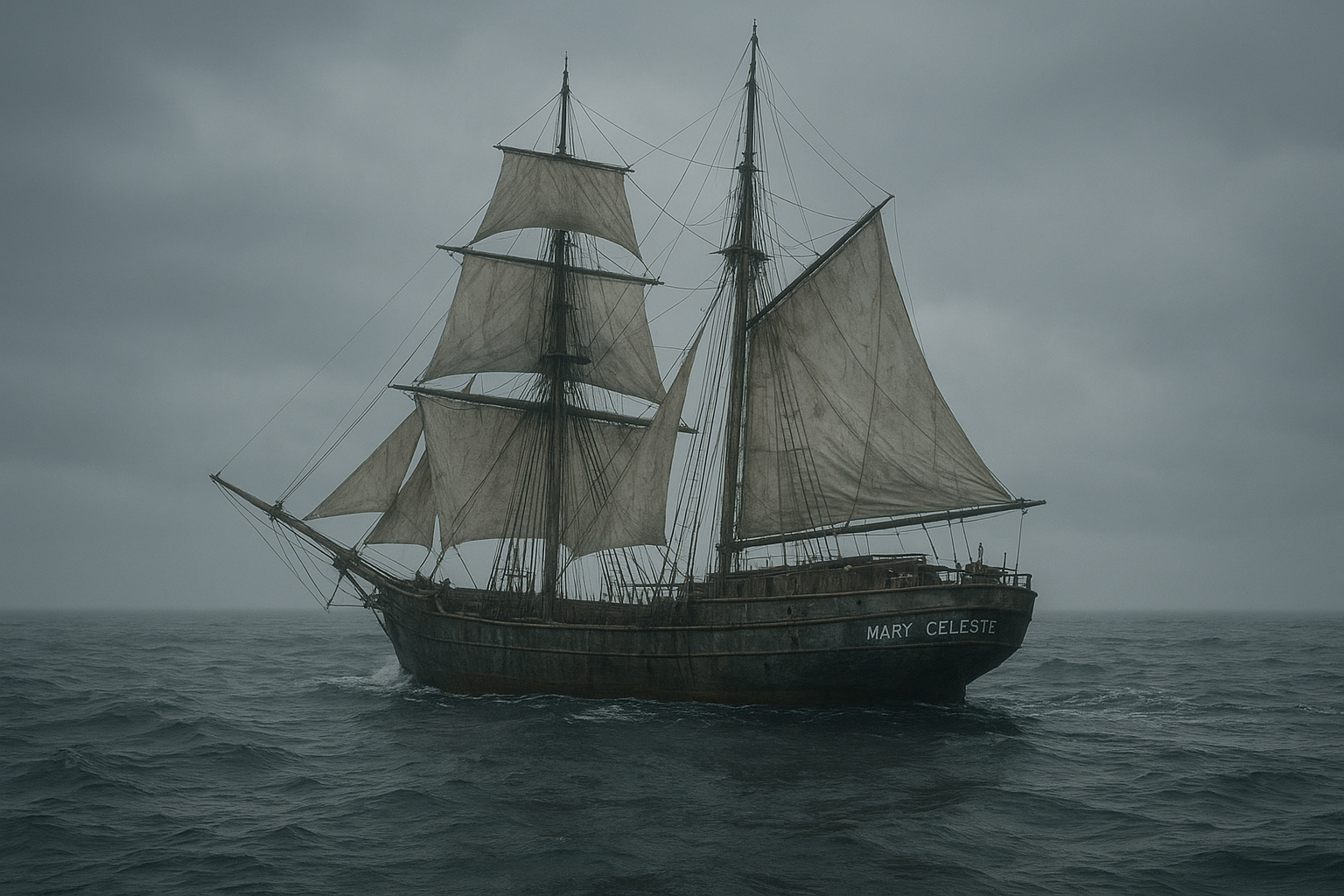
On December 4, 1872, the crew of Captain David Morehouse’s ship saw a sailing ship heading roughly west in the Atlantic, east of the Azores. She still had some sail set, but her course was erratic. Morehouse hailed her from his brigantine, the Dei Gratia. When nobody answered, he sent two men across in a boat. The ship they boarded was the Mary Celeste, outward bound from New York for Genoa. She should have been sailing the other way.
Two men board the Mary Celeste
Oliver Deveau and John Wright found the covers of two cargo hatches lying on deck. The stand that held the compass had been knocked over. Below deck, the cabin and galley were wet. The men could see damage to the sails and rigging, and water had collected in the bottom of the ship. Yet the casks of industrial alcohol were still in the hold. Food and drinking water remained aboard. So did the belongings of people who appeared to have left without packing.
There was a place on deck for a small boat, normally stowed over the main hatch. It was empty. Among the things Deveau and Wright could still lay their hands on was a slate, the working surface on which sailors recorded observations for the ship’s log. Its last entry was dated the morning of November 25. That gave the two men a position for the ship nine days before they stepped aboard. It gave them no instructions about where to look for the boat.
Who Was on Board?
Captain Benjamin Briggs was crossing with his wife Sarah, their two-year-old daughter Sophia, and seven crewmen. First mate Albert Richardson was already known to Briggs. Two brothers, both sailors, also made the passage. The brigantine had a paying cargo of 1,701 casks to deliver in Italy. The Briggses’ seven-year-old son Arthur had stayed with his grandmother in Massachusetts to go to school.
While the vessel was still in New York, Sarah wrote to Arthur about his arithmetic and spelling. She asked whether he had learned to skate and told him that his little sister had put a kiss on the paper for him. His father wrote separately to Arthur’s grandmother about money for his board and clothes and getting his skates ready. The letters, reproduced by the Old Dartmouth Historical Society, preserve the ordinary arrangements the parents had made for a winter apart.
Headwinds held up the departure. Sarah described the delay in a letter to her mother-in-law. After leaving their berth, they had anchored rather than trying to beat their way out in poor conditions. On November 7 the wind was favorable enough for Briggs to take the ship to sea.
Timeline of Events
- November 7, 1872. The Mary Celeste sails from New York for Genoa.
- November 25. The last surviving slate entry places the ship near Santa Maria in the Azores.
- December 4. Deveau and Wright find the ship deserted farther east.
- December 13. Deveau brings the Mary Celeste into Gibraltar, a day after the Dei Gratia arrives.
- March 1873. A salvage award compensates the men who brought the vessel to port.
Three sailors bring the ship to Gibraltar
Morehouse had a decision of his own to make at sea. He could take his men back aboard the Dei Gratia, or he could spare enough of them to bring a second vessel some 600 nautical miles to Gibraltar. Recovering the ship and cargo could earn a salvage award. To make the attempt, he had to divide his small company. Deveau and two other men took charge of the Mary Celeste.
In a letter home, Deveau counted nine days for the passage. He thought they had made good time with only three men. He expected a share of the salvage and wondered how much it would be. He also wanted news of his little boy James, particularly whether he could talk yet. Deveau dated his boarding December 4 and his arrival December 13. Royal Museums Greenwich and historian Graham Faiella follow the December 4 discovery date. Some later accounts give December 5.
In Gibraltar the vice-admiralty court took up the salvage claim. The witnesses could answer for the work they had done and the condition in which they found the ship. The attorney general, Frederick Solly-Flood, suspected a killing aboard her. A sword from the captain’s cabin and marks on the deck drew attention. A doctor examined them and found no trace of blood. A diver who inspected the hull reported no evidence of a collision. The court eventually awarded the salvagers £1,700. Its proceedings produced testimony about the ship, but no evidence establishing that one of the missing people had harmed another.
What Doesn’t Add Up
Three men could sail the ship into port. Why would ten people have needed to leave it? One difficulty with that question is the nine-day gap. Deveau managed the vessel in the condition in which he found her on December 4. If Briggs had been trying to judge how fast she was taking on water in rough weather, he faced a different problem. One of the two pumps was partly dismantled when the boarding party arrived. Nearby lay a sounding rod, a tool for measuring the depth of liquid. Those objects survive in the witnesses’ descriptions. The reading that Briggs or a crewman might have taken does not.
The absent boat, ship’s papers and navigation instruments make a deliberate departure plausible. Each could be useful to people trying to reach land. Yet none fixes the spot where they left. The last entry gave a position near an island. The vessel was hundreds of miles farther east by the time Morehouse saw her. No witness from the small boat supplied a position between the two.
Could the ship have sailed on without a crew?
Documentarian Anne MacGregor put that question to oceanographer Phil Richardson. Working from historical weather and ocean records, they tested whether a vessel left near Santa Maria could have reached the reported discovery position on her own. Their reconstruction, described in Smithsonian Magazine in 2007, showed that she could. That result makes a departure within sight of land possible. It leaves open when the boat went into the water and who decided to launch it.
MacGregor also considered a danger peculiar to the cargo. Nine casks were found empty. One theory holds that alcohol vapors forced up the main hatch and frightened the people aboard. The two open hatches Deveau and Wright saw were fore and aft. According to MacGregor, the main hatch was secured, and the boarders reported no smell of fumes. The nine empty casks had been recorded as red oak, a more porous wood than the white oak used for the others. Leakage could account for their condition without establishing an explosion.
Her alternative involved several smaller troubles coming together. She proposed that an error in navigation delayed the expected sight of land. A recent refit and an earlier cargo of coal suggested possible sources of debris in a pump. A captain unsure how much water lay beneath a tightly packed cargo might consider a nearby island worth trying for. The weather records and the partly dismantled pump make that account possible to examine. Neither tells us whether any debris actually blocked the pump.
The witness who existed only in print
In 1884 Arthur Conan Doyle published a story in The Cornhill Magazine purporting to give a survivor’s statement. Even the name on its fictional ship was different. Doyle called her the Marie Celeste. The extra letter survives in retellings, along with the much larger invention that somebody returned to describe what happened on board.
Some of the Briggs family’s belongings did come home. The Old Dartmouth Historical Society’s account records that packages from Gibraltar brought back Sarah’s musical instrument and two of Sophia’s dolls. Arthur could receive the things his sister had played with aboard ship. Nobody could bring him word of her.
FAQ
What happened to the Mary Celeste?
Another crew recovered her in the Atlantic in December 1872 and sailed her into Gibraltar. The whereabouts of the ten people who had left New York aboard her remain unknown.
What papers survived from the voyage?
The Gibraltar inquiry preserved evidence about the ship’s condition. Transcriptions of the last days of the log were available to later researchers. Letters written before sailing also survive in print.
Did pirates take the cargo?
The boarding party found the shipment of alcohol still in the hold. The surviving evidence gives little support to robbery as an explanation for the disappearance.
Was there a surviving eyewitness?
Deveau and Wright witnessed the discovery. Neither was aboard when the people disappeared. The supposed survivor who gave his own account in 1884 was a character in Doyle’s fiction.
Sources & References
- Royal Museums Greenwich — The mystery of Mary Celeste
Curator’s account of the voyage, boarding evidence and salvage inquiry. - Historical Association — Mary Celeste: History of a mystery
Public excerpt on the ship’s course, hatches and cargo. - Smithsonian Magazine — Abandoned Ship: Mary Celeste
Anne MacGregor’s investigation and alternatives to the fumes theory. - Old Dartmouth Historical Society, Historical Sketch No. 74
Letters from the Briggs family and Oliver Deveau, reports from Gibraltar, and the disposition of belongings.
Related stories
- The Roanoke colony and the evidence left behind
- The Somerton Man identity research and the questions about his death
- The ancient mechanism recovered from a shipwreck
- The artifact covered in symbols that historians still cannot read with confidence
The Bermuda Triangle and the stories of missing vessels
Explore more mysteries of the ancient world
More historical mysteries
Watch This Story on YouTube
The retained video presents an earlier narration. The written account distinguishes boarding evidence from proposed explanations.