Some historical mysteries survive because the evidence is missing. Others survive because the evidence exists, sits in a museum, inside a monument, on a fragment of text, on a sea route, or in a clue that looks meaningful enough to solve something — and still refuses to close the case. That second kind of mystery is harder to shake because it leaves you staring not at total darkness, but at unfinished evidence.
This collection moves across ancient, medieval and modern history. It compares unread texts, damaged machinery, missing sites and incomplete accounts. Some questions remain open, while others have well-supported explanations that should not be obscured by a mystery label.
The surviving clue can be an artifact, a monument, an inscription or a document. Those records pose different questions: what an object did, who made it, where a site stood or what happened between two known events.
They matter because unresolved evidence works differently from legend. A legend can remain open because it is too distant to test. A historical mystery remains open because the clue is real enough to demand interpretation and incomplete enough to resist finality. That is why these cases keep drawing readers back: the object, inscription, machine, monument, or record survives strongly enough to make certainty feel close.
The cases below are grouped by the kind of evidence they leave, rather than by the assumption that every conventional explanation has failed.
Historical Mysteries Organized by the Evidence They Leave Behind
Antikythera Mechanism
Recovered from a Greek shipwreck, the Antikythera Mechanism is an ancient geared astronomical calculator. Its sophistication is remarkable, but the National Archaeological Museum places it within the knowledge, techniques and materials available in its own period.
Its damaged remains leave room for research on the arrangement and operation of its parts. That is different from treating the mechanism as evidence of technology impossible in antiquity.
The key mystery point is that solving what the mechanism did only sharpens the harder question of how much comparable knowledge disappeared with it.
Read the full case here: Antikythera Mechanism: An Ancient Astronomical Calculator.
Phaistos Disc
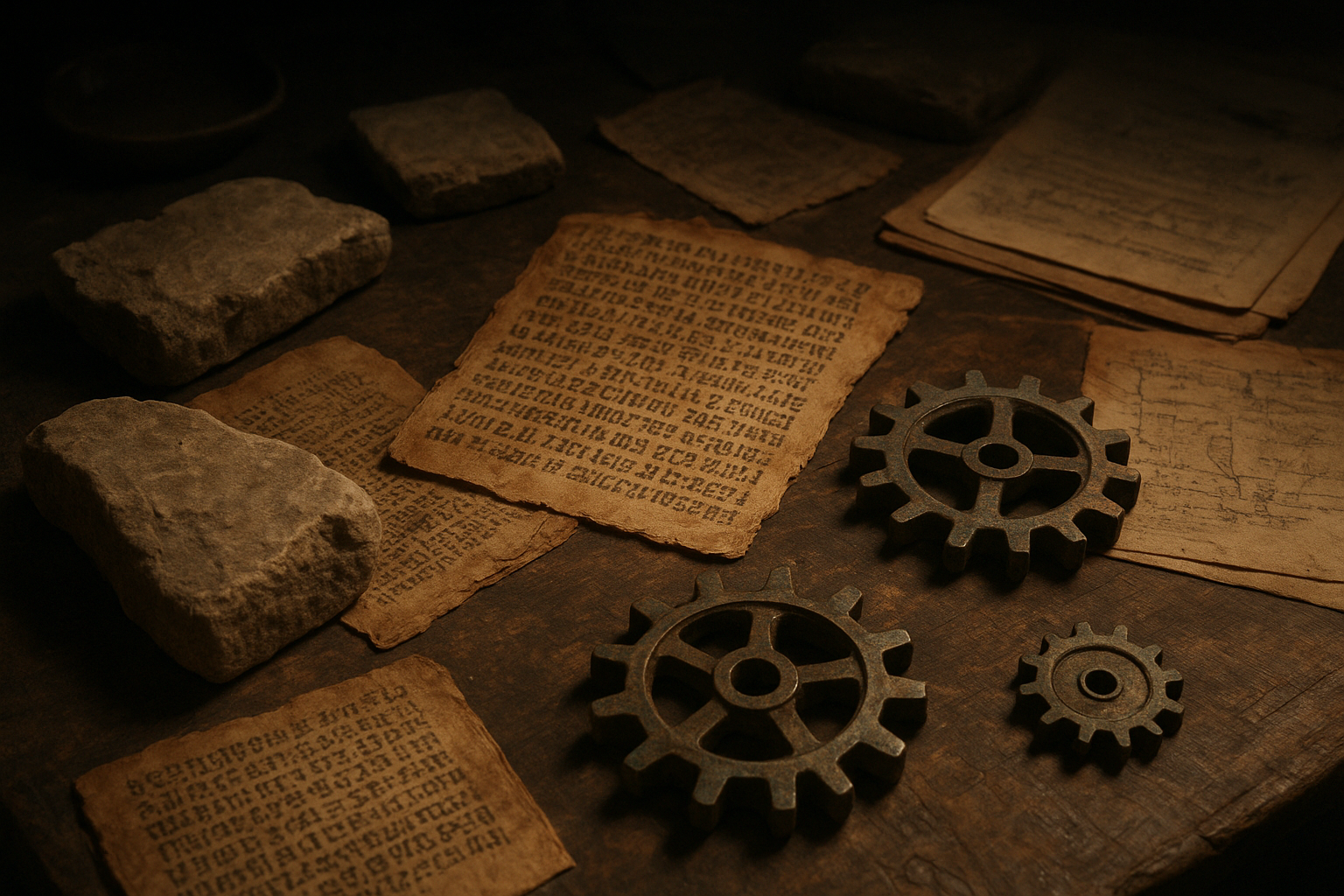
The Phaistos Disc remains one of the strangest objects in archaeology: a fired clay disk stamped with repeating symbols that look deliberate enough to be meaningful and elusive enough to keep scholars from forcing a final translation. It sits at the exact boundary between language and permanent uncertainty.
It belongs here because historical mysteries become especially potent when the artifact survives but the interpretive key does not. This is the undeciphered-text problem in its cleanest form.
The key mystery point is that the disc preserves a message-shaped pattern without preserving enough context to make that message uncontested.
Read the full case here: Phaistos Disc Mystery — The Ancient Code Nobody Can Decode.
Copper Scroll
The Copper Scroll feels less like scripture than an instruction set from a world that no longer lines up neatly with the landscape. Inscribed on copper rather than parchment, it appears to describe hidden caches or preserved valuables, which turns it into both a textual mystery and a geographic one.
It fits the hub because it lives between code, record, and vanished world. The words survive, but the reality they point to refuses to become fully testable.
The key mystery point is whether the scroll recorded literal treasure locations, symbolic references, or a historical map that no longer matches the ground.
Read the full case here: The Ancient Treasure Map: Unearthing the Secrets of the Copper Scroll.
Nazca Lines
The Nazca Lines are large geoglyphs on Peru’s arid coastal plain, including animal, plant and geometric forms. UNESCO places them within the cultural and religious traditions of the region’s pre-Hispanic societies and describes proposed ritual and astronomical functions.
Questions about individual designs and uses can remain without making their human cultural setting an unexplained civilization.
The key mystery point is that the more deliberate the lines appear, the harder it becomes to accept a single tidy answer for all of them.
Read the full case here: Nazca Lines Mystery — Who Created the Giant Desert Drawings?.
Alexander the Great’s Lost Tomb
The missing tomb of Alexander the Great is a reminder that even the ancient world’s most famous dead can disappear into documentary fog. For a conqueror whose campaigns reshaped continents, the uncertainty around his final resting place feels almost structurally impossible — and that is exactly why it endures.
It belongs in this archive as a vanished-site mystery. The unresolved evidence is not an unreadable inscription but the absence of the physical anchor that should tie a world-historical figure back to one secure location.
The key mystery point is that Alexander’s death is known, his legacy is documented, and yet the burial evidence that ought to close the story still does not.
Read the full case here: Alexander the Great Tomb Mystery — Where Is the Lost Tomb of History’s Greatest Conqueror?.
The Great Sphinx’s Archaeological Context
Egypt’s Ministry of Tourism and Antiquities dates the Great Sphinx to the Fourth Dynasty and links its face to Khafre. Its position beside Khafre’s valley temple and causeway is part of that archaeological context.
The monument’s restoration and interpretation can be studied without treating much earlier alternative dates as equally established. The official archaeological account provides the baseline for that discussion.
The question is how to assess the monument’s surviving context, rather than whether every proposed age has the same evidential weight.
Read the full case here: The Great Sphinx: Dating, Archaeological Context and Alternative Claims.
Voynich Manuscript
The Voynich Manuscript is a medieval or early modern illustrated manuscript held by Yale’s Beinecke Library. Its script is unidentified and its meaning remains disputed. The library notes that it is not established whether the text is encoded at all.
It belongs here because undeciphered evidence often lingers longer than missing evidence. The object survives in extraordinary detail, yet meaning stays just beyond reach.
The key mystery point is that the manuscript continues to behave like a message without granting modern readers the one thing they want most: a stable reading.
Read the full case here: Voynich Manuscript Explained — The Book Nobody Can Read.
Mary Celeste
Mary Celeste was found abandoned in the Atlantic in December 1872. Its ten occupants were missing. Later investigations have examined possible explanations for leaving the vessel, but no complete account of their fate has been established.
It fits this page because some historical mysteries are really vanished-sequence mysteries. The material evidence remains; the human chain that would interpret it correctly does not.
The key mystery point is that the most important missing artifact in the case is not cargo or equipment but the final narrative of departure itself.
Read the full case here: Mary Celeste Mystery — The Ghost Ship Found Adrift With No Crew.
Somerton Man: Identity and Unexplained Clues
The Somerton Man was found dead on an Adelaide beach in 1948. In 2022, independent researchers proposed Carl “Charles” Webb as his identity through genetic genealogy. ABC reported in July 2026 that the separate police investigation had not yet delivered its findings to the coroner.
It belongs here because unresolved clues do not stop mattering just because part of the surrounding story becomes clearer. Sometimes the surviving fragment remains stranger than the person attached to it.
The letter sequence associated with the case has been called a code, but that label does not establish that it encodes a decipherable message or explains his death.
Read the full case here: Somerton Man: The Identification Research and Unexplained Clues.
Ulfberht Swords
Ulfberht-inscribed swords belong to medieval craftsmanship. The Metropolitan Museum dates one example to about 850–900 and explains that the name and blade-making style were copied by later craftspeople. Their quality does not by itself demonstrate technology beyond the period.
They fit this archive because historical mysteries do not only gather around one-off artifacts. Sometimes they gather around a pattern of craftsmanship that suggests capabilities many readers do not expect from the period.
The key mystery point is whether the swords represent isolated excellence, trade-route metallurgy, branding, imitation, or a broader technical story history still underestimates.
Read the full case here: Ulfberht Swords: Medieval Craftsmanship and the Repeated Signature.
What These Historical Mysteries Have in Common
What unites these stories is not one era or one geography. It is the tension between evidence and closure. In every case, something durable remains: a manuscript, a mechanism, a disk, a ship, a monument, a clue, a burial question, a site that should be findable, a pattern that looks interpretable. Yet durability is not the same thing as resolution. The clue survives, and the explanation still does not lock.
These mysteries also fail in different ways. Some are translation failures. Some are chronology disputes. Some are missing-location problems. Some are context failures, where the object survives but the world needed to read it correctly does not. Others linger because one clue can support several plausible stories at once without forcing one winner. That variety is exactly why a structured archive matters: it lets readers compare not only famous mysteries, but the different ways history itself stays unfinished.
The result is a stronger documentary pattern than simple “ancient secrets” content ever offers. These are cases where the past is not silent so much as incomplete. It still speaks through fragments, mechanisms, ruins, records, maps, and symbols. What keeps the mystery alive is that the fragments are persuasive enough to matter and incomplete enough to keep argument alive.
A manuscript with an unidentified script, damaged mechanical parts and a missing tomb pose different research problems. Comparing them is useful when those differences remain visible.
The cases above show different limits in the surviving record. An undeciphered script is not the same problem as an uncertain burial location, and an interpretation under discussion is not the absence of an explanation.
It also explains why these cases continue to generate documentaries, books, essays, and endless re-analysis. People are not only attracted to mystery in the abstract. They are attracted to mystery with residue — the sensation that the answer is trapped somewhere inside the surviving clue and that one better method, one new excavation, one cleaner translation, or one overlooked context could finally make the whole thing lock into place. That promise of almost-closure is what keeps historical mysteries alive for generations.
Conclusion
Surviving evidence can make a historical question specific without making it fully answerable: a disc with signs, a damaged astronomical mechanism, a metal list of valuables, a monument with an archaeological context, a lost burial site or an abandoned ship.
Each example offers a different route into the past. The task is to separate what the evidence establishes from what remains uncertain, rather than expect one kind of mystery to explain them all.
In other words, the archive is not just about mystery. It is about the anatomy of unresolved history — the places where records, artifacts, symbols, and sites all survive long enough to matter and still fail to give up a clean ending.
The linked articles allow these questions to be explored separately: language, chronology, location, craftsmanship and missing context. Their evidential limits differ, even when their stories share the feeling of an unfinished past.
Research Sources
The following resources were consulted to verify and update this article.
- National Archaeological Museum, Athens — The Antikythera Mechanism: Science Historian
Explains the mechanism’s historical technology and stages of reconstruction. - The Unicode Consortium — The Unicode Standard: Phaistos Disc (Chapter 22, PDF page 59)
Describes the stamped clay disc and its undeciphered signs. - The Jordan Museum — The Dead Sea Scrolls
Describes the Copper Scroll’s material, inscription and treasure information. - UNESCO World Heritage Centre — Lines and Geoglyphs of Nasca and Palpa
Provides cultural context and proposed functions for the geoglyphs. - Smithsonian Magazine — Raising Alexandria
Examines ancient Alexandria and the uncertainty around Alexander’s tomb. - Egypt Ministry of Tourism and Antiquities — The Great Sphinx
Gives the Fourth Dynasty dating and connection with Khafre. - Yale Library — The Beinecke Cipher (Voynich) Manuscript
Describes its unidentified script and medieval or early modern context. - Smithsonian Magazine — Abandoned Ship: The Mary Celeste
Reviews the 1872 abandonment and later documentary investigation. - ABC News — SA Police report to coroner into Somerton Man case complete “very soon”
Distinguishes the Webb research identification from the July 2026 official status. - The Metropolitan Museum of Art — Sword, Germanic or Scandinavian, ca. 850–900
Documents a medieval Ulfberht blade and the emulated signature.
🔎 If this story stayed with you, the author suggests these deeper investigations next:
- Internet mysteries where the surviving clue still feels like a trapdoor
- Real events that feel too strange to fit neatly into history
- Sky mysteries where the evidence is visible and the answer still isn’t
Explore more Historical Mysteries stories here: