The Sphinx’s True Age? The Erosion Clues That Turned a Monument Into a Historical Fight
9 min readJuly 30, 2025
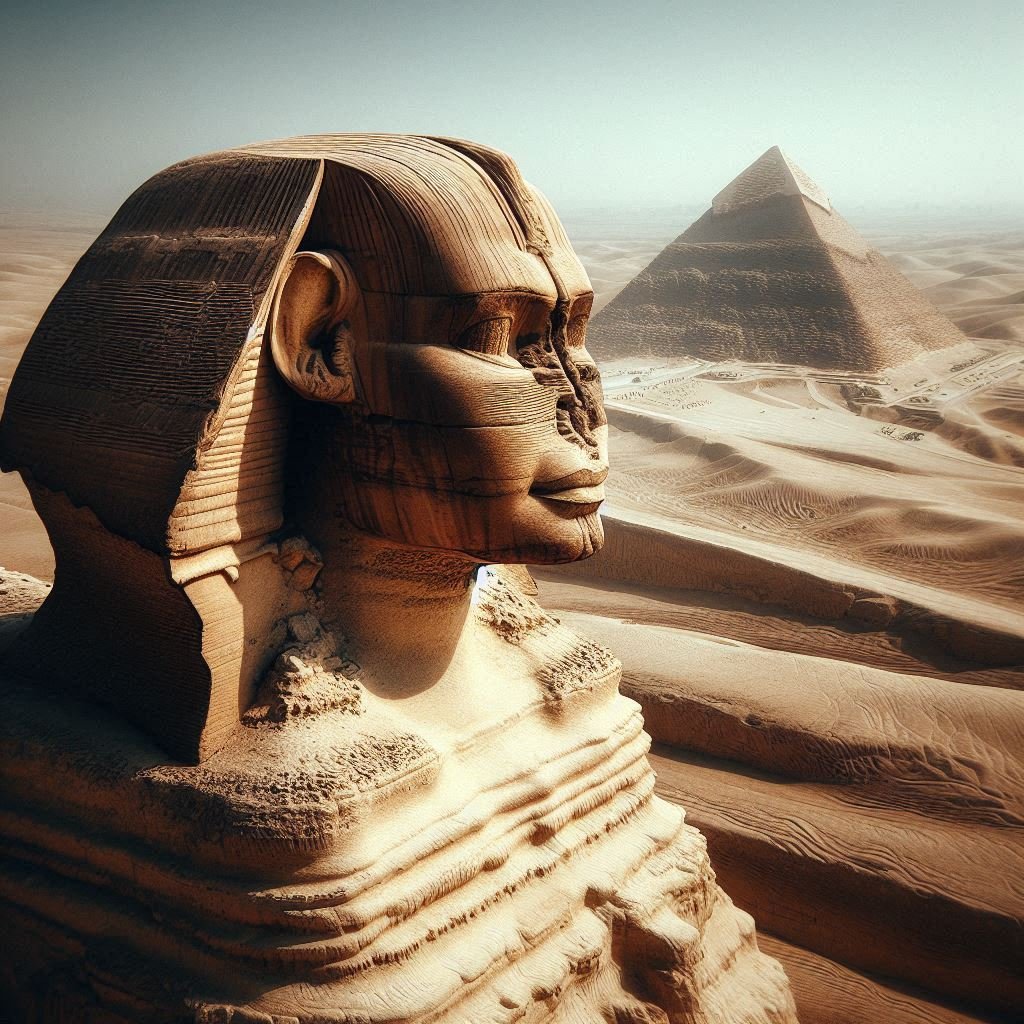
Long before the tour buses arrive, before the heat starts rising off the Giza Plateau in waves, the Sphinx is already there in the half-light — silent, worn, and staring east like it has been waiting for something that never came. From a distance it looks familiar, almost too familiar, one of those monuments the modern world has flattened into a postcard. But up close, the stone feels less certain. The face is calm. The body is battered. And the rock around it seems to carry an older argument than the one printed in guidebooks.
Listen to “The Sphinx’s True Age” on Spreaker.The Great Sphinx of Giza sits at the center of one of history’s most persistent debates. The main question behind the Sphinx’s true age is simple but explosive: was it carved around 2500 BCE during the reign of Khafre, or do the erosion patterns and surrounding geology suggest something much older? That argument still matters because if the older-age theory were ever proven, it would force historians to rethink when monumental knowledge, planning, and stonework first appeared.
If this kind of lost-history argument pulls you in, Ancient Mysteries That Still Can’t Be Explained is the broader rabbit hole, because the Sphinx belongs to that unnerving class of artifacts that feel stable on the surface and deeply unsettled underneath.
The official story is the one most visitors hear first. Around 4,500 years ago, workers in the Old Kingdom carved the Sphinx directly from the limestone bedrock beside Khafre’s pyramid complex. It makes intuitive sense. The monument stands inside the architectural orbit of Khafre’s world. The nearby valley temple and mortuary complex connect it to the same royal landscape. The head, at least in broad style, fits the visual language of pharaonic power. For a long time, that was enough. The Sphinx was old, magnificent, and explained.
But the monument never really behaved like a finished answer. Even people who accepted the standard dating kept circling back to the body, the enclosure walls, and the damage in the stone. The face had been repaired. The body had suffered. The surrounding trench looked harshly weathered. None of that proved a radical theory on its own. Still, it left room for doubt, and doubt is where old monuments become live mysteries again.
That doubt widened dramatically in the late 20th century, when geologist Robert Schoch argued that the weathering around the Sphinx looked less like the result of desert wind and more like prolonged water erosion. His claim was not just that the monument was damaged. It was that the pattern of damage belonged to a wetter climate — one far older than dynastic Egypt. If that reading were right, then the stone was telling a story the accepted timeline could not comfortably hold.
c. 2500 BCE: Mainstream archaeology places the carving of the Sphinx in the reign of Pharaoh Khafre during Egypt’s Old Kingdom.
New Kingdom era: Later rulers, including Thutmose IV, restore and memorialize the monument, showing it was already ancient to them.
19th–20th centuries: Excavation, restoration, and modern study bring renewed focus to the Sphinx’s body, enclosure, and damaged surface.
Early 1990s: Robert Schoch publicly argues that the enclosure weathering resembles heavy rainfall erosion more than standard desert wear.
1990s onward: Writers such as Graham Hancock and Robert Bauval popularize older-age arguments and connect them to broader astronomical and lost-civilization theories.
Today: Egyptologists, geologists, and independent researchers still dispute what the erosion, context, and missing evidence really mean.
The reason this timeline matters is that the Sphinx debate was never just one theory colliding with one date. It became a layered fight over what kind of evidence deserves the most weight. Archaeologists leaned on context: location, dynastic patterns, associated structures, and the broader absence of a known older civilization at Giza. Geologists who questioned the standard view leaned on the stone itself. If the rock carried marks of rain on a scale the later desert climate could not explain, then maybe the site was older than the civilization credited with shaping it.
And once that door opened, the argument stopped being local. It spilled outward into other unresolved history questions. Readers who get stuck on the Sphinx often end up in nearby cases like the Alexander the Great tomb mystery or the Antikythera Mechanism, because all three stories trigger the same uneasy thought: what if history did not disappear neatly, and what if some missing chapters were far bigger than we realize?
The older-age theory usually begins with the enclosure. Instead of narrow abrasion lines consistent with a dry, wind-beaten environment, critics of the standard date point to rounded vertical weathering and deeper grooves that look, to them, like water once ran down the stone over long periods of time. That matters because the Giza Plateau has been arid for thousands of years. To fit the rainfall argument, you have to go back much further, toward the end of the last Ice Age, when North Africa was wetter and the climate looked very different.
If that sounds like a small technical dispute, it isn’t. It blows open everything around it. An older Sphinx would mean either the monument itself predates dynastic Egypt or at least part of the carved complex does. Then the next questions come fast. Who planned it? Who had the labor and symbolic vision to shape it? Why is there no equally obvious sister monument from the same lost phase? And if a later pharaoh reworked the head, how much of what we are looking at now belongs to one age versus another?
Evidence That Keeps the Argument Alive
Geology: Supporters of an older age say the enclosure walls show rounded, vertical weathering more consistent with rainfall than with mere windblown sand.
Context: Mainstream scholars counter that the Sphinx sits inside Khafre’s complex, which strongly anchors it to the Old Kingdom.
Head-to-body proportions: Some older-age advocates argue the head appears too small for the body, suggesting possible later recarving.
Lack of older ruins: Critics of the older-age theory point out that there is no confirmed lost civilization layer at Giza producing comparable monuments from 10,000 BCE.
Astronomical speculation: Alternative researchers tie the east-facing lion form to the constellation Leo around 10,500 BCE, though this remains highly disputed.
The astronomy angle is where the case becomes especially seductive. The Sphinx faces east. Rewind the sky through the slow wobble of precession, and some writers argue that around 10,500 BCE the constellation Leo would have risen at the spring equinox in symbolic alignment with the lion-bodied monument. It is the kind of idea that feels almost too cinematic to ignore. But it is also where the theory becomes easier to overreach. Symbolic alignment is not the same thing as proof, and once the case leans too hard on cosmic destiny, skeptics become even less willing to entertain the geology.
Mainstream Egyptologists push back hard for that reason. They argue the erosion can be explained through a combination of salt crystallization, groundwater, restoration history, and the uneven behavior of limestone exposed to changing conditions over long spans of time. They also return to the most uncomfortable problem for the alternative view: there is still no accepted archaeological record of a vanished monument-building civilization at Giza from 10,000 BCE. No matching inscriptions. No broad urban remains. No parallel stone program waiting under the sand. Just one monument that some researchers think looks older than it should.
What Still Doesn’t Add Up
The body looks rougher than the story around it: even for people who accept the Khafre date, the monument’s weathering keeps inviting a second look.
The evidence points in different directions: site context supports the Old Kingdom, while some geological readings suggest a much deeper timeline.
The head raises proportion questions: if it was reworked, that could explain visual inconsistencies, but the extent of any recarving remains debated.
No clean resolution has emerged: decades of attention have not fully buried the older-age argument or fully confirmed it.
The stakes distort the debate: because proving the Sphinx older would rewrite so much history, every claim gets treated as either world-changing or reckless.
That last point is part of why the Sphinx still pulls people in. This is not only a fight over stone. It is a fight over how much uncertainty the historical record is allowed to contain. If the conventional dating holds, the Sphinx remains one of the most impressive creations of the Old Kingdom, and the mystery becomes more about preservation and symbolism than origin. If the older-age theory survives serious scrutiny, then the monument turns into something colder and stranger: a survivor from a chapter of human organization that was never supposed to exist.
And that is what gives the story its staying power. Plenty of ancient sites are impressive. Fewer feel like they are arguing back. The Sphinx does. Its face belongs to order, kingship, and permanence. Its body tells a rougher story. Its enclosure keeps inviting specialists to look again. Its timeline still refuses to sit perfectly still. That is why it lives so naturally beside Voynich Manuscript Explained, Nazca Lines Mystery, and Phaistos Disc Mystery. Each one is a reminder that mystery does not begin where evidence disappears. Sometimes it begins where evidence survives, but refuses to agree with itself.
Maybe the likeliest explanation is still the least dramatic one: that the Sphinx belongs to Khafre’s era, that its damage has been overinterpreted, and that later fascination has turned geological ambiguity into a civilizational crisis. That is entirely possible. But even that restrained conclusion leaves one fact untouched. The monument still generates serious disagreement because its stone is not as straightforward as a tourist caption wants it to be.
So the Sphinx remains where it has always been — crouched at the edge of the desert, facing sunrise, carrying more certainty in its silhouette than in its evidence. It may be exactly what the orthodox timeline says it is. Or it may be the rare monument that keeps exposing how fragile our timelines become when rock, climate, and human ambition stop telling the same story.
FAQ
How old is the Great Sphinx of Giza according to mainstream archaeology?
Mainstream archaeology generally dates the Sphinx to around 2500 BCE and connects it to Pharaoh Khafre and his pyramid complex on the Giza Plateau.
Why do some researchers think the Sphinx is older?
The main older-age argument comes from claims that the weathering on the Sphinx enclosure looks more like prolonged rainfall erosion than normal desert erosion, which would suggest a much wetter and much earlier climate.
Is there proof that the Sphinx is 10,000 years old?
No. That claim remains controversial and unproven. It is based on disputed geological interpretation, and it has not been matched by a widely accepted archaeological record for a lost Giza civilization from that period.
What is the biggest problem with the older-age theory?
The biggest problem is the lack of broader supporting evidence. Skeptics argue that if the Sphinx truly came from a far earlier civilization, there should be clearer traces of that culture beyond one debated monument.
Why does the Sphinx age debate still get attention?
It keeps attention because the stakes are enormous. If the standard dating is right, the Sphinx is an Old Kingdom masterpiece. If it is wrong, the monument could force a major rewrite of early human history.
🔎 If this mystery pulled you deeper, the author suggests these related real cases next:
I RECALL IN A FORM OF DREAM STATE THAT I TRAVELLED BY SHIP FROM ATLANTIS OVER WHAT I BELIEVE TO BE AROUND 12000 YEARS AGO DURING AN EARLIER INCARNATION AND ARRIVED IN WHAT IS NOW EGYPT.
I SAW THE SPHINX AND ENTERED BETWEEN ITS PAWS INTO THE CHAMBERS BELOW. I DO NOT REMEMBER ANYTHING ELSE ABOUT THAT EXPERIENCE BUT BELIEVE MY LIFE AT THAT TIME ENDED IN EGYPT.
I RETURNED TO VISIT THE SITE IN 1967 AND SUBSEQUENTLY MET A MEDIUM WHO HAD HAD, UNPROMPTED, A SIMILAR EXPERIENCE TO MINE.
OTHER LIFETIMES I HAVE RECALLED AROUND 2000AD, 1395AD AND ONWARDS TO PERIODICALLY EXPERIENCE AND LEARN FROM LIFETIMES BORN INTO.
THIS IS A NATURAL PROGRESSIVE SITUATION FOR ALL SOULS, IN MANY CASES QUITE OFTEN BEING WITH THE SAME FAMILY SOULS BUT IN DIFFERENT CHANGING RELATIONSHIPS SO MORE EX[ERIENCE OF LIVES AND ORIENTATIONS IS THEREBY ACHIEVED, WHICH IS LARGELY WHY WE ARE HERE PERIODICALLY ON OUR ROUTE TO ULTIMATE ENLIGHTENMENT.
Linking the Sphinx to the constellation Leo is pure rubbish. The constellations were not named with their made-up symbols until sometime in the 2nd century CE, about 2700 years after the Sphinx was constructed.





I RECALL IN A FORM OF DREAM STATE THAT I TRAVELLED BY SHIP FROM ATLANTIS OVER WHAT I BELIEVE TO BE AROUND 12000 YEARS AGO DURING AN EARLIER INCARNATION AND ARRIVED IN WHAT IS NOW EGYPT.
I SAW THE SPHINX AND ENTERED BETWEEN ITS PAWS INTO THE CHAMBERS BELOW. I DO NOT REMEMBER ANYTHING ELSE ABOUT THAT EXPERIENCE BUT BELIEVE MY LIFE AT THAT TIME ENDED IN EGYPT.
I RETURNED TO VISIT THE SITE IN 1967 AND SUBSEQUENTLY MET A MEDIUM WHO HAD HAD, UNPROMPTED, A SIMILAR EXPERIENCE TO MINE.
OTHER LIFETIMES I HAVE RECALLED AROUND 2000AD, 1395AD AND ONWARDS TO PERIODICALLY EXPERIENCE AND LEARN FROM LIFETIMES BORN INTO.
THIS IS A NATURAL PROGRESSIVE SITUATION FOR ALL SOULS, IN MANY CASES QUITE OFTEN BEING WITH THE SAME FAMILY SOULS BUT IN DIFFERENT CHANGING RELATIONSHIPS SO MORE EX[ERIENCE OF LIVES AND ORIENTATIONS IS THEREBY ACHIEVED, WHICH IS LARGELY WHY WE ARE HERE PERIODICALLY ON OUR ROUTE TO ULTIMATE ENLIGHTENMENT.
Linking the Sphinx to the constellation Leo is pure rubbish. The constellations were not named with their made-up symbols until sometime in the 2nd century CE, about 2700 years after the Sphinx was constructed.