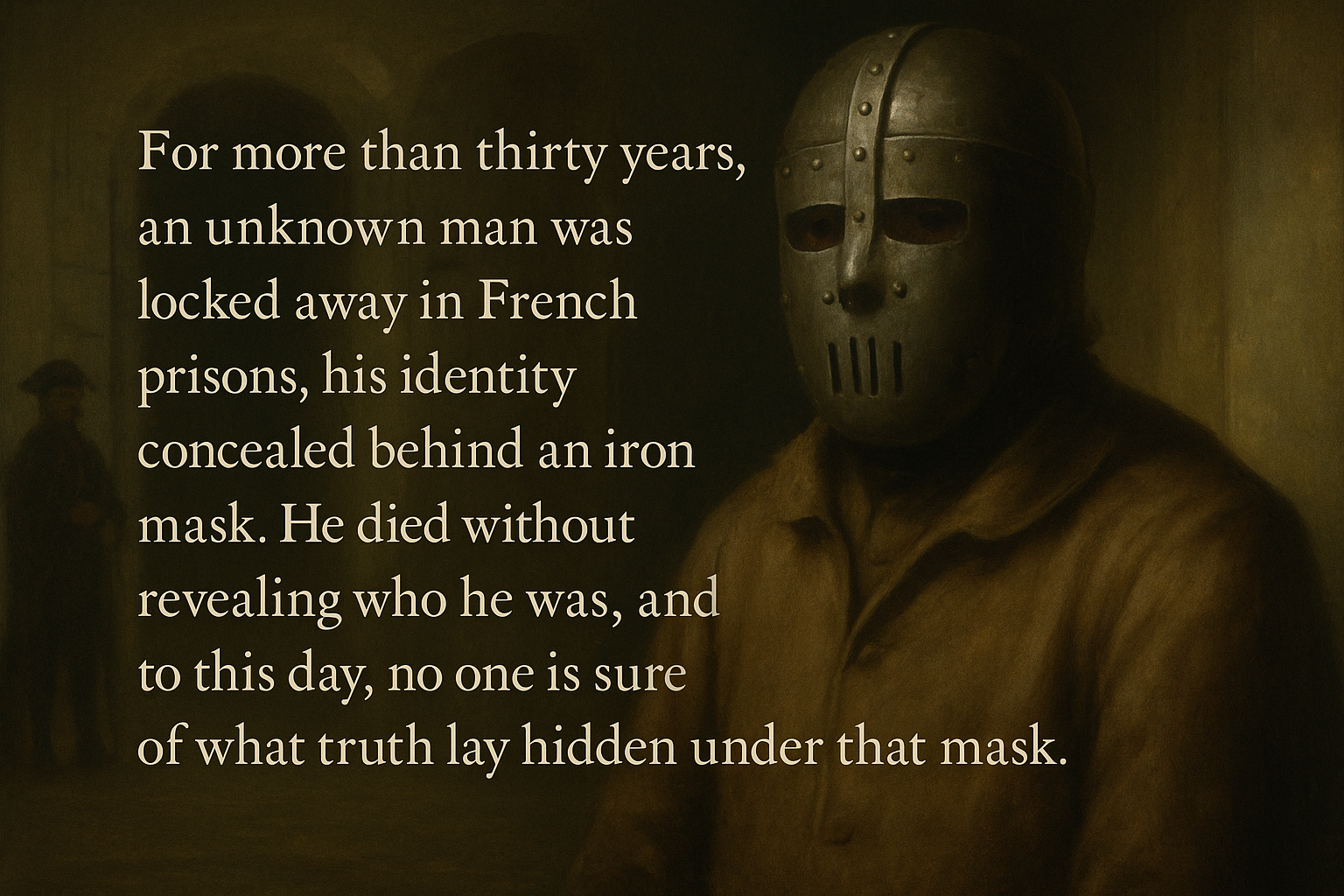
Who Was the Man in the Iron Mask? The Prisoner Louis XIV Hid and the Identity Theories That Still Won’t Die
8 min readNovember 10, 2025
For years, a prisoner moved through France like a shadow the crown refused to name. Doors were secured before he arrived. Orders were whispered instead of spoken plainly. And whenever he was taken from one stone fortress to another, his face had to disappear before anyone else could look at it.
By the time he reached the Bastille, he was already less a man than a state secret. Guards knew he mattered. They knew he was dangerous to somebody powerful. But they were never told why. When he died in 1703, the room was cleaned, the traces were stripped away, and the identity at the center of the mystery was buried under another name.
The Man in the Iron Mask remains one of history’s most famous unsolved identity mysteries because the imprisonment was real, the secrecy was documented, and yet the one fact people wanted most was never settled: who was the prisoner Louis XIV kept hidden for more than three decades? The case still matters because it sits in that uneasy space between archive and legend, where just enough evidence survives to make the silence feel deliberate.
That feeling is part of what links this case to other identity-driven historical mysteries like the Somerton Man, where the records exist, the clues are real, and the most important answer still stays just out of reach.
A Prisoner Delivered Under Orders No One Was Supposed to Forget
In 1669, Louis XIV’s minister, the Marquis de Louvois, sent instructions to Bénigne Dauvergne de Saint-Mars, the governor of the prison at Pignerol. A prisoner would be arriving under the name Eustache Dauger. Saint-Mars was told to prepare a cell with unusual precautions. He was to see the man personally. He was to limit contact. And if the prisoner spoke about anything except his immediate needs, he was to be killed.
That is where the real chill of this story begins. Not with the later novels. Not with the iron mask in popular culture. With paperwork. With a government letter calm enough to sound routine and severe enough to tell you this was not an ordinary inmate. Even in a kingdom built on rank, secrecy, and gossip, this prisoner required an extra layer of silence.
Pignerol was not where France sent petty criminals. It was a place for politically dangerous prisoners and inconvenient men who could embarrass the state. So when a new captive arrived under secret instructions, people inside that system noticed. The man’s earliest documented identity was not “the Man in the Iron Mask.” It was the name Eustache Dauger. That detail matters because it is one reason historians have spent centuries arguing over whether Dauger was the prisoner’s real name, a false label, or only one layer in a larger deception.
Timeline of the Captivity
1669: A prisoner identified in state correspondence as Eustache Dauger is arrested and sent to Pignerol under strict secrecy orders.
1669–1681: He remains under the supervision of Saint-Mars at Pignerol, where his existence is treated as unusually sensitive.
1681: Saint-Mars is transferred to Exilles, and the prisoner goes with him.
1687: The prisoner is moved again when Saint-Mars takes charge on Île Sainte-Marguerite.
1698: Saint-Mars becomes governor of the Bastille and brings the same prisoner to Paris.
1703: The prisoner dies in the Bastille and is buried under the name “Marchioly” or a similar variation.
That timeline is the spine of the mystery. The prisoner was not forgotten in one dungeon and left there. He was carried from one posting to the next by the same governor, almost like part of Saint-Mars’s private burden. That pattern is one of the strangest facts in the whole case. It suggests the man mattered less as a person than as a problem that had to be contained by someone trusted to keep containing it.
Every move made the legend darker. From Pignerol to Exilles, from Exilles to Île Sainte-Marguerite, and finally to the Bastille, the prisoner passed through the machinery of the French state without ever truly entering public view. The distances changed. The walls changed. The silence did not.
What the Mask Probably Was — and Why It Still Terrified People
The phrase “iron mask” is so famous that it feels inseparable from the story, but the historical record is murkier than the legend. Many historians believe the prisoner more likely wore a black velvet mask in key moments, especially during transfers, and that the image of literal iron hardened over time as rumor and retelling took over.
But whether the covering was velvet or metal, the point was the same: this man’s face had become dangerous information. In a monarchy obsessed with bloodlines, scandal, and control, a hidden face was more than a physical barrier. It was a warning. Somewhere behind that covering was a truth powerful enough that the crown preferred decades of speculation to one moment of recognition.
What Doesn’t Add Up About the Identity Theories
Over the centuries, the Man in the Iron Mask has been identified as almost everyone powerful, inconvenient, or symbolically irresistible enough to fit the myth. But most theories collapse when they hit the same hard wall: the surviving timeline.
The twin brother of Louis XIV: This is the most famous theory because Voltaire helped turn it into a cultural obsession, and later Alexandre Dumas made it unforgettable. But historians have found no solid evidence that the king had a secret twin hidden from the world.
Nicolas Fouquet: He was certainly a high-profile prisoner under Saint-Mars, but the dates do not work cleanly. Fouquet’s imprisonment is separately documented, and he is known to have died before the Bastille ending tied to the masked prisoner.
Ercole Antonio Mattioli: Some researchers point to the burial name “Marchioly” and argue the prisoner may have been the Italian diplomat Count Mattioli. That theory explains one of the strongest surviving clues, but it does not settle every contradiction.
Eustache Dauger: For many historians, this remains one of the most plausible answers. Dauger appears in the original state correspondence, and the prisoner’s treatment suggests someone connected to sensitive knowledge rather than simple noble status. But if he was only a servant or valet, people still ask why the secrecy became so theatrical and lasted so long.
This is the tension that keeps the story alive. The royal-brother theory is emotionally powerful but weak on evidence. The more grounded Dauger theory fits the paper trail better, but it leaves the imagination unsatisfied. People want the prisoner to have been someone explosive enough to justify the legend. The documents keep hinting that the truth may have been less glamorous and somehow still dangerous.
Why Historians Keep Coming Back to Eustache Dauger
The most persuasive modern arguments often circle back to Dauger because his name appears at the beginning of the state record, and because the official instructions around him are so extreme. He may not have been a prince. He may not have needed to be. In Louis XIV’s France, a person did not have to stand near the throne by birth to become dangerous to it. He only had to know something the wrong people feared might spread.
That possibility gives the mystery a more unsettling edge. If the prisoner was a witness, a servant, or a man trapped near a political scandal, then the case becomes less like a fairy tale about secret heirs and more like a documentary about state paranoia. It suggests the mask was not preserving romance. It was erasing a human being who had drifted too close to sensitive truth.
Why This Story Still Pulls People Back In
The Man in the Iron Mask still gets attention because the mystery taps into several fears at once: the fear of being erased by power, the fear that official records can hide as much as they reveal, and the fear that history sometimes preserves the shell of a story while destroying the name inside it.
There is also something uniquely haunting about how long the imprisonment lasted. A sudden disappearance is terrifying in one way. A decades-long disappearance in plain custody is different. It means the man remained alive inside the system while his identity was slowly reduced to rumor. He was not lost in the wilderness or at sea. He was held by a government that knew exactly where he was and refused to say who he was.
That is what makes the case feel close to stories like the Lost Colony of Roanoke, the Green Children of Woolpit, the Pollock Twins, and Dyatlov Pass. In each of them, the surviving facts are strong enough to keep belief alive but too incomplete to force a single answer.
Strip away the powdered wigs and fortress walls, and the core question remains painfully modern: what happens when a state decides secrecy matters more than a person?
FAQ
Who was the Man in the Iron Mask?
No one has proved his identity with certainty. The strongest historical candidates include Eustache Dauger and the Italian diplomat Ercole Antonio Mattioli, while more dramatic theories claim he was related to Louis XIV.
Was the mask really made of iron?
Probably not in the way popular culture imagines it. Many historians believe the prisoner was more likely forced to wear a black velvet mask during transfers, and that the iron version grew larger through rumor and retelling.
Why was the Man in the Iron Mask imprisoned?
The surviving documents suggest he knew or was involved in something politically sensitive. The exact reason was never clearly recorded in a way that settled the case for later historians.
Is the Man in the Iron Mask mystery solved?
Not fully. Some historians think the most plausible answer is already in the records, but the evidence still leaves enough gaps that the mystery remains open in the public imagination.
Why does this case still get so much attention?
Because it combines real state secrecy, a missing identity, and a legend that grew directly out of documented history. It feels less like a rumor invented from nothing and more like a silence someone worked very hard to protect.
🔎 If this story stayed with you, the author suggests these real cases next: