Melinda “Pip” Beardsley was a teenage hitchhiker whose body was found near Emigrant Gap in California in 1977, but for nearly fifty years she was known only as Jane Doe. This solved cold case matters because modern forensic DNA finally gave a name back to a girl who vanished into one of the West’s oldest unsolved mysteries.
In the summer of 1977, the Sierra Nevada mountains held onto their secrets the way mountains usually do: quietly, without apology, and for much longer than anyone thinks is possible.
The place was near Emigrant Gap, high in Northern California, where the roads cut through pine forests and granite and the air can feel sharp even on a bright day. It was the kind of country where a person could pull over, step into the trees, and disappear from sight in a matter of seconds. Beautiful country. Lonely country. The sort of landscape that makes silence feel bigger than it should.
That year, hunters moving through the area found something no one ever expects to find in a place like that. They came across human remains. The victim was young. Very young. A girl, or maybe a young woman, somewhere around her teens. She had been left in the mountains long enough that the natural world had already started its slow, indifferent work. There was no ID in a wallet, no simple answer tucked into a pocket, no one standing nearby to say, that’s my daughter, that’s my sister, that’s the girl we’ve been trying to find.
So the first thing she lost was not her life. It was her name.
Investigators worked with what they had. They estimated her age. They examined clothing and physical details. They tried to picture the last hours that brought her to that mountainside. But 1977 was a different world for cold cases. There was no internet to blast her face across the country in minutes. No genealogy databases. No rapid DNA comparisons moving between states at the speed of a click. If a person disappeared far from home, especially if they were young, transient, or hitchhiking, there was a terrifying chance they could slip between systems and simply stop existing on paper.
That possibility hung over the Emigrant Gap Jane Doe case from the beginning.
Who was she? Why was she there? Had she been local? Was she traveling? Had somebody been searching for her in another state, calling police departments that never connected the dots? Or had the people who loved her been trapped in that particular kind of grief that has no grave, no confession, and no final proof?
Years passed. Then more years. California changed. The country changed. Highways changed. Entire generations grew up and grew old. The girl in the mountains remained where she had always been in the public record: unknown.
When a case survives that long, it starts to harden into legend. Not a famous legend, necessarily. Sometimes it becomes something smaller and sadder than that. A line in an old file. A reconstruction image. A page on a database. A handful of investigators who still remember it. The public gives these victims a temporary identity because people cannot bear total emptiness. So she became Emigrant Gap Jane Doe. Not a person, exactly. More like a label attached to a wound that never closed.
And somewhere far away, long before most people had heard that label, there had been a real girl.
Her name was Melinda Beardsley, though people who knew her called her “Pip.” It is one of those nicknames that instantly makes somebody feel real. Pip does not sound like a case file. It sounds like laughter from the back seat of a car, a note scribbled in a yearbook, a teenager who was once so familiar to the people around her that they gave her a smaller, softer name to carry through the world.
By the time she vanished into history, she was just fourteen years old.
That detail changes the whole shape of the story. Jane Doe suggests distance. It feels clinical. It makes the imagination stop at the edge of procedure. But fourteen is impossible to keep at arm’s length. Fourteen is a child standing on the dangerous border where the world starts treating you like you are older than you are. Old enough to move through bus stations. Old enough to trust the wrong person. Old enough, in the eyes of strangers, to be seen but not protected.
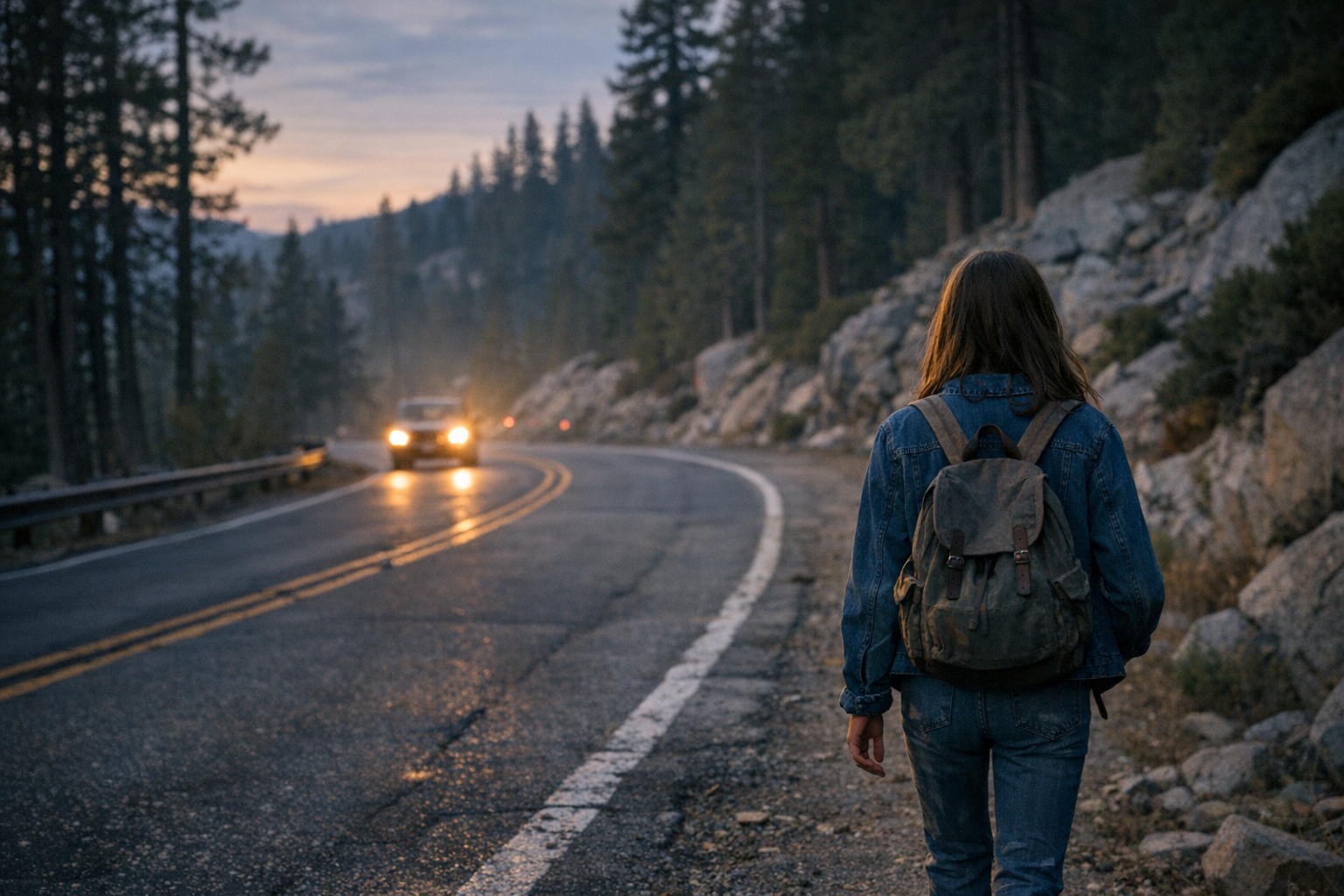
Reports that surfaced after her identification painted a heartbreaking picture. Pip had been hitchhiking. She was young, vulnerable, and moving through a country that in the 1970s still treated hitchhiking with a casualness that now feels almost unreal. Back then, people did it openly. They stuck out their thumbs on highways. They climbed into cars with strangers because that was how some young people crossed states, escaped trouble, chased freedom, or just tried to get somewhere else. It could feel adventurous right up until the moment it became deadly.
Somewhere between the road she took and the mountains where she was found, Pip met the wrong person.
That part of the story still carries darkness. An identification is not the same thing as a full ending. Naming a victim answers the first question, but it does not automatically answer every other one. Who killed her? Why was she taken there? What happened in the hours before her body was left near Emigrant Gap? Cold cases sometimes open one locked door while several more remain shut behind it.
But names matter more than people realize.
For decades, investigators kept trying. That persistence is easy to underestimate because cold-case work often looks motionless from the outside. A file sits on a shelf. A line item remains open. Nothing dramatic seems to happen. Then, years later, a breakthrough appears in a headline and it sounds sudden, almost miraculous. But breakthroughs like this are usually the product of people refusing to let silence win. Evidence has to be preserved. Files have to be revisited. New technology has to be applied to old material by people patient enough to believe that old bones can still speak.
In recent years, forensic genealogy has changed the meaning of “unsolvable.” DNA taken from long-unknown victims can now be compared through techniques that were science fiction when Pip died. Instead of waiting for a direct match in a criminal database, investigators can build outward, tracing distant relatives, family lines, and forgotten branches until the shape of a missing person begins to emerge from the fog. It is meticulous work. Slow work. Human work, despite the technology involved, because at every step somebody has to interpret the clues, test assumptions, and decide whether one more lead is worth chasing.
For Emigrant Gap Jane Doe, that work finally broke the case open.
Nearly fifty years after her body was found, investigators announced that the unknown girl in the Sierra was Melinda “Pip” Beardsley. In one moment, a mystery that had lasted almost half a century shifted into something else. Not solved in every possible way, maybe not finished in the emotional sense, but transformed. The victim was no longer an outline. She was a fourteen-year-old girl with a name, a nickname, and a place in someone’s memory.
Imagine that moment landing on the people who had spent years, maybe decades, with unfinished questions. Even when families suspect the worst, uncertainty stretches grief into something unnatural. It leaves loved ones balancing between hope and dread, unable to fully bury the missing because some small part of the mind keeps whispering that missing is not the same as dead. That whisper can last a lifetime. When identification finally comes, it can feel like both a mercy and a second tragedy. Relief crashes into horror. At least now we know. God, now we know.
There is something especially haunting about cases involving children and teenagers from that era. So many were treated as runaways first and endangered victims second. So many were assumed to have left on purpose, as if youth made them less breakable. A fourteen-year-old hitchhiker in the 1970s could vanish into a bureaucratic blind spot. If she crossed a state line, used a nickname, drifted among friends, or came from family circumstances that were already unstable, the path back to her identity could disappear almost completely.
That is why this case has such a strong hold on people now. It is not just a forensic success story. It is a reminder of how easily vulnerable young people used to fall through every crack at once. Pip was not a myth. She was not a symbol. She was a teenager moving through a dangerous world, and for nearly half a century the world knew what had been done to her before it knew who she was.
The identification also fits a pattern that has become one of the most compelling developments in true crime: the return of the nameless. Across the United States, genetic genealogy has been giving identities back to victims who were once reduced to county nicknames and Doe numbers. Cases that sat cold for thirty, forty, fifty years are suddenly speaking again. Sometimes the answers expose killers. Sometimes they simply return dignity to the dead. Both matter. A solved case is not only about handcuffs. Sometimes it is about restoring the person that violence tried to erase.
And violence does try to erase people. That is one of its ugliest powers. It takes a life, then tries to strip away everything else too: history, family, context, voice. A body left in a remote place is not just hidden. It is pushed toward anonymity. Toward becoming no one. That is what makes these identifications feel so powerful. They reverse part of that damage. They say: you did not succeed in making this person vanish. Not completely. Not forever.
For Pip, the recovery of her name carries an added cruelty. She was fourteen. Fourteen-year-olds are supposed to be loud in the world. They are supposed to leave traces everywhere: school photos, arguments, music tastes, scribbled notes, a hundred little irritations and joys that make adults roll their eyes and smile later when the house is too quiet. A girl that young should not have to be reconstructed from forensic evidence. She should have been remembered in ordinary ways.
Instead, her identity had to be recovered through science, patience, and luck working together decades too late.
Still, too late is not the same as never.
That is the strange comfort in stories like this. The mountains kept her for years. The file kept her longer. Time buried her so deeply that people could have assumed the truth was gone for good. But truth is stubborn in ways that darkness never expects. A preserved sample, a new method, a determined investigator, a distant relative in a database—sometimes that is all it takes to pry open a mystery that once looked permanent.
Now when people talk about the Emigrant Gap Jane Doe case, they should say her real name. Melinda “Pip” Beardsley. They should picture not an evidence label but a teenage girl on the road, full of whatever private hopes and fears she carried before everything went wrong. They should remember that for almost fifty years the central crime was not only murder. It was the long theft of identity that followed.
We still do not know every answer the case may hold. There may yet be more to learn about who crossed Pip’s path, who left her in the Sierra, and whether justice in the fullest sense can still reach across so much time. But one of the hardest battles is over. She is no longer nobody. She is no longer just a place name and a date and a forensic estimate.
At last, the girl in the mountains has come back as herself.
🔎 Related Investigation:
If this case pulled you deeper into the mystery, continue into:
🔎 If this story stayed with you, the author suggests these real cases next:
- The suburban predator who vanished for decades until family-tree DNA dragged him back into the light
- The murder case that stayed frozen for years until one tiny piece of genetic evidence changed everything
- The woman who died with a hidden identity and left investigators unraveling a life built on secrets
Explore more Solved Cases stories here: