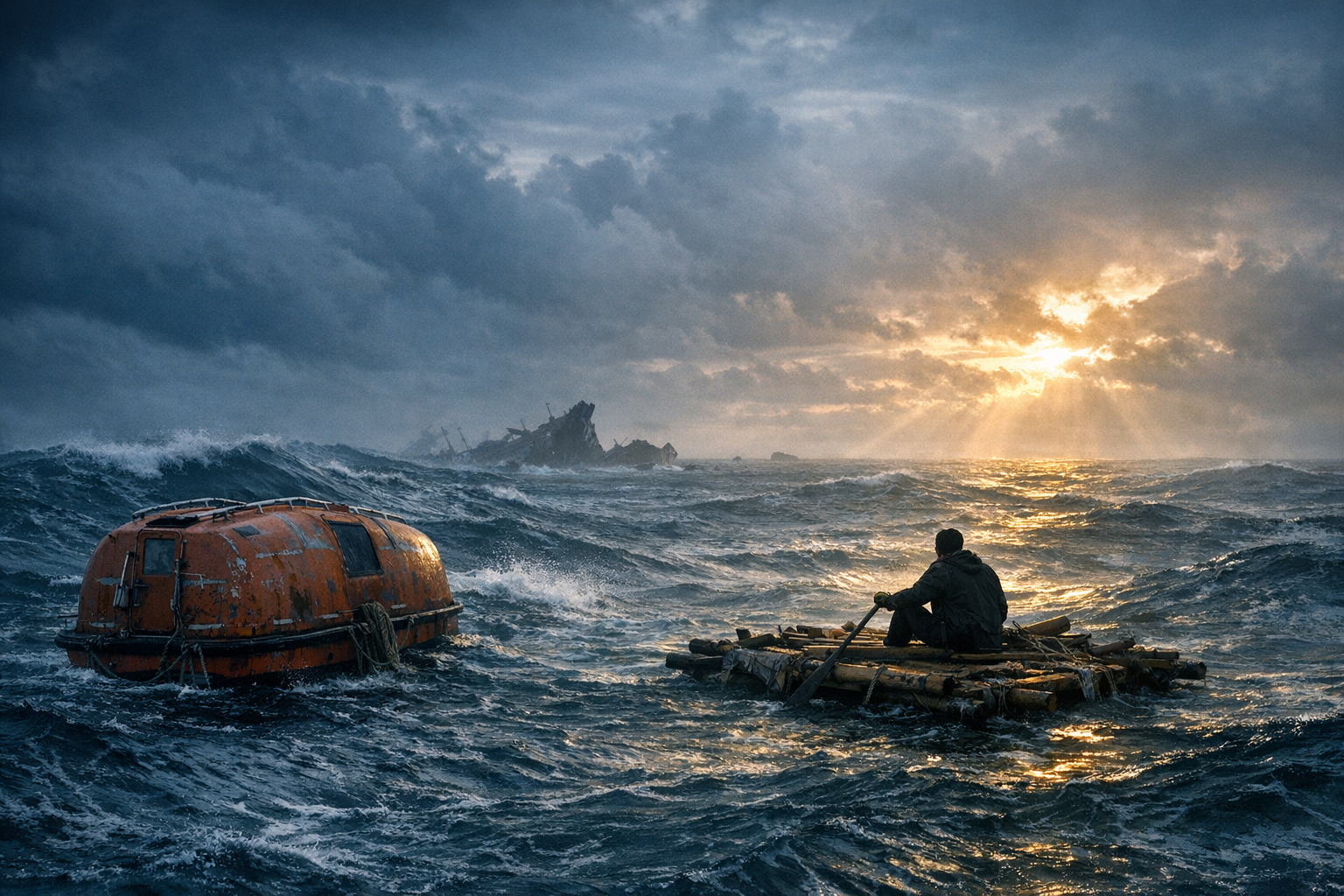
The ocean kills without hurrying. That is what makes lost at sea survival stories feel different from almost every other disaster account. There is no clean ending, no obvious enemy, just hunger, thirst, cold, salt, distance, and the slow terror of realizing the horizon looks the same in every direction. The cases in this roundup begin with storms, collisions, sinking ships, and freak waves, but they all turn into the same brutal question: how long can a human being stay alive after the sea decides to keep them?
When the Water Takes Everything at Once
The first shock in these stories is usually violent and fast. A boat breaks apart. A ship goes under. A wave tears away the last piece of stability. Then comes the second phase, which is often worse: silence, exposure, and time. That is the part you feel in the 438 Days at Sea ordeal and Steve Callahan’s 76 days adrift. Once rescue stops being immediate, survival turns into math. How much water is left? How much skin is burning? How much longer before the body starts making decisions for you?
That is why maritime survival has such a specific kind of dread. Mountain stories at least give you land to aim for. In the open ocean, there may be nothing to walk toward, nothing to hide behind, and no real way to tell whether help is one mile away or a thousand. The survivors in these cases were not simply brave. Many of them were forced into a state beyond bravery, where staying alive became repetitive, ugly, and painfully practical.
The Men Who Drifted So Long They Stopped Belonging to Time
438 Days at Sea remains one of the most staggering examples of long-form ocean survival because it reads like something no body should endure. Drifting for more than a year sounds fictional until you start stacking the daily realities: raw sun, contaminated water, failing hope, and the mental damage caused by endless repetition. The ocean did not try to kill him in one dramatic blow. It tried to erase him slowly.
Steve Callahan’s raft survival story carries the same unbearable logic in a tighter window. Seventy-six days is shorter than 438, but still long enough for the mind to begin narrowing around routine and desperation. Fish become food, rain becomes salvation, and every passing vessel becomes a tiny trial. These are the stories that reveal the ocean’s favorite weapon is duration. People do not just survive impact. They survive being left alone with time.
Shipwrecks Where Rescue Came Too Late for Most
Some sea survival stories are terrifying not because nobody knew the victims were out there, but because even when help came, it came after the worst part. the USS Indianapolis disaster is one of the clearest examples. The ship went down so fast that hundreds of men were thrown into open water, where dehydration, exposure, injuries, and sharks turned the sea into a killing field. Survival in that case was not heroic in the movie sense. It was endurance inside a mass tragedy that kept getting worse by the hour.
the Estonia ferry survival account shows the same principle in a different form. Disaster at sea becomes chaos almost instantly because the environment punishes hesitation. Tilt, darkness, freezing water, blocked exits, panic, and mechanical failure all compress into minutes. If you make it off the vessel, the danger is not over. In many cases, the water itself becomes the longest final test.
The Ocean Does Not Care Whether You Started on a Lifeboat or a Roof
One of the strangest things about these cases is how random the first floating object can be. A raft. Debris. A half-submerged compartment. A rooftop ripped loose by a tsunami. the Japan tsunami drifter story feels almost unreal because it turns a domestic object into an accidental lifeboat. In a normal disaster story, a roof is shelter. In the open sea, it becomes a tiny argument against drowning.
The same eerie randomness appears in the man who survived inside a sunken ship for 60 hours. That case strips sea survival down to pure claustrophobic horror. Instead of endless horizon, the survivor faced darkness, flooding, pressure, and the knowledge that the ocean was pressing from every side. It is the mirror image of raft drift stories, but the lesson is identical: once the sea isolates you, survival depends on whatever impossible pocket of air or buoyancy remains.
Cases That Still Feel Half-Forgotten
Some of the most unsettling maritime stories are not the most famous. They are the ones that seem to slip between wars, headlines, and larger disasters. The Three Men the Ocean Forgot lands that way because forgetting is part of the horror. To drift in wartime, or in any chaotic period, is to risk becoming paperwork before you become a rescue target. The men are still out there, but the world is busy. That delay can be fatal.
These quieter stories matter because they reveal a grim truth: survival at sea is not only about skill. It is also about whether someone notices, whether they can search the right patch of water, and whether bureaucracy, weather, or distance steals the narrow window when rescue is still possible. Plenty of people have survived the initial sinking. Far fewer survive being overlooked.
Cases Solved by Endurance, Not Answers
Unlike many mystery roundups, sea survival stories do not always end with neat explanation or justice. Sometimes the question is not who caused the disaster, but how anyone lived through it. That is why these accounts hit so hard. They replace puzzle-solving with attrition. The answer is not clever. It is human stubbornness mixed with luck, timing, and an almost frightening refusal to die.
That is also why the best maritime survival stories stay with people for years. They make modern life feel thin. We move through days assuming our systems work, our vessels hold, and rescue is close if something goes wrong. Then a case like USS Indianapolis, Steve Callahan, or 438 Days at Sea reminds you how quickly civilization can shrink to one body, one float, and one more sunrise you somehow have to endure.
Why Lost at Sea Survival Stories Never Stop Pulling People In
The sea is one of the few settings where a person can still vanish into something ancient and indifferent. That is why these stories pull so hard. They are survival narratives, yes, but they are also stories about scale. A human being versus weather. A raft versus distance. A pocket of breath versus thousands of tons of water. Even when survivors make it home, the ocean remains larger than the ending.
And maybe that is the reason these cases feel almost mythic without losing their realism. Every one of them proves the same brutal thing in a different way: people can last longer than logic says they should. But they also prove something colder. Survival at sea is never clean, never noble for very long, and never fully under human control. It is one of the last places on earth where endurance still looks primitive.
In the end, the most haunting lost at sea survival stories are not just about rescue. They are about what happens in the long stretch before rescue, when people are forced to live minute by minute inside salt, cold, hunger, fear, and silence. Some found rafts. Some found wreckage. Some found one impossible space to breathe inside a dead ship. All of them discovered the same thing: the ocean does not negotiate, and surviving it even once feels like stealing something back from death.
🔎 Explore more deep-dive investigations like this: