Just after midnight on July 30, 1945, the USS Indianapolis was moving through the Philippine Sea. Then two torpedoes slammed into the ship, steel buckled, fire blew into the dark, and within minutes hundreds of men were in the Philippine Sea looking for each other in oil and wreckage. The ones who survived the sinking had no way to know the worst part of their ordeal had only just begun.
The USS Indianapolis survival story remains one of the most haunting war survival cases ever recorded because hundreds of sailors and Marines were left in the water for several days in open ocean, facing dehydration, exposure, exhaustion, and repeated shark attacks before rescue finally arrived. It still matters because this was not only a naval disaster, but a human endurance story built minute by minute in water that offered no mercy.
That slow collapse of hope is part of why readers still move from this case into other ocean ordeals like Lost at Sea Survival Stories: Shipwrecks, Drifting Boats, and Ocean Ordeals That Somehow Ended in Survival, where survival depends on the same brutal equation: time, water, injury, and whether anyone notices you before the sea finishes the job.
The Indianapolis had just completed a top-secret mission delivering parts of the atomic bomb to Tinian. Most of the crew had no idea what they had transported. Then, at 12:15 a.m., the Japanese submarine I-58 found them.
The first torpedo hit near the bow. The second tore into the fuel tanks. In an instant, the ship became noise and fire and confusion. Men were thrown from bunks. Passageways filled with smoke. Some sailors were burned before they even reached the deck.
The USS Indianapolis sank in about twelve minutes. Hundreds died during the sinking. The rest spilled into the sea in scattered groups, some with life jackets, some with only debris, some injured badly enough that survival had already become a countdown.
At first, many of them still believed rescue was close. Somebody would realize the ship had failed to arrive. A signal must have gone through. Planes would come at dawn. That belief was probably the only thing that made the first hours bearable. In darkness, they clustered together to stay visible and to keep fear from breaking into panic. Around them, the ocean was enormous and almost perfectly indifferent.
Then daylight exposed the truth.
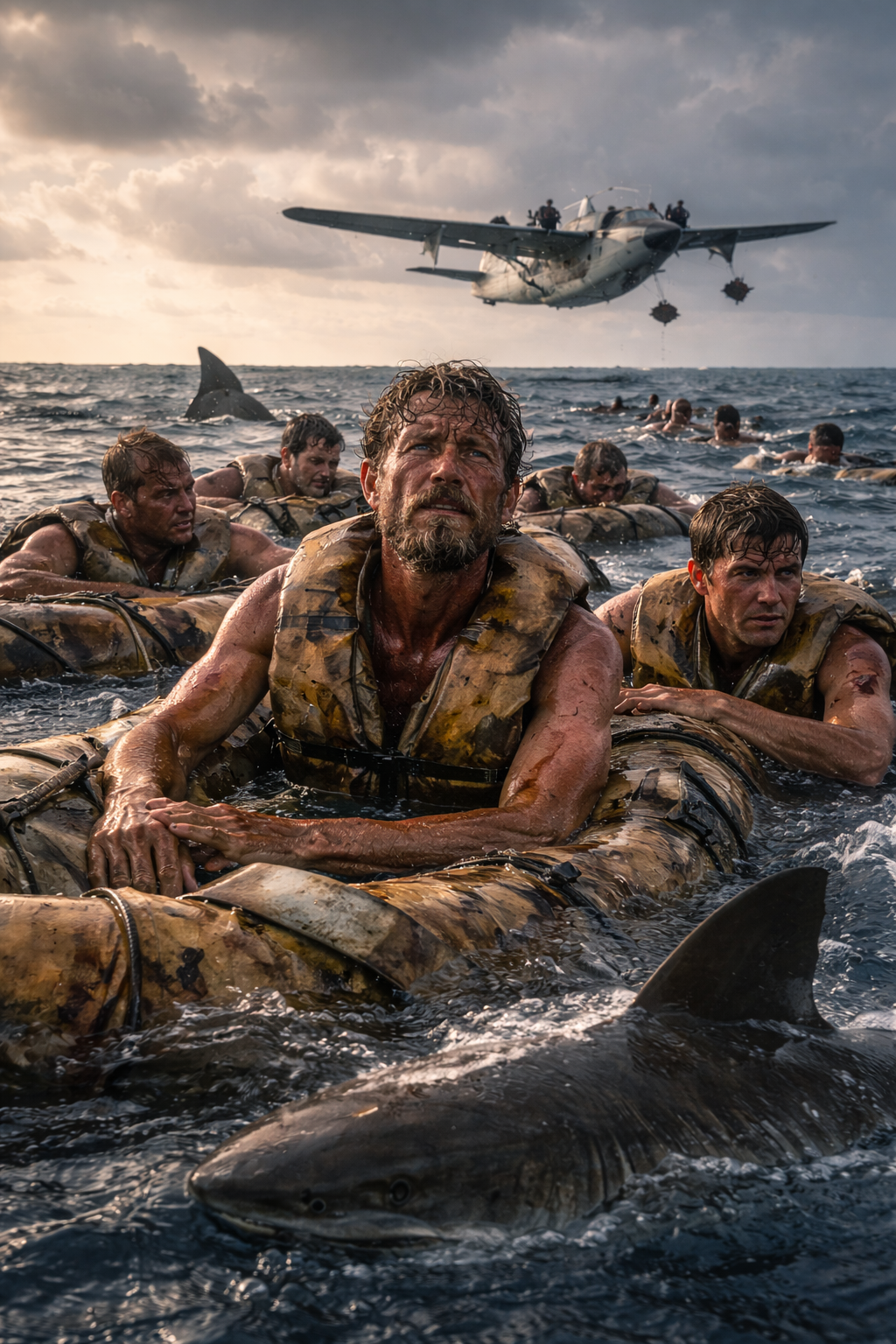
There were men everywhere, but not in any organized line of survival. They were spread over miles of open water among oil slicks, wreckage, and bodies. Many were wounded. Many had swallowed fuel or seawater. And below them, something had already started circling.
Oceanic whitetip sharks are often mentioned whenever the Indianapolis is discussed, and with good reason. Survivors described dark shapes moving beneath the surface, first at a distance and then much closer. The attacks did not come all at once. That may have made them worse. A splash somewhere. Then a scream. Then a place in the water where a man had been a second earlier and now was not.
That rhythm changed the psychology of the entire ordeal. The sailors were not only trying to stay alive. They were trying to stay calm enough not to look like the easiest target. Survivors described grouping together and trying to conserve strength, while shark attacks added to the fear. In the middle of all that, they had to keep floating, keep rationing energy, and keep talking each other through the next hour.
Timeline of Events
- July 30, 1945, around 12:15 a.m.: The USS Indianapolis is struck by two torpedoes from the Japanese submarine I-58.
- Within about 12 minutes: The ship sinks; hundreds die and others enter the water.
- First daylight hours: Hundreds of survivors are left drifting in open water, many injured, burned, or without adequate flotation.
- Day 1 to Day 3: Dehydration, exposure, exhaustion, and shark attacks steadily reduce the number of survivors.
- Day 4, morning: A U.S. Navy patrol plane spots the men by chance during a routine flight.
- Rescue begins: Lieutenant Robert Adrian Marks lands a Catalina seaplane in rough water and starts pulling men aboard, even tying some to the wings.
- Final toll: Archival reconciliation records 1,195 aboard,879 lost and 316 survivors.
By the second day, the sharks were only one part of the nightmare. The sun became another. Men floated for hours with almost no shade, no fresh water, and skin already damaged by oil, burns, and salt. Lips split. Tongues swelled. Bodies weakened in ways that made clear thinking harder and harder.
This is where the story becomes almost harder to read than the attacks themselves, because some of the deadliest choices looked, in the moment, like relief. Seawater tempted desperate men who had gone too long without drinking. But saltwater speeds dehydration and can trigger delirium. Survivors later described men seeing ships on the horizon that were not there, or believing they had reached islands that existed only in a mind failing from thirst. Some swam away from the group chasing rescue. They disappeared into the same water that had already taken so many others.
Others did the opposite. They made survival smaller. Not the next day. Not the next sunrise. Just the next minute. Stay with the cluster. Keep your legs quiet. Hold onto someone. Answer when spoken to. In a story this large, survival came down to tiny acts of discipline repeated while the body was giving every reason to stop.
The emotional horror of the Indianapolis was not only violent death. It was attrition. Every few hours the water grew quieter. Fewer voices. Fewer men. Some drifted off silently. Some slipped under after drinking seawater. Some were taken in sudden bursts of motion no one could stop.
Conditions in the Water: What Made Survival So Difficult
- Severe dehydration: Nearly four days in tropical sun without fresh water pushed men into delirium and collapse.
- Exposure and exhaustion: Continuous floating drained strength, especially for the wounded and burned.
- Shark activity: The area was known for large predatory sharks, and survivors consistently reported repeated attacks.
- Scattered survivor groups: The men were spread widely, making mutual protection and visibility harder.
- Delayed rescue: Communication damage and failures to report the ship’s non-arrival delayed recognition of the loss.
The Navy historical analysis states that the supposed received distress signals could not be corroborated. The investigation found no evidence that a distress message had actually been transmitted. Failures in reporting the ship’s non-arrival nevertheless left survivors waiting.
On August 2, Lieutenant (junior grade) Wilbur Gwinn found an oil slick during patrol and followed it to survivors. His contemporary interview put the sighting at 11:18 a.m. and his dispatch at 11:25; other retellings give different times. The date and discovery during patrol are secure.
He circled lower and saw what others had failed to see for days: men. Hundreds of them, scattered across the surface, waving weakly or barely able to lift an arm. That sight changed everything in an instant. Radio calls went out. Rescue started moving. But even then, it was not neat or immediate. Lieutenant Robert Adrian Marks brought a PBY Catalina seaplane down onto the sea in rough conditions and began taking survivors aboard. When the plane filled, more men were tied to the wings with parachute cord. It was improvisation born from the fact that after all that waiting, nobody in the rescue wanted to tell another sailor to hold on just a little longer.
The final survivor count was 316. In 2018, historians reconciled the sailing list:1,195 had been aboard and 879 died.
That number is why this case never stays only in the category of military history. It lives in the same emotional territory as other endurance stories where survival becomes a test of how long the human body can endure terror after the original disaster is already over. You can feel that same pressure in stories like The Three Men the Ocean Forgot: 34 Days Adrift in the Pacific, Louis Zamperini Survival Story: The Olympian, the Raft, and the War That Refused to Break Him, and The Knock in the Dark: 60 Hours Alive Inside a Sunken Ship.
Why This Case Stayed Famous
The sharks are what most people remember first, but the deeper reason the USS Indianapolis story stayed famous is that nearly every part of it feels unbearable. A secret wartime mission. A ship lost in minutes. Hundreds of men left alive in open water. Failures that left the loss unrecognized. Days of waiting while thirst, fear, and isolation did the rest. Even decades later, survivors spoke less about heroics than about memory: the sounds, the silences, and the awful realization that rescue had not simply been delayed by distance, but by failure.
That lingering pain extended beyond the water. Captain Charles McVay was long blamed for the sinking in ways many survivors believed were unfair. In 2000, the U.S. government formally exonerated him. But even that correction could not reverse what had already happened. The real weight of the story was never just who was blamed. It was what the men endured while no one came.
And that is why the case still lands so hard. Strip away the military context, and the central image remains simple and awful: young men floating in endless ocean, trying not to move too much, trying not to drink the water around them, trying not to listen too closely when another voice goes missing.
For almost four days, survival meant resisting panic, resisting thirst, resisting sleep, resisting the temptation to believe each false horizon. It meant shrinking life into the next minute and then doing it again. That is what makes the USS Indianapolis survival story more than a disaster recap. It feels like a study in how people endure after rescue should already have happened.
Even now, the story leaves behind the same final impression: not a dramatic last stand, but a long, merciless wait in water that kept taking men one by one until someone in the sky finally looked down at the right moment.
FAQ
What happened to the USS Indianapolis?
The USS Indianapolis was torpedoed by the Japanese submarine I-58 shortly after midnight on July 30, 1945. The ship sank in about twelve minutes, and hundreds of surviving sailors were left in the Philippine Sea waiting for rescue.
How long were the survivors in the water?
Many of the survivors were stranded for nearly four days before a patrol plane spotted them by chance and rescue operations began.
How many men survived the USS Indianapolis sinking?
The corrected totals are 1,195 aboard,316 survivors and 879 dead. Men died in the sinking and afterward from injuries, drowning, dehydration, exposure and shark attacks; exact totals by cause are uncertain.
Were sharks really a major part of the USS Indianapolis survival story?
Yes. Survivor accounts consistently describe repeated shark attacks during the days the men were stranded. Sharks were not the only cause of death, but they became one of the most terrifying parts of the ordeal.
Why does the USS Indianapolis case still get so much attention?
It still gets attention because it combines wartime secrecy, catastrophic rescue failure, extreme survival conditions, and one of the most psychologically haunting endurance stories in U.S. naval history.
Research Sources
The following resources were consulted to verify and update this article.
- Naval History and Heritage Command — H-051-1: The Last Sacrifices
Navy historical analysis of the torpedoing, rescue failures, shark attacks and the August 2–3 rescue sequence. - U.S. Naval Institute / NHHC historian Richard Hulver and Sara Vladic — Setting the Record Straight: Loss of the USS Indianapolis and the Question of Clarence Donnor
Archival reconciliation correcting the final sailing list to 1,195 aboard,879 lost and 316 survivors. - Naval History and Heritage Command — 1945 operational records — Summation of Rescue Operations
Original rescue reports and interviews with Gwinn and Marks documenting discovery and improvised aircraft rescue.
🔎 If this story stayed with you, the author suggests these real cases next:
- Other ocean ordeals where rescue came almost too late
- Three men drifting so long the world nearly erased them
- The Olympian who survived the raft, the war, and the breaking point
- The knocking under the dark water that proved someone was still alive
- The survival archive for more real stories built around impossible endurance
Explore more Survival Stories here: