By the time anyone saw him clearly, Hiromitsu Shinkawa was no longer part of the shore.
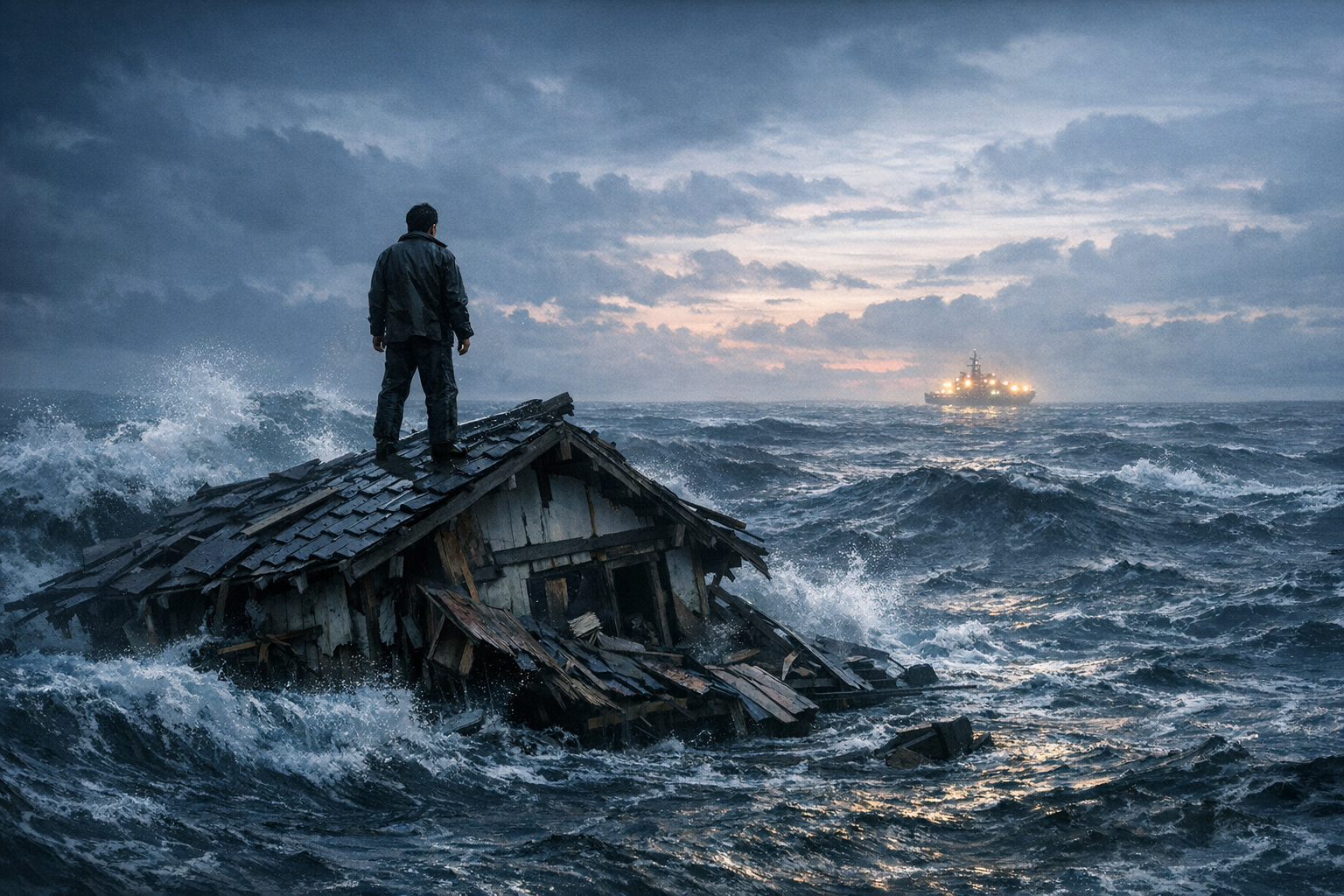
He was standing on the roof of his own broken house, surrounded by gray water and drifting wreckage, nearly ten miles off Japan’s devastated coast. There was no engine beneath him. No radio. No flare. Just a man in his sixties, two days after one of the worst natural disasters in modern history, still refusing to let the sea take the last thing it had left him.
The 2011 Japan tsunami drifter story still gets remembered because it turns an almost impossible survival into one image you can’t shake: a rooftop, an empty Pacific horizon, and one survivor waiting for a search crew that had no reason to think he would still be alive.
Stories like this sit inside a much wider tragedy. If you want the broader disaster context, RTRS also has a deeper collection on disaster survival stories where ordinary days turned into rescue clocks. But Hiromitsu Shinkawa’s ordeal matters on its own because it reduces the scale of the 2011 Tohoku catastrophe to one human body trying not to slip into freezing water.
The Morning Everything Still Looked Normal
On March 11, 2011, the northeast coast of Japan was moving through what should have been an ordinary Friday. In coastal communities, routines were still intact. Roads were open. Homes were occupied. Fishing ports and neighborhoods near the sea were alive with the kind of movement people stop noticing because it feels permanent.
Then, at 2:46 p.m. local time, the earthquake struck off the coast of Tohoku.
It was not a short shock. It rolled on with a scale that stripped away the usual instinct to wait it out. Buildings swayed hard enough to make balance feel temporary. Cabinets emptied themselves. Utility lines whipped overhead. Sirens began to sound, and with them came the deeper fear that people in Japan know too well: if the shaking is this bad, the water may be coming next.
Hiromitsu Shinkawa and his wife were in the coastal city of Minamisoma. Like thousands of others, they were suddenly trapped inside a disaster that was still unfolding. The earthquake was already catastrophic. But the earthquake was only the opening act.
The warning that followed was even worse. A tsunami was on the way.
People in threatened areas had minutes, not hours, to decide what mattered. Leave now. Grab family. Head uphill. Hope the roads stay open. Hope the wave arrives later than predicted. Hope your decision is not the one that costs everything.
Shinkawa and his wife tried to escape. Accounts from the time say they went back toward their home to collect belongings after initially evacuating, a decision that sounds painfully human in hindsight. Catastrophe had not fully become real yet. Houses still looked like houses. Streets still looked like streets. The mind always wants one more minute to believe that maybe the warning is too big, too frightening, too unreal to be true.
Then the ocean arrived.
When the Wave Reached the House
Descriptions of tsunamis often fail because the word wave sounds too simple. It suggests something shaped, brief, and visible. What reached the coast that afternoon was more like the sea turning into force.
Black water pushed inland carrying timber, fuel, fishing gear, vehicles, concrete, walls, metal, broken docks, and pieces of other people’s lives. It did not just flood neighborhoods. It tore through them. Anything anchored weakly enough was ripped free. Anything solid enough became a weapon.
For Shinkawa, the next minutes became the kind of chaos survivors later describe in fragments. There was no steady floor. No clean line between inside and outside. No reliable sense of direction. Houses broke apart under hydraulic pressure. Windows vanished. Furniture slammed into walls. Water forced its way through every opening and then made new ones.
In that violence, he was separated from his wife.
That detail matters because it changes the story from a simple survival anecdote into something much more painful. He was not just trying to stay alive. He was trying to survive while not knowing whether the person beside him minutes earlier had already been taken. The fear was not abstract. It had a name. It had a face. It had a home attached to it.
At some point after the initial destruction, Shinkawa managed to cling to the remains of his house. More specifically, he ended up on part of the roof as the wreckage drifted away from land. It was not a raft built for survival. It was debris. Temporary. Unstable. Wet. Likely slick with salt, splinters, and the residue of everything the tsunami had ripped apart.
And then the current kept carrying him farther out.
The coastline that had defined the world began to disappear behind him.
If you want another survival story where the ocean became its own merciless world, the site’s lost at sea survival stories archive shows how quickly open water strips people down to instinct. But Shinkawa’s ordeal was even stranger than most drift-at-sea cases because he had not chosen the ocean. He had been dragged into it by a national disaster.
Timeline of Events
- March 11, 2011, 2:46 p.m. local time: The Tohoku earthquake strikes off the coast of Japan.
- Minutes later: Tsunami warnings spread through northeastern coastal communities.
- That afternoon: A massive tsunami slams into areas including Minamisoma, destroying homes and sweeping debris inland and back out to sea.
- During the inundation: Hiromitsu Shinkawa is separated from his wife and ends up clinging to the roof section of his destroyed house.
- March 11 night into March 12: He survives the first freezing night adrift in open water.
- March 12 into March 13: He continues drifting offshore amid debris, exposed to wind, cold, and exhaustion.
- March 13: Search crews spot him roughly nine to ten miles offshore. He is rescued alive after about two days at sea.
Why Survival Became Less Likely With Every Hour
It is tempting to flatten this into a feel-good miracle. But what made the story so stunning in the first place was how unlikely survival should have become as time passed.
The first problem was exposure. Even if the air temperature was not arctic, cold wind over open water strips heat fast, especially from someone soaked, shocked, sleep-deprived, and unable to shelter properly. He could not climb below deck because there was no deck. He could not get dry because there was nowhere dry to go. He could not rest deeply because balance itself was part of staying alive.
The second problem was instability. A roof is not designed to behave like a survival platform. It shifts. It tilts. It rises and slams. Every wave changes the angle. Every hour forces muscles to keep doing small corrective work just to prevent one bad slip. Fatigue under those conditions is dangerous because the body eventually stops responding with clean precision.
The third problem was invisibility. Post-disaster search zones are huge. The ocean after a tsunami is not an empty blue field. It becomes a moving graveyard of debris. One roof among wreckage does not stand out from the air unless someone happens to notice movement. And by then the searchers are also scanning land, flooded streets, rooftops near shore, and countless places where survivors might still be trapped.
The fourth problem was psychology. After a disaster, time distorts. One hour can feel endless, and the mind begins bargaining with itself. Hold on until dark. Hold on until morning. Hold on until the next aircraft sound. Hold on through one more set of waves. People imagine survival as one heroic decision made once. In reality it is often hundreds of tiny refusals to give up.
That is what makes Shinkawa’s position so haunting. He was not waiting comfortably for rescue. He was surviving minute by minute on something that could stop functioning as a lifeline at any time.
The First Night Offshore
Night at sea changes everything.
During daylight, at least the world has edges. You can see wave height. You can spot debris drifting toward you. You can scan for helicopters, aircraft, or ships. You can keep your eyes fixed on one point long enough to pretend the day still has structure.
At night, the ocean becomes atmosphere instead of geography. Direction collapses. Distance collapses. Every gust sounds larger. Every movement under you feels less predictable because you can no longer see it arriving. For someone already in shock, darkness magnifies every doubt.
Shinkawa later said he wanted to be rescued by a Japanese vessel. It is a small detail, but it reveals something important: he was still mentally organizing the future. He was still thinking in terms of rescue, not surrender. Even then, after the earthquake, after the wave, after the separation, after being swept offshore on a broken roof, some part of him was still tracking the possibility that help could arrive.
That mental grip matters. Plenty of survival stories collapse at the point where the survivor stops believing the next hour belongs to them. In stories like The Three Men the Ocean Forgot, open-water endurance becomes a battle not just against hunger and weather but against the mind’s ability to imagine disappearing without witness. Shinkawa faced a shorter ordeal, but it unfolded inside a disaster so huge that being overlooked must have felt terrifyingly possible.
Morning eventually came, gray and cold.
No rescue came with it.
What Doesn’t Add Up Until You Picture the Scale
On paper, drifting nine or ten miles offshore in roughly two days may not sound impossible. But paper lies about scale.
The 2011 tsunami did not leave behind one neat field of debris. It tore apart whole coastal sections and sent huge amounts of wreckage moving through violent water. Search crews were not looking at one man against a clean horizon. They were searching a disaster zone stretched across land and sea while thousands were dead, missing, injured, or stranded.
That changes the meaning of every distance figure.
- Nine to ten miles offshore is far enough that the coast can stop feeling close and rescue becomes a problem of spotting one small signal in a giant search space.
- Two days adrift means at least one full night, likely two periods of darkness, and long exposure to wet cold, fatigue, and uncertainty.
- One roof in a debris field means his platform was visually competing with wreckage that may have looked similar from above.
- A national disaster backdrop means search resources were stretched across countless simultaneous emergencies.
That is why the rescue reads almost unreal. It was not simply fortunate that help existed. It was fortunate that help saw him.
The Moment Rescuers Spotted Him
Search crews did keep looking. That part of the story deserves as much attention as the drifting itself.
In the days after the tsunami, Japanese military and rescue units were operating inside one of the harshest recovery environments imaginable. Roads were damaged or gone. Coastal maps no longer matched what crews were seeing. Entire neighborhoods had been turned into contaminated wreckage. Fires, fuel spills, structural collapse, and communication problems made even routine movement dangerous.
And yet teams kept scanning shorelines, inland ruins, and open water because survival windows in disasters are unpredictable. Most people found after such events are found quickly. A few are found later than logic says they should be. Those rare recoveries are why crews keep making one more pass.
On March 13, searchers spotted movement offshore. Not just debris. A person.
Shinkawa was waving from the roof section, still alive. Reports from the time said he was found around nine to ten miles from shore and brought to safety after being located by a military helicopter and rescued by a vessel.
Try to hold that image still for a second.
You have been looking at nothing but water and wreckage. Your body is exhausted. Your skin is cold. Your hands are numb from gripping edges. The world has narrowed to wind, motion, and the possibility that nobody will ever see you.
Then, far above or beyond you, there is sound.
You look up. You wave. Maybe you shout even though the wind will tear the sound away. Maybe you do not even trust what you are seeing at first. But then the aircraft circles, or the ship changes course, and the impossible thing becomes real.
Someone has seen you.
That is the point where an ordeal turns into a story people can tell later. One second before that, it is still a disappearance in progress.
Why This Rescue Hit So Hard Around the World
Most major disasters create statistics so enormous they become strangely hard to feel. Death tolls rise into the thousands. Entire districts vanish. Infrastructure damage is measured in categories too big for the human nervous system to process. You understand it intellectually, but the emotional meaning slips away.
Then one story cuts through.
The reason the Japan tsunami drifter story traveled so widely is that it gave the catastrophe a single unforgettable frame. Not an aerial view. Not a map. Not a chart of destruction. One survivor on the roof of a house that no longer belonged to land.
It also carried a brutal contrast. This was a miracle nested inside an event defined by mass loss. Shinkawa lived, but tens of thousands across the region were dead or missing. His rescue did not soften the disaster. If anything, it sharpened it. It reminded people how many others had faced the same water without the same ending.
There is also the emotional architecture of the image itself. A roof is supposed to protect you from what is outside. In this story, the roof became the last floating piece of home. That reversal makes the survival feel both cinematic and intimate. He was not on a lifeboat designed for rescue. He was on the remains of ordinary life.
In that sense, the story belongs naturally beside other ocean and disaster ordeals in The Survival Stories Archive. But even within that archive, Shinkawa’s case feels unusually haunting because the rescue platform itself was a visual symbol of everything already lost.
The Aftermath No Survival Story Can Ignore
It would be dishonest to end with the rescue alone and pretend the story closes there.
The 2011 Tohoku earthquake and tsunami devastated northeastern Japan. Entire communities were erased or shattered. Families were split apart in seconds. Thousands of people died. Thousands more were listed missing. The disaster also triggered the Fukushima nuclear crisis, extending the damage well beyond the initial hours of impact.
That wider context matters because it keeps the story grounded. Shinkawa’s survival is moving precisely because it stands against overwhelming loss, not outside it. The miracle is real. So is the scale of grief surrounding it.
That is also why the case still gets attention years later. It is not just a survival feat. It is a human-sized doorway into one of the defining catastrophes of the century. Through one man on a roof, people can suddenly feel the force of the event in a way that statistics alone never manage.
And there is one more emotional layer: uncertainty. Early reports said he had been separated from his wife during the tsunami. Even with rescue, the emotional cost of surviving something like this is not clean. People are pulled from disasters alive while still carrying questions, shock, grief, and the disorienting fact that the world they return to is no longer the one they left.
That is why the story lingers. Not because it is neat. Because it isn’t.
FAQ
Who was the Japan tsunami drifter rescued on a roof?
The survivor was Hiromitsu Shinkawa, a man from Minamisoma, Japan, who was swept out to sea during the 2011 Tohoku tsunami and later found alive on the roof of his destroyed home.
How long was Hiromitsu Shinkawa adrift?
Reports from the time said he survived for about two days at sea before rescuers spotted him and brought him to safety.
How far offshore was the Japan tsunami drifter found?
News coverage generally placed him around nine to ten miles offshore, which helps explain why the rescue felt so unlikely in the middle of a massive debris field and disaster search zone.
Why does this case still get so much attention?
Because it compresses the scale of the 2011 tsunami into one unforgettable image: a man on the roof of his own house, floating alone in open water, still alive when rescuers finally saw him.
Was this rescue part of the 2011 Japan earthquake and tsunami disaster?
Yes. Shinkawa’s ordeal happened during the aftermath of the March 11, 2011 Tohoku earthquake and tsunami, one of the deadliest natural disasters in modern Japanese history.
🔎 If this story stayed with you, the author suggests these real cases next:
- Disaster survival stories where whole days turned into rescue countdowns
- Ocean survival stories where the horizon became the enemy
- The hospital story where the sea came indoors and never felt far enough away
- Three men adrift in the Pacific after the world almost moved on without them
- The wider survival archive for readers chasing the next impossible rescue
Explore more Survival Stories here: