The Bermuda Triangle has terrified sailors and pilots for generations — not because people believe in monsters, but because some of the disappearances inside this stretch of ocean still don’t fully make sense.
The ocean has always been good at hiding things.
Ships sink. Storms erase evidence. Planes disappear into miles of open water where recovery crews may never find a single bolt or fragment. But there is one part of the Atlantic Ocean where disappearances seem to carry a different kind of weight — a place where stories of vanished crews, missing aircraft, and ghost ships have built one of the most famous mysteries in modern history.
It’s called the Bermuda Triangle.
For decades, people have argued over whether the Triangle is genuinely dangerous or simply the victim of exaggerated legends. Scientists say there are logical explanations. Skeptics believe the mystery was created by sensational books and television specials. Yet even now, the Bermuda Triangle continues to fascinate millions because some of the stories connected to it still leave behind uncomfortable questions.
Not because they prove something supernatural.
But because sometimes, even in the modern world, people can still vanish without a clear answer.
What Is the Bermuda Triangle?
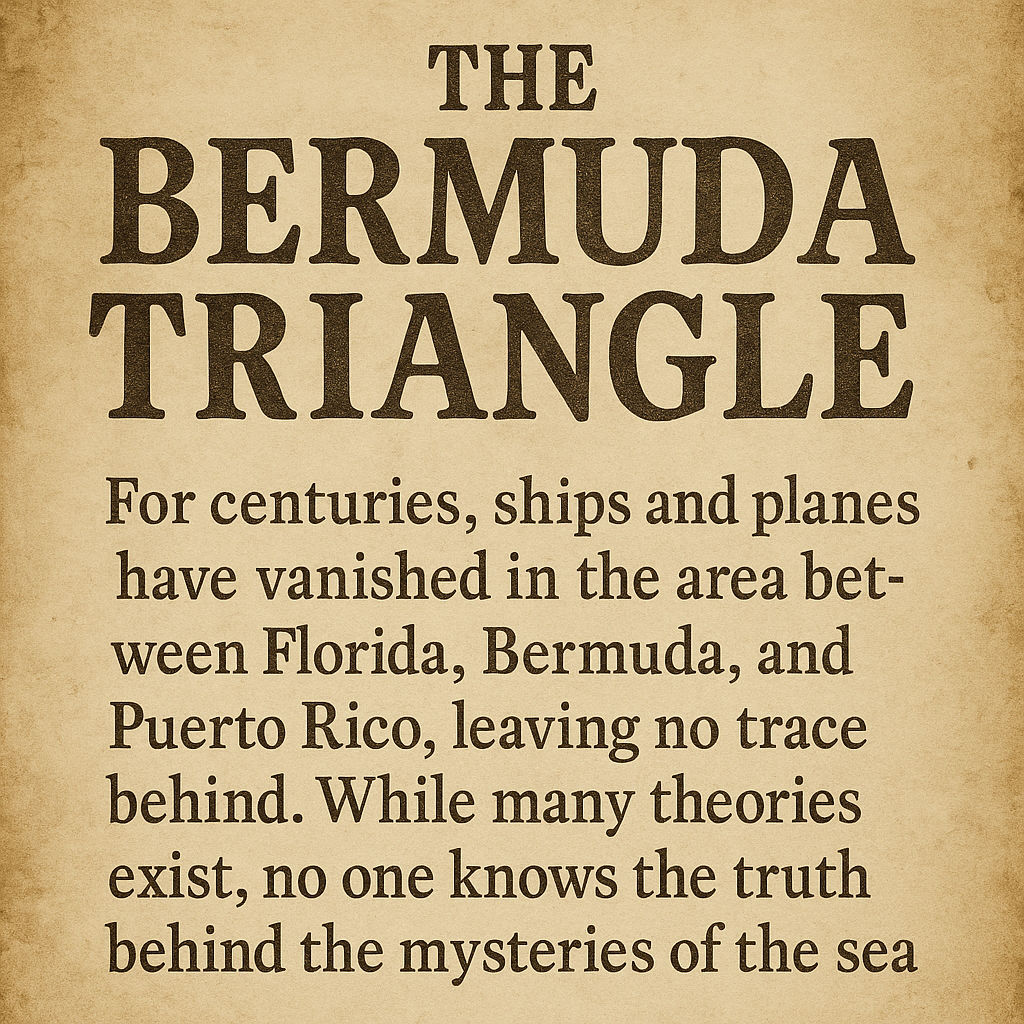
The Bermuda Triangle is a loosely defined region in the Atlantic Ocean bordered by Miami, Bermuda, and Puerto Rico. Depending on who is describing it, the area covers between 500,000 and 1.5 million square miles of ocean.
It is one of the busiest maritime and flight corridors in the world. Cargo ships, cruise liners, military aircraft, and commercial planes travel through it every single day.
Most complete their journeys without incident.
But over the years, enough strange disappearances happened inside this region that people began to believe there was something different about it.
The legend grew larger in the mid-20th century after magazines and books started collecting stories about ships and aircraft that had vanished under unusual circumstances. Some cases had reasonable explanations. Others did not.
And once the Bermuda Triangle entered pop culture, it became something bigger than geography.
It became a symbol of the unknown.
The First Strange Reports
Long before the phrase “Bermuda Triangle” existed, sailors crossing the Atlantic told stories about strange lights, sudden storms, and navigational problems in the area.
One of the earliest accounts came from Christopher Columbus during his 1492 voyage across the Atlantic. According to his journal entries, Columbus and his crew observed unusual lights in the distance and noticed strange compass readings while traveling through the region.
Modern historians believe there are likely scientific explanations for those events. Compasses naturally shift depending on geographic location, and atmospheric conditions can create unusual lights over the ocean.
But at the time, sailors interpreted such things very differently.
To people crossing enormous oceans in wooden ships, the sea already felt alive and unpredictable. Any strange event could quickly become part of a larger superstition.
And over centuries, those stories accumulated.
Flight 19: The Disappearance That Changed Everything
If one event truly created the Bermuda Triangle legend, it was the disappearance of Flight 19 in December 1945.
That afternoon, five U.S. Navy TBM Avenger torpedo bombers departed from Fort Lauderdale, Florida, on a routine training exercise. The mission was supposed to be simple. The pilots would complete navigation drills and return home within a few hours.
The weather initially appeared normal.
Leading the squadron was Lieutenant Charles Taylor, an experienced pilot with hundreds of flight hours. The crews expected an ordinary day.
Then the radio transmissions began changing.
About ninety minutes into the flight, Taylor contacted ground control sounding confused. He reported that both of his compasses were malfunctioning and that he was no longer certain of his location.
At first, controllers assumed the pilots had simply become disoriented.
But the situation worsened.
Radio operators heard increasing panic from the squadron as the pilots struggled to identify landmarks below them. One transmission reportedly included the chilling statement:
“We can’t tell where we are… everything looks wrong.”
As daylight faded, the pilots became increasingly lost over open water.
Then radio contact disappeared entirely.
The Navy launched an enormous search operation involving aircraft and ships. During that search, another plane — a PBM Mariner rescue aircraft carrying thirteen men — also vanished after takeoff.
No confirmed wreckage from Flight 19 was ever recovered.
The Navy’s final report listed the cause of the disappearance as “unknown.”
That single word helped fuel decades of speculation.
🔎 Related Mystery Power Posts:
What Most Likely Happened to Flight 19
Today, many aviation historians believe Flight 19 was likely the result of navigational confusion combined with worsening weather and fuel exhaustion.
Investigators think Lieutenant Taylor mistakenly believed the squadron was flying over the Florida Keys when they were actually over the Bahamas. That error may have caused the pilots to head farther out into the Atlantic instead of back toward Florida.
Once darkness arrived and fuel ran low, the planes likely crashed into rough ocean waters.
That explanation makes logical sense.
But there’s still one detail that keeps the mystery alive:
Almost nothing was ever found.
No major debris field. No confirmed aircraft remains. No closure for the families.
And when the ocean keeps its secrets, speculation grows.
The USS Cyclops: One of the Largest Naval Disappearances Ever
Long before Flight 19, another disappearance shocked the United States Navy.
In March 1918, the USS Cyclops departed Barbados carrying more than 300 crew members and passengers along with thousands of tons of manganese ore.
The Cyclops was massive for its time — over 500 feet long and considered one of the Navy’s largest fuel ships.
It never arrived at its destination.
No distress call was received. No wreckage was discovered. No confirmed explanation was ever established.
To this day, the loss of the USS Cyclops remains one of the largest non-combat losses of life in U.S. Naval history.
Several theories have been proposed over the years.
Some researchers believe the ship may have become structurally unstable because of its heavy cargo load. Others suspect severe weather or a rogue wave may have caused the vessel to capsize quickly before the crew could send an SOS signal.
There were even rumors of German submarine attacks during World War I, although no evidence ever confirmed that theory.
The unsettling part is not necessarily that the Cyclops sank.
Ships sink all the time.
The unsettling part is that a vessel carrying more than 300 people disappeared so completely that investigators were left with almost nothing to study.
The Ghost Ship Carroll A. Deering
In 1921, another strange maritime case added fuel to the Bermuda Triangle legend.
The Carroll A. Deering, a five-masted commercial schooner, was discovered grounded near North Carolina. At first glance, the ship appeared mostly intact.
But the crew was gone.
The lifeboats were missing. Personal belongings had been left behind. Food was reportedly still prepared in parts of the ship.
It looked as though the crew had abandoned the vessel suddenly.
Investigators considered multiple possibilities including piracy, mutiny, storms, or mechanical problems. But no definitive answer was ever proven.
Cases like this helped cement the idea that something unusual happened in this region of the Atlantic.
Not because there was proof of supernatural activity.
But because abandoned ships with missing crews naturally trigger the imagination.
What Makes Sense About the Bermuda Triangle
One reason the Bermuda Triangle debate continues is because there actually are several logical explanations for why accidents happen there.
The Weather Can Change Extremely Fast
The region is known for sudden tropical storms, hurricanes, and dangerous weather systems. Massive waves can form quickly, especially during hurricane season.
Microbursts — sudden downward blasts of air — can create violent conditions capable of overwhelming both aircraft and ships.
The Ocean Is Deep and Difficult to Search
Large portions of the Atlantic floor inside the Triangle are incredibly deep. If a plane crashes or a ship sinks, wreckage may descend thousands of feet and become extremely difficult to locate.
Ocean currents can also scatter debris over huge distances.
Human Error Plays a Huge Role
Many historical disappearances occurred before modern GPS and satellite communication existed. Navigational mistakes over open water were far more common in earlier decades.
A small error in direction could quickly become deadly.
Heavy Traffic Means More Accidents
Millions of ships and aircraft have passed through the Bermuda Triangle over the years. Some researchers argue the number of disappearances is not statistically unusual compared to other heavily traveled parts of the ocean.
That explanation frustrates conspiracy believers, but it matters.
Because sometimes a mystery feels larger simply because people keep focusing on it.
What Still Doesn’t Fully Add Up
Even with rational explanations, certain details continue bothering investigators and historians.
Why were some distress calls never sent?
Why was so little wreckage recovered in some major cases?
Why do so many survivors describe sudden confusion, compass problems, or strange weather changes?
Some experts believe those reports may be exaggerated over time. Others point out that memory becomes unreliable during traumatic situations.
Still, a handful of cases remain difficult to explain completely.
And those unresolved gaps are exactly what keep the Bermuda Triangle alive in popular culture.
Theories That Refuse to Die
Once a mystery captures the public imagination, theories begin multiplying.
Some people believe underwater methane gas eruptions may temporarily reduce water density enough to sink ships rapidly.
Others point to magnetic anomalies that could interfere with navigation systems.
Then there are the more extreme theories.
Alien abductions.
Underwater UFO bases.
Time warps.
The lost civilization of Atlantis using ancient technology beneath the sea.
Most scientists dismiss these ideas entirely because there is no reliable evidence supporting them.
But mystery stories survive because humans naturally search for extraordinary explanations when ordinary answers feel incomplete.
And the Bermuda Triangle is filled with incomplete answers.
Why the Legend Still Exists Today
The Bermuda Triangle continues surviving for one simple reason:
It combines two fears humans have carried for centuries.
The fear of the unknown.
And the fear of the ocean.
The sea can look calm one moment and deadly the next. It hides wrecks, storms, and entire histories beneath miles of darkness. Even with modern technology, large parts of Earth’s oceans remain poorly explored.
That uncertainty leaves room for imagination.
And once stories of vanished planes and missing ships entered books, documentaries, podcasts, and movies, the legend became permanent.
Today, most experts do not believe the Bermuda Triangle is a supernatural zone.
But that does not mean every case has been solved.
Some disappearances still lack clear answers.
Some wrecks were never found.
Some crews were never recovered.
And whenever that happens, the mystery continues growing.
The Most Likely Truth
The most likely explanation for the Bermuda Triangle is not aliens, sea monsters, or portals through time.
It is a combination of dangerous weather, unpredictable seas, navigational mistakes, strong currents, and the enormous difficulty of recovering evidence in deep ocean water.
In other words, the Bermuda Triangle is probably not cursed.
But it is absolutely capable of killing people.
And when tragedies happen in places where evidence disappears easily, legends thrive.
Closing Thoughts
Every year, planes still cross the Bermuda Triangle.
Ships still pass through its waters.
Tourists still sail across it without even thinking about the stories below them.
Yet the legend refuses to disappear.
Because somewhere deep in human nature is the uncomfortable realization that no matter how advanced technology becomes, parts of this world remain beyond our complete understanding.
The Bermuda Triangle reminds people that the ocean does not care about radar, engines, or confidence.
Sometimes it simply takes things.
And never gives them back.
Frequently Asked Questions About the Bermuda Triangle
Is the Bermuda Triangle a real place?
Yes. The Bermuda Triangle refers to a region in the Atlantic Ocean between Miami, Bermuda, and Puerto Rico. However, its exact boundaries are loosely defined.How many ships and planes disappeared in the Bermuda Triangle?
There is no exact number, but dozens of disappearances and accidents have been associated with the region over the past century.What caused Flight 19 to disappear?
Most historians believe navigational confusion, weather conditions, and fuel exhaustion likely caused the loss of Flight 19 in 1945.Do scientists believe the Bermuda Triangle is supernatural?
Most scientists do not believe the area is supernatural and point to weather, ocean conditions, and human error as the main explanations.Why is the Bermuda Triangle still famous?
The mystery survives because several disappearances still lack complete explanations, allowing theories and speculation to continue decades later.🔎 If you found this Bermuda Triangle mystery interesting, the author suggests these real mysteries next:This story is part of our growing collection of strange real mysteries, disappearances, and unbelievable cases that continue to puzzle investigators and historians today. 👉 Explore more here: Bizarre & Unbelievable Stories
- Flight MH370 Disappearance — The Plane That Vanished Without a Trace
- Gone Between the Waves — The Modern Mystery of Vanishing Ships
- D.B. Cooper Mystery — The Man Who Hijacked a Plane and Vanished
- Mary Celeste Mystery — The Ghost Ship Found Adrift With No Crew
Watch This Story on YouTube
Prefer to watch? See the full story on our YouTube channel.