At first, the sound was so faint it almost felt imagined.
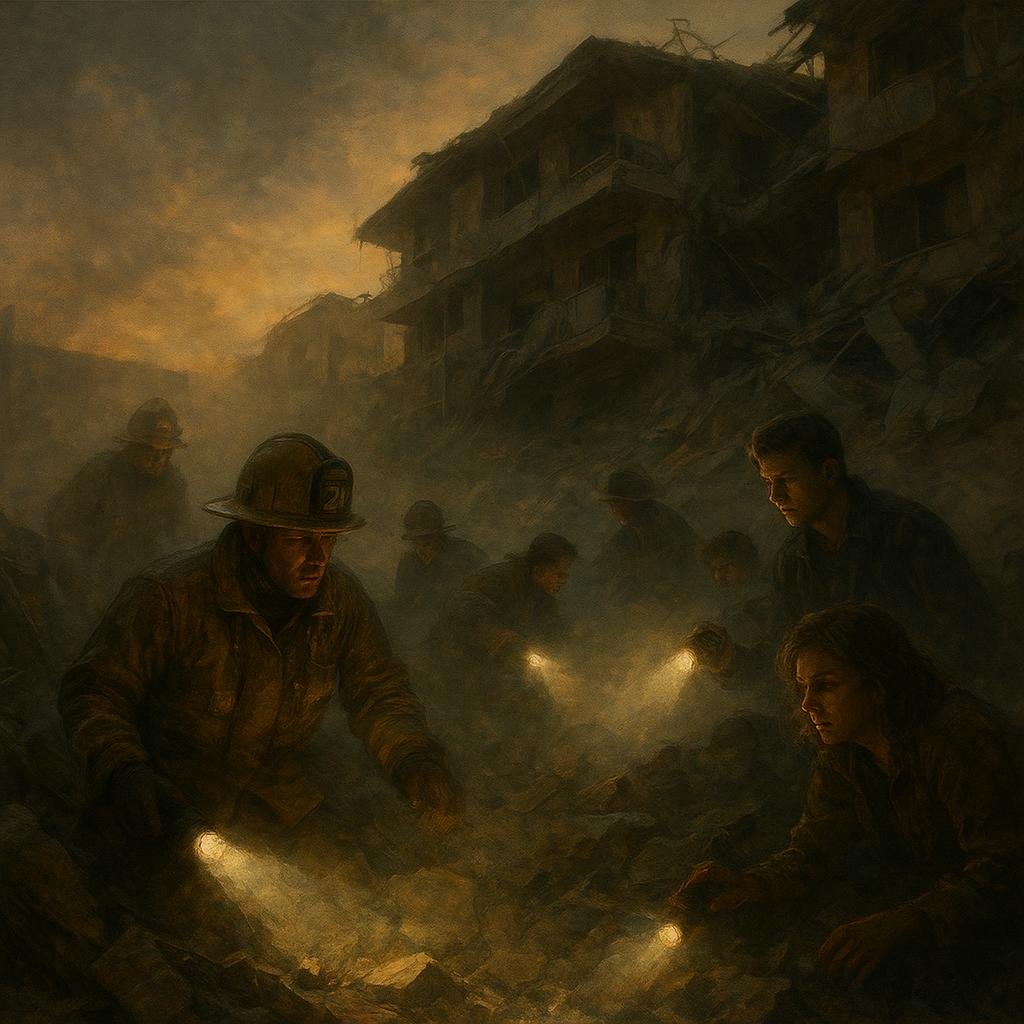
Rescuers were standing on a pile of broken concrete in Sylmar, California, less than a day after the 1971 San Fernando earthquake, when someone lifted a hand and told everyone to stop. The collapsed apartment building beneath them looked finished. Floors had folded into each other. Stairwells were crushed flat. Bed frames, pipes, and slabs were packed so tightly together that sunlight barely reached the spaces below.
Then it came again.
A knock. Weak. Deliberate. Human.
That sound turned the collapse from a graveyard into a race against time. Buried-alive survival stories often come down to one impossible moment like this—the second the people above realize the silence underneath them is not really silence at all. In Sylmar, that moment opened one of the most haunting rescue efforts of the earthquake.
The Sylmar earthquake survival story still matters because it was never only about a building falling down. It was about what happened after: trapped families, rescuers working by instinct and engineering, and the terrifying truth that survival can depend on a few inches of empty space and the strength to knock one more time.
The Morning Everything Broke
Before dawn on February 9, 1971, the San Fernando Valley was still half asleep. Kitchen lights were just beginning to come on. Early-shift workers were getting dressed. Children were still in bed. Inside an apartment building near Foothill Boulevard, people were doing the ordinary things that only feel sacred after disaster—checking the time, reaching for shoes, rolling deeper into a blanket.
At 6:00 a.m., the ground hit hard.
The San Fernando earthquake measured 6.6, and because the epicenter was so close, there was almost no warning. Residents later described it as a violent sideways snap followed by a roar that seemed to come from everywhere at once. Concrete groaned. Steel screamed. Glass burst outward. Walls split. Floors dropped.
Inside the apartment building, anyone who tried to run was thrown down before reaching a door. Hallways cracked. Stairwells twisted. Then sections of the structure pancaked into themselves, compressing bedrooms, corridors, and kitchens into a jagged stack of concrete and splintered framing.
When the main shaking stopped, screaming replaced it. Neighbors ran outside barefoot, coated in dust, shouting names into the dark. Gas hissed. Car alarms went off. The building that had stood there minutes earlier was now a ruin of broken slabs and exposed walls, and people were still inside.
The first rescuers were not professionals. They were neighbors. Men clawed at debris with bleeding hands. Women passed bricks into growing piles in the street. Teenagers crawled into gaps too narrow for adults. They dug because waiting felt worse than danger.
By sunrise, police, fire crews, paramedics, and engineers had begun arriving across Sylmar. But the scale of the quake was already overwhelming. Hospitals were damaged. Freeway structures had failed. Calls for trapped victims were coming from every direction.
At the apartment ruins, one hope kept the teams working: maybe there were air pockets. Maybe somebody below was still alive. Maybe, if the noise stopped long enough, the building would answer.
Timeline of the Sylmar Rescue
- 6:00 a.m., February 9, 1971: The San Fernando earthquake strikes, collapsing apartment buildings and damaging hospitals, homes, and major infrastructure.
- Minutes later: Neighbors begin pulling people from the outer edges of the rubble before full rescue teams arrive.
- Morning, Day 1: Firefighters repeatedly stop machinery to listen for movement and tapping beneath the debris.
- Later that morning: Faint knocking is detected under a crushed section of the building, confirming survivors are still inside.
- Day 1 into Night 1: Crews stabilize the debris, pass water into a narrow void, and work to widen access without collapsing it.
- Around dawn on Day 2: A trapped child is reached and brought out alive after an extremely slow extraction.
- Following days: Additional trapped residents are found as crews continue working through aftershocks, exhaustion, and unstable rubble.
- Aftermath: The quake helps expose serious structural weaknesses and becomes part of California’s wider building-safety reckoning.
The Knock Under the Ruins
Collapse rescues are not constant motion. They are noise followed by silence. Teams cut for a few minutes, then stop. They kneel. They listen. That is how the breakthrough came in Sylmar.
Near what had once been an upper-floor section of the apartment building, firefighters thought they heard a faint tapping sound. At first it could have been settling debris. Then it came again—short, uneven, but deliberate enough to freeze everyone in place.
The mood on the pile changed instantly. Heavy machinery became dangerous. Cutting too fast could kill the very people they had just discovered. But moving too slowly invited dehydration, shock, and suffocation.
Crews marked the area and shifted to hand tools where they could. Engineers studied the weight of the slabs above the suspected void. Firefighters laid shoring and crawled over unstable concrete to peer into narrow seams. Eventually they opened a line of communication.
The first voice that came back was weak, dusty, and hoarse.
There was more than one person inside.
That made everything harder. One trapped resident might be close to the opening. Others could be pinned deeper behind collapsed furniture, beams, or broken walls. Medics shouted questions through the gap: How many of you are there? Is anyone bleeding badly? Can anyone move?
One answer hit the rescue teams especially hard: there was a child in the void.
Now the entire scene changed shape emotionally. Families behind barricades heard updates only in fragments, but the rescuers working the hole could hear how tired the voices below were becoming. Water was passed in through tubing in tiny amounts. Every aftershock sent more dust down. Every cut through metal or concrete had to be measured against the risk of bringing the pocket down on the people still alive inside it.
What Doesn’t Add Up Until You Picture the Void
From the outside, the collapse looked unsurvivable. That is part of what makes the story so hard to shake. Buildings that pancake this way do not seem like places where anyone could remain alive for long.
- Survival depended on geometry: A fallen beam, reinforced wall, or piece of heavy furniture can create a tiny triangular space that keeps a person from being crushed outright.
- Silence was misleading: Survivors were often too weak to shout continuously, which meant rescuers had to work on the assumption that quiet did not equal death.
- Speed was not always the answer: In a collapse, reckless digging can be deadlier than delay. The teams had to go slowly enough to keep the void intact.
- Contact mattered: Even minimal communication helped rescuers judge where survivors were and whether they could safely shift the debris.
That is why the case belongs so naturally beside the site’s broader disaster survival stories. The haunting part is not only that people were buried. It is that survival depended on tiny details that could easily have gone the other way.
The Child Rescuers Could Not Leave Behind
One trapped woman was eventually reached first. She had been pinned in darkness for hours, coated in dust, surviving in a space too small to stand in. When rescuers freed her and pulled her into the open, the relief on the pile was immediate—but incomplete.
Her child was still inside.
The boy was deeper in the void, pinned beneath debris that could not simply be ripped away. Crews had to shift weight slowly, using controlled lifting and careful cutting. A firefighter reportedly crawled inward so tightly that even breathing had to be managed. In spaces like that, every inch feels borrowed.
When they reached the child, he was still alive.
That detail is what gives the story its staying power. In the middle of a collapse that looked final from the street, a child was still there in the dark, waiting for the voices above him to get closer. Other buried-survivor cases carry that same emotional force—stories like Reshma Begum’s rescue from rubble after 17 days—but Sylmar has a special kind of immediacy because everything unfolded so close to home, in the first light of morning, under a clock everyone could feel running out.
Near dawn, after hours of cutting, bracing, reaching, and waiting, the boy was brought out alive.
People cried, but not because the moment felt simple. It did not. A rescue like that never erases the dead. It only proves that life is still somewhere inside the wreckage, which makes the next silent pocket even harder to face.
Why the Story Still Lingers
The Sylmar rescue did not end with one survivor. Over the following days, teams kept working through a brutal pattern: hope, then silence; another sound, then another risky tunnel; one life saved, then another area yielding nothing back.
By then the whole region looked altered. Streets were split. Buildings leaned. Hospitals were damaged. The quake helped force California to confront hard truths about structural weakness and emergency planning.
But what stayed with people was not policy language. It was sensory memory. Dust in the throat. Rebar jutting from concrete. A rescuer talking into a crack because he believed someone below could still hear him. A family standing in the cold because leaving would feel like giving up.
That is why this case still gets attention. It does not read like a neat inspirational story. It feels raw and claustrophobic, more like a documentary rescue clock than a polished tale of triumph. The central image never really lets go: a ruined building, a silent pile of debris, and then a faint knocking from somewhere underneath.
Life answering back.
FAQ
What happened in the Sylmar earthquake survival story?
During the 1971 San Fernando earthquake, an apartment building in Sylmar collapsed and trapped residents under layers of concrete and debris. Rescue teams, along with neighbors who started digging immediately, located survivors by listening for faint knocking and then carefully extracting them from narrow air pockets.
How long were people trapped under the ruins in Sylmar?
Some survivors were reached within the first day, while others were reportedly found after much longer periods under the rubble. The rescue effort stretched across multiple days because crews had to move slowly enough to avoid collapsing the remaining voids.
Why is the “knock under the ruins” part so important?
Because that faint knocking was the proof that people were still alive beneath what looked like a total collapse. In buried-survivor rescues, a small sound can completely change strategy, turning a recovery scene into a precision rescue.
Why does the Sylmar earthquake case still get attention today?
It stays with people because it combines a devastating quake, trapped families, a child rescue, and the unforgettable image of life signaling back from beneath the debris. It also became part of a larger reckoning over how vulnerable buildings and communities were to seismic collapse.
🔎 If this story stayed with you, the author suggests these real cases next:
- Real rescues where the only sign of life was a knock, scrape, or whisper under the debris
- Disaster survival stories where ordinary mornings turned into rescue clocks
- The garment worker who stayed alive beneath rubble for 17 days
- A wider archive of buried survivors, ocean ordeals, crashes, and impossible escapes
Explore more Survival Stories here: