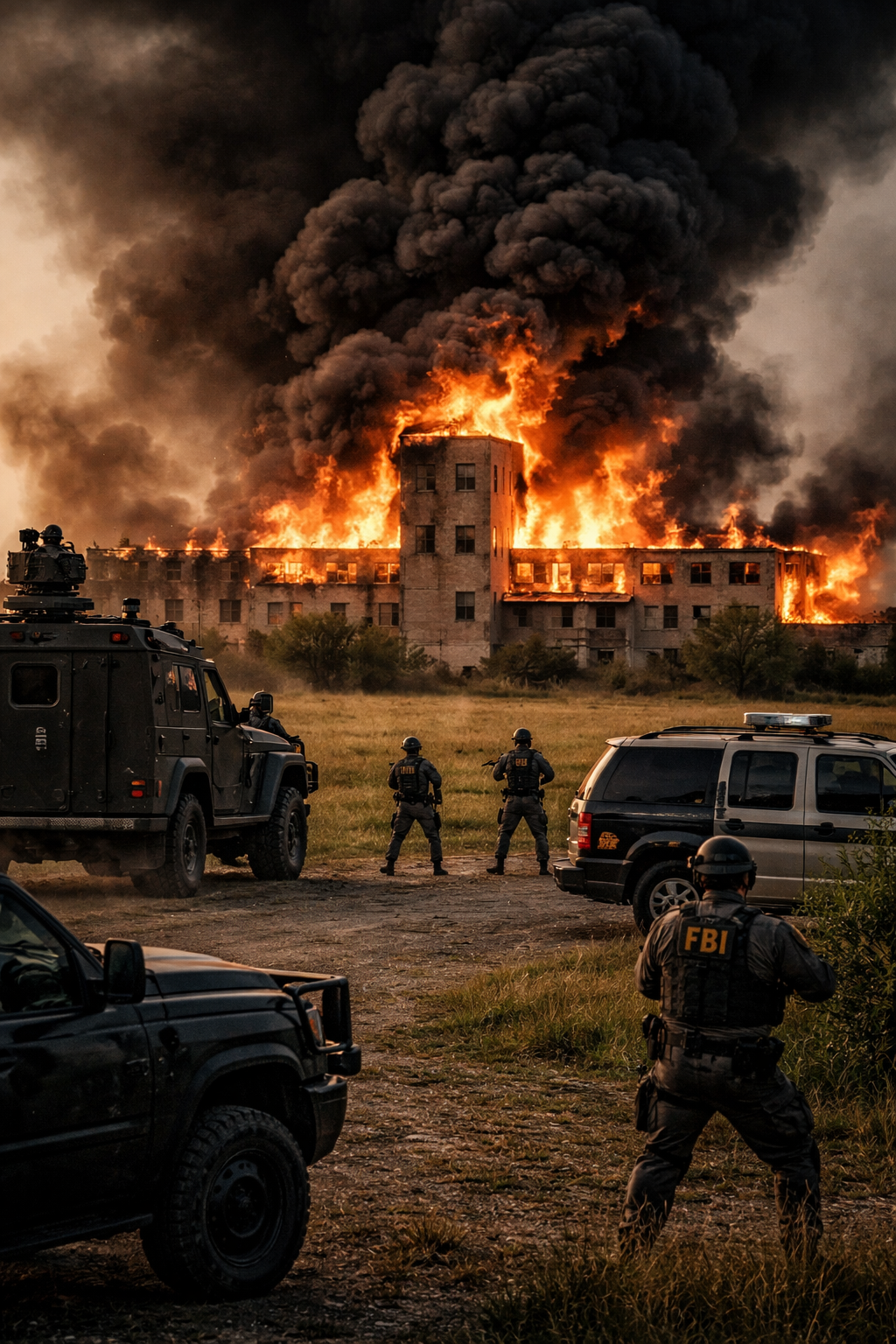
By the time the sun came up over the Texas fields on February 28, 1993, the road to Mount Carmel no longer looked like the approach to a quiet religious community. Trucks rolled in. Agents moved fast. Somewhere inside the long, battered building at the end of that dirt road, people were waking up to another ordinary morning. Then the shooting started, and in a matter of minutes, the place had become the center of one of the most disputed sieges in modern American history.
The Waco siege was the 51-day standoff between federal agents and the Branch Davidians, a religious sect led by David Koresh outside Waco, Texas. What began as an ATF raid over alleged weapons violations turned into a national spectacle about belief, force, fear, and government decisions that are still debated more than three decades later.
It belongs to the same grim lineage as other doomsday cults that ended in death, but Waco stands apart because the final catastrophe unfolded under direct federal siege instead of inside a sealed world no one could see.
It also sits in a larger pattern of closed worlds that collapsed under pressure, much like NXIVM’s hidden system of control, where outsiders saw manipulation long before many followers did.
The world David Koresh built at Mount Carmel
Long before armored vehicles arrived, Mount Carmel had already become a place set apart from ordinary life. The Branch Davidians were rooted in an offshoot of Seventh-day Adventist belief, but under David Koresh, the group became something more intense, more isolated, and more dangerous. Koresh did not present himself as a simple preacher. He presented himself as the man chosen to unlock prophecy.
Followers listened as he moved through scripture in long, winding sessions that made him sound less like a pastor and more like the only person with the map to the end of the world. He taught that violent confrontation was not just possible but foretold. He also consolidated power inside the community in deeply personal ways, controlling relationships, authority, and the emotional atmosphere of daily life.
To the people inside Mount Carmel, life could still feel ordinary in pieces. There were shared meals, chores, children, and long stretches of waiting. But the emotional center of the compound belonged to Koresh. He gave meaning to hardship. He explained away contradiction. He made pressure feel like proof.
That mattered later, because when federal agents closed in, many followers did not see the outside world as rescuers or law enforcement. They saw the very confrontation Koresh had warned them about.
The raid that turned into a war zone
The ATF had been investigating the Branch Davidians over allegations that the group was illegally modifying weapons and stockpiling arms. By late February 1993, agents planned a raid they believed would secure the compound quickly. Instead, the operation unraveled almost as soon as it began.
Accounts still diverge on the most explosive question: who fired first. That uncertainty has haunted the case ever since. What is not disputed is how fast the morning collapsed. Gunfire broke out almost immediately. Windows shattered. Agents were pinned down. People inside the compound scrambled for cover as bullets tore through walls and rooms that had been, only moments earlier, part of a secluded religious routine.
By the end of the first exchange, four ATF agents were dead. Six Branch Davidians were also killed. The planned raid was over, and something far more volatile had taken its place. What should have lasted minutes became a siege that would last 51 days.
How the standoff hardened on both sides
After the failed raid, the FBI took over. Negotiators opened phone lines with Koresh. Tactical teams surrounded the compound. And from that point on, every move by either side made peaceful resolution harder.
There were moments that looked hopeful. Some children were released early in the siege. Koresh sometimes sounded cooperative, even measured, on the phone. He made promises that suggested surrender might still happen. But those moments kept dissolving. Scripture, prophecy, delay, and shifting conditions repeatedly interrupted negotiations.
Outside Mount Carmel, agents tightened pressure. Power was cut. Loud noises were used at night. Armored vehicles moved closer. The idea was to weaken resistance and force movement. But inside the compound, the pressure often worked in the opposite direction. It strengthened the siege mentality Koresh had already built. If he had told his followers that hostile forces would come, then each helicopter pass, each floodlight, each engine rumble seemed to confirm his authority.
That is one of the reasons Waco still feels so grim in hindsight. Both sides were responding to the same reality through completely different logic. Federal agents saw a barricaded armed group led by a manipulative man. Many inside Mount Carmel saw prophecy unfolding in real time. Once those two realities locked together, every day made the ending more fragile.
Timeline of the Waco siege
- 1980s: Vernon Howell, later known as David Koresh, rises inside the Branch Davidian movement and takes control at Mount Carmel.
- Early 1990s: Federal authorities investigate the group over alleged weapons violations and reports of abuse.
- February 28, 1993: ATF agents raid Mount Carmel. A gun battle leaves four agents and six Branch Davidians dead.
- March 1993: The FBI assumes control. Negotiations continue while the compound remains surrounded.
- During the siege: Some children leave the compound, but promised surrenders repeatedly stall.
- April 19, 1993: The FBI begins a final operation using armored vehicles and tear gas.
- Later that morning: Fires break out inside Mount Carmel. The building is destroyed.
- Aftermath: More than 70 Branch Davidians die, including David Koresh and many children.
The final assault and the fire that defined everything
On April 19, after weeks of stalemate, the FBI launched its final operation. The plan was to insert tear gas into the compound using armored vehicles and force the people inside to come out. Officials later argued that the move was meant to end the siege without a direct firefight. Critics have spent decades asking whether that confidence was disastrously misplaced.
For hours, vehicles punched openings into the structure and delivered gas. But the hoped-for surrender never came. Then the fires started.
Smoke rose from multiple points. Within minutes, the building was burning hard. The structure itself helped doom the people inside: wood, narrow spaces, confusion, collapse, heat, choking smoke. The image of Mount Carmel going up in flames became the permanent visual symbol of Waco, but the image alone never explained what happened.
Some people escaped. Most did not. When the fire was over, more than 70 Branch Davidians were dead, including children and David Koresh himself. The compound that had been framed for weeks as a place of prophecy, resistance, and fear ended as a blackened ruin.
What doesn’t add up about Waco
Waco never settled into a clean historical conclusion because too many of its key questions remain bitterly contested.
- Who fired first during the raid? Competing accounts shaped public trust from the very beginning.
- Did pressure tactics make a peaceful exit less likely? Sleep disruption, armored intimidation, and escalating force may have reinforced Koresh’s apocalyptic narrative.
- Who started the fires? Government investigations concluded the fires were set from inside, but critics still argue the final assault created conditions that made mass death almost inevitable.
- Could more time have changed the outcome? Koresh repeatedly delayed, but some negotiators believed continued dialogue still had a chance.
- Was the operation designed around law enforcement goals rather than the psychology of belief? That question may be the most unsettling of all.
The hardest truth in Waco is that a manipulative leader and an aggressive federal response can both be part of the story at the same time. Treating one side as entirely villainous and the other as entirely blameless makes the case easier to process, but less honest.
Why the case still pulls people back in
Waco remains magnetic because it touches several American fears at once. It is a cult story, but also a government story. It is about guns, prophecy, children, media spectacle, failed judgment, and a fire so catastrophic that no official explanation has ever quieted public suspicion.
It also changed the national imagination. Later extremist movements, anti-government groups, and conspiracy-minded communities repeatedly referenced Waco as proof that the state could become a mortal threat. In that sense, the siege did not end when Mount Carmel burned. It kept echoing outward into politics, militia culture, and public distrust, much like other scandals explored in government conspiracies that turned out to be real.
But there is another reason the story endures: the human scale of the tragedy. Behind the arguments were people who had surrendered their judgment to a leader they believed had divine authority. There were children trapped inside adult conviction. There were agents who walked into chaos believing they were executing a plan. And there was a country watching live, realizing too late that this was not going to end cleanly.
That is why Waco still feels less like a closed case than a wound. The facts exist. The footage exists. The reports exist. And yet the event resists tidy explanation because it sits at the point where certainty failed everyone in the room.
FAQ
What happened at Waco?
The Waco siege began with an ATF raid on the Branch Davidian compound near Waco, Texas, on February 28, 1993. After a deadly gun battle, the FBI surrounded the compound for 51 days. The standoff ended on April 19 when a final tear-gas operation was followed by a fire that destroyed Mount Carmel and killed more than 70 people.
Who were the Branch Davidians?
The Branch Davidians were a religious sect led by David Koresh at Mount Carmel. Under Koresh, the group became increasingly isolated and centered around his apocalyptic teachings and personal authority.
Did the government start the fire at Waco?
Official investigations concluded that the fires were started from inside the compound, but the government’s tactics remain heavily criticized. Many people still debate whether the final assault created the deadly conditions that made mass loss of life unavoidable.
Why is the Waco siege still controversial?
It remains controversial because of unresolved arguments over the first gunfire, the FBI’s pressure tactics, the decision to launch the final assault, and the fire itself. The case sits at the intersection of cult control, government force, and public distrust.
Why does Waco still get attention today?
Waco still gets attention because it feels bigger than one siege. It raises lasting questions about belief, authority, tactical judgment, and what happens when a closed religious world collides with armed state power under the eyes of the entire country.
Continue exploring:
- Disturbing cult cases where belief turned into catastrophe
- How NXIVM hid coercion behind self-improvement language
- The Manson world of control, paranoia, and murder
- Cases where the official story refused to stay settled
More Cults & Extremist Groups stories: