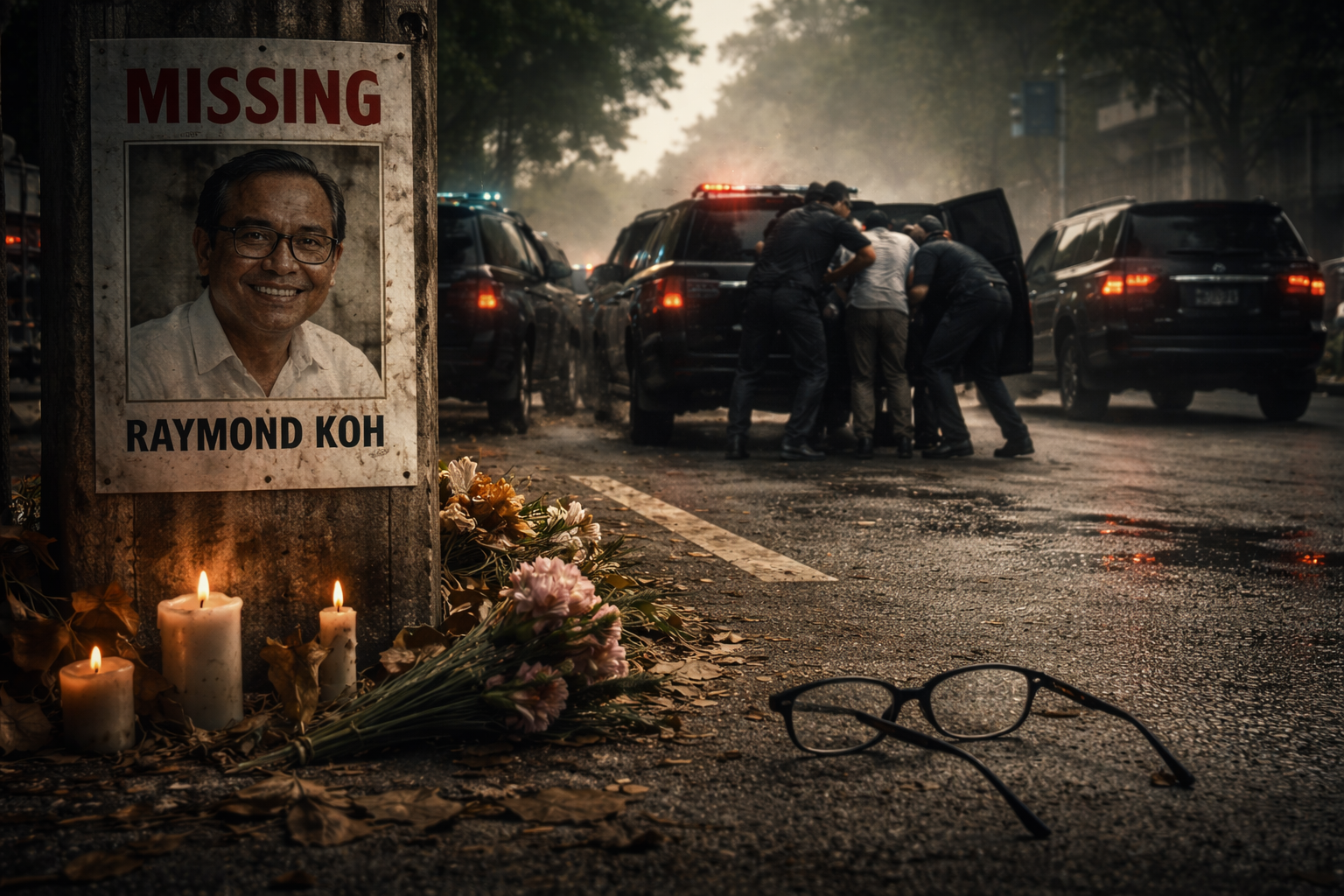
Traffic was moving normally that morning. Motorbikes slipped between cars. Sunlight hit the windshields. People were thinking about work, errands, lunch, the thousand small things that make a weekday feel forgettable. Then, in the space of a few seconds, a white car was boxed in at an intersection, doors opened, men moved with terrifying calm, and one man disappeared so neatly it almost looked official.
That is the image that still clings to the Raymond Koh case. Not chaos. Not panic. Precision.
Raymond Koh, a Malaysian pastor and activist, was abducted in broad daylight on February 13, 2017, in a case that was captured on CCTV and later became one of the country’s most disturbing disappearance cases. What makes the mystery so hard to shake is not just that he vanished, but that the operation looked planned, disciplined, and confident from the first second to the last.
Cases like this tend to stay with readers because the camera did not simply record a final sighting. It recorded the moment normal life broke apart. That is part of why stories in Disappearances Caught on Surveillance Footage: 9 Cases Where the Camera Recorded the Last Known Moment hit so hard: seeing the final known moments can make a mystery feel even colder, not clearer.
The Morning Raymond Koh Was Taken
By all outward appearances, February 13 should have been ordinary. Raymond Koh was driving through Petaling Jaya, Selangor, during daylight hours, on a road where other people were close enough to witness movement but not close enough to understand it in real time. Then several vehicles converged around him.
The footage later circulated widely because it did not look messy. It looked rehearsed. Cars blocked his path. Men got out quickly. Within moments, Koh was removed from his vehicle and taken away in another car. Then the convoy left. Traffic resumed. The road kept doing what roads do, as if nothing impossible had just happened in the middle of it.
That visual detail matters because most abductions people imagine are loud and frantic. This one appeared controlled. There were no obvious signs of a botched robbery, no ransom demand, and no immediate public explanation. For Raymond Koh’s family, that left only one terrible possibility: he had been deliberately taken.
Timeline of Events
- February 13, 2017: Raymond Koh is intercepted and abducted in broad daylight in a multi-vehicle operation caught on CCTV.
- Immediate aftermath: His family reports him missing and searches for answers, but there is no clear acknowledgment of an arrest and no known ransom demand.
- Public attention grows: The CCTV footage spreads and turns the disappearance into a national and international human-rights concern.
- Later inquiries and legal pressure: Human-rights investigators and advocates push the case forward as suspicions of official involvement deepen.
- 2025 court ruling: A Malaysian court concludes that police officers were responsible for abducting Raymond Koh, formally recognizing what the family had feared for years.
- What remains unresolved: Where he was taken, who ordered the operation, and what ultimately happened to him remain unanswered.
Who Raymond Koh Was Before the Disappearance
One reason the case never faded is that Raymond Koh was not a random name pulled from a headline and then forgotten. He was known in his community as a husband, father, pastor, and activist. People described him as someone who quietly helped people living at the edges of society: struggling families, people battling addiction, and others who were easy for the world to overlook.
That background matters because it shaped the way the disappearance was understood. Koh was not someone who simply dropped out of sight without leaving an emotional crater behind him. He had routines, responsibilities, and relationships. He was visible in the deep, ordinary way people become visible when they spend years showing up for others. When a person like that vanishes in the middle of a normal morning, the silence that follows does not feel accidental. It feels imposed.
His family did what families always do in the first terrible hours: they assumed there had to be an explanation. A detention. A mistake. Some bureaucratic confusion that would soon be corrected. But time kept moving and the explanation never arrived.
What Doesn’t Add Up
- The operation was too coordinated to feel random. Multiple vehicles, rapid movement, and daylight timing suggested planning and confidence.
- The setting was unusually public. If the goal had been simple criminal opportunism, the busy street and camera exposure made little sense.
- No clear ordinary motive emerged. There was no public trail pointing cleanly to robbery, ransom, or a spontaneous street crime.
- The footage created evidence without resolution. The camera showed the seizure, but it did not answer who ordered it, where Koh was taken, or what happened next.
- The family faced denial without clarity. The absence of a straightforward arrest record or clear official acknowledgment only deepened suspicion.
That last point may be the most haunting. In many mysteries, there is no image at all. Here, there was an image, and that image only sharpened the fear that this was something larger than a single unexplained crime.
The CCTV Footage Changed Everything
The Raymond Koh disappearance is often discussed alongside other modern cases where surveillance created a strange kind of false comfort. People assume footage should lead to answers. It should identify faces, confirm movements, lock down time, and force the truth into daylight. But sometimes the opposite happens. The camera proves something happened and still leaves the core of the story sealed shut.
That is what made this case so unnerving. The video did not capture confusion. It captured purpose. The men involved moved like people who expected the operation to work, and that impression shaped public suspicion from the beginning.
It also pushed Raymond Koh’s disappearance into a wider conversation about state power and public trust. A disappearance that appears organized at this level suggests not just violence, but confidence that the truth can be buried afterward.
Theories, Evidence, and Why Suspicion Kept Growing
Over time, the case stopped feeling like a single family tragedy and started to resemble a test of whether institutions would ever fully confront what the footage seemed to imply. Rights groups, advocates, and the family continued pressing for answers. The central questions remained brutally simple: Who took Raymond Koh? Who ordered it? Where was he taken? Was he still alive?
Those questions only became heavier as official denials collided with the visual evidence already in public view. In cases where the record is thin, uncertainty can scatter attention. In this case, the footage acted like a magnet. It kept dragging people back to the same conclusion: whatever happened here, it did not look accidental.
That pressure eventually led to findings that gave the family some measure of recognition, though not relief. A Malaysian court later ruled that police officers were responsible for the abduction. For the public, that was a stunning moment. For the family, it was something even more complicated. It confirmed the shape of the nightmare without ending it.
Why the 2025 Court Finding Mattered
There is a cruel difference between suspicion and acknowledgment. For years, Raymond Koh’s loved ones had to live inside that gap. They had the footage. They had the unanswered questions. They had the growing sense that this was not a normal disappearance. But suspicion, no matter how strong, still leaves families fighting to be believed.
The court ruling mattered because it moved the case out of the realm of whispered implication and into formal recognition. It said, in effect, that this was not simply a man who vanished. He was abducted. That distinction changed the moral weight of the story.
And still, the ruling did not return him. It did not explain where he went after those few seconds on camera. It did not map the chain of command. It did not answer the question every family trapped in a disappearance asks in the quietest part of the night: if he was taken, was he ever meant to come back?
Why This Case Still Gets Attention
- The abduction happened in daylight. That alone makes the case feel brazen and unforgettable.
- CCTV preserved the moment. People are haunted by mysteries where the final known scene can be watched.
- The case intersects with public distrust. When a disappearance appears coordinated, it raises fears bigger than one family’s loss.
- The legal acknowledgment came without full closure. Recognition of responsibility did not answer the deepest questions.
- The emotional wound is still open. There is no body, no confirmed final location, and no ending the family can truly live with.
That is why the story still belongs in larger archives of unresolved cases. It sits naturally beside What Happened After the Last Sighting? The Disappearance Cases Where One Witness, One Camera, or One Clue Changed Everything and the broader Unsolved Disappearances Archive, even though its category remains Unsolved Mysteries. The reason is simple: this case lives at the point where a final sighting becomes evidence, and evidence still fails to produce a human answer.
The Family’s Long Aftermath
One of the hardest truths about enforced disappearance cases is that they do not end cleanly. A murder case, awful as it is, at least gives grief a shape. A confirmed death allows mourning to become real. But disappearance suspends people in place. Family members keep living, but part of their life stays stuck in the last known moment.
For Raymond Koh’s family, that moment is not abstract. It exists in footage, in headlines, and in every unanswered demand for accountability. The uncertainty is relentless. Is he alive? Was he held somewhere? Did someone higher up give the order?
That is what gives the case its lasting chill. The road where he was taken did not look like the edge of the world. It looked like the middle of daily life, which is exactly what makes the disappearance so unforgettable.
FAQ
What happened to Raymond Koh?
Raymond Koh was abducted in broad daylight in Malaysia on February 13, 2017, during a coordinated multi-vehicle operation that was captured on CCTV. He has never been found, and his final fate remains unknown.
Is the Raymond Koh case still unsolved?
Yes. Even though a Malaysian court later ruled that police officers were responsible for abducting him, the case is still unresolved in the most important ways: where he was taken, what happened afterward, and whether anyone will ever fully account for it.
Why does the Raymond Koh disappearance still get attention?
It continues to draw attention because the abduction was caught on camera, happened in daylight, and appeared highly coordinated. The footage gave the public a clear glimpse of the event, but not the answers that should have followed.
Was Raymond Koh’s disappearance caught on surveillance footage?
Yes. CCTV footage showed multiple vehicles boxing in his car and men removing him in what looked like a fast, organized operation. That footage became one of the central reasons the case remained impossible to ignore.
Why is the Raymond Koh case considered so disturbing?
The case feels especially disturbing because it did not look chaotic or random. It looked controlled. That sense of precision, followed by years of uncertainty, is what gives the disappearance its lasting psychological weight.
🔎 If this story stayed with you, the author suggests these real cases next:
- Enter the wider archive of unsolved cases that still leave reality feeling slightly open
- Read the disappearance cases where the camera captured the last known moment
- Follow the cases where one witness, one camera, or one clue changed everything
- Keep digging through timelines, sightings, vehicles, and unresolved disappearances
Explore more Unsolved Mysteries stories here: