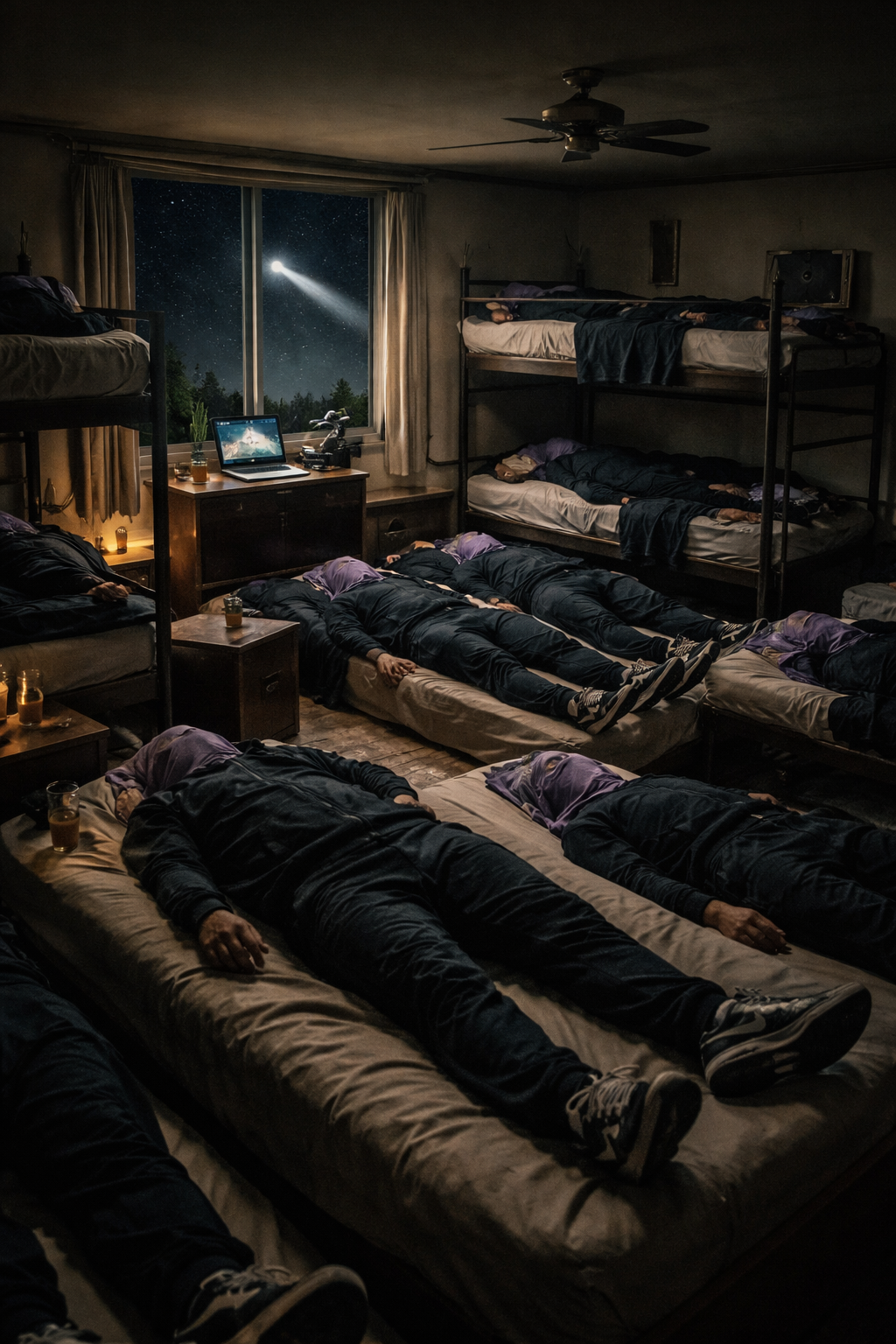
By the time the house went quiet, the decision had already hardened into ritual.
Inside the rented mansion in Rancho Santa Fe, the blinds were drawn, the rooms were clean, and the people moving through them were dressed almost exactly alike. Dark shirts. Dark sweatpants. Fresh sneakers. Purple shrouds folded and waiting. Outside, it looked like any wealthy Southern California home tucked behind landscaping and calm streets. Inside, 39 people believed they were standing at the edge of another world.
They were not waiting for death in the way outsiders would later describe it. They believed they were preparing for departure. Above them, Comet Hale-Bopp burned across the night sky. And somewhere behind it, they were told, a spacecraft was coming.
The Heaven’s Gate cult became one of the most infamous doomsday groups in modern history because its final act was not chaotic or sudden. It was organized, rehearsed, and built on years of belief shaped by Marshall Applewhite’s teachings about leaving Earth, shedding the human body, and ascending to what he called the Next Level.
That is part of why the story still unsettles people now. If you have ever fallen into other belief-driven catastrophes like Doomsday Cults That Ended in Death, Heaven’s Gate stands out because everything about the ending felt so calm.
The night the waiting finally seemed over
In March 1997, the group was living together in near-total separation from ordinary life. Members had already given up families, careers, money, and private identity. Many had new names. Their speech patterns had changed. Their routines were strict, almost monastic. Even desire itself was treated like a trap. Some male members underwent voluntary castration. The body was not something to honor or enjoy. It was a temporary vehicle, and vehicles were meant to be abandoned when the journey changed.
By then, Marshall Applewhite was no longer just a leader to his followers. He was an interpreter of reality. Years earlier, he and Bonnie Nettles had built the movement around a strange fusion of Christian prophecy, UFO theology, apocalyptic expectation, and total detachment from the human world. Nettles had died in 1985, a moment that should have shattered the prophecy. Instead, Applewhite reshaped the doctrine. Death did not disprove the path. It became part of it.
So when Hale-Bopp appeared, the comet did not feel like a random object in the sky. It felt like confirmation. Rumors had circulated that an object might be trailing behind it. To most people, that claim sat in the same category as late-night radio talk and internet-era speculation. To Heaven’s Gate, it felt like the long-awaited sign that their exit window had opened.
And once the sign arrived, everything in the house narrowed toward one point.
Members recorded farewell videos. They smiled in ways that feel almost impossible to watch now. They spoke softly, gratefully, with the strange peace of people who believed they had escaped confusion and finally reached clarity. They thanked Applewhite. They talked about joy. They described what they were doing as graduation.
That word matters. Graduation suggests progress, reward, arrival. It turns catastrophe into achievement. It makes an irreversible act sound like a ceremony.
How the ideology changed ordinary people
One of the most disturbing parts of the Heaven’s Gate story is that the group did not survive on constant panic. It survived on structure. Applewhite did not have to scream every hour. He built a closed system in which every doubt could be reinterpreted as weakness and every sacrifice could be recast as growth.
At the center of the belief system was a brutal but effective idea: the world you know is false, your instincts cannot be trusted, and the people outside the group are asleep. Once someone accepts that framework, almost anything can be explained away. Homesickness becomes attachment. Fear becomes human programming. Independent thought becomes failure.
That same pattern appears in other coercive groups, whether the manipulation is dressed in prophecy, therapy, or revolution. In NXIVM, control hid behind self-improvement language. In the Manson Family, belief became obedience and then violence. Heaven’s Gate took a different route. It stripped life down until the group itself became more real than the outside world.
Members lived together, worked together, ate together, and filtered reality through a leader who gave their lives cosmic meaning. The more they sacrificed, the harder it became to admit they had been misled. Every loss became another reason to keep going. By the time the final teachings focused on leaving Earth, many followers had already surrendered too much to turn back without destroying the only identity they had left.
Rancho Santa Fe, step by step
The final days were not a burst of frenzy. Investigators concluded the deaths happened in stages over several days. Small groups died first, and others remained alive long enough to clean the scene, cover bodies, and prepare the next group. That detail alone makes the case feel colder than most people expect. It was not a single chaotic collapse. It was a sequence.
Each member wore nearly identical clothing. Many had armbands that read “Heaven’s Gate Away Team.” In their pockets were bills and coins, small travel money for a journey that only made sense inside the belief system. Applesauce had been mixed with phenobarbital. Vodka helped it go down. Plastic bags were used as the final step.
When authorities entered the house on March 26, 1997, they found the bodies arranged with deliberate uniformity. Faces were covered with purple cloth. Beds and bunks were orderly. The scene was not violent in the messy, improvisational sense most people associate with panic. It looked prepared. That was the horror of it. The house held almost no sign of resistance because the resistance had been dismantled long before the final night arrived.
Even the farewell tapes deepen the unease. These were not rambling last words from people who seemed unsure. Many sounded composed and convinced. Applewhite himself had spent months delivering video messages in which he looked directly into the camera and spoke with unsettling certainty, as if he were announcing a timetable rather than leading human beings toward disaster.
Timeline of the Heaven’s Gate case
- Early 1970s: Marshall Applewhite and Bonnie Nettles begin attracting followers with teachings about transformation, extraterrestrial salvation, and leaving the human condition behind.
- Mid-1970s to 1980s: The group travels, recruits, and gradually becomes more isolated, asking members to abandon family ties, possessions, and ordinary identities.
- 1985: Bonnie Nettles dies, forcing a major doctrinal adjustment. Applewhite reframes death and continues leading the movement.
- 1990s: Heaven’s Gate becomes more controlled and inward-looking, with members living communally and treating the body as a disposable vehicle.
- March 1997: Comet Hale-Bopp appears in the sky, and the group interprets it as the sign that a spacecraft is near.
- March 22-26, 1997: Members die in carefully organized stages inside the Rancho Santa Fe house.
- March 26, 1997: Authorities discover 39 bodies, turning Heaven’s Gate into one of the most chilling cult tragedies in modern history.
What doesn’t add up from the outside
From the outside, the belief seems too bizarre to sustain. A spacecraft behind a comet. Human bodies as containers. Salvation through departure. It sounds like something that should collapse the moment it is spoken aloud.
But that reaction misses how closed belief systems actually work. People do not usually join at the ending. They join somewhere much earlier, when the ideas feel unusual but survivable, when the community feels warm, when the purpose feels clean, when the leader sounds certain and the world outside feels empty or hostile. The most extreme conclusion only works after years of smaller conclusions have already been accepted.
That is why Heaven’s Gate still gets discussed alongside cases like the Order of the Solar Temple. The details differ, but the emotional architecture is familiar: isolation, sacred language, an inner circle that believes it has seen through ordinary reality, and a leader or doctrine that transforms irreversible choices into spiritual necessity.
There is another reason the case remains so sticky in public memory. Heaven’s Gate arrived at the edge of the internet age. The group had a website. Their language survives online. Their images and farewell videos feel strangely modern, as if the story belongs not only to the 1990s but to the digital world that came after. It makes the case feel less buried in history and more uncomfortably accessible.
Why the story still feels so modern
Some cult stories feel sealed inside a different century. Heaven’s Gate does not. The aesthetics were clean, almost corporate. The members were not hiding in a jungle compound or a desert fortress. They were in suburban California, building websites, discussing extraterrestrial evolution, and folding themselves into a system that looked disciplined rather than visibly broken.
That modern surface matters because it disrupts the lazy myth that only obviously unstable people fall into extreme belief. Many followers had once lived ordinary, functional lives. What trapped them was not simple foolishness. It was belonging, certainty, repetition, sacrifice, and a doctrine that offered a total explanation for pain, confusion, and purpose.
And unlike stories where the final violence is directed outward, Heaven’s Gate leaves behind a quieter kind of dread. The group turned all that conviction inward. No frantic siege. No chaotic public showdown. Just a locked house, a comet crossing the sky, and a set of beliefs that had been sharpened for years until they left almost no room for reality to get back in.
That is why the case keeps resurfacing in documentaries, late-night rabbit holes, and larger roundups like Disturbing Cult Stories That Actually Happened. The ending is horrific, but the path toward it may be even more frightening. It shows how people can be trained to reinterpret surrender as transcendence.
In the end, Heaven’s Gate was not really about a comet. The comet was only the final symbol. The real engine was a closed world built piece by piece, until 39 people could look at the same sky as everyone else and believe they were seeing a doorway.
That is what lingers after the details fade. Not just the purple shrouds or the matching shoes or the eerie farewell tapes, but the realization that the house in Rancho Santa Fe was filled with people who thought they had finally found the truth. And because they believed that, almost nothing in the ordinary world could reach them anymore.
FAQ
What was Heaven’s Gate?
Heaven’s Gate was a religious UFO cult led by Marshall Applewhite and Bonnie Nettles. The group taught that Earth was a lower world, the human body was only a temporary vehicle, and loyal followers could ascend to a higher existence called the Next Level.
Why did Heaven’s Gate believe in Comet Hale-Bopp?
Members believed Hale-Bopp was linked to a spacecraft hidden behind the comet. To outsiders that claim sounded absurd, but inside the group it was treated as the long-awaited sign that their chance to leave Earth had finally arrived.
How many people died in the Heaven’s Gate case?
Thirty-nine people died in March 1997 inside the group’s rented house in Rancho Santa Fe, California, including leader Marshall Applewhite.
Why does the Heaven’s Gate story still get so much attention?
The case still draws attention because it feels both bizarre and modern. The farewell videos, the internet presence, the matching uniforms, and the calm, deliberate nature of the final act make it one of the most unsettling cult stories ever recorded.
Continue exploring:
- Other doomsday beliefs that ended in catastrophe
- The ritual ending of the Order of the Solar Temple
- How control hid behind the language of self-improvement in NXIVM
- When belief curdled into violence inside the Manson Family
More Cults & Extremist Groups stories: