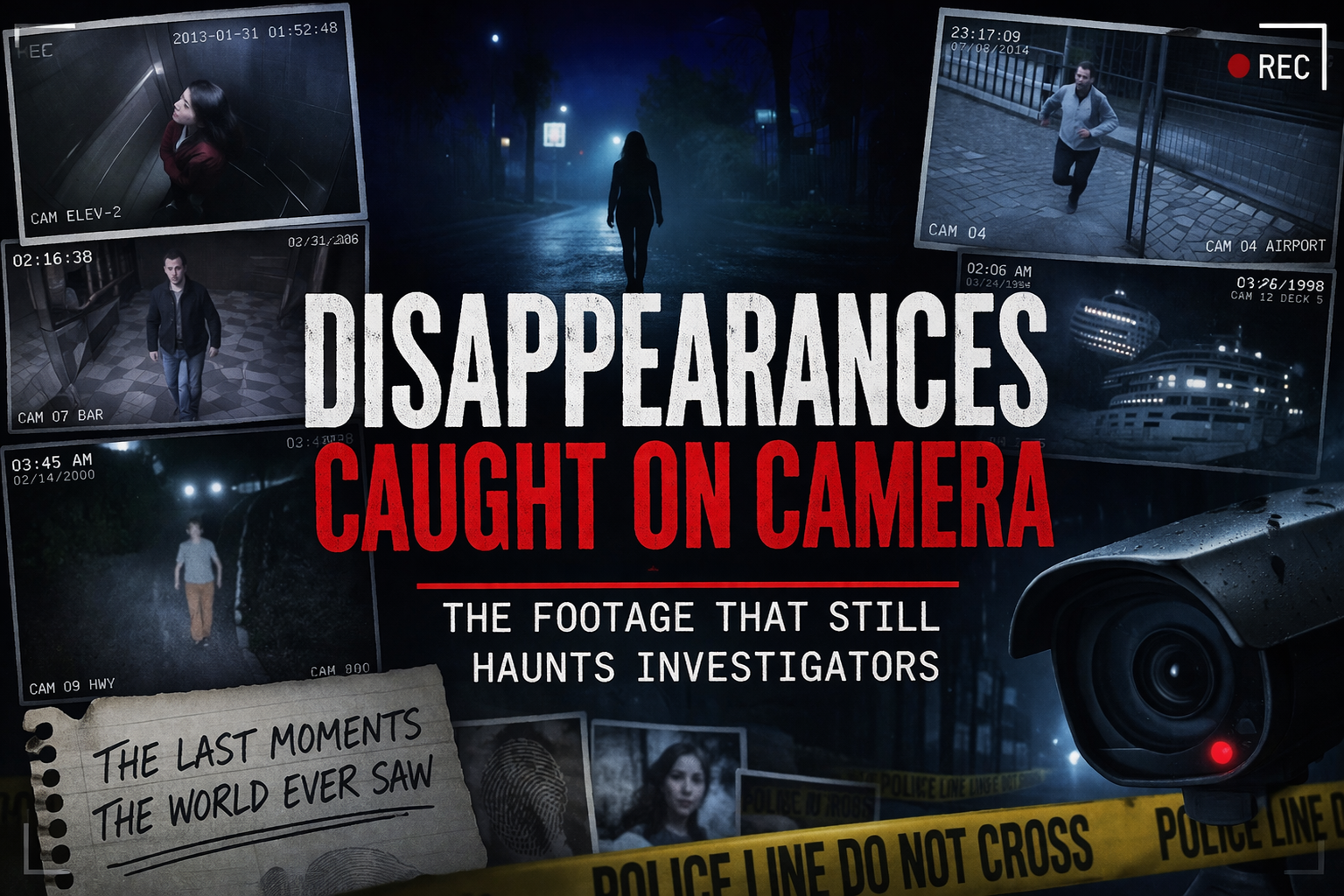
The camera is supposed to settle the argument. A lens doesn’t panic. It doesn’t forget. It doesn’t blink. So when a disappearance is captured in fragments—an elevator door closing, a man entering a bar, a tourist sprinting out of an airport, a figure crossing a parking lot—we expect the footage to do what witnesses and rumors cannot. We expect it to tell us what happened.
Instead, some of the most haunting disappearance cases on the internet work in reverse. The video exists. People replay it for years. Investigators slow it down, zoom in, and build timelines around it. And somehow the footage does not close the case. It widens it. It leaves behind missing minutes, blind spots, and one unbearable feeling: the answer may have passed through the frame, and still escaped.
These disappearances caught on camera remain some of the most searched unsolved cases because the footage feels so close to a solution. From the Lars Mittank disappearance to the elevator video in Elisa Lam’s final hours, these are the stories where surveillance, sightings, and recorded last-known moments only made the mystery more disturbing.
If this kind of evidence-driven mystery pulls you in, the broader Unsolved Disappearances Archive opens into even more cases where the trail should have held—and didn’t.
Airport footage, hotel cameras, and the false promise of being seen
There is something uniquely cruel about a disappearance with video attached to it. In other unsolved cases, families are left with silence. Here, they are left with motion. A final walk. A pause. A glance over the shoulder. A door opening and closing. The record feels tangible enough to solve, which is exactly why these stories become rabbit holes.
They also reveal a pattern. The camera rarely captures the answer itself. It captures the edge of the answer—the seconds before a person leaves the safe part of the map, the hallway before the wrong turn, the blind spot before the last trace goes dark. That pattern is what makes these cases so binge-worthy and so upsetting. Each one feels almost solvable, right up until it isn’t.
The airport cases: when the last image is a person moving fast
Few clips are as instantly unnerving as the footage tied to Lars Mittank. In 2014, the German tourist appeared on airport surveillance in Bulgaria behaving in a way that still feels abrupt and impossible to fully explain. He ran out of the terminal, climbed a fence, and disappeared into nearby terrain. It is the kind of footage that makes viewers believe the mystery begins to clear the moment the video starts. Instead, it does the opposite. It freezes the most dramatic part of the case while telling us almost nothing about what was happening inside his mind—or what waited beyond the fence.
That same unease hangs over newer disappearance coverage too. Cases like Hannah Kobayashi show why airport-linked vanishings grab people so hard. Airports are highly surveilled spaces. They are transitional by design, full of exits, strangers, and bad timing. When someone disappears inside that environment, the public expects the system to catch it. When it doesn’t, the failure feels bigger than one missing person. It makes the whole map look unreliable.
The hotel and resort cases: footage that feels intimate but incomplete
No disappearance-on-camera list can avoid Elisa Lam. The elevator video is one of the most replayed mystery clips online for a reason. It is not just that she was recorded. It is how she was recorded—pressing buttons, stepping in and out, appearing agitated, then vanishing from the frame. Days later, she was found dead in a rooftop water tank at the Cecil Hotel. The footage did not answer the central question. It turned the case into an obsession.
That is what hotel surveillance often does in true disappearance stories. It creates a feeling of intimacy without providing context. You are close enough to study body language, gestures, and timing, but too far away to know what those movements mean. Every frame becomes material for theories, and every theory becomes proof of how little the video actually settled.
The resort setting in the Madeleine McCann case carries a similar weight, even though there is no single iconic clip that explains the disappearance. What remains instead is a maze of movements, timelines, sightings, and surveillance-related questions around the night she vanished in Portugal. It is one of the clearest examples of how being in a watched environment does not guarantee clarity. Sometimes it only creates more people, more windows, more routes, and more uncertainty.
There is also the cruise-ship version of this nightmare. Amy Bradley remains one of the most unsettling cases because a ship feels like a controlled world. If someone disappears there, the assumption is that someone had to see something. Yet the story has lived for years in the space between sightings, speculation, and the awful logic of a place that seems too contained for a person to vanish. A related camera-linked maritime mystery, Rebecca Coriam, deepens that same fear: heavily monitored spaces can still leave behind nothing clean enough to close a case.
The final corridor problem: bars, elevators, and the places people should reappear
Some disappearances become famous because the geography feels impossible. Brian Shaffer is one of those cases. Security cameras captured him entering a Columbus bar in 2006. The enduring horror is simple: he was never clearly seen leaving. That gap transformed an ordinary night out into one of the internet’s favorite unsolved puzzles. A crowded building. A recorded entrance. No obvious recorded exit. It sounds like a trick, which is exactly why people keep returning to it.
But the Brian Shaffer case also shows how deceptive “closed” spaces can be. Buildings have service doors, blind angles, unmonitored transitions, distracted witnesses, and minutes that no one thinks matter until later. The story is not really about a man evaporating from existence. It is about how modern people trust coverage—camera coverage, social coverage, architectural coverage—more than those systems deserve.
That same corridor logic is why the Jennifer Kesse case still gnaws at people, even though her disappearance is anchored more to parking lots and apartment walkways than to one indoor threshold. In 2006, Jennifer vanished after leaving for work in Orlando. Her car was later found elsewhere, and surveillance captured a person of interest walking away from it. The clip is infamous because fence posts obscure the face in every crucial frame. It feels almost malicious in its timing, as if the camera performed its job right up until the second identity mattered most. For readers who want the full breakdown, the Jennifer Kesse disappearance remains one of the most maddening examples of footage that preserved motion while protecting the answer.
Street sightings, roadside traces, and the cases that slip beyond the frame
Not every “caught on camera” disappearance is built around a perfect surveillance clip. Some survive in a messier category: audio, witness sightings, and partial visual traces that create the same feeling of proximity. Asha Degree was reportedly seen walking along a highway in the early hours of the morning. That image—a child alone in bad weather, moving through darkness with unknown purpose—has become one of the most haunting last-seen moments in any disappearance case.
Brandon Lawson belongs here too, even though the most famous artifact is his frantic 911 call rather than surveillance video. His case still behaves like a footage case in the public imagination because the final trace is recorded, replayable, and open to interpretation. Listeners hear fear, confusion, and urgency. What they do not hear is a clean explanation. That gap is what keeps the story alive.
Other modern disappearances follow the same structure. Phoenix Coldon left in her SUV and seemed to vanish almost in plain sight. Daniel Robinson left behind a vehicle in the Arizona desert, the kind of abandoned-machine clue that always makes a case feel one step from resolution. Leah Roberts remains another powerful example of how a route, a wrecked vehicle, and a partial trail can deepen a mystery instead of simplifying it.
What these footage cases have in common
- The final evidence is visual, but not complete. The camera or sighting captures movement, not motive.
- The missing minutes matter more than the recorded minutes. Viewers fixate on what is seen because the unseen stretch feels small enough to conquer.
- The setting creates false confidence. Airports, hotels, bars, apartment complexes, resorts, and ships all feel monitored enough to prevent total mystery.
- The footage often replaces certainty with obsession. The more replayable the evidence becomes, the easier it is for the public to confuse visibility with understanding.
That is why these stories travel so well across forums, YouTube essays, and Reddit threads. People do not just want the mystery. They want to beat it. They want to be the one who notices the missed detail in the hallway, the timing inconsistency, the figure in the background, the route that no one mapped correctly the first time.
The blind spots investigators and viewers keep running into
The cruelest thing about surveillance footage is that it makes blind spots feel accidental when many are structural. Cameras cover entrances but not side exits. Parking-lot angles lose faces. Night footage turns people into shapes. Timelines are built from clocks that may not match. Witnesses remember the emotional center of a moment, not the exact minute.
That is why so many of these stories cross into other disappearance subclusters. Some belong with last-seen-on-surveillance cases. Some fit the logic of witness sightings that made the mystery stranger. Others belong beside found-vehicle cases like this found-vehicle disappearances archive, where the machine remains and the person does not.
If there is a shared lesson, it is this: footage is not truth. Footage is evidence with edges. It can anchor a case. It can narrow a timeline. It can destroy one theory and create five more. But in the most haunting disappearances, the camera records the threshold of the mystery, not the mystery itself.
Why these cases still pull readers in for hours
There is a reason people binge one of these stories and then immediately click into three more. They all carry the same unbearable promise. The answer feels nearby. It feels frame-adjacent. It feels hidden in plain sight. And because the evidence is visible, the unresolved ending lands harder. Silence is one kind of nightmare. Recorded silence is another.
That is why pages like Vanished Into the Frame, Disappearances That Were Never Meant to Be Solved, and 10 Unsolved Disappearances That Still Have No Answers remain such natural next reads. They extend the same feeling: a person was there, then they weren’t, and the trail that should explain everything only sharpened the emptiness.
And if one version of this mystery unsettles you more than the others, there is probably a reason. Maybe it is the airport sprint. Maybe it is the elevator pause. Maybe it is the person who entered a building and somehow never came back out. Maybe it is the parking-lot figure whose face vanished behind fence posts at exactly the wrong moment. Different footage, same result. The camera kept rolling. The answer did not.
FAQ
What are the most famous disappearances caught on camera?
Some of the most famous cases include Elisa Lam, Brian Shaffer, Lars Mittank, Jennifer Kesse, and Rebecca Coriam. Each case became widely discussed because surveillance footage or recorded last-known moments seemed like they should solve the mystery—but never fully did.
Why do disappearance cases with surveillance footage get so much attention?
Because video creates the feeling that the truth is close. Viewers can replay the final moments, study body language, and track timelines, which makes the missing answer feel almost reachable. That tension keeps people coming back.
Did the footage in the Elisa Lam case explain what happened?
No. The elevator footage became the most iconic part of the case, but it did not provide a definitive explanation for Elisa Lam’s death. Instead, it intensified public fascination and debate.
Why is the Brian Shaffer disappearance still considered so strange?
Because surveillance appeared to show Brian Shaffer entering a bar without clearly showing him leaving. That apparent gap turned the case into one of the most replayed and argued-over disappearance mysteries online.
Can surveillance footage actually hurt an investigation?
It can complicate one. Footage is powerful, but it can also create false certainty, over-focus attention on one narrow sequence, and encourage endless interpretation of moments that still lack context. In some cases, it becomes the center of the mystery instead of the solution.
🔎 If this mystery pulled you in, the author suggests these related real cases next:
- More disappearances where the final footage only made the mystery worse
- Cases where witness sightings made the trail even stranger
- Abandoned vehicles, empty roads, and the disappearances that left the machine behind
- Another roundup of cases where being seen solved nothing
- Ten more disappearances where the last trace only deepened the silence
Explore more Blog stories here:
Continue exploring:
- The disappearance archive built around last-seen clues, footage, and timelines that never close
- Cases where the truth may be buried deeper than the evidence left behind
- The roadside disappearance that still haunts every timeline reconstruction
- The strange all-night drive that ended in an empty car and a vanished son
- The teenager who bought a one-way ticket and was never seen coming home
More Blog stories: