
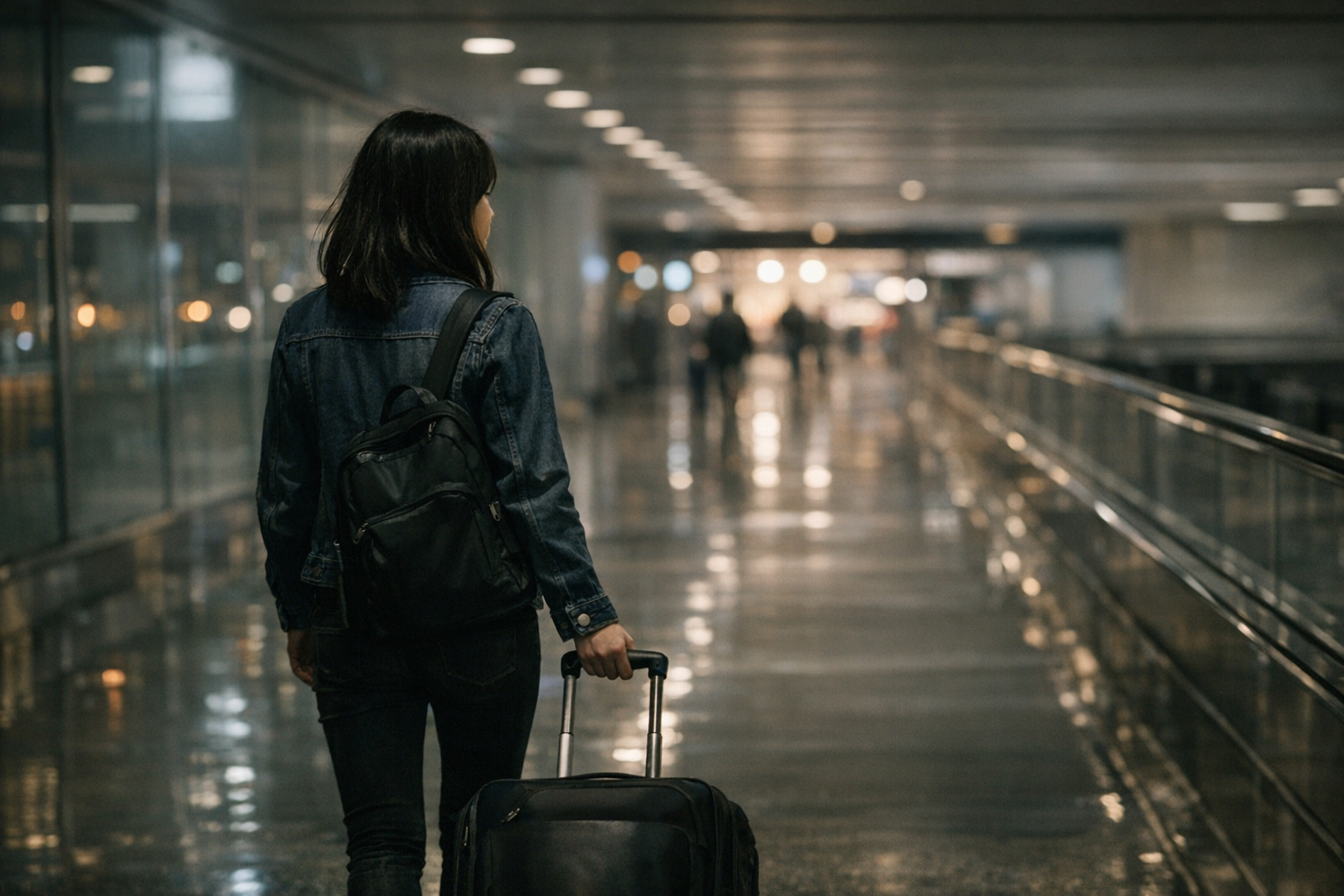
On November 8, 2024, Hannah Kobayashi arrived at Los Angeles International Airport from Maui and missed her connection to New York. Her checked luggage continued onward; she collected it in Los Angeles on November 11. What began as an interrupted journey soon became a widely publicized family search.
Instead, Hannah Kobayashi walked out of one of the busiest airports in America and into a story that somehow became harder to understand the more visible it got. Cameras caught pieces of it. Text messages made it stranger. And when the search exploded online, the case stopped feeling like a simple missing-person alert and started looking like a public mystery no one could fully control.
Hannah Kobayashi became the center of a missing person case that drew national attention because it seemed to have everything investigators and the public usually beg for: travel records, surveillance images, timestamps, texts, and a clear starting point at LAX. Yet even after the disappearance turned into a Mexico reappearance, the case still matters because it exposed how an unsolved disappearance-style public narrative can spiral long before the truth settles.
That tension is part of why airport vanishings hold people so tightly. In the Lars Mittank disappearance, another traveler seemed to move from ordinary transit into pure confusion almost without warning. Hannah Kobayashi’s story felt different in outcome, but it hit the same nerve: a crowded public place, a visible last known path, and a trail that only made people argue harder.
The flight that was supposed to continue
Hannah Kobayashi, a woman from Hawaii, landed at LAX in November 2024 during what was supposed to be a layover on the way to New York. On paper, it was the kind of trip nobody would remember. A few hours in Los Angeles. A connecting flight. Then the rest of the journey.
But she never boarded that next plane.
That single decision changed the shape of everything that came after. Once a traveler leaves the clean logic of an airport itinerary, the story breaks open. Every hour after that becomes vulnerable to rumor, interpretation, and fear. In Hannah’s case, those hours filled up fast.
Her relatives described subsequent messages as alarming and reported her missing on November 11. Their concern was real, but the messages did not establish that she had been abducted or trafficked.
And that is where the case took on its unique shape.
This was not just a woman who missed a flight. This was a woman who seemed to leave behind two separate stories at once. One story was visible: LAX, transit records, camera sightings, border footage. The other story lived inside interpretation: what she meant, what she feared, what she was hiding, and whether the public was looking at a crisis, a coercive situation, or an intentional disappearance from view.
Timeline of Events
- November 8, 2024: Hannah Kobayashi arrives at LAX during a layover on a trip from Maui to New York and does not board her connecting flight.
- November 9–11: Family concern grows after unusual text messages and a break in expected contact.
- November 11: She is reportedly seen on surveillance footage near a Metro station in downtown Los Angeles.
- Late November: The public search intensifies, and Hannah’s father, who came to Los Angeles to help find her, dies during the search.
- December 2: LAPD says surveillance and border review show Hannah crossed into Mexico on foot on November 12, alone and appearing unharmed.
- December 11: Authorities say she has been found alive.
- December 15–16: She reenters the United States on December 15. LAPD announces the next day that she appeared well and closes the case.
What made this timeline so hard to process was that each new fact seemed to answer one question while opening three more. If she had crossed the border alone, why did the earlier messages sound so alarming? If she wanted privacy, why did the case feel so full of panic? And if the public had mistaken the shape of the story, when exactly had that happened?
What made the public search go off the rails
In many disappearance cases, the central mystery is absence. With Hannah Kobayashi, the central mystery became narrative.
Almost everything about the case invited projection. LAX is symbolic all by itself: a giant transit machine where people are supposed to pass through, not disappear into uncertainty. The text messages added urgency without full context. Surveillance reports suggested movement, but not motive. Then the story became even heavier when Hannah’s father, who had joined the search in Los Angeles, died during that same desperate period.
That tragedy changed the emotional temperature of the case. After that, the public no longer felt like it was watching a missing traveler. It felt like it was watching a family being broken apart in real time by uncertainty.
Then came the turn that split public opinion. Authorities said surveillance review showed Hannah crossing into Mexico on foot, alone, with luggage, and without obvious signs of distress. Suddenly, the case that many people had read as an abduction or crisis looked, at least from the outside, more like an intentional departure.
But that did not cleanly resolve the story. It made it stranger.
Because visibility is not the same thing as clarity. A camera can show where someone walked. It cannot explain what pressure they were under, what state of mind they were in, what they feared, what they wanted to escape, or what they believed would happen next. The public had been handed images, timestamps, and travel movement. What it still did not have was certainty.
What doesn’t fully add up
- The messages versus the movement: The reported texts sounded distressed, but the later border footage suggested deliberate travel.
- The public narrative moved faster than confirmed facts: Online theories hardened before investigators revealed the Mexico crossing.
- Being found did not end the debate: Once Hannah was safe, attention shifted from “Where is she?” to “What was really happening?”
- Privacy clashed with public ownership: After such a massive search, many people expected a complete explanation that may never come.
This is the angle that makes Hannah Kobayashi’s case such a good fit for the site’s disappearances archive. It lives in that uneasy territory where a person can be found, and the case can still remain culturally unresolved. Not legally unsolved in the pure traditional sense, but unsettled in the public mind.
That is why people kept circling back to it after the biggest headlines faded. The story hit a modern pressure point: what happens when internet attention, family fear, police caution, and incomplete evidence all collide before anyone knows which version of the story is real?
LAPD said it found no evidence of trafficking or foul play and did not regard Kobayashi as a criminal suspect. Her safe return closed the missing-person case; speculation about her private relationships does not establish a crime or explain her decisions.
The public debate continued after the investigation ended.
🔎 Related Investigation:
If this case pulled you deeper into the mystery, continue into:
Why this case still gets attention
Most missing person stories lock people in with one question: what happened?
Hannah Kobayashi’s story adds a second, very modern one: how did everyone get the story so wrong, or at least so incomplete, while it was happening?
- It unfolded in public: Social media, surveillance updates, and press coverage kept feeding the sense that the next answer was always one step away.
- It involved a transit hub: Airport and border cases naturally trigger fear because they combine movement, anonymity, and disappearing choices.
- It ended without emotional closure: Being located alive is not the same as explaining the fear, the silence, or the fallout.
- It exposed the limits of online investigation: The internet can amplify urgency, but it can also turn fragments into false certainty.
That last point may be the most important. Hannah Kobayashi’s case became a lesson in how public narrative can fail all at once. Family members can be terrified. The public can be sincere. Investigators can hold back details for legitimate reasons. And still, the combined result can be confusion so deep that the story feels unresolved even after the missing person is no longer missing.
That is why this case belongs next to stories like unsolved disappearances where the final hours still don’t add up. Not because the ending is identical, but because the emotional architecture is. There is a trail. There are timestamps. There are visible moments people keep revisiting. And there is still a gap between what can be seen and what can be understood.
The case after the case
Once Hannah Kobayashi was reported safe, the official emergency ended. In May 2025, ABC News reported that she thanked supporters publicly while facing continued criticism. But public curiosity did not reopen the closed missing-person case.
People debated whether she had been fleeing pressure, cutting herself off, making a private decision that became public against her will, or moving through a situation more complicated than the headlines ever captured. Her family’s pain, especially the death of her father during the search, meant the case could never shrink back into a simple travel anomaly.
That is what gives the story its lasting weight. It is not only about where Hannah went. It is about how quickly an ordinary gap in a travel plan became a national mystery, how badly visibility can mislead, and how a person can reappear while the larger story still refuses to settle into one clean truth.
In older disappearance cases, the horror usually comes from permanent absence. In Hannah Kobayashi’s case, the unease came from something more current and maybe more recognizable: too much information, too little context, and a public desperate to turn fragments into certainty before the facts were ready.
Maybe that is the most honest way to read the case now. Not as a neat solved-or-unsolved label, but as a warning about the distance between being seen and being understood. Hannah Kobayashi left an airport, crossed into a bigger mystery, and forced everyone watching to confront how fragile a public narrative becomes when secrecy, fear, and visibility all fail at the same time.
🔎 Related Investigation:
🔎 Related Investigation:
Research Sources
The following resources were consulted to verify and update this article.
- Los Angeles Police Department — Statement Regarding Hannah Kobayashi
Official travel findings and closure of the missing-person investigation. - Associated Press — Police say a Hawaii woman disappeared voluntarily and traveled to Mexico
Police findings on luggage retrieval, travel and the lack of evidence of a crime. - Associated Press — Hannah Kobayashi, missing Hawaii woman whose disappearance prompted a massive search, is found safe
The December11 safety announcement and family search. - ITV News — ‘I am still processing it all’: Hannah Kobayashi breaks silence after her disappearance
Her statement after returning to the United States. - ABC News — Hawaii woman Hannah Kobayashi breaks silence months after controversial disappearance
Her May2025 public comments and continuing criticism.
🔎 If this story stayed with you, the author suggests these real cases next:
- The sightings and timeline gaps in Mekayla Bali’s disappearance
- The one-way train trip at the center of Andrew Gosden’s case
- The airport panic and unexplained vanishing of Lars Mittank
Explore more Disappearances stories here: