
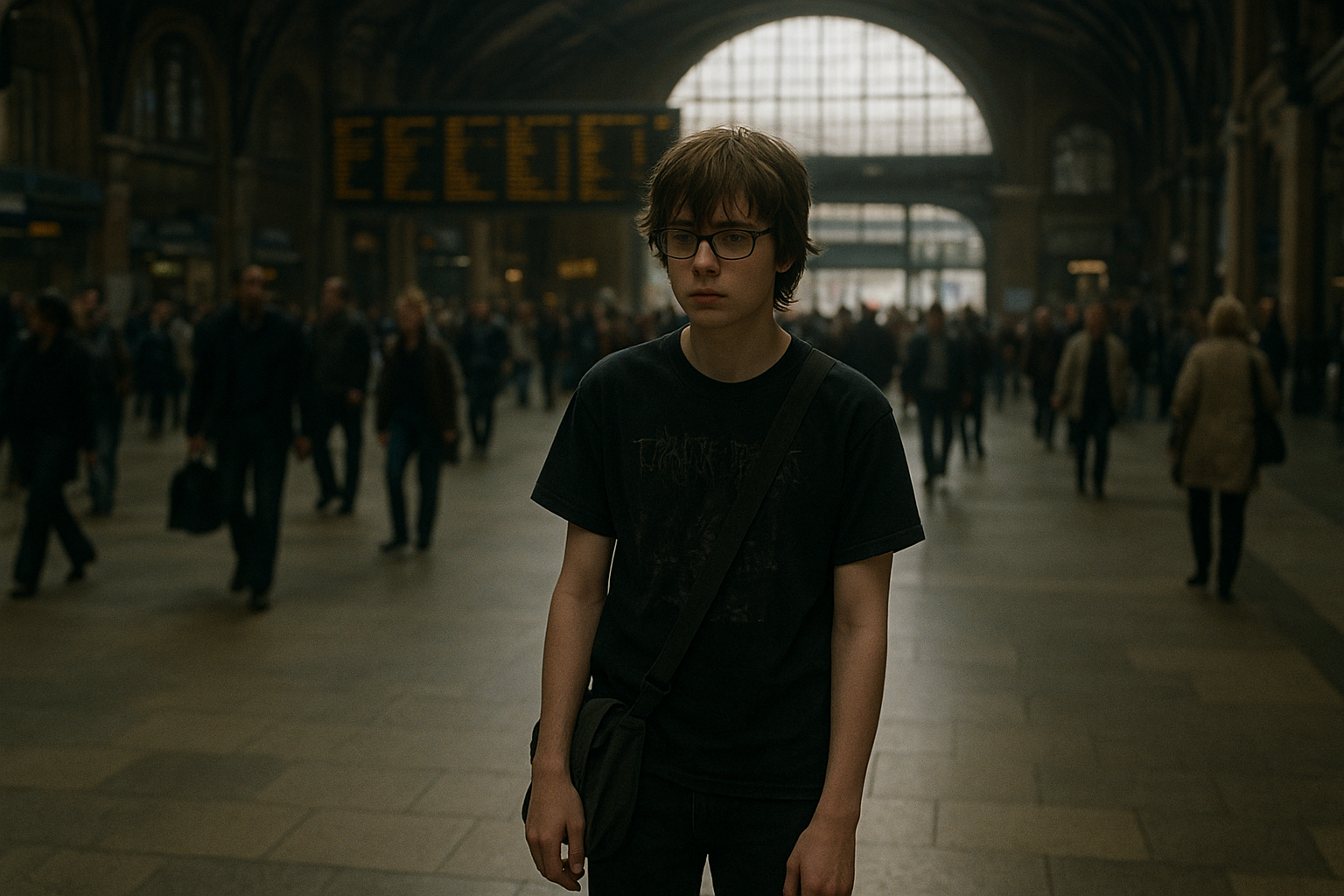
At 9:35 on a Friday morning, 14-year-old Andrew Gosden left his house in Doncaster wearing a school uniform and carrying a backpack. By 11:25 a.m., CCTV captured him walking out of London’s King’s Cross Station. He looked calm. He looked purposeful. He looked like he knew exactly where he was going.
Then he disappeared.
For nearly two decades, investigators, journalists, and Andrew’s family have returned to the same haunting question: why would a bright, quiet teenager secretly travel to London alone—and what happened after he stepped beyond the reach of that final camera?
What happened to Andrew Gosden? Andrew Gosden was a 14-year-old boy from Doncaster, England, who disappeared on September 14, 2007. After leaving home as if he were going to school, he withdrew money from his bank account, changed clothes, bought a one-way train ticket to London, and was captured on CCTV leaving King’s Cross Station. No confirmed sighting has ever been verified after that moment, and his disappearance remains unsolved.
In some disappearances, the most chilling part isn’t what’s missing—it’s what was left behind. Evidence that continues to puzzle investigators.
Who Was Andrew Gosden?
Andrew Gosden did not fit the stereotype people often imagine when they hear about a missing teenager.
He was not known for running away.
He was not constantly getting into trouble.
He was not someone who had a history of disappearing from home.
Teachers described him as exceptionally bright. He was considered gifted academically and had attended programs for high-achieving students. Friends and family knew him as quiet, thoughtful, and deeply private.
He enjoyed video games.
He loved music.
He wore strong glasses and preferred keeping to himself rather than being the center of attention.
In many ways, Andrew seemed exactly like the kind of teenager people assume would make safe decisions.
That assumption would become one of the most unsettling parts of the entire case.
Because whatever happened to Andrew began with a series of deliberate choices.
Timeline of Andrew Gosden’s Disappearance
September 14, 2007 – Morning
- Andrew leaves home wearing his school uniform.
- A family friend sees him walking toward his usual route.
- Instead of going to school, he withdraws £200 from his bank account.
Mid-Morning
- Andrew returns home.
- Neighbor CCTV later shows him changing out of his school uniform and leaving again in casual clothes.
Approximately 9:35 a.m.
- Andrew arrives at Doncaster railway station.
- He purchases a one-way ticket to London King’s Cross.
11:25 a.m.
- CCTV captures Andrew leaving King’s Cross Station.
- This becomes the last confirmed sighting of him.
Later That Day
- His family discovers he never attended school.
- Police are contacted.
2021
- Two men are arrested on suspicion of kidnap and human trafficking.
- They are later ruled out.
Today
- Andrew remains missing.
The Morning Everything Changed
September 14, 2007, began like any other Friday.
Parents went to work.
Students headed to school.
People moved through routines they had followed countless times before.
Andrew appeared to be doing exactly the same thing.
He left his house wearing his school uniform.
A family friend saw him walking toward the route he normally used.
Nothing looked unusual.
Nothing suggested he was about to disappear.
But somewhere between leaving home and reaching school, Andrew changed plans.
He withdrew £200 from his bank account.
At the time, it was nearly everything he could access.
Then he went home.
This is one of the most important moments in the entire case.
Neighbor CCTV later showed Andrew entering the house after everyone else had left.
Inside, he removed his school uniform.
He folded it neatly.
He changed into casual clothes.
Then he walked out again.
There was no panic.
No visible rush.
No sign of someone acting impulsively.
Everything appeared methodical.
And that is why one line has followed this case for years:
Andrew did not vanish in chaos. He vanished in sequence.
This disappearance is one of many cases where the final known moments remain deeply unsettling. What happened next is still unknown, and that’s exactly what makes these stories so hard to forget.
👉 See more disappearances that make no sense
The One-Way Ticket
After leaving home the second time, Andrew made his way to Doncaster railway station.
There, he purchased a ticket to London King’s Cross.
But there was one detail that immediately stood out.
He bought a one-way ticket.
The employee selling the ticket reportedly informed him that a return ticket would cost only slightly more.
Andrew still declined.
He wanted a single ticket.
That decision has fascinated investigators for years.
At first glance, it feels meaningful.
Most people naturally assume it suggests intention.
Maybe Andrew planned to stay overnight.
Maybe he expected someone else to pay for his return.
Maybe he did not intend to return at all.
Or maybe the explanation is far simpler.
Perhaps he was a shy teenager who simply answered quickly without thinking.
The problem is that nobody knows.
The ticket became one of the most discussed clues in the case because it feels important.
Yet nobody can say exactly what it means.
What Andrew Took—and What He Left Behind
Investigators paid close attention to the items Andrew carried that day.
He wore a black Slipknot T-shirt.
Black jeans.
A dark shoulder bag decorated with music patches.
He brought his wallet.
His keys.
His PSP gaming system.
But several items were notably absent.
He did not bring a coat.
He did not bring the charger for his PSP.
He did not take his passport.
He left money behind in his room.
These details created another puzzle.
If Andrew intended to disappear permanently, his preparations seemed incomplete.
If he intended a short trip, why travel secretly to London alone?
If he planned to return that evening, what prevented him from coming home?
Nearly every theory collides with the same problem.
Some details suggest planning.
Others suggest spontaneity.
The evidence refuses to settle comfortably into either category.
King’s Cross Station
At approximately 11:25 a.m., Andrew’s train arrived in London.
CCTV cameras recorded him leaving King’s Cross Station.
The footage remains one of the most famous images in British missing-person history.
Andrew appears calm.
He does not seem frightened.
He does not appear lost.
He is not visibly running.
He is not looking over his shoulder.
He simply walks forward.
Around him, thousands of people move through one of London’s busiest transportation hubs.
For a few seconds, Andrew is visible.
Then he blends into the crowd.
And after that, the trail ends.
No confirmed sighting has ever been verified beyond that point.
That fact remains astonishing.
Andrew disappeared in one of the most heavily populated and heavily monitored cities in Europe.
Yet somehow, he managed to leave almost no trace.
🔎 Related Investigation:
The Investigation
Back in Doncaster, Andrew’s family initially believed he was at school.
School officials assumed his absence had been reported.
Those assumptions created a devastating delay.
Hours passed before anyone realized Andrew was missing.
In missing-person investigations, those early hours can be critical.
By the time authorities learned what had happened, Andrew had already been in London for much of the day.
Investigators eventually reconstructed his journey.
The bank withdrawal.
The train ticket.
The CCTV footage.
The arrival at King’s Cross.
The problem was what came next.
There was nothing.
No confirmed phone activity.
No verified contact with friends.
No financial trail.
No clear destination.
The investigation had clarity right up until King’s Cross Station.
After that, it entered darkness.
Did Andrew Plan to Meet Someone?
One of the most common theories is that Andrew traveled to London to meet someone.
At first glance, this seems plausible.
Teenagers sometimes keep secrets.
A trusted person could potentially persuade a young person to travel.
And London’s size would make such a meeting difficult to trace.
But there are problems with the theory.
Investigators found no obvious online relationship.
No clear digital trail.
No confirmed messages arranging a meeting.
No known evidence proving someone was waiting for him.
That does not mean it did not happen.
It simply means there is no publicly known evidence confirming it.
And that uncertainty has defined the case from the beginning.
The Silence
One of the most unsettling aspects of Andrew’s disappearance is what did not happen afterward.
There were no confirmed calls.
No emails.
No verified online activity.
No financial activity.
No reliable communication.
Modern disappearance cases usually leave digital footprints.
Andrew left almost none.
That absence has fueled countless theories.
Some see it as evidence of foul play.
Others believe it suggests Andrew intentionally disappeared.
Still others argue the answer may be something entirely different.
Regardless of interpretation, the silence remains one of the strongest mysteries in the case.
The 2021 Arrests
In December 2021, hope returned unexpectedly.
Police arrested two men on suspicion of kidnap and human trafficking connected to Andrew’s disappearance.
For Andrew’s family, it represented something they had waited years to hear.
A possible breakthrough.
Media attention surged.
People wondered whether the mystery might finally be approaching an answer.
But the optimism did not last.
The suspects were eventually ruled out.
No charges followed.
The case returned to where it had been before.
Unsolved.
Once again, investigators had approached what appeared to be a doorway.
Once again, the doorway opened into uncertainty.
What Doesn’t Add Up?
Several aspects of the case continue to puzzle investigators.
The one-way ticket.
Why refuse the return ticket when it cost only slightly more?
The careful preparation.
Andrew changed clothes and withdrew money before leaving.
These actions appear deliberate.
The missing items.
If he planned a long trip, why leave behind essentials?
The lack of communication.
Why has no confirmed message ever surfaced?
The disappearance after King’s Cross.
How does someone vanish so completely in one of the busiest cities in Europe?
Each question seems important.
Together, they create one of the most frustrating mysteries in modern British criminal history.
Most Likely Explanation
The truth is that investigators still do not know why Andrew traveled to London.
The available evidence suggests the trip was intentional.
He withdrew money.
Changed clothes.
Purchased a ticket.
Boarded a train.
None of those actions appear accidental.
What happened after arrival is far less clear.
It is possible he intended something harmless and encountered danger.
It is possible he planned to meet someone.
It is possible he made a decision that placed him in a vulnerable position.
The strongest certainty in the case is also the most painful one.
Andrew successfully reached London.
Whatever happened to him occurred after that.
Somewhere beyond the camera footage.
Somewhere beyond the station.
Somewhere beyond the final confirmed image.
?? Related Investigation:
If this case pulled you deeper into the mystery, continue into:
🔎 Related Investigation:
If this case pulled you deeper into the mystery, continue into:
FAQ
Who was Andrew Gosden?
Andrew Gosden was a 14-year-old boy from Doncaster, England, who disappeared on September 14, 2007.
Where was Andrew Gosden last seen?
He was last confirmed on CCTV leaving King’s Cross Station in London at approximately 11:25 a.m.
Why did Andrew go to London?
Investigators have never determined why he traveled there.
Did Andrew buy a return ticket?
No. He purchased a one-way ticket despite being offered a return ticket for only a small additional cost.
Were there any suspects?
Two men were arrested in 2021 on suspicion of kidnap and human trafficking but were later ruled out.
Has Andrew Gosden been found?
No. His disappearance remains unsolved.
The Final Image
Nearly twenty years later, most people who know this case still return to the same image.
A teenager stepping out of King’s Cross Station.
A shoulder bag hanging at his side.
Thousands of strangers moving around him.
Nothing dramatic.
Nothing obviously dangerous.
Just a boy walking into a city.
Somewhere beyond that camera frame, something happened.
Maybe it happened within minutes.
Maybe it happened hours later.
Maybe someone noticed him.
Maybe someone spoke to him.
Maybe someone knew exactly why he had come to London.
Whatever happened, it was enough to erase him from the visible world.
That is why the case remains so haunting.
Not because Andrew vanished without being seen.
But because he was seen so clearly right up until the moment he wasn’t.
A boy left home on a Friday morning.
He bought a one-way ticket.
He walked out of King’s Cross Station.
And the city kept the rest.
🔎 Related Investigation:
- Unsolved Disappearances With Witness Sightings That Only Made the Mystery Stranger
- 10 Unsolved Disappearances Where the Timeline Still Doesn’t Add Up
🔎 If this story stayed with you, the author suggests these real cases next:
- The late-night call from a stranded student that ended in sudden silence
- The crash on a lonely road that was followed by a total disappearance
- The tourist who ran out of an airport and was never seen again
Explore more Disappearances stories here: