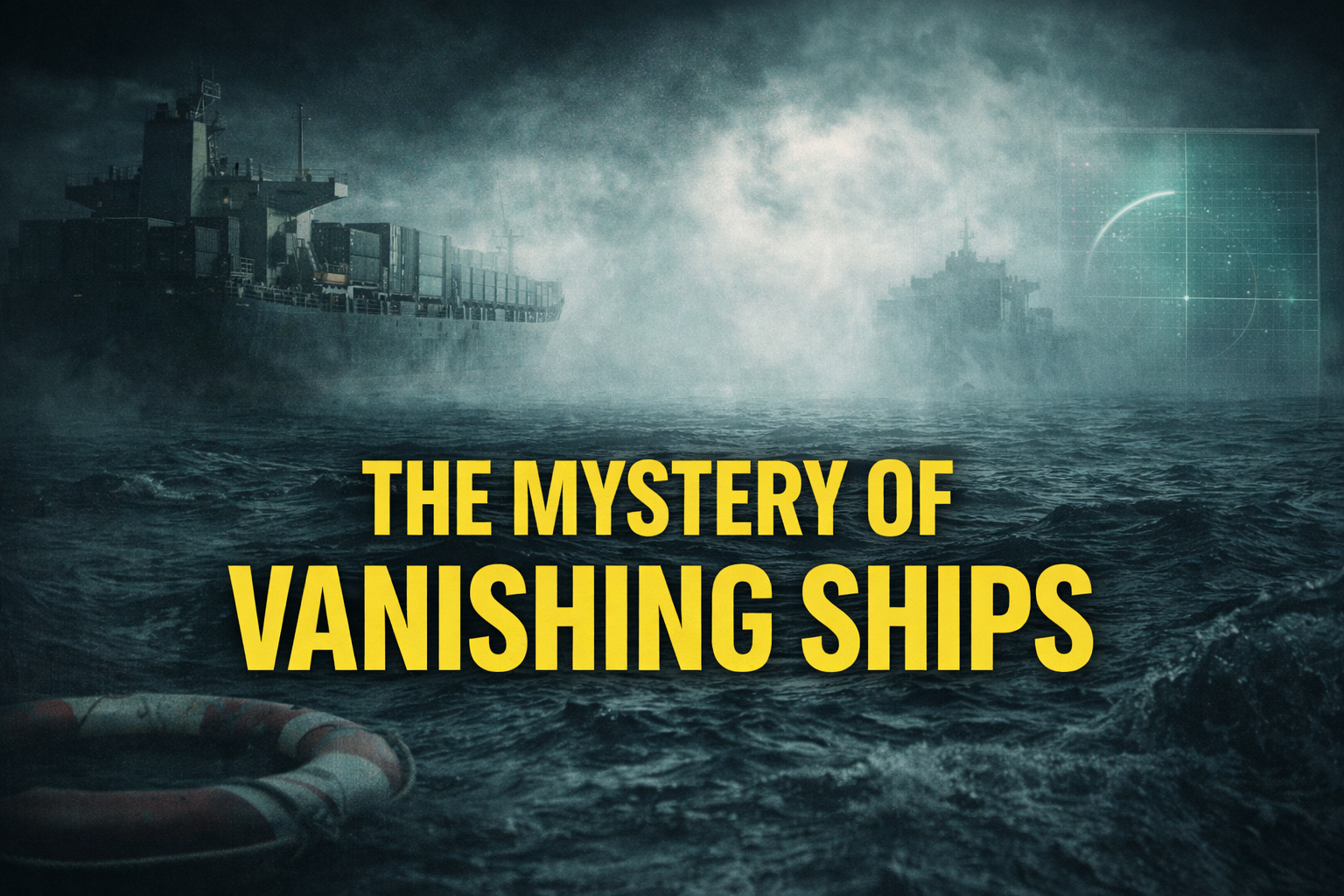
Of the three vessels in this story, one lay in pieces on the deep-ocean floor, one left investigators fragments without a wreck they could examine, and one was found afloat. It was the people aboard that last vessel who had vanished. Each investigation started with a different question because each had something different to work with.
Derbyshire: A question left on the foredeck
In September 1980 the British bulk carrier Derbyshire was lost during Typhoon Orchid off Japan. All 44 people aboard died. There was no surviving witness to say where the sea first entered a vessel large enough to carry a mountain of iron ore inside its hull.
The discovery of the wreck in 1994 made another kind of inquiry possible. Investigators could examine the debris field and test rival accounts of how the ship failed. The reopened formal investigation addressed a question with particularly painful implications for the crew’s families. Had someone left the hatch to the bosun’s store on the foredeck unsecured?
The inquiry rejected that suggestion. Its reconstruction began with ventilators and air pipes damaged by heavy seas on the foredeck. Water entered spaces in the bow, bringing the front of the ship lower. Increasing loads on the main hatch covers led to their progressive collapse. The loss of watertight protection across the cargo holds left the vessel unable to survive.
This conclusion did more than put a label on the weather. Everyone knew there had been a typhoon. The underwater evidence allowed the investigators to identify the parts of the vessel that had given way and to clear the crew of the specific allegation about the hatch.
Marine Sulphur Queen: A judgment without a final frame
In February 1963 the tanker Marine Sulphur Queen failed to arrive after leaving Beaumont, Texas, carrying molten sulphur. Thirty-nine men were aboard. Some debris was recovered. The search did not supply the kind of evidence that would let an investigator examine the tanker’s hull and establish the sequence of its destruction.
The ship had been converted from a tanker to carry its unusual cargo. Its condition, loading history and the changes made during conversion became subjects of detailed testimony. In civil proceedings, a federal court considered the evidence of structural weakness, loading and seaworthiness. Families seeking compensation did not need a photograph of the moment of sinking for the condition of the vessel to matter in court.
An explanation for legal liability is not necessarily a reconstruction of the last minute at sea. The judge considered possible mechanisms, including capsizing, without making a finding that this was exactly what happened. The records could show how the ship had been operated and what hazards it faced. They could not produce a witness to the event that finally took it down.
Kaz II: The vessel came back without its crew
On April 15, 2007, Derek Batten and brothers Peter and James Tunstead left Airlie Beach, Queensland, aboard the catamaran Kaz II. The yacht was subsequently found drifting off the Queensland coast. All three men were missing. A search failed to recover them.
Investigators had something rare in a disappearance at sea. They could board the vessel itself. A video made by one of the men preserved an ordinary moment during the passage, with Peter fishing. It gave the inquest a view of the people and their positions before the emergency. It ended before it could show why any of them entered the water.
Queensland’s state coroner concluded that the three had probably gone overboard on April 15 and drowned. He considered how an accident involving fishing gear, an attempted rescue and movement of the boom could have left all three in the water. That sequence was a possibility reconstructed from the available evidence. The inquest could not establish precisely how each man went over the side.
What the sea returned
In the Derbyshire inquiry, photographs acquired long after the sinking helped investigators distinguish one entry point for water from another. In the Marine Sulphur Queen litigation, surviving records of the conversion and operation answered questions about responsibility even without a recovered hull. In Queensland the hull was available almost at once. It was the missing interval between the last recording and the discovery of the yacht that nobody could fill.
Frequently asked questions
Did all three ships disappear without trace?
No. Derbyshire’s wreck was eventually located. Identifiable debris survived the loss of Marine Sulphur Queen. Kaz II remained afloat.
Did an open foredeck hatch sink Derbyshire?
The reopened investigation rejected that allegation. It found that seas damaged ventilators and air pipes, initiating flooding that preceded the collapse of the main hatch covers.
Was the cause of Marine Sulphur Queen’s loss proven?
The court made findings about seaworthiness, operation and liability. The evidence did not conclusively identify the immediate physical cause of the loss.
Did the Kaz II inquest determine what happened?
The coroner found that the men had died and considered drowning after going overboard the probable explanation. The precise sequence remains uncertain. That is a narrower and more important distinction than calling the entire voyage inexplicable.
Research Sources
The following resources were consulted to verify and update this article.
- Report of the reopened formal investigation into the loss of MV Derbyshire — Sets out the wreck survey, foredeck flooding, hatch failure sequence and rejection of crew blame.
- UK Parliament, statement on the Derbyshire investigation — Summarizes the report’s findings on the ventilators, air pipes and progressive failure of hatch covers.
- In re Marine Sulphur Transport Corp., U.S. District Court decision — Records the final voyage, debris, structural concerns and the distinction between liability and an established sinking mechanism.
- Queensland State Coroner, findings on Derek Batten, Peter Tunstead and James Tunstead — Reconstructs the Kaz II voyage and explains the evidentiary limits on how the men went overboard.
- ABC News, Missing catamaran trio likely drowned — Contemporaneous coverage of the coroner’s possible accident sequence and death findings.
🔎 If this mystery pulled you in, the author suggests these related real cases next:
- The wider archive of unresolved cases where reality keeps slipping out of focus
- The unexplained signals that feel as distant and unsettling as a lost vessel’s last silence
- Strange sky cases where modern observation still fails to give a clean answer
- Real lost-at-sea ordeals that show what the ocean does when someone survives long enough to tell it
Explore more Unsolved Mysteries stories here: