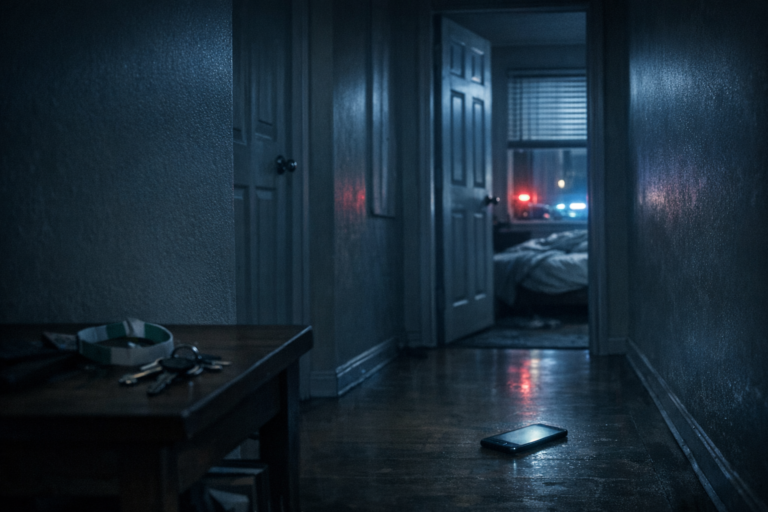

By the time the parking lot began to thin out, the Christmas glow was still hanging over Westdale Mall. Storefront lights reflected off cold pavement. People were carrying gift bags, coats, and the ordinary little worries of a week before Christmas. Somewhere in that blur of headlights and winter air, Michelle Martinko made the short walk back to her car. It should have been one of the safest moments of the night.
Instead, it became the last quiet moment of her life.
The Michelle Martinko murder remains one of Iowa’s most haunting true crime cases because it began in such a familiar place: a mall parking lot during holiday shopping. For decades, the case stood as a brutal unsolved murder until genetic genealogy and preserved DNA evidence finally pointed investigators to Jerry Lynn Burns.
If the forensic side of this case draws you in, the broader Cold Cases Solved by DNA and Genetic Genealogy roundup shows how often old evidence waits years for science to catch up.
A Holiday Night That Turned Violent Without Warning
Michelle was 18 years old, a student at Morningside College, and home in Cedar Rapids for the holidays. She had plans, friends, and the kind of life that still felt wide open. On December 19, 1979, she spent part of the evening shopping at Westdale Mall for a coat and a gift before a holiday concert later that night. It was an ordinary errand folded into an ordinary winter evening.
That normalcy is part of what still makes the case so unsettling. There was no deserted highway, no remote road, no obvious setup that would have made the danger visible from a distance. Michelle was in a crowded commercial area during one of the busiest weeks of the year. The setting was bright, public, and painfully routine.
At some point after returning to her car, she was attacked inside the vehicle. Investigators later concluded there had been a fierce struggle. Michelle fought back. The scene suggested rage, speed, and extreme violence. She had been stabbed multiple times, and whoever did it disappeared before anyone could stop him.
The Case That Froze in Place
Cedar Rapids did not forget Michelle Martinko. Her murder struck the city with the kind of force that changes how people look at ordinary places. Parking lots, quick errands, walks to the car after dark – those small pieces of daily life suddenly felt exposed.
Investigators worked the case hard. They looked closely at Michelle’s relationships, retraced her last movements, interviewed people who may have seen her that night, and chased the possibility that the killer was either someone who knew her or someone who seized a moment of opportunity. Both explanations had weight. The attack felt intensely personal because of its violence, but the setting also left room for the terrifying possibility of a stranger encounter.
For years, the case lived in that uncertain space between intimacy and randomness. Was Michelle targeted specifically, or did someone see her alone and act? Theories kept building, but theories are not answers.
What gave detectives reason to keep believing the truth was still reachable was the physical evidence. The killer had left DNA behind. In another era, that fact might have felt almost symbolic – proof that the answer existed somewhere, but not proof anyone could actually reach it.
That is the strange cruelty of older forensic cases. The evidence can survive long before the science is mature enough to interpret it. Michelle’s murder became one of those cases where the future seemed to be holding the answer hostage. Detectives preserved what they could, waited through one generation of forensic limits after another, and kept the file alive while the technology slowly changed around them.
Timeline of Events
- December 19, 1979: Michelle Martinko, home from college for Christmas break, spends the evening at Westdale Mall in Cedar Rapids.
- Later that night: She returns to her car in the mall parking lot and is attacked inside the vehicle.
- Shortly afterward: Michelle is found fatally wounded. Investigators determine there was a violent struggle.
- 1980s-2000s: The investigation continues, suspects are examined, rumors circulate, and the case remains unsolved.
- As DNA science improves: Preserved evidence becomes the most important surviving path toward identifying the killer.
- Late 2010s: Detectives use genetic genealogy techniques to build family-tree connections from the unknown DNA.
- 2018: Investigators secretly obtain Jerry Lynn Burns’s DNA and compare it to the evidence from the murder.
- After the match: Burns is arrested and charged in Michelle Martinko’s murder nearly 39 years after the crime.
- 2020: Burns is convicted of first-degree murder.
Why the DNA Mattered More Than Anything Else
Long before genetic genealogy became part of public conversation, Michelle’s case already contained the seed of its solution. The problem was not whether evidence existed. The problem was that the evidence had outlived the tools available to read it properly.
As the years passed, DNA changed criminal investigations everywhere. Cases once thought buried began to move again. Direct matches in law enforcement databases solved some mysteries, but other cases demanded something more patient and far more complicated. That is where family-tree work changed the landscape.
Instead of waiting for the killer to already be in a criminal database, investigators could compare unknown DNA to genetic information shared through genealogy platforms and begin tracing relatives. The result was not an instant answer. It was a narrowing process. Branch by branch, cousin by cousin, line by line, the circle tightened.
That same method transformed other cases readers often follow, from Rita Curran’s half-century-old murder to the chilling identification work behind the Bear Brook murders. In Michelle’s case, it finally gave investigators a path through nearly four decades of darkness.
Eventually the family-tree work pointed toward Jerry Lynn Burns, a man who had lived in the Cedar Rapids area at the time of the killing. Detectives then did what cold-case investigators often have to do when they believe they are close: they waited, watched, and gathered a confirmatory sample without announcing what they suspected.
When Burns’s DNA was tested against the evidence from the crime, the waiting ended. The sample matched.
That moment must have been surreal for everyone who had carried the case across the years. Michelle’s family had spent decades with a wound that never closed. Investigators had inherited a murder older than some of the people working it. And then, after so long, the science stopped being a promise and became an answer.
What Does Not Add Up About the Original Mystery
Even with a conviction, this case still leaves behind questions that help explain why it continues to grip people.
- How could such a violent attack happen in a mall parking lot without a decisive witness? The public setting should have increased the odds of somebody seeing something useful, yet the most critical detail never surfaced in time.
- Did the killer know Michelle, target her, or simply seize an opportunity? The brutality made the crime feel personal, but the location left open the possibility of a sudden encounter.
- How many years did the answer sit silently inside preserved evidence? One of the most haunting parts of the story is knowing the truth may have been physically recoverable long before science could unlock it.
- Would the case have remained unsolved without genetic genealogy? That question lingers because traditional investigative paths had already stretched across decades without producing a conclusive name.
A conviction can solve the legal question of who did it, but it does not erase the emotional shape of the mystery. Michelle’s final moments still feel close, cold, and partly hidden behind the windshield glass of a car in a holiday parking lot.
When the Frozen Story Started Moving Again
By the time Burns went to trial in 2020, Michelle had been gone for longer than she had ever been alive. That fact alone gives the case its almost unreal scale. The murder belonged to one generation; the solution arrived in another.
At trial, prosecutors argued that Burns attacked Michelle in her car and left her to die after the struggle. The defense challenged the case, but the DNA evidence was central and powerful. After all the years of rumor, doubt, and dead ends, the core fact investigators needed was finally solid enough to stand in court.
Burns was convicted of first-degree murder.
No verdict could return Michelle to the people who loved her. It could not restore the Christmas season that was ripped apart in 1979, or the decades that followed with no name attached to the violence. But it did something families in many cold cases never receive: it replaced the unbearable blank space with a conclusion the legal system recognized as real.
That is also why this story belongs naturally inside the site’s larger True Crime Archive and alongside other DNA-driven cases. Michelle Martinko’s murder is not remembered only because it was brutal. It is remembered because it became a clear example of what happens when evidence survives longer than secrecy does.
Why This Case Still Gets Attention
Some cases stay in the public mind because they remain unsolved. Others stay there because the eventual answer feels almost impossible in retrospect. Michelle Martinko’s case does both at once. For decades, it carried the emotional weight of an unsolved holiday killing. Then it became a forensic breakthrough story that showed how the dead can still speak through preserved evidence.
It also touches one of the deepest fears inside true crime: the idea that danger can step into an ordinary evening without warning. Michelle was not deep in the wilderness. She was not isolated in some place that already felt ominous. She was where thousands of people go every winter – to shop, to head home, to move through a routine they barely think about. That closeness to normal life is what keeps the case from fading.
In the end, the Michelle Martinko murder feels less like a single shocking event and more like a long, frozen scene that finally cracked open. A young woman walked back to her car a few days before Christmas. Her killer believed darkness, time, and the limits of an older era would protect him. For nearly 39 years, it looked like he might be right.
Then the evidence spoke.
FAQ
What happened to Michelle Martinko?
Michelle Martinko was an 18-year-old college student who was attacked and fatally stabbed inside her car after a night of shopping at Westdale Mall in Cedar Rapids, Iowa, on December 19, 1979.
Was the Michelle Martinko case ever solved?
Yes. After decades as a cold case, investigators used genetic genealogy and a DNA match to identify Jerry Lynn Burns, who was later convicted of first-degree murder in 2020.
How was Michelle Martinko’s killer identified?
Detectives used preserved DNA evidence from the crime and traced family-tree connections through genetic genealogy. That process led them to Jerry Lynn Burns, whose DNA was later matched to the evidence.
Why does the Michelle Martinko murder still get attention?
The case still grips people because of its setting, its violence, and the extraordinary gap between the crime and the conviction. It began as a terrifying holiday-night murder in a public parking lot and ended nearly four decades later through modern forensic science.
Continue exploring:
- More murders that only started talking once genetic genealogy caught up
- Cold cases that looked buried until old evidence finally broke open
- Other true crime stories pulled back into the light by new evidence
- The family killer who vanished, aged in peace, and was finally found
- An Iowa massacre that still hangs over the state like a dark legend
More True Crime stories: