
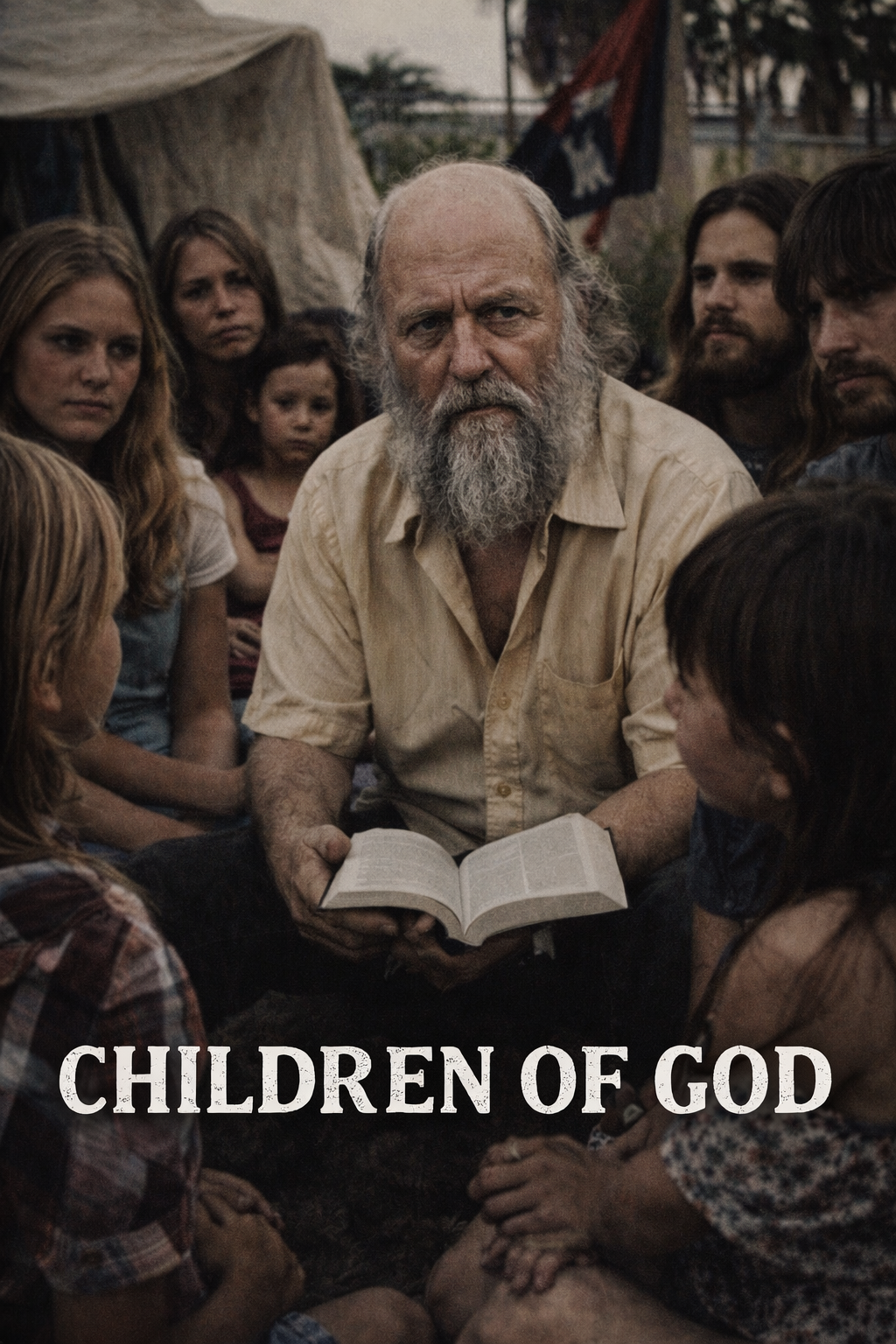
Before the group had a global name, before the allegations, before former members spent years trying to explain what life inside it felt like, there was a simpler image.
A beach in Southern California. Young people with backpacks and sunburned shoulders. Guitars. Bibles. A generation that had stopped trusting the institutions it was raised with and was looking for something that felt alive.
Into that atmosphere walked David Berg, speaking with the confidence of a man who seemed to have an answer ready for every fear they carried. He did not need iron gates or armed guards. He offered something more seductive than that. He offered certainty, family, purpose, and the feeling that the lost could become chosen.
That is where the Children of God story begins, and it is why the case still unsettles people decades later. What first looked like a radical Christian movement for drifters and seekers would slowly harden into a system of isolation, obedience, sexual exploitation, and abuse that former members say reshaped every part of their lives.
If this pattern feels familiar, it belongs in the same dark lineage as NXIVM Cult Explained, where trust and self-reinvention became tools of control long before the public saw the full picture.
When the Movement Still Looked Like Salvation
The Children of God emerged out of the late-1960s Jesus Movement, when spiritual experimentation and anti-establishment idealism were colliding in public. To young people who felt alienated from mainstream churches, Berg seemed to speak a different language. He talked about love, prophecy, corruption, and the end of the world in a way that felt urgent instead of formal.
That mattered. Movements like this rarely begin by announcing the damage they will cause. They begin by naming a wound accurately enough that people feel seen. Berg told followers that the outside world was rotten, that traditional religion had failed, and that a pure community could still be built if people were willing to leave the old system behind.
For many recruits, the appeal was not abstract theology. It was belonging. Communal living promised a new kind of family. Shared food, shared money, and shared mission made life feel stripped down and meaningful. Members sang together, traveled together, and spread the message together. For someone who already felt emotionally unmoored, that kind of certainty could feel less like a warning sign and more like rescue.
That is what makes the opening chapter of this story so important. It did not feel, at first, like walking into a nightmare. It felt like stepping into a place where confusion finally had structure.
How David Berg Turned Faith Into Total Authority
The real transformation did not happen in one shocking moment. It happened the way coercive systems usually grow: through a long series of smaller permissions. Berg’s writings, widely known as the “Mo Letters,” became more than guidance. They became the internal law of the movement. Members were expected to read them, absorb them, and shape their lives around them.
Once that happened, David Berg stopped functioning as an eccentric preacher and started functioning as the final interpreter of reality. The group did not just teach devotion to God. It taught devotion through Berg, with Berg defining what loyalty, morality, sacrifice, and love were supposed to mean.
That shift changed everything. If family members doubted the group, they were not simply worried relatives. They became outsiders who could poison faith. If a member felt alarmed by a new teaching, that feeling was not a reason to slow down. It could be framed as weakness, rebellion, or evidence that the outside world still had too much power over them.
Over time, the movement became more insulated. Communal life made separation easier. The group provided housing, identity, social connection, and spiritual purpose all at once. And when one organization becomes your home, your language, your emotional support, and your map of the world, leaving it stops feeling like a decision. It starts feeling like stepping off a cliff.
The Belief System That Kept Pulling Members Deeper
The Children of God did not survive on charisma alone. It survived on a belief structure that kept reinterpreting obedience as virtue. Berg’s teachings often presented ordinary boundaries as worldly limitations. Mainstream morality, mainstream family life, and mainstream authority were treated as compromised or spiritually blind. Inside the movement, members were taught that they were part of something higher, purer, and more courageous than the life they had left behind.
That kind of framing is powerful because it turns sacrifice into proof. The more a person gives up, the more they can be told that their loss means they are serious. Distance from parents becomes faith. Submission becomes maturity. Discomfort becomes growth. Confusion becomes a test.
In that environment, it became harder and harder to distinguish spiritual commitment from manipulation. Members were expected to surrender privacy, adopt the group’s internal logic, and accept teachings that kept shifting under Berg’s control. Some former members later described that process not as one dramatic capture, but as the slow replacement of their own internal compass.
That is one reason the story still lands so hard. It was not just about what followers believed. It was about what they gradually lost the ability to question.
Where the Group Crossed the Line Into Exploitation
As the movement spread internationally, the darker parts of its culture became harder to hide. Berg introduced teachings and practices that critics and former members say pushed the group far beyond unconventional religion and into systematic exploitation. One of the most notorious was “flirty fishing,” a recruitment and fundraising practice in which female members were encouraged to use sex or sexual attention to attract men to the movement or secure support.
That alone revealed how far the internal morality had shifted. Intimacy was no longer simply private. It could be turned into strategy, duty, or proof of loyalty. A belief system that began by promising spiritual freedom had become a machine that could claim access to the body itself.
Even more disturbing were the allegations involving children. Former members and later reporting described an environment in which severe abuse could be concealed under the language of spiritual exception and internal authority. Over the years, the Children of God and its later forms faced sustained scrutiny over child sexual abuse, coercive practices, and the ways children were raised within a closed, highly controlled system.
This is the point in the story where the phrase “faith movement” stops sounding merely unusual and starts sounding dangerously incomplete. The issue was not that the group held eccentric beliefs. The issue was that those beliefs became cover for a system in which boundaries could be redrawn by leadership whenever leadership wanted them redrawn.
Timeline of the Children of God
- Late 1960s: David Berg begins attracting young followers during the Jesus Movement in California.
- Early 1970s: The movement grows under the name Children of God, with communal living and missionary outreach becoming central.
- 1970s: Berg’s “Mo Letters” increasingly shape doctrine and internal behavior across the group.
- 1970s–1980s: The movement expands internationally, while controversial internal teachings and sexual practices deepen concern.
- Over time: Former members begin describing isolation, control, exploitation, and abuse within the group.
- Later years: The organization rebrands, eventually becoming associated with The Family and later The Family International.
- Decades after its rise: Public criticism, survivor accounts, and investigative attention continue to define how the movement is understood.
What Made the System So Hard to Escape
One of the most important things to understand about the Children of God is that people did not remain inside simply because they were fooled once. Many stayed because the group had become the whole structure of their lives. Leaving meant more than changing churches. It could mean losing housing, community, relationships, and the only moral framework they had been taught to trust.
For children raised inside the movement, the difficulty was even deeper. They were not comparing the group to a stable outside life they remembered. The group was the world they knew. That is what makes survivor accounts so haunting. Many former members have described not only the damage done inside the movement, but the enormous difficulty of learning what ordinary boundaries, trust, and safety were supposed to look like afterward.
That aftermath is part of why this story belongs beside Order of the Solar Temple and Jonestown Massacre Explained. The visible outcomes are different, but the internal pattern is painfully recognizable: a leader becomes central, dissent becomes danger, isolation becomes protection, and ordinary moral instincts are gradually reclassified as betrayal.
What Doesn’t Add Up About the “Family” It Claimed to Be
- It sold safety while demanding separation: a movement that called itself loving often required members to distrust relatives and outsiders.
- It framed obedience as liberation: the more control leadership gained, the more that control was described as spiritual maturity.
- It used shifting doctrine to justify harm: practices that would alarm almost anyone outside the group could be reframed as holy, necessary, or misunderstood.
- It called itself a family while survivors describe fear and exploitation: that contradiction is one of the clearest signals of how fully language had been turned inside out.
Why the Children of God Story Still Gets Attention
The Children of God case still gets searched because it sits at the intersection of several lasting fears. One is the fear of charismatic leadership mutating into unchecked private power. Another is the fear that language about love, salvation, or freedom can be used to disguise abuse for years. And perhaps the deepest fear is how ordinary the entry point looked compared with the damage that followed.
It is easy to imagine danger when it announces itself loudly. It is harder when it arrives with guitars, scripture, smiles, and a promise that your loneliness is finally over.
That is why the story remains larger than one era. The Children of God rose out of the 1960s, but the mechanism is painfully modern: isolate people, redefine morality from the top down, reward surrender, punish doubt, and make the group feel like the only safe place left. Once that architecture is built, harm can keep expanding long after outsiders start to suspect something is wrong.
The movement later changed names, but rebranding never erased the history attached to it. The core question stayed the same. How does a search for faith become a structure that can excuse so much damage while convincing people that staying is holy?
That question is what keeps the case alive. Not just what David Berg taught, but how those teachings bent everyday human needs—belonging, certainty, family, meaning—into tools that could hold people in place even when the cost became unbearable.
FAQ
What was the Children of God cult?
The Children of God was a religious movement founded by David Berg during the Jesus Movement era. It began as a communal Christian group but later became known for coercive control, sexual exploitation, and serious abuse allegations connected to its internal teachings and leadership.
What happened inside the Children of God?
Former members and later reporting described a system built around Berg’s authority, communal isolation, shifting sexual doctrine, and pressure to obey leadership over ordinary personal or family boundaries. Over time, the movement became heavily criticized for exploitation and abuse, including severe allegations involving children.
Did the Children of God become The Family International?
Yes. The movement later changed names and became associated with The Family and then The Family International. But the rebranding did not erase the earlier history or the survivor accounts tied to the group’s original culture.
Why does the Children of God case still get attention?
Because it shows how a movement that first looked like spiritual refuge could slowly become a system of control. The contrast between the hopeful beginning and the harm later described by former members is what makes the story linger.
Who was David Berg?
David Berg was the founder and central authority figure behind the Children of God. His teachings, especially the “Mo Letters,” shaped the movement’s beliefs, rules, and internal culture for years.
Continue exploring:
- How NXIVM hid coercion behind polished self-help language
- The secret rituals and staged endings of the Solar Temple deaths
- The final broadcast and jungle collapse of Jonestown
- The comet, the videotapes, and the final night of Heaven’s Gate
- The cult disasters where belief kept marching toward catastrophe
More Cults & Extremist Groups stories: