
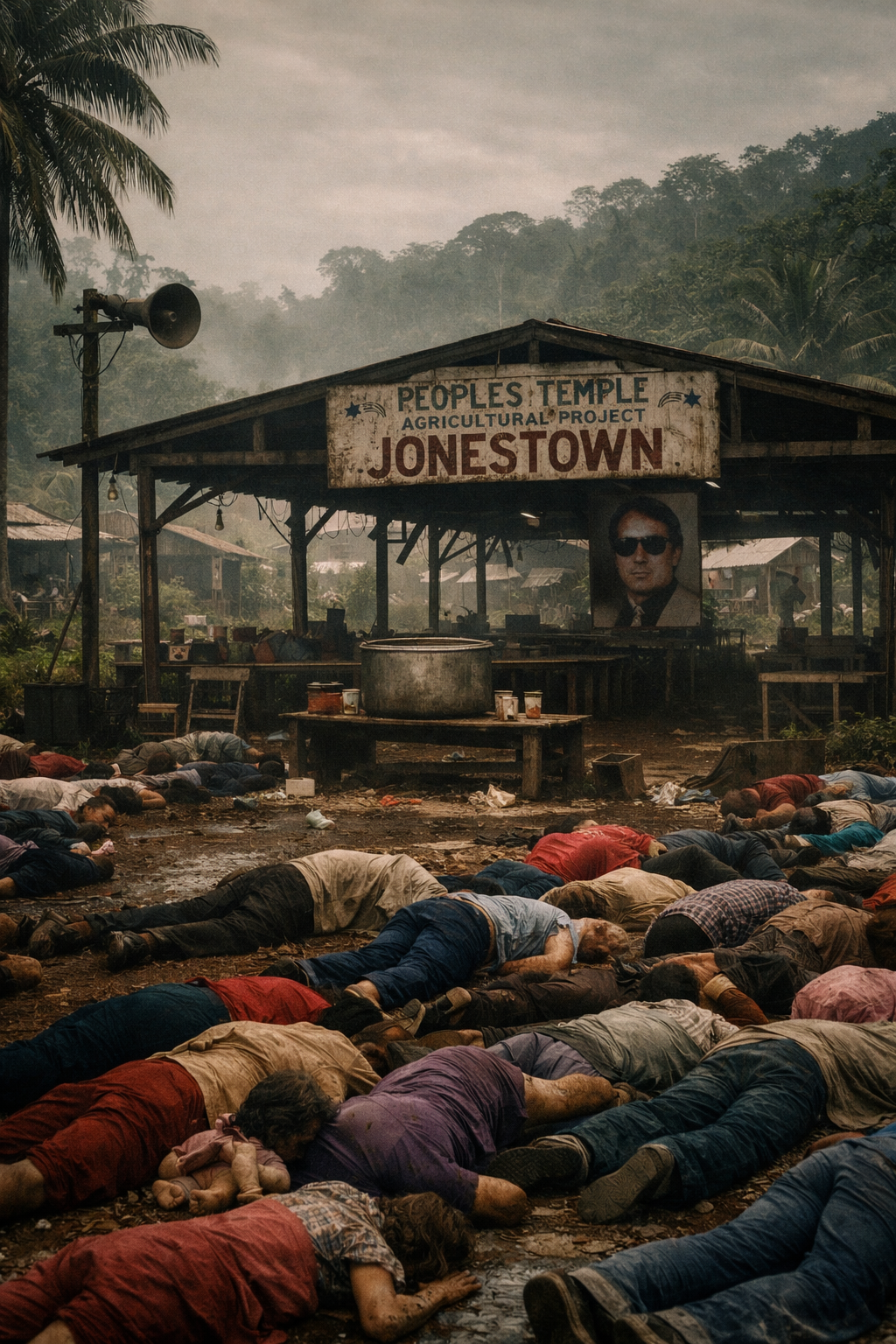
The loudspeaker was calm.
By the time Jim Jones began talking that final afternoon, the jungle air over Jonestown felt heavy enough to pin people in place. Parents held children. Armed guards hovered at the edges. People who had crossed an ocean and burned through every doubt they could afford to ignore now sat inside a pavilion listening to a man tell them the world was closing in.
Hours earlier, panic had already broken loose at a nearby airstrip. A congressman was dead. Defectors had tried to leave. News of the shooting had raced back through the settlement faster than reason could catch it. And now, in the middle of the Guyanese jungle, more than 900 lives were about to hinge on a voice that had spent years teaching followers to confuse obedience with survival.
Jonestown did not begin as a mass grave. It began as a promise.
The Jonestown massacre was the final catastrophe of Peoples Temple, the movement Jim Jones built by preaching equality, communal care, and protection for people who felt shut out by the wider world. The case still matters because it was not one sudden explosion of madness. It was a slow conversion of hope into control, isolation, paranoia, and finally mass death in November 1978.
If this kind of collapse pulls you deeper into the psychology of closed belief systems, it sits in the same disturbing lineage as Heaven’s Gate and its fatal promise of escape.
How Peoples Temple Turned a Dream Into a Closed World
In the beginning, Jim Jones did not look like the kind of man history would remember beside one of the darkest mass-death events of the twentieth century. To many followers, he looked like an answer. He preached racial integration when many churches still reflected segregation. He spoke the language of justice, sacrifice, and shared burden. He fed people. He helped the elderly. He built the feeling that the abandoned had finally found a place willing to claim them.
That is the part of the Jonestown story that can get flattened if the ending is told too quickly. Peoples Temple was not held together by fear alone. It was also held together by genuine emotional need. Many members believed they were participating in something moral, even historic. That belief gave Jones more than loyalty. It gave him permission to move deeper into their lives.
Over time, the message changed. The language of equality stayed on the surface, but beneath it came tests of obedience, public humiliations, pressure campaigns, and a constant emphasis on enemies. Critics were no longer just critics. They were threats. The government was a threat. The press was a threat. Family members who questioned what was happening became threats too.
The movement eventually shifted from California toward a far more isolated future in Guyana. Jones presented it as a socialist refuge, a place where the Temple could escape racism, capitalism, and persecution. To followers already trained to distrust the outside world, the relocation sounded less like exile than salvation.
Arrival in Jonestown
The settlement carved out of the jungle was supposed to feel like a beginning. Instead, many people found relentless heat, exhausting labor, crowded living conditions, and a leader whose presence became impossible to escape. Loudspeakers carried Jones’s voice across the compound for hours at a time. Sleep was interrupted. Privacy thinned out. Letters were monitored. Movement was restricted. Even doubt began to feel dangerous.
Jonestown belongs in the same bleak tradition as other cult stories that ended in psychological or physical destruction. The settlement did not merely trap bodies in one place. It trapped interpretation. If food was scarce, followers were told sacrifice was noble. If punishments were harsh, they were told discipline was necessary. If Jones sounded unstable, members were told instability belonged to the enemies outside the gates.
By then, leaving was no longer a simple matter of changing your mind. For many followers, leaving meant abandoning family, admitting they had been deceived, and stepping back into a world they had spent years being taught to fear.
Leo Ryan Arrives and the Performance Starts Cracking
Concern had been growing back in the United States for months. Relatives of Temple members reported letters that sounded wrong, accounts of punishments, and fears that loved ones were being kept under coercive conditions. Those warnings eventually reached Congressman Leo Ryan, who traveled to Guyana in November 1978 with journalists and concerned family members to see the settlement for himself.
At first, Jonestown tried to perform normalcy. Visitors were greeted. Meals were served. Music played. People smiled. The community was staged as proof that everything outsiders believed was false.
But fragile systems break at the points where performance becomes too hard to maintain. During the visit, several residents quietly passed notes to Ryan’s group asking for help getting out. Those notes changed the emotional gravity of the entire trip. The question was no longer whether Jonestown looked strange from the outside. The question was whether people inside were asking for rescue.
Ryan said that anyone who wanted to leave could go with him. A few stepped forward, then more. Private doubt had become public defection.
The Airstrip Murders and the Final Descent
On November 18, Ryan and the defectors headed toward the Port Kaituma airstrip. The escape looked possible for a brief, fragile stretch of time. Then armed Temple loyalists arrived and opened fire. Ryan was killed along with several others. Journalists and defectors were wounded or left scrambling for cover in open ground with nowhere safe to run.
The violence at the airstrip was not separate from what happened next. It was the trigger that made the final mass death possible. Once the shooting began, Jones could frame the outside world as retaliation already in motion. The story he had been rehearsing for years suddenly had fresh blood inside it.
Timeline of the Jonestown Collapse
- Early years: Jim Jones builds Peoples Temple around racial integration, communal support, and loyalty to his authority.
- Mid-1970s: Increasing scrutiny, abuse allegations, and Jones’s paranoia push the movement toward deeper isolation.
- Settlement in Guyana: Jonestown is presented as a utopian refuge but becomes a tightly controlled, exhausting, surveillance-heavy community.
- November 1978: Congressman Leo Ryan visits with journalists and relatives after mounting concerns from Temple families.
- Defections begin: Several Temple members ask to leave with Ryan, exposing how unstable the settlement really is.
- Port Kaituma airstrip attack: Ryan and others are shot by Temple gunmen as the group attempts to depart.
- Final pavilion gathering: Jones tells followers retaliation is coming and pushes what he calls “revolutionary suicide.”
- Mass deaths: More than 900 people, including many children, die in Jonestown on November 18, 1978.
What Doesn’t Add Up Until You Understand the Control
To people outside the story, Jonestown can seem almost impossible to comprehend. How could so many people stay? How could parents hand poison to children? Why did nobody stop it? Those questions are natural, but they can mislead if they assume the final day existed in isolation from everything before it.
The better question is how years of pressure changed what felt possible. By the time the end came, followers had been trained to see Jones as protector, critic, father figure, judge, and final interpreter of danger. They had endured rehearsals for catastrophe, often called White Nights, where death was discussed as a political act and loyalty was measured under stress. In that environment, terror did not arrive as a brand-new idea. It arrived as the fulfillment of one already practiced.
That same dynamic appears in other high-control groups, including NXIVM’s manipulative system of obedience hidden behind self-improvement language and the escalating closed-world pressure that defined the Branch Davidians at Waco. The specifics differ, but the mechanism is painfully familiar: isolate people, narrow their options, redefine dissent as betrayal, and fear begins doing work that force alone cannot.
Recordings, Survivor Testimony, and the Myth of a Peaceful Ending
One of the most important contradictions in the Jonestown story is the old shorthand that everyone simply “drank the Kool-Aid” and chose death together. That phrase is lazy, and it obscures the real horror. The poisoning involved a flavored drink mixture, but more importantly, the event unfolded inside an atmosphere of coercion, armed supervision, screaming children, panic, and exhausted surrender.
The so-called death tape and survivor accounts matter because they strip away the myth of calm collective martyrdom. On the recording, Jones can be heard pressing the crowd forward, reframing death as dignity while objections flicker at the edges. Survivors described fear, confusion, pressure, and the terrifying speed with which children were given poison first. Once that happened, the emotional structure of resistance changed. Parents were being forced to watch the point of no return arrive in real time.
That is why Jonestown is not just a story about belief. It is a story about how belief behaves after it has been weaponized.
Why Jonestown Still Holds the Public Imagination
The case endures because it sits at the intersection of several obsessions people never fully resolve: charismatic authority, failed utopias, mass persuasion, and the fear that good intentions can be exploited until they become lethal. It also remains one of the clearest examples of how a documentary-scale tragedy can still be made out of ordinary human ingredients: loneliness, trust, need, exhaustion, and the longing to belong somewhere without conditions.
And even now, the story keeps pulling readers toward the larger pattern. Jonestown did not happen because people were foolish in some simple way. It happened because a manipulative leader learned how to turn vulnerability into devotion, devotion into isolation, and isolation into obedience under extreme pressure. That lesson is why the case still echoes through every later conversation about cult dynamics.
If you want to keep following that darker lineage, the same pattern resurfaces in the fatal ritual logic of the Order of the Solar Temple and the broader archive of doomsday cults that ended in death.
In the end, the most haunting fact about Peoples Temple is not only that it died in the jungle. It is that many of the people who followed Jones there were searching for decency, fairness, and shelter from a cruel world. What they found instead was a closed world built to consume that hope from the inside. By the time the loudspeaker finally fell silent, Jonestown had become what the settlement was supposedly created to escape: a place where human life meant almost nothing beside the demands of power.
FAQ
What happened at Jonestown?
On November 18, 1978, more than 900 people died at Jonestown in Guyana after Jim Jones pushed followers of Peoples Temple into a mass poisoning following the murder of Congressman Leo Ryan and others at a nearby airstrip.
Was the Jonestown massacre voluntary?
Not in any simple sense. Survivor testimony, the death tape, and the presence of armed guards all point to heavy coercion, extreme psychological control, and a terrifying atmosphere where many people had little real freedom to resist.
Why did people follow Jim Jones in the first place?
Jones initially attracted followers by preaching racial equality, social justice, communal support, and belonging. Many members joined because Peoples Temple seemed to offer safety, dignity, and purpose before the movement turned increasingly abusive and controlling.
Why does the Jonestown case still get so much attention?
It still draws attention because it shows how charisma, isolation, paranoia, and group pressure can turn a movement built on hope into a catastrophe. Jonestown remains one of the clearest warnings about how dangerous unchecked control can become.
Continue exploring:
- A comet, a promise of escape, and the group that followed belief past the point of return
- The siege at Waco and the closed world that kept tightening under pressure
- How NXIVM hid coercion behind ambition, status, and self-help language
- More cult stories where devotion curdled into fear, secrecy, and irreversible harm
More Cults & Extremist Groups stories: