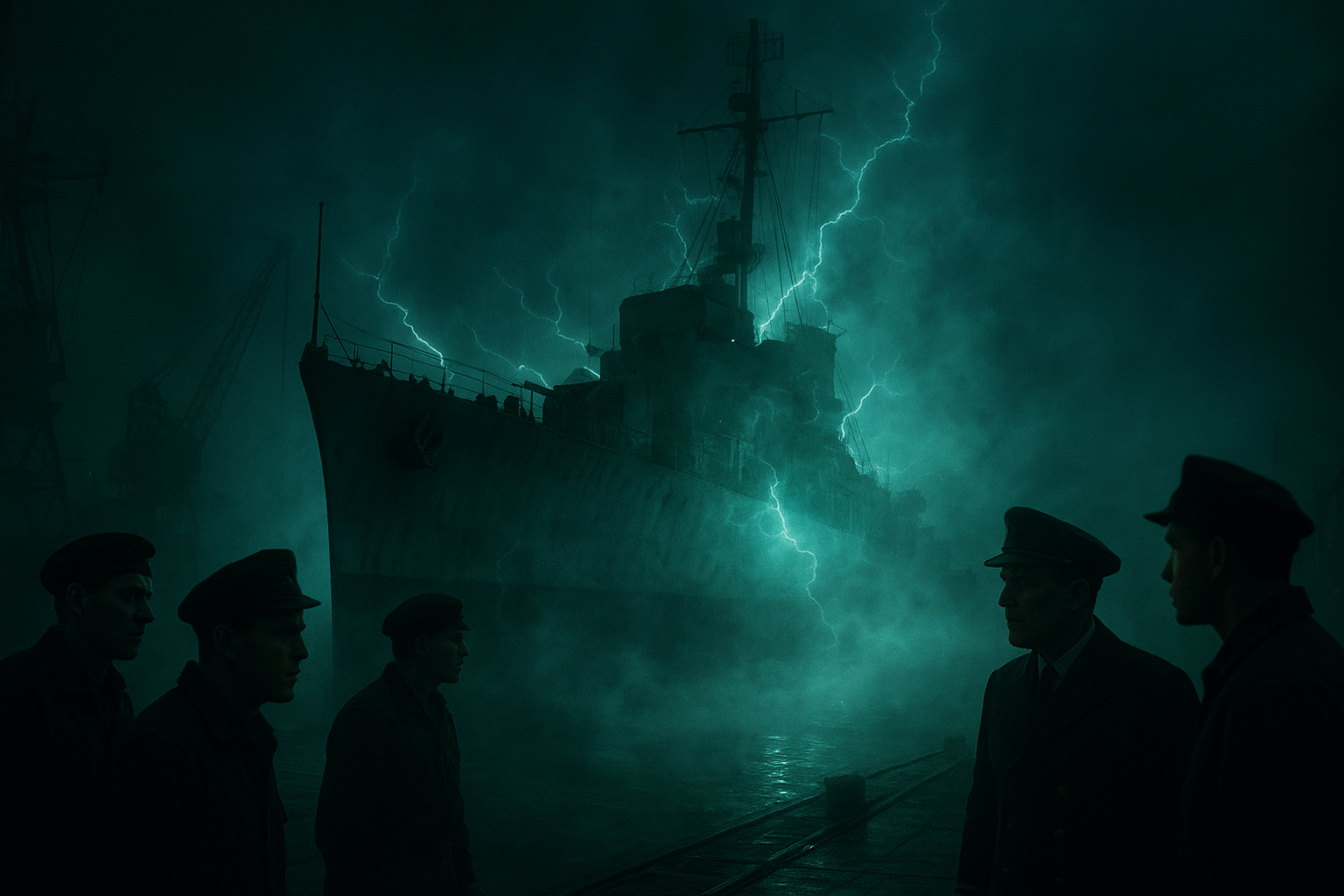
At the edge of the Philadelphia Navy Yard, the story says, a warship began to hum.
Men on the dock watched the gray outline of the vessel blur in a strange green haze. Metal seemed to bend into fog. The ship that had been there a moment earlier was suddenly, impossibly, gone. Then, according to the legend, it appeared hundreds of miles away in Norfolk before snapping back to Philadelphia with its crew shattered, sick, and in some versions, fused into the steel itself.
That is the nightmare at the center of the Philadelphia Experiment. Not just a missing ship. Not just a secret test. A story about wartime science crossing a line no one could uncross.
The Philadelphia Experiment is the famous claim that the U.S. Navy made the USS Eldridge vanish during a secret World War II experiment in 1943. The story still matters because it sits in the uneasy space between real wartime secrecy, misunderstood technology, and a legend that kept growing every time someone tried to bury it.
It belongs beside other strange government-secrecy stories like the hidden postwar deal that brought dangerous knowledge into America, because both ask the same uncomfortable question: when governments are afraid enough, what will they risk behind closed doors?
The Dockyard Legend That Refused to Die
The setting is what gives the Philadelphia Experiment its first spark of believability. World War II was not quiet for American shipyards. German U-boats stalked the Atlantic. Radar, sonar, magnetic mines, and experimental communications were no longer science fiction. They were survival tools.
So when people hear that the Navy may have tried something strange in 1943, the idea does not feel impossible at first. The military really was testing new technology. Projects really were classified. Sailors really did work around equipment they did not fully understand.
But the Philadelphia Experiment goes much further than a classified test.
In the famous version, the Navy wanted to make a ship invisible to enemy radar. The experiment supposedly involved powerful electromagnetic fields wrapped around the USS Eldridge, a destroyer escort. The goal, believers say, was not magic. It was camouflage — a way to bend light, radar, or magnetism so the ship could not be seen.
Then the story turns darker.
The field allegedly worked too well. The ship did not simply disappear from radar. It vanished from sight. Some versions say it teleported to Norfolk, Virginia. Others say the crew suffered madness, burns, nausea, or bodies trapped inside metal bulkheads. Every retelling adds another layer of dread, as if the ship came back carrying something the Navy never wanted the public to understand.
What the Official Record Actually Shows
The USS Eldridge was real. It was a Cannon-class destroyer escort built for war. It served in the U.S. Navy and later in the Greek Navy. Its existence is not in question. The trouble begins with what people claim happened to it.
There is no solid documentary evidence that the Eldridge vanished, teleported, or was used in an invisibility experiment. Navy records do not support the famous October 1943 story. The ship’s known service history does not line up cleanly with the legend’s most dramatic claims. Former crew members rejected the story.
One of the biggest pieces is degaussing.
Degaussing was a real naval process used to reduce a ship’s magnetic signature. Ships could be wrapped with electrical cables to make them less vulnerable to magnetic mines. To someone who did not understand the system, the equipment might have looked bizarre: heavy cables, electric current, strange procedures, men working around a ship as if they were charging it with invisible power.
But degaussing did not make ships vanish. It did not bend space. It did not teleport crews through time. It made a vessel less magnetically detectable to certain weapons.
The Letters That Turned a Rumor Into a Case File
The Philadelphia Experiment did not explode into public imagination because of a Navy report. It grew from strange letters, fringe claims, and a man named Morris K. Jessup.
Jessup wrote about UFOs and unusual scientific possibilities in the 1950s. After publishing work about anti-gravity and unexplained technology, he reportedly received letters from a man identifying himself as Carlos Miguel Allende, also known as Carl Allen. These letters claimed the Navy had already achieved something extraordinary during the war.
Allende said he had witnessed, or knew of, the USS Eldridge experiment. His descriptions were dramatic and unsettling: invisibility, teleportation, and terrible effects on sailors. The letters read less like a calm witness statement and more like a warning from someone who believed he had seen forbidden science.
An annotated copy of Jessup’s book appeared, filled with odd notes and references to hidden knowledge. The Office of Naval Research became aware of it and had copies made. To believers, this looked like proof that the Navy was interested because the claims were true. To skeptics, it looked more like officials examining a bizarre document connected to fringe science.
Either way, the paper trail gave the legend weight. Suddenly the story had names, letters, a real author, and a government office — enough fragments to make people wonder what else might be missing.
Timeline of the Philadelphia Experiment Legend
- 1943: The alleged experiment is said to happen at the Philadelphia Naval Shipyard, usually involving the USS Eldridge and a supposed disappearance or teleportation event.
- World War II era: The Navy uses real technologies such as radar research, shipboard electronics, and degaussing, creating a believable background for later rumors.
- 1950s: Morris K. Jessup receives letters from Carlos Allende/Carl Allen describing the alleged experiment and its horrifying consequences.
- Mid-1950s: The annotated Jessup book draws attention, feeding the idea that officials may have taken the claims seriously.
- Later decades: Books, interviews, and films turn the Philadelphia Experiment into a major American conspiracy legend.
- Modern view: Historians, Navy records, and crew statements strongly dispute the disappearance story, while the legend survives as a case study in secrecy, rumor, and distrust.
Claim vs. Record: Where the Story Breaks Apart
The most powerful conspiracy stories often survive because they are built around a small real object. In this case, the real objects are the ship, the war, the degaussing technology, the letters, and the government interest in strange documents. Those pieces are real enough to keep the door cracked open.
But the larger claim has serious problems.
- The ship’s movements do not match the legend cleanly. The most dramatic versions conflict with known records.
- There is no verified crew testimony supporting the horrific effects. Stories of sailors fused into metal are vivid, but not backed by reliable evidence.
- Degaussing explains some of the strange technology without requiring invisibility. Real electromagnetic equipment could be misunderstood or exaggerated.
- The main witness trail is unstable. The Carlos Allende/Carl Allen letters are central, but they are not documented proof.
- The legend grew through retelling. Books, television, and movies made the details more polished and extreme.
That does not make the story meaningless. It makes it revealing.
Why People Still Believe Something Happened
People believe because history has taught them that governments do keep secrets. The Manhattan Project was real. Covert intelligence programs were real. Human experimentation scandals were real. Classified aircraft, hidden surveillance, and strange military research did happen. When the public learns about those things later, the line between documented secrecy and rumored secrecy starts to blur.
That is why this story connects so naturally to Project Blue Book and the government files that shaped America’s UFO obsession. In both cases, the official record does not stop the questions. Sometimes it creates new ones. People do not just ask, “What happened?” They ask, “What was left out?”
The Philadelphia Experiment also has a perfect horror-story shape. A ship. A crew. A secret switch thrown in wartime. A moment when science does not fail quietly, but opens a door it was never supposed to open. That image is hard to kill, even when the evidence is weak.
Documented Secrecy vs. Disputed Legend
The strongest way to understand the Philadelphia Experiment is not to treat it as either pure fact or pure nonsense. It sits between two different kinds of stories.
On one side are documented secret programs. These have records, timelines, witnesses, budgets, and later confirmations. Operation Paperclip, for example, was not a ghost story. It was a real postwar program with real names, real moral compromises, and a legacy that still makes people uncomfortable.
On the other side are disputed legends. These may grow from real anxiety, real technology, or real secrecy, but the central claim remains unsupported. The Philadelphia Experiment belongs closer to this side. It has atmosphere, fragments, and a cultural footprint. But the vanishing ship itself remains a claim without the kind of proof such an extraordinary event would need.
That distinction matters because conspiracy history gets dangerous when every rumor is treated like a hidden fact. The better question is not, “Can we make the legend sound scarier?” It is, “What made this legend feel believable to so many people?”
What Makes This Case So Strange
The strangest part is how durable the story became.
It survived official denials. It survived skeptical investigations. It survived contradictions in the timeline. It survived because it offered a story people were already prepared to believe: that somewhere behind the public version of history, scientists and military officials were testing things too dangerous to admit.
That is why the Philadelphia Experiment still gets discussed alongside stories like the secret mind-control program that blurred the line between research and cruelty and the airport conspiracy that turned tunnels and symbols into a national obsession. Some stories are documented. Some are symbolic. Some are misunderstandings that become myths. But all reveal what people fear powerful institutions might be hiding.
The Legacy of a Ship That Probably Never Vanished
Today, the Philadelphia Experiment is best understood as a military legend built around real wartime conditions and later amplified by letters, books, and pop culture. The USS Eldridge did not need to disappear for the story to become powerful. It only needed to exist in a moment when the world was already full of machines, codes, weapons, and secrets ordinary people could not see.
The official answer is clear: there is no credible evidence that the Navy made the USS Eldridge vanish. But the emotional answer is messier. The story remains because it gives shape to a suspicion that never fully went away — the suspicion that history’s strangest doors are not always locked because nothing is behind them.
FAQ
Was the Philadelphia Experiment real?
There is no credible evidence that the USS Eldridge vanished, teleported, or became invisible during a Navy experiment. The story appears to be a legend built from real wartime secrecy, misunderstood naval technology, and later claims that became more dramatic over time.
What ship was involved in the Philadelphia Experiment?
The ship most often named is the USS Eldridge, a real U.S. Navy destroyer escort from World War II. The ship existed, but the extraordinary claims about it disappearing from Philadelphia are not supported by reliable records.
Why do people still believe the Philadelphia Experiment?
People still believe it because the story grew from a believable atmosphere: classified wartime research, strange electromagnetic technology, and public distrust of government secrecy. Even without proof of teleportation, the legend feels like something that could have been hidden.
Continue exploring:
- The documented secret that makes this legend feel almost believable
- The government UFO files that kept America asking what was hidden
- The real mind-control program that proved some secrets were worse than rumors
- The airport mystery where symbols, tunnels, and distrust became a modern myth
- The internet rabbit holes where codes, videos, and rumors refused to settle
More Conspiracies & Theories stories:
For a wider path through government secrets, cover-ups, UFO files, and disputed legends, start with The Conspiracies & Theories Archive.