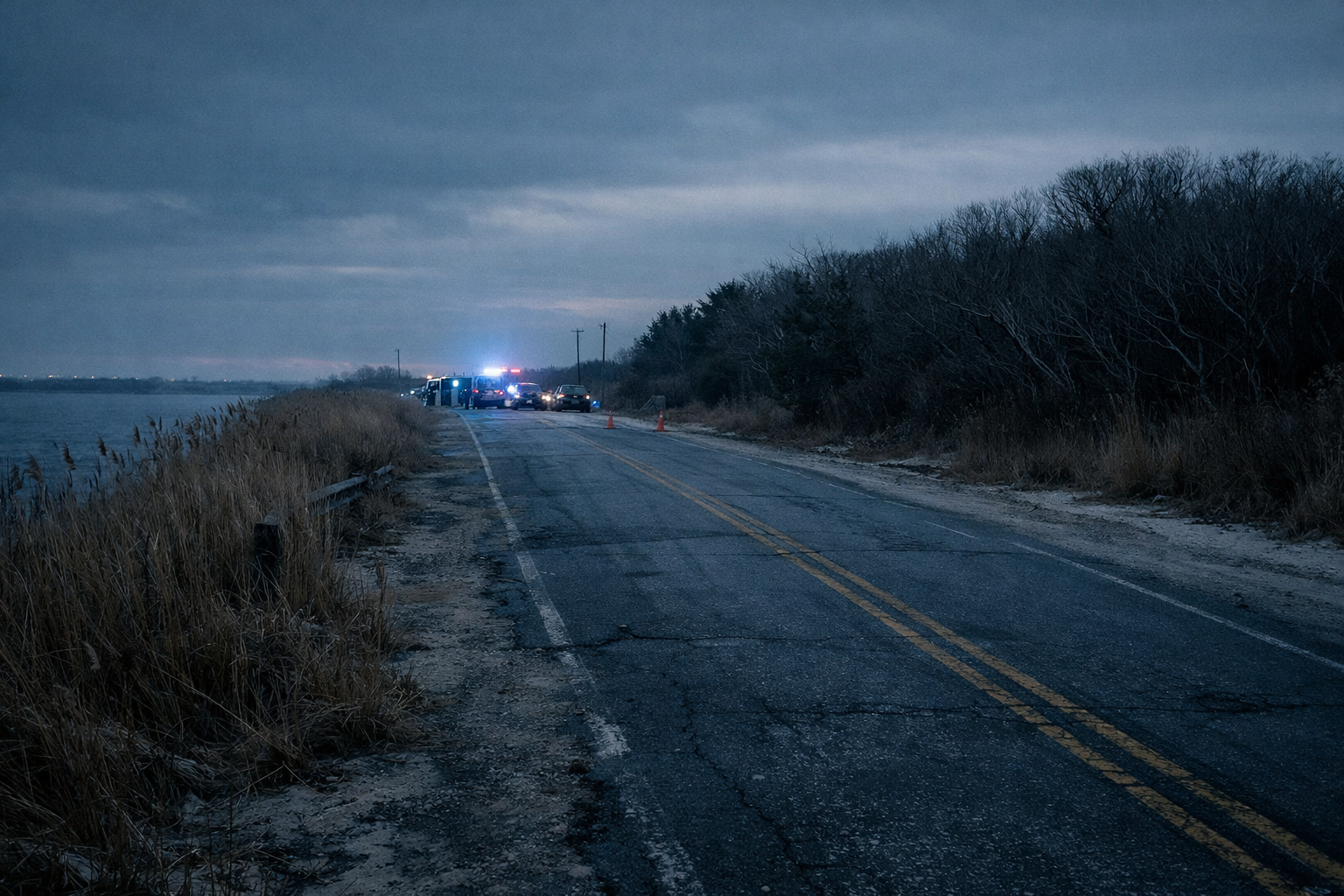
Ocean Parkway does not look like a place built for secrets.
In daylight, the road cuts across a thin strip of Long Island with water on one side, brush on the other, and the kind of empty sky that makes a drive feel calm. But in December 2010, a search along that road exposed something buried just beyond ordinary sight. What investigators found near Gilgo Beach turned a missing-person search into one of New York’s darkest true crime investigations.
The Long Island Serial Killer case, often called the Gilgo Beach murders, centers on multiple victims found along or near Ocean Parkway after the disappearance of Shannan Gilbert led police into the area. The case matters because it changed from an unidentified serial-killer mystery into a suspect-focused prosecution, while still leaving painful questions about victims, timelines, investigative delays, and whether every death belongs to the same story.
For readers who follow long-running investigations, Gilgo Beach sits beside other cases in the True Crime Archive because it shows how a case can stay cold in public memory, then suddenly begin moving again when old evidence is reexamined with new pressure.
The Search That Found More Than One Story
The first name many people remember is Shannan Gilbert. In May 2010, Gilbert vanished after a terrifying early-morning episode in Oak Beach. She called 911, sounded frightened, and ran through a neighborhood where no one seemed able to understand exactly what was happening in time to save her.
Months later, police searching for signs of Gilbert found something else near Gilgo Beach: human remains hidden in the roadside brush. Then they found more. The discovery did not feel like a single crime scene. It felt like a corridor.
The women later known as the Gilgo Four were Melissa Barthelemy, Maureen Brainard-Barnes, Megan Waterman, and Amber Lynn Costello. They were young women with families, fears, routines, children, histories, and people who waited for them to come home. Too often, the first public description reduced them to the circumstances that made them vulnerable. But that vulnerability was part of the horror. Predators often depend on society looking slowly, listening late, and treating some missing people as easier to ignore.
Ocean Parkway Became Part of the Fear
Some crime scenes feel contained. Gilgo Beach did not. The setting stretched along a road, through brush, sand, marsh, and quiet spaces where traffic could pass without anyone knowing what lay nearby.
That geography gave the case its atmosphere. Ocean Parkway became more than a location. It became evidence of confidence. Whoever placed victims there appeared to understand isolation, timing, and the way a body could be hidden in plain sight if the world did not look closely enough.
As the search expanded in 2011, investigators recovered additional remains in the wider area. Some discoveries seemed connected to the same pattern. Others raised harder questions. Was one killer responsible for all of them? Were there separate offenders using the same lonely landscape? Did the beach hide one story, or several overlapping tragedies?
Those questions are why Gilgo Beach stayed alive in public attention for years. It was not only a murder case. It was a map that refused to make itself simple.
The Victim Timeline Without Erasing the Victims
Melissa Barthelemy disappeared in 2009. After she vanished, her sister received taunting phone calls believed by many to be linked to the killer. That detail gave the case a cruel psychological edge. The person on the other end was not just hiding. He was stepping close to a family’s pain and enjoying the distance between fear and proof.
Maureen Brainard-Barnes, Megan Waterman, and Amber Lynn Costello each disappeared under circumstances that later drew investigators toward the same grim stretch of Long Island. Their cases showed the same broad danger: women contacted through escort work, moving through meetings where trust could collapse in seconds, then disappearing into a silence that families had to fight against.
Shannan Gilbert’s death remained separate and disputed in public discussion. Some believe she may have been connected to the larger series. Authorities have often treated her death differently from the Gilgo Four, and the debate around her case has never fully disappeared. In a mystery this large, uncertainty can become its own kind of haunting.
How the Investigation Changed
For more than a decade, the Long Island Serial Killer case existed as an unsolved shadow. There were theories about a local suspect, arguments about investigative missteps, questions about jurisdiction, and public frustration over how long the case seemed to drift.
Then, in 2023, authorities arrested Rex Heuermann, a Manhattan architect from Massapequa Park, and accused him in connection with several of the murders. The shift was jarring. The case that had lived for years as a faceless nightmare now had a name, a house, a commute, a profession, and a biography.
That is one reason the Rex Heuermann timeline became so important. It showed how investigators described the path from old victimology and roadside discoveries toward a modern prosecution built around phone activity, witness information, vehicle leads, digital behavior, and forensic claims.
The arrest did not erase the earlier uncertainty. It changed the center of gravity. The story moved from “Who was out there?” to “What can prosecutors prove, and which parts of the larger Gilgo Beach mystery remain outside the current charges?”
Key Evidence and Clues
The evidence discussed publicly in the Gilgo Beach investigation is not one magic clue. It is a pressure system made from many smaller pieces.
- Phone records and burner phones: Investigators described patterns involving communications with victims and activity that helped narrow focus.
- Vehicle information: Witness accounts and vehicle leads became part of the suspect-focused narrative.
- Digital trail: Searches, accounts, and electronic records became important in explaining how an old case could move forward years later.
- DNA and forensic material: Public filings have referenced DNA-related evidence, though the court process determines how evidence is challenged, admitted, and weighed.
- Victim overlap: Similar circumstances among the Gilgo Four helped investigators see a possible pattern rather than four disconnected disappearances.
That blend connects Gilgo Beach to broader cold-case work, where older investigations can change when science, databases, and patient reconstruction finally meet. The same kind of slow pressure drives many cases in the DNA Cold Case Archive and in stories about cold cases solved by DNA and genetic genealogy, even when each investigation has its own limits.
What Still Does Not Feel Settled
An arrest can make a case feel solved from a distance. Up close, Gilgo Beach is more complicated. There are still public questions about the full victim list, the relationship between different remains found along the barrier beach, and how many answers the current prosecution can realistically provide.
There is also the deeper question of delay. Why did it take so long for the case to reach this point? How many clues were waiting in files? How many assumptions slowed the response because the victims lived in ways the public finds too easy to judge?
That is where the case becomes larger than one defendant. The Long Island Serial Killer investigation is also a story about attention. It asks who gets urgent searches, who gets doubt, who gets blamed for their own danger, and how long families are expected to keep screaming before the world hears them.
Why the Case Still Gets Attention
Gilgo Beach keeps pulling people back because it has two kinds of fear. The first is obvious: the fear of a predator moving through ordinary places. The second is quieter: the fear that someone can vanish and be treated like a problem instead of a person.
The case also belongs to the same modern true-crime world as murder cases caught on surveillance footage, digital-trail investigations, and old serial-killer files because it shows how technology can both expose and deepen a mystery. Phones can point backward. Searches can leave marks. But none of it gives families back the years they lost.
That is why Ocean Parkway still feels charged. The road did not confess. It simply held the evidence until someone finally looked hard enough.
The Larger Shadow of Serial Killer Cases
The Gilgo Beach case also changed how people think about serial predators in modern life. The most frightening possibility was never that the killer looked like a monster. It was that he might look ordinary, live locally, understand the roads, and return to normal routines while families fell apart.
That fear echoes through the Serial Killer Archive, where the most disturbing thread is often the double life: the gap between the person the public sees and the harm investigators later allege or prove. Gilgo Beach fits that nightmare because the setting was not remote in the way people want evil to be remote. It was near homes, beaches, traffic, and familiar exits.
FAQ
What is the Long Island Serial Killer case?
The Long Island Serial Killer case refers to the investigation into multiple victims found along or near Gilgo Beach and Ocean Parkway on Long Island. The case began gaining national attention after a search for Shannan Gilbert led investigators to remains connected to other missing women.
Who were the Gilgo Four?
The Gilgo Four were Melissa Barthelemy, Maureen Brainard-Barnes, Megan Waterman, and Amber Lynn Costello. Their remains were found near one another along Ocean Parkway, and their cases became central to the Gilgo Beach murder investigation.
Has anyone been arrested in the Gilgo Beach murders?
Yes. Rex Heuermann was arrested in 2023 and accused in connection with several Gilgo Beach murders. The legal process is ongoing, and allegations must be tested in court.
Why did the Gilgo Beach case take so long?
The case involved years of fragmented evidence, difficult victim timelines, jurisdictional issues, and public questions about investigative delays. It also exposed how vulnerable victims can be overlooked until a case becomes impossible to ignore.
Is every body found near Gilgo Beach connected to one killer?
That remains one of the hard questions. Some victims are central to the same alleged pattern, while other remains found in the wider area have raised separate questions about whether the beach hid one offender’s crimes or multiple tragedies.
In the end, Gilgo Beach remains unforgettable because it began with one missing woman and opened into a landscape of hidden grief. A road that once looked ordinary became a witness. The brush held names. The sand held silence. And for years, families waited while the truth sat close enough for passing cars to move beside it without ever knowing.
Continue exploring:
- The archive of double lives, taunting clues, and serial predator investigations
- Cold cases where old evidence finally started speaking again
- Hollywood’s most infamous unsolved killing, still buried in shadows
- The coded taunts and clues behind the Zodiac Killer nightmare
- The final road trip that became a national true-crime reckoning
More True Crime stories: