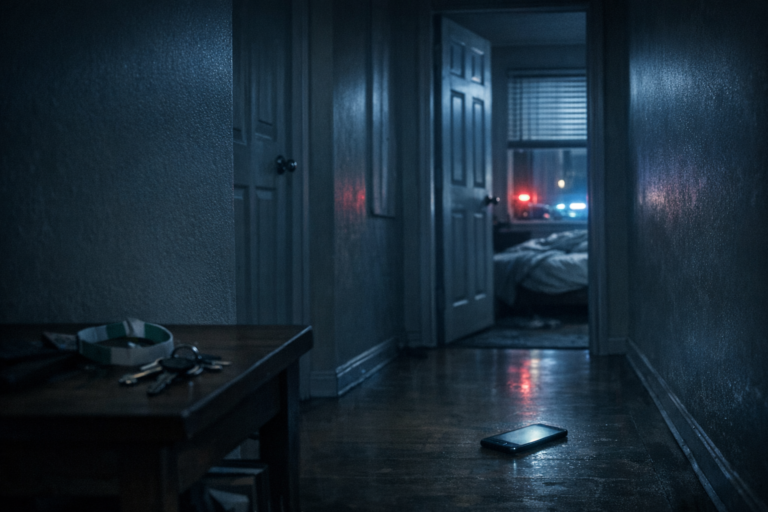
Before anyone opened the bathroom door, the house still felt ordinary.
It was a bright June morning in Mesa, Arizona. Outside, the street looked clean and calm, the kind of suburban block where every driveway and trimmed yard seems to promise that nothing truly terrible could be happening behind the walls. Travis Alexander was supposed to be preparing for a trip. He was supposed to be answering calls. He was supposed to be somewhere in motion, because that was the rhythm of his life.
Instead, his friends stood in uneasy silence, trying to explain away the feeling that something had gone badly wrong.
When they finally went inside, the first rooms did not look like a crime scene. There was no shattered furniture, no dramatic sign of forced entry, no chaos that announced itself from the doorway. That made the discovery even worse. The violence was not waiting in the open. It was deeper in the house, hidden behind the appearance of normal life. And once it was found, nothing about that home looked normal again.
The Travis Alexander murder case still grips people for that reason. It was not just a brutal killing. It was a story about intimacy turning into danger, about a relationship that kept pulling two people back toward each other even after it had already started to rot, and about the eerie piece of digital evidence that seemed to freeze the final minutes before everything collapsed.
If this story pulls you into the psychology of the trial as much as the crime itself, the companion piece on the Jodi Arias case goes deeper into the courtroom spectacle that followed.
The relationship that never really ended
To understand why the Travis Alexander case became so consuming for the public, you have to start before the murder. Travis and Jodi Arias met in 2006 at a conference tied to the sales world they both moved through. Travis came across as polished, ambitious, social, and intensely driven. Jodi entered that world with intensity of her own, and the connection moved fast.
But what followed was not stability. It was a loop of breakups, continued contact, jealousy, secrecy, and emotional pressure that never fully settled. Even after the official relationship ended, the bond did not really disappear. That unstable middle ground helps explain why the final violence never felt random. The murder of Travis Alexander did not look like a stranger walking in off the street. It looked personal from the start.
Timeline of Events
- 2006: Travis Alexander and Jodi Arias meet and begin a relationship.
- 2007 to early 2008: The relationship becomes increasingly turbulent, with breakups, continued contact, and emotional conflict.
- June 4, 2008: Travis is killed inside his Mesa, Arizona home.
- June 9, 2008: Friends concerned about Travis enter the house and find his body in the shower.
- After the discovery: Investigators recover a damaged digital camera and reconstruct deleted photos from the day of the killing.
- Trial years: The case becomes a national obsession as the evidence, competing narratives, and Arias’s changing explanations play out in public.
- 2013: Jodi Arias is convicted of first-degree murder.
- Later sentencing phase: After extended legal proceedings, she is ultimately sentenced to life in prison without release.
The quiet before the body was found
On the morning friends came looking for Travis, the first warning sign was absence. He had missed what he was supposed to do next. For someone who usually stayed connected, that silence did not feel small. It felt wrong.
That silence was the first fracture in the ordinary pattern of Travis Alexander’s life. Before the blood, before the camera, before the media spectacle, there was just a group of people realizing that one person had suddenly stopped acting like himself.
Inside the house, the scene changed instantly from worry to horror. Travis Alexander had been killed with extraordinary violence. He suffered multiple stab wounds, a gunshot wound, and a deeply cut throat. The injuries told a story of closeness and fury. From that point on, the question was not whether the killing had been intimate. It was how that intimacy had curdled into something so catastrophic.
The camera that refused to stay silent
Cases often turn on one hard piece of evidence that suddenly strips the mystery down to its bare frame. In the Travis Alexander murder, that piece of evidence was the digital camera found in the washing machine.
Whoever tried to destroy it almost succeeded. But almost is not enough in a murder case. Investigators recovered deleted photographs from the memory card, and those images changed everything. The photos placed Travis and Jodi together in the house on the day of the killing. They erased the simplest denial before it could survive for long.
Then the images became even more haunting. Some of them showed Travis alive in the bathroom shortly before the murder. Others blurred into accidental fragments during the violence itself, the kind of photographic evidence that feels less like documentation and more like a glitch in reality. The camera did not explain motive. It did not narrate the entire attack. But it did something almost as devastating. It anchored Jodi Arias to the final window of Travis Alexander’s life.
That is a big reason this case never faded into the background of routine true crime. The evidence did not just point to a suspect. It seemed to capture the atmosphere of the last minutes before the story went dark.
What doesn’t add up about the changing story
- The travel path mattered. Arias was supposed to be heading elsewhere, but the route investigators traced pulled her toward Travis’s home.
- The explanations kept changing. Denial, intruder claims, and self-defense did not emerge as one stable account. They shifted as pressure increased.
- The physical evidence pushed against self-defense. The severity of the wounds and the broader crime-scene pattern gave prosecutors a powerful argument that this was not a simple defensive act.
- The digital evidence cut through ambiguity. The recovered photos did not leave much room for distance between suspect and victim in the final hours.
- Post-crime behavior looked calculated. Investigators focused on details like the rental car, missing floor mats, and gas-can planning because those details suggested preparation rather than panic.
The case prosecutors built
Once investigators began stacking the evidence together, the broader theory came into focus. Prosecutors argued that jealousy, rejection, obsession, and emotional escalation had all been building beneath the unstable relationship. In that version of events, Arias traveled to Arizona, spent time with Travis in a setting that still looked intimate and ordinary, and then the tension snapped into violence.
That theory was powerful because it matched the emotional shape of the story. This was not a cold, faceless killing. The entire case felt loaded with grievance, humiliation, desire, control, and rage.
The defense fought back with a different picture. Arias ultimately claimed she had killed Travis in self-defense and portrayed him as abusive behind closed doors. But the prosecution had one enormous advantage: the injuries, the camera, the blood, the shifting explanations, and the suspicious travel pattern all pressed in the same direction. Even for people willing to entertain complexity in the relationship, the final violence still looked devastatingly hard to explain as self-defense.
Why the trial became such a national obsession
Some murder cases stay local. This one exploded.
Part of that came from the brutality. Part came from the almost unbelievable intimacy of the evidence. But a huge part came from Jodi Arias herself. She did not recede into silence the way many defendants do. She spoke publicly, offered shifting versions of events, and became a central presence in the story rather than a remote figure sitting wordlessly behind counsel.
That turned the courtroom into a kind of psychological theater. Viewers were not just hearing evidence; they were watching personality, contradiction, performance, and interpretation collide in real time. The public kept trying to answer the same question that haunted the jurors: what happened in those final minutes, and what kind of emotional storm had to be building for it to end that way?
Cases like the Casey Anthony case and the Scott Peterson case drew the country in for similar reasons: the crime was terrible, but the public obsession came from the gap between outward appearance and private collapse. The Travis Alexander case belongs in that same dark lineage.
Why this murder still lingers
At the center of all the media noise is one brutal truth: Travis Alexander let someone he knew into his home, spent time with her in what looked like an ordinary private moment, and then died in a scene so violent that it became impossible to forget.
That is what gives the case its lasting weight. It was not just savage. It was intimate. The atmosphere before the murder was calm enough for photos, conversation, and routine. Then the entire emotional architecture collapsed at once.
It also lingers because it sits inside a broader pattern of true crime stories where the most terrifying thing is not a monster coming from nowhere. It is the moment trust is already in the room. That is why readers who get stuck on this case often keep going into stories like the Chris Watts case or the broader family murder cases where ordinary homes became crime scenes.
Travis Alexander’s case is remembered for the blood, the wounds, the photographs, and the trial. But what truly stays with people is the quieter image that comes before all of that: a normal-looking house, a man with plans still ahead of him, and a final day that did not feel historic until it was already too late.
FAQ
What happened to Travis Alexander?
Travis Alexander was murdered inside his Mesa, Arizona home in June 2008. He was later found in the shower with multiple stab wounds, a gunshot wound, and a deeply cut throat, and the case quickly focused on his former girlfriend Jodi Arias.
Who killed Travis Alexander?
Jodi Arias was convicted of first-degree murder in the killing of Travis Alexander. The prosecution argued that the murder followed an obsessive and unstable relationship that had become increasingly volatile.
What evidence convicted Jodi Arias?
The most famous evidence was a damaged digital camera recovered from the washing machine. Investigators restored deleted photos that placed Arias with Travis inside the house on the day he was killed. Blood evidence, travel details, and her changing explanations also played major roles.
Why did the Travis Alexander case become so famous?
The case became famous because it combined extreme violence, an intimate and emotionally charged relationship, unusual digital evidence, and a trial that turned into a national media event. People were drawn in by both the brutality of the crime and the shifting stories told afterward.
Was the Travis Alexander murder case self-defense?
Arias claimed self-defense, but prosecutors argued the physical evidence strongly contradicted that explanation. The jury ultimately convicted her of first-degree murder.
🔎 If this story stayed with you, the author suggests these real cases next:
- The courtroom story of obsession, testimony, and the trial that kept twisting in public
- Another case where a familiar home became the last place a family looked safe
- A marriage, a missing woman, and a murder trial the country could not stop watching
- A high-profile death that turned into one of America’s most bitterly debated courtroom stories
- A deeper rabbit hole of family murders, fractured trust, and final hours that still haunt readers
Explore more True Crime stories here: