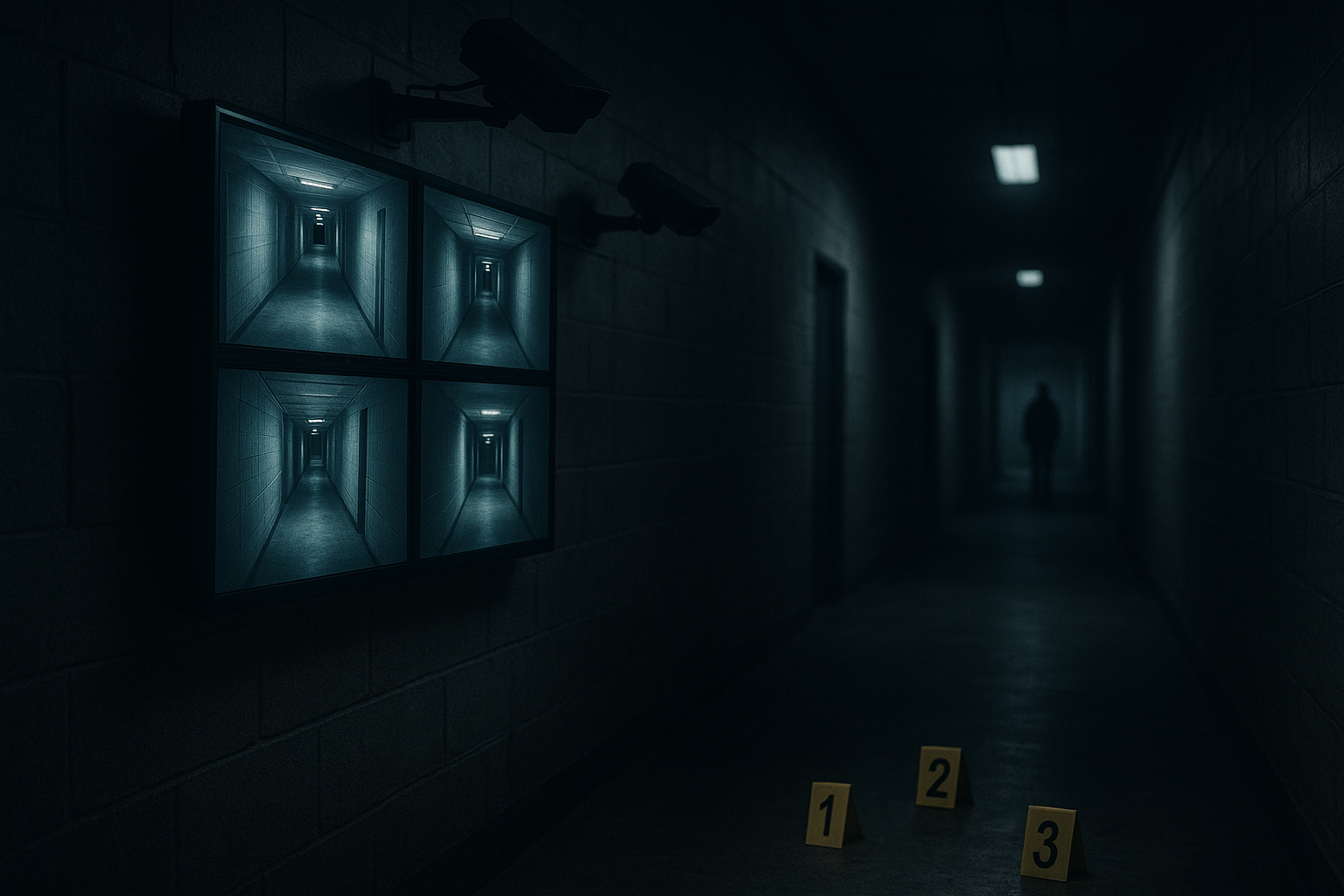
Surveillance footage is supposed to tighten a murder case. It gives investigators a hallway, a parking lot, a doorway, a church vestibule, a roadside stop, a timestamped digital trail, or a final recorded movement that feels close enough to truth to touch. But in some of the most compelling true crime cases, the camera does the opposite. It gives the public one visible fragment — one entry, one exit, one blind spot, one final ordinary moment — and then leaves the central question hanging in open air.
That is what this page covers. Not a generic roundup of famous murders. Not a catch-all list of notorious cases with video somewhere in the background. Crime investigations shaped by footage, security failures and reconstructed timelines. The selection includes an art theft and a DNA-led cold case as comparisons; several cases have reached legal or investigative conclusions. In some cases the footage captures the last known movement. In others it creates a timeline so sharp that the missing gap becomes even more disturbing. In others, the absence of one decisive camera angle becomes the most haunting clue of all.
They want the footage, the blind spot, the final sequence, the contradictory timeline, the moment where the investigation should have become easier and instead became stranger. Related disappearance stories include Jennifer Kesse Disappearance — The Woman Who Vanished in Broad Daylight, Rebecca Coriam Disappearance — The Cruise Ship Mystery Captured on Camera, and the broader visual-evidence roundup Disappearances Caught on Surveillance Footage: 9 Cases Where the Camera Recorded the Last Known Moment. Those pages examine partial visual records. A recording can establish a movement without revealing everything that followed.
Why Surveillance Evidence Changes the Way People Experience a Murder Case
Most murder stories reach readers through reconstruction: witness statements, police theories, forensic summaries, and courtroom narratives stitched together after the fact. Surveillance changes that experience. It turns the reader into a watcher. Instead of imagining the final stretch from scratch, they replay it. They pause the church footage. They map the digital timestamps. They study the route, the parking lot, the bodycam stop, the place where someone should have appeared on camera and did not. The investigation stops feeling purely verbal and starts behaving like a visible puzzle.
That visible puzzle is exactly why this angle builds authority. Readers who land on What Happened to Missy Bevers? The Church Surveillance Footage and Timing Questions That Still Haunt This Unsolved Murder often want another case where the recording deepened the mystery instead of solving it. Readers pulled into Bryan Kohberger Timeline Explained: The Idaho Murders, the Digital Trail, and the Night That Still Haunts the Case are already interested in how a case behaves when the digital trail becomes part evidence, part public obsession. And readers who stay with Karen Read Retrial — Why the John O’Keefe Case Is Back at the Center of True Crime are looking not just for guilt-or-innocence drama, but for the way timeline pressure changes everything once the visual record enters the fight.
This page also sits naturally beside larger archive hubs like The True Crime Archive — Unsolved Murders, DNA Breakthroughs, False Narratives, Retrials, and the Cases That Still Divide the Public and True Crime Cases Back in the Spotlight: Retrials, Appeals, and New Evidence That Reopened the Story. Those pages map major true crime patterns. This one drills into a narrower but highly bingeable evidence lane: cases where cameras, recordings, or visible timelines became the final witness and still left a core piece of the story unresolved.
Cases Where the Camera Changed the Murder Story
Missy Bevers
What Happened to Missy Bevers? The Church Surveillance Footage and Timing Questions That Still Haunt This Unsolved Murder is one of the clearest examples of a true crime case defined by surveillance imagery. The footage from inside the church does not simply support the investigation; it effectively became the case’s public face. Viewers can watch the figure moving through the building in tactical-looking gear, opening doors, lingering in hallways, and turning what should have been a routine early-morning setup into one of the most studied unsolved murder timelines on the site.
The camera seems to reveal so much while withholding the one thing everyone wants most: a clean explanation of identity, motive, and sequence. The gait analysis, the timing window, the strange calm of the intruder’s movement, and the mismatch between visible behavior and clear resolution are exactly what make this a surveillance-evidence case rather than just an unsolved murder page.
The key mystery point is brutal in its simplicity: the footage gave the public a moving suspect to examine and still failed to make the person legible enough to end the case.
Bryan Kohberger
Bryan Kohberger Timeline Explained: The Idaho Murders, the Digital Trail, and the Night That Still Haunts the Case belongs here because modern surveillance is no longer only a single CCTV clip. It is a chain of digital visibility: vehicle captures, route reconstruction, phone data, timeline compression, and the pressure that comes from stitching multiple sources into one narrative. In the Idaho murders, the surveillance and digital trail became central to how the public understood the case before Kohberger pleaded guilty in July 2025 and received four consecutive life sentences without parole.
That makes it a perfect fit for this hub. Kohberger’s case shows the twenty-first-century version of the same obsession found in older camera mysteries: a sequence of recorded traces examined alongside other evidence. His conviction is established; public questions about motive do not undo it. A white sedan on a route can feel almost as haunting as a hallway clip when the unanswered gap is what happened between the timestamps.
The lesson is that video and phone records must be evaluated with the rest of the evidence.
Gabby Petito
Gabby Petito Case — What Happened During Her Final Days fits this collection because the case became inseparable from visible evidence. Bodycam footage, roadside encounters, travel documentation, public sightings, and the final-days timeline changed how millions of people consumed the story. Instead of hearing only about a disappearance that turned into a homicide case, readers were drawn into a visual reconstruction of a relationship under pressure and a final stretch that still feels unbearably close to intervention.
In January 2022, the FBI concluded that Brian Laundrie was responsible for Gabby’s death, citing his written admission and other evidence. It expands the angle from “camera caught the suspect” to “the visual timeline changed everything about how the public interpreted danger, control, and missed warning signs.”
The key mystery point is not whether the tragedy was recorded in one perfect clip. It is how much of the final emotional atmosphere became visible before the full truth was known — and how difficult it is to watch that visibility now without feeling the weight of what went unprevented.
The Gardner Museum Heist
The Gardner Museum Heist: The 81 Minutes That Emptied a Museum and Left 500 Million Missing is not a murder case, but it belongs inside this surveillance-evidence collection because it shows another version of the same psychological mechanism: a crime committed in a monitored environment where the visual record should have narrowed uncertainty more than it ultimately did. The famous museum robbery remains one of the site’s strongest camera-and-blind-spot stories, and it serves as a useful bridge between homicide investigations and other true-crime mysteries built around controlled spaces.
The FBI says the thieves took the robbery-night surveillance recording. The footage released in 2015 showed the preceding night. Surveillance does not only matter when it catches the final victim movement. It matters whenever a supposedly secure, visible environment still allows the central act to slip into legend. Readers who arrive through Gardner are often primed for murder cases where the same contradiction appears: strong setting, visible infrastructure, incomplete answer.
The key mystery point is that security architecture creates the illusion of inevitability. When the truth still escapes, the missing piece feels larger, not smaller.
Houston Lovers’ Lane Murders
Houston Lovers Lane Murders: This is a DNA-led comparison, not a case solved by surveillance footage. Cheryl Henry and Andy Atkinson’s 1990 murders led to a capital-murder charge against Floyd William Parrott in March 2026 after a DNA match. Parrott died in custody before trial.
That fits the hub’s documentary framing. Not every surveillance-evidence case is pure footage. Some belong because they operate on the same emotional circuitry: a known route, a compressed final timeline, a setting that feels close enough to visibility to hurt, and a question about what was missed in the crucial interval.
The charge was never tested at trial; Parrott was not convicted of these killings.
Karen Read
Karen Read Retrial — Why the John O’Keefe Case Is Back at the Center of True Crime belongs here because surveillance-style evidence is one of the reasons the case refuses to cool. This is not a simple CCTV mystery. It is a timeline war. Vehicle movement, weather conditions, party departures, phone activity, and the visual logic of the scene all combine into a modern true-crime argument where the question is not just what happened, but whether the visible and physical record supports the official story cleanly enough to survive relentless scrutiny.
On June 18, 2025, the retrial ended with acquittals on the homicide and leaving-the-scene charges, and a drunken-driving conviction. Readers return because they are not only following the courtroom. They are following the sequence — the part of the case that can be reconstructed, challenged, reinterpreted, and replayed.
The verdict resolved the criminal prosecution. Competing accounts of John O’Keefe’s death must still be attributed rather than treated as established fact.
What These Cases Have in Common
What connects these cases is not one victim profile, one suspect type, or one legal outcome. It is the failure of visibility to create closure on its own. The church footage in Missy Bevers gave movement without identity. Kohberger’s digital trail became part of a prosecution ending in conviction. Gabby Petito’s case gave the public visible warning signs without granting the power to stop what was coming. The Gardner Museum Heist proved that even high-security environments can turn into blind-spot legends. Houston Lovers’ Lane illustrates a DNA breakthrough followed by the suspect’s death before trial. Karen Read’s retrial illustrates how disputed timelines are tested in court; its criminal verdict is no longer pending.
This is why surveillance-driven true crime pages behave differently from broad crime lists. Readers are not just drawn by horror. They are drawn by the visible threshold — the point where the story feels one camera angle, one minute, one better recording, or one missing frame away from clarity. That is the same instinct that makes readers binge into Jennifer Kesse Disappearance — The Woman Who Vanished in Broad Daylight, Rebecca Coriam Disappearance — The Cruise Ship Mystery Captured on Camera, and the disappearance hub Disappearances Caught on Surveillance Footage: 9 Cases Where the Camera Recorded the Last Known Moment. Across categories, the question is the same: why did visibility fail?
There is another reason these cases stay sticky in memory. Surveillance looks objective. It feels more trustworthy than rumor, more stable than witness recollection, more final than commentary. But footage is never total. It gives angle, not omniscience. It gives timing, not motive. It gives movement, not the missing event just beyond the frame. When the public mistakes visibility for completeness, these cases become especially haunting, because they expose how much can remain unknowable even after the camera has done its part.
That partial certainty is exactly what makes the best surveillance-based true crime pages so bingeable. They create a reader habit that ordinary case files do not. People replay the visible fragment, then go looking for the next case where one image, one route, one bodycam interaction, one security failure, or one compressed timeline produced the same unresolved pressure. In editorial terms, that is powerful because it creates a recognizable sub-cluster: camera-led mystery, blind-spot mystery, and timeline-led suspicion all feeding one another instead of sitting as isolated posts.
It also creates a strong bridge between categories that might otherwise feel separate. A reader can move from a murder page like Missy Bevers to a disappearance page like Jennifer Kesse because the connective tissue is evidence behavior. The camera witnessed something vital and still did not finish the story. That same reader can then move into broader archive pages, including The True Crime Archive — Unsolved Murders, DNA Breakthroughs, False Narratives, Retrials, and the Cases That Still Divide the Public, where surveillance-heavy cases sit beside DNA cases, retrial cases, and narrative-fracture cases as part of a larger true crime system.
This is also where the hook becomes SEO clarity. People searching for surveillance-footage murders are often not looking for one victim or one suspect first. They are looking for a pattern: cases where the recording exists, the public has seen it or knows about it, and the visual evidence changed the emotional weight of the investigation. That is why this page can rank as a hub rather than just another case summary. It gives searchers the pattern and then routes them into the strongest single-story pages.
It gives the site a dedicated evidence-analysis lane that bridges murder coverage, reopened-case interest, and adjacent disappearance reading patterns. Someone who enters through Missy Bevers can move to Jennifer Kesse. Someone who arrives through Karen Read can move into broader timeline and retrial investigations at True Crime Cases Back in the Spotlight: Retrials, Appeals, and New Evidence That Reopened the Story. Someone pulled in by Gardner’s security paradox can branch into The True Crime Archive — Unsolved Murders, DNA Breakthroughs, False Narratives, Retrials, and the Cases That Still Divide the Public or forensic-return cases like The DNA Cold Case Archive — Murders Solved by Genetic Genealogy, Family Trees, and Evidence That Waited Decades to Speak. The internal structure makes sense because the reader’s obsession makes sense first.
Conclusion
The most unsettling surveillance-driven true crime stories are not the ones with the least evidence. They are the ones with visible evidence that still refuses to finish the job. A church corridor, a traffic route, a bodycam stop, a museum security failure, a lovers’ lane timeline, a winter-night sequence under legal attack — each case offers a recorded threshold that feels close to explanation and remains painfully incomplete.
The footage survives. The missing frame does not. And that split between what can be replayed and what still cannot be fully known is exactly why readers keep coming back.
Research Sources
The following resources were consulted to verify and update this article.
- Midlothian Police Department — Missy Bevers Murder Investigation
Police account of church footage and the limits of gait and height estimates. - Idaho Attorney General — Life Sentences for Bryan Kohberger
Confirms the July 2025 sentence and the completed prosecution. - FBI — Final Investigative Update on Gabrielle Petito Case
Establishes Laundrie’s responsibility and the investigation’s conclusion. - FBI — Historic Footage Connected to Gardner Museum Burglary Released
Distinguishes the preceding-night footage from the stolen robbery-night recording. - KPRC 2 — Family of Lover’s Lane murder victims react to suspect’s jail death
Reports the DNA-linked charge and Parrott’s death before trial. - WBUR / Associated Press — Key takeaways from the acquittal of Karen Read
Reports acquittals, the OUI conviction and disputed trial narratives.
🔎 If this story stayed with you, the author suggests these deeper investigations next:
- The True Crime Archive — Unsolved Murders, DNA Breakthroughs, False Narratives, Retrials, and the Cases That Still Divide the Public
- True Crime Cases Back in the Spotlight: Retrials, Appeals, and New Evidence That Reopened the Story
- The DNA Cold Case Archive — Murders Solved by Genetic Genealogy, Family Trees, and Evidence That Waited Decades to Speak
Explore more True Crime stories here: