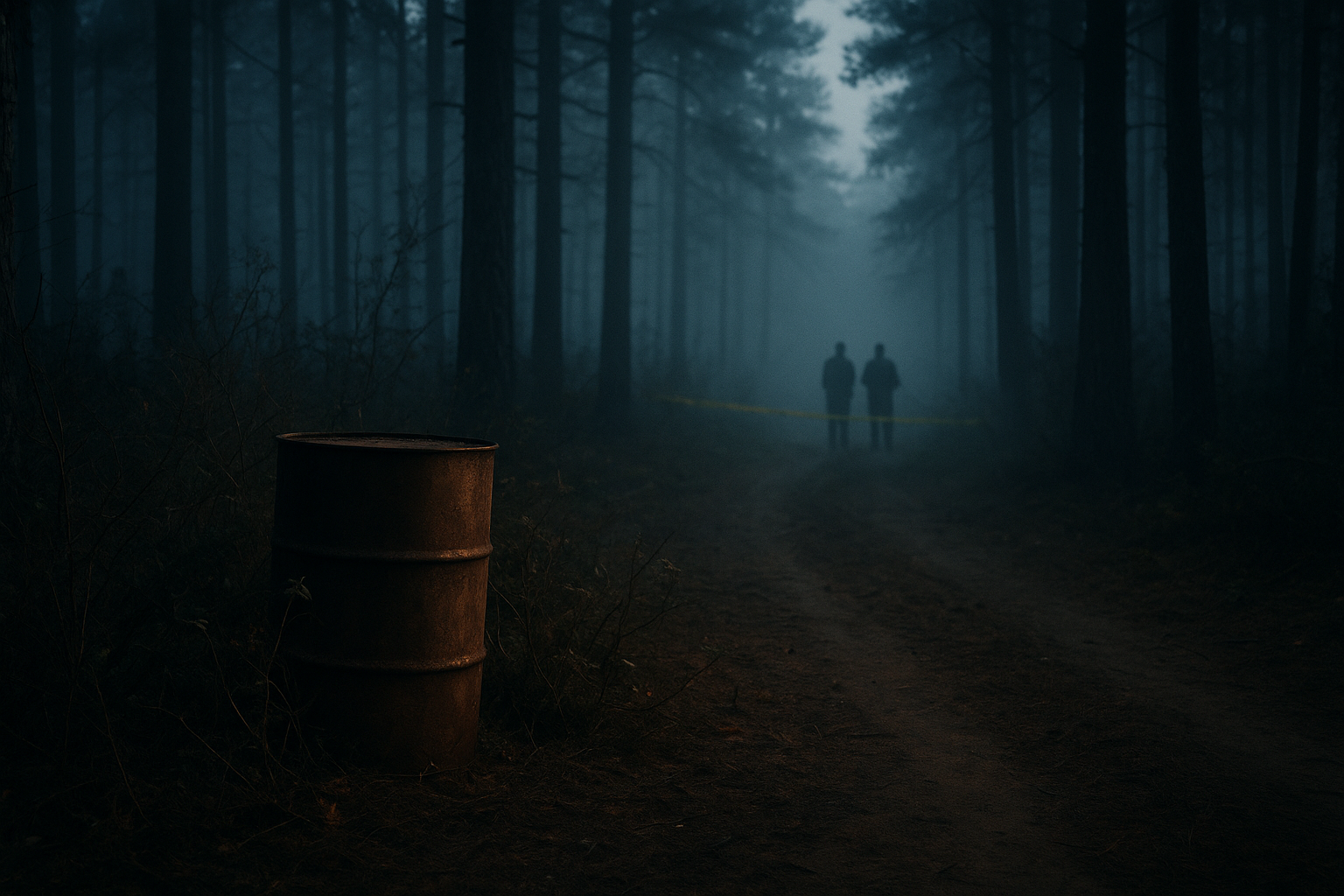
The first barrel was sitting in the New Hampshire woods like trash someone expected the forest to swallow.
It was November 1985, near Bear Brook State Park in Allenstown, and the trees had already begun closing around the season. A hunter saw the metal container, looked closer, and stepped into a story that would take decades to untangle. Inside were the remains of a woman and a little girl. No names. No obvious history. Just two lives hidden so carefully that even the ground seemed to have kept the secret.
The Bear Brook murders became one of America’s most haunting true crime cases because the mystery was not only who killed the victims. For years, investigators could not even say who the victims were. The case would eventually connect a vanished family, a serial predator, and one of the most important DNA cold case breakthroughs in modern forensic genealogy.
It belongs beside other cases where time, science, and stubborn investigators dragged answers out of silence, including the DNA cold case archive of murders solved through family trees and old evidence.
The Barrel in the Woods
At first, the scene looked brutally simple. A barrel had been dumped in the woods. Inside were two bodies: one adult woman, one child. Investigators believed they had been dead for years before anyone found them.
But simple is not the same as solvable. There was no wallet, no paperwork, no abandoned car nearby, and no name stitched into the scene. Detectives compared the remains to missing-person reports and dental records, waiting for someone to recognize the case and call in. Almost nobody seemed to be looking in the right place.
That absence became one of the most disturbing parts of Bear Brook. The victims were not just killed. They had been cut loose from every system that should have noticed them.
Fifteen Years Later, the Woods Answered Again
Then, in 2000, the case changed shape.
Near the same area where the first barrel had been found, investigators discovered a second barrel. It had been out there for years, concealed by brush and weather and ordinary neglect. When it was opened, police found the remains of two more young girls.
That turned the case from one terrible discovery into something much larger. Four victims. One adult woman. Three children. Two barrels. Same remote patch of New Hampshire woods.
The odds of coincidence disappeared.
Now investigators were looking at a connected group, likely a family or a family-like unit. The adult woman and at least some of the children appeared to belong together somehow. But the details refused to settle. The girls were different ages. The relationships were not immediately clear. And the longer police looked, the more the case felt less like a single murder scene and more like the final page of a much longer hidden life.
The forest had given up the bodies. It had not given up the story.
The Victims Without Names
For years, the Bear Brook victims were known through descriptions instead of identities. That is a different kind of cruelty. A murder can take a life in one moment, but anonymity keeps taking from the victim afterward. It takes the birthday. The voice. The family photographs. The little details that make a person more than evidence.
Investigators believed the adult woman was connected to at least two of the children, but the fourth child did not fit as cleanly. DNA testing eventually showed that one of the girls was not biologically related to the woman or to the other two children. That single fact complicated everything.
If this was a mother and her daughters, who was the other girl? Was she a stepchild? A child from another relationship? A child traveling with the group for reasons nobody had documented? Or was she evidence that the man at the center of the case had left behind more victims, more aliases, and more broken families than anyone knew?
The case carried the same grim pressure found in many cold cases solved years later through preserved evidence: the answers were there, but they were trapped inside fragments no one yet knew how to read.
The Man With Too Many Names
The name that eventually emerged was Terry Peder Rasmussen.
Rasmussen was not famous when the Bear Brook barrels were found. He was not a household name. That was part of what made him dangerous. He moved through ordinary spaces under different identities, slipping into relationships, leaving jobs and towns and women behind, and then becoming someone else somewhere new.
To one person, he was a boyfriend. To another, a coworker. To another, a man with a different name and a different story. People like that do not always look monstrous from a distance. Sometimes they look forgettable enough to be trusted.
Rasmussen’s trail kept leading back to missing women and children. He had lived under aliases and was eventually convicted in California for the murder of Eunsoon Jun, a woman he had known while living as Larry Vanner. That conviction put him in prison, but it did not fully reveal who he had been before.
For readers who follow predator cases built around double lives and hidden violence, Bear Brook sits in the same dark territory as the serial killer archive of double lives, DNA breakthroughs, and ordinary men who were anything but ordinary.
The DNA Breakthrough That Changed the Case
What made Bear Brook historic was not just that DNA helped identify a suspect. It was how DNA began to restore identities to victims who had been unnamed for decades.
Traditional identification methods had hit wall after wall. Then genetic genealogy opened a different door. Instead of needing a direct match, investigators could compare DNA to family lines, distant relatives, and branching trees of people connected by blood.
The adult woman was identified as Marlyse Elizabeth Honeychurch. Two of the girls were identified as her daughters, Marie Elizabeth Vaughn and Sarah Lynn McWaters. Suddenly the case was no longer only “the bodies in the barrels.” It was Marlyse. Marie. Sarah.
The fourth child remained unidentified longer, and that made her presence even more heartbreaking. Investigators eventually learned she was Rasmussen’s biological daughter. She was later identified as Dawn Elaine Rasmussen.
That answer closed one door and opened another. Dawn was not just near Rasmussen. She came from him. And yet even that biological connection did not explain how she ended up dead in a barrel with Marlyse and her daughters. The identification gave her back a name, but it could not give back every missing hour.
Timeline of the Bear Brook Murders
- Late 1970s to early 1980s: Investigators believe the victims were killed years before the first barrel was discovered.
- November 1985: A barrel is found near Bear Brook State Park in Allenstown, New Hampshire. Inside are the remains of an adult woman and a young girl.
- 2000: A second barrel is discovered nearby, containing the remains of two more young girls.
- 2010: Terry Peder Rasmussen dies in prison while serving time for a separate murder conviction.
- 2017–2019: Genetic genealogy and renewed forensic work help identify Marlyse Honeychurch, Marie Vaughn, Sarah McWaters, and eventually Dawn Rasmussen.
The timeline matters because the case existed in pieces. The bodies were found in two stages. The suspect was understood in fragments. The victims were named only after decades of work. Bear Brook was not solved in one dramatic moment. It was untangled slowly.
Key Evidence and Clues
- The two barrels: Their proximity strongly suggested the victims were connected and that the killer knew the area well enough to use it as a hiding place.
- The victim relationships: DNA showed Marlyse was the mother of Marie and Sarah, while Dawn had a different connection as Rasmussen’s biological daughter.
- Rasmussen’s aliases: His history of false identities helped explain how people could vanish around him without one clean paper trail following him.
- Genetic genealogy: Family-tree research became the tool that finally gave the victims their names back.
- Rasmussen’s silence: His death meant investigators could never force him to answer the questions only he may have known.
That is why Bear Brook still feels unfinished even after the identifications. The science answered who. It pointed strongly toward how the lives intersected. But it could not replay the final days in the house, the car, the room, or wherever the violence began.
What Still Doesn’t Add Up
The biggest unanswered question is not whether Rasmussen was central to the case. The evidence points directly at him. The harder question is how many other lives he damaged while hiding behind names that were never really his.
He moved from place to place, attached himself to women, and carried stories that were hard to verify and easy to abandon. That mobility is exactly what makes older cases difficult. Bear Brook also forces a painful question about visibility: how did a woman and three children disappear so completely that it took decades to identify them?
Those questions are what connect Bear Brook to wider true crime history, including cases like the Long Island Serial Killer investigation, where buried patterns and overlooked victims became part of the horror.
Why Bear Brook Still Haunts People
Some cases stay with the public because the crime is shocking. Bear Brook stays because the silence around the crime lasted so long.
The setting sounds almost peaceful: a state park, trees, trails, families passing through New Hampshire without knowing what the woods held. But under that ordinary landscape were four hidden victims waiting not only to be found, but to be recognized.
That recognition matters. It is the difference between evidence and memory. Between “unidentified remains” and a mother named Marlyse, children named Marie and Sarah, and a little girl named Dawn.
There was no perfect ending. Rasmussen died before a full public accounting. But the work still proved something important: time does not always win. Old evidence can wait quietly for the right science. A killer’s lies can outlive him, but not necessarily forever.
That is the strange power of the Bear Brook murders. The case begins with rusted barrels in the woods, but it ends with names being spoken again.
FAQ
What were the Bear Brook murders?
The Bear Brook murders were the killings of Marlyse Elizabeth Honeychurch, her daughters Marie Elizabeth Vaughn and Sarah Lynn McWaters, and Dawn Elaine Rasmussen. Their remains were found in two barrels near Bear Brook State Park in Allenstown, New Hampshire, in 1985 and 2000.
Who was the suspect in the Bear Brook murders?
Terry Peder Rasmussen is believed to be responsible. He used multiple aliases, was connected to other crimes, and was later identified as Dawn Rasmussen’s biological father. He died in prison in 2010 while serving time for another murder.
How were the Bear Brook victims identified?
The victims were identified through a combination of forensic investigation, DNA testing, and genetic genealogy. Researchers used family connections and DNA comparisons to rebuild identities that had been missing for decades.
Is the Bear Brook case fully solved?
The victims have been identified and Rasmussen is considered the central suspect, but many details remain unanswered. Because Rasmussen died before fully explaining what happened, the final days of the victims’ lives may never be known completely.
Continue exploring:
- Step into the wider true crime archive of unsolved murders, DNA breaks, and cases that still divide people
- Follow more cases where family-tree DNA finally made old evidence speak
- Read the cold cases that waited years before the truth started moving again
- See how the Michelle Martinko case turned preserved evidence into a decades-late arrest
- Read the case of Craig Coley, where old assumptions collapsed after years of damage
More True Crime stories:
More related investigations: