
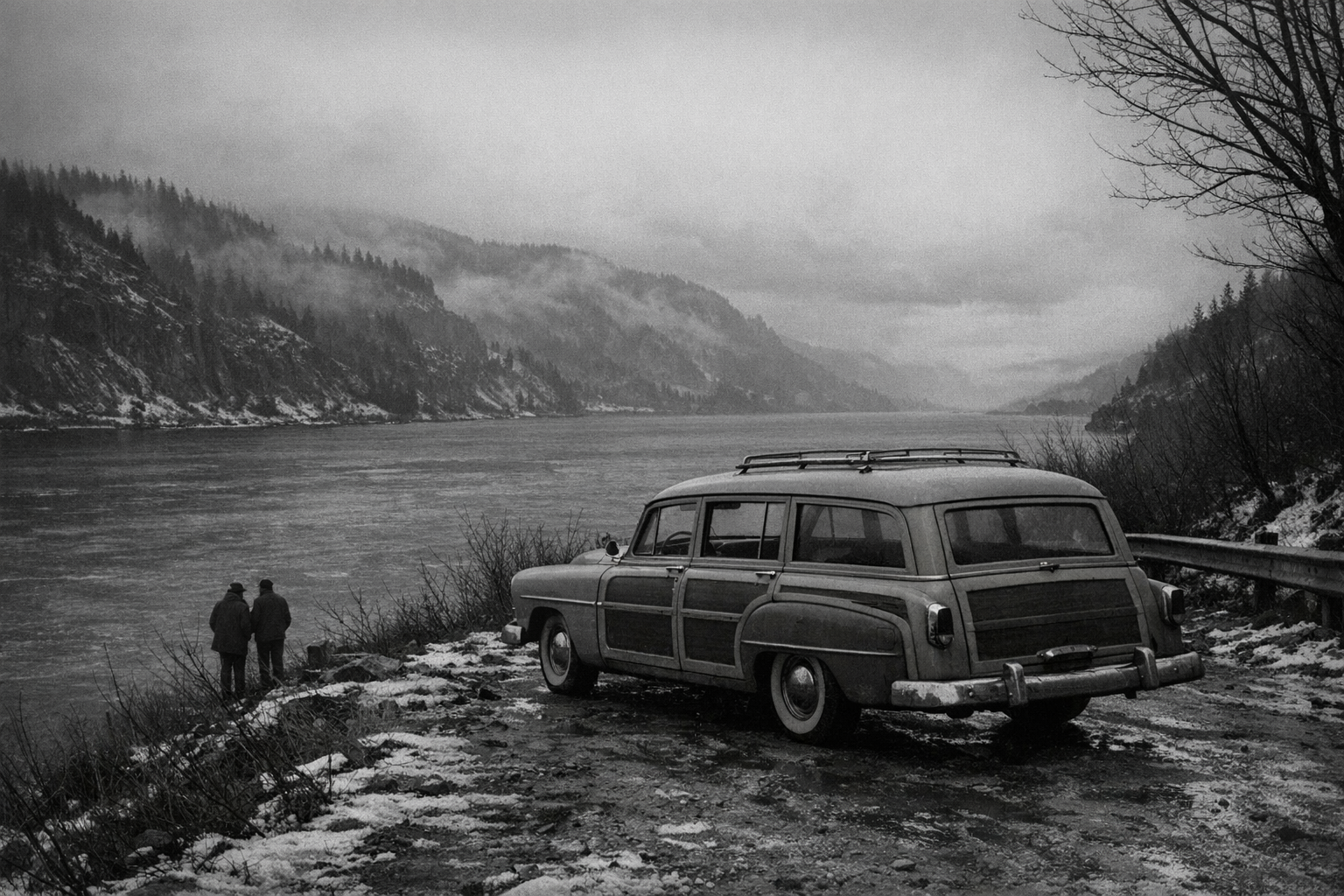
The Martin family mystery follows a Portland family that vanished in 1958 after what should have been a simple day trip, leaving behind one of Oregon’s most haunting cold cases. After decades of rumors, river searches, and unanswered questions, modern DNA testing finally helped identify the family linked to remains recovered from the Columbia River.
There are some disappearances that feel as if they happen all at once, like a door slamming shut. Then there are the cases that seem to dissolve in slow motion, piece by piece, until the people at the center of them start to feel more like a local ghost story than a real family who once sat at a real kitchen table. The Martin family case belongs in that second category. For nearly seventy years, it drifted through Oregon memory like fog over dark water, a story passed down in fragments. A family left home. The weather was cold. The roads were slick. Christmas was near. And then, somehow, five people simply seemed to fall out of the world.
In December 1958, Kenneth and Barbara Martin lived in Portland with their children. By every public measure, they looked like the kind of family no one imagines becoming a mystery. They were not running from the law. They were not at the center of a public feud. They were not famous. They were just a family moving through the ordinary rituals of early December, when the air in Oregon turns sharp, the days dim early, and people start thinking about greenery, decorations, and the slow approach of Christmas. At some point, the Martins left on what should have been a routine outing connected to the season. Then they did not come home.
That is where the story stops being ordinary and starts becoming the kind of thing that gets under a region’s skin. Because when a whole family disappears, the mind rebels against it. One person can vanish and leave behind a hard, lonely mystery. But a mother, a father, and children disappearing together feels wrong in a deeper way. Families are supposed to leave traces. They are supposed to be seen at gas stations, on roads, in diners, by neighbors, by someone. A whole family should create a wake through the world. The Martins seemed to create one only long enough for it to vanish.
The first days mattered most, because that is when hope is strongest and fear is still trying to disguise itself as logic. Searchers looked at roads, riverbanks, likely routes, and the places where a car might have slid off in winter conditions. People asked the first obvious questions. Had there been an accident? Had the car gone into water? Had the family taken an unexpected detour? Could someone have seen them and simply failed to realize what mattered? But the more time passed, the stranger the silence became. Silence is one of the cruelest things in a family disappearance. A body can break your heart. Silence breaks your imagination first.
As the case spread, it took on the shape many famous disappearances do. Rumors began growing where facts ended. Some people thought the family had gone off the road into a canyon or river and simply had not been found. Others wondered if there had been foul play. In cases this old, uncertainty has a way of multiplying. Every year without an answer becomes permission for a dozen new theories. And because the Pacific Northwest is full of rivers, forests, steep roads, and weather that can erase evidence with frightening efficiency, almost any theory could feel plausible for a while.
But even in the middle of all that uncertainty, one idea kept returning: the river. The Columbia is not just a river in that part of the country. It is a force. Wide, cold, and indifferent, it moves with the kind of power that makes people understand how small they are. It keeps secrets well. Cars can disappear in it. People can disappear in it. Objects can drift, sink, shift, and reappear far from where anyone expects them. If the Martins had somehow ended up in the Columbia, the river itself might have become both witness and accomplice.
Years passed. Then more years. Search efforts, tips, recovered evidence, and public interest rose and fell in waves. Remains connected to the mystery would be found at different points, and yet even that did not bring the simple relief people expect from discovery. A recovery is not always an answer. Sometimes it only sharpens the shape of what is still missing. The Martin case became one of those long, painful investigations where every partial discovery seemed to prove only that the family had been real, the loss had been real, and the full story still sat just beyond reach.
That is part of what made the case so haunting for so long. It was never just one missing-person report buried in an archive. It became one of those Oregon stories that older generations could still recall decades later, not because they remembered every fact, but because they remembered the feeling. A family vanishes near Christmas. A great river moves through the background of the case. Children are involved. There is no clean ending. Those ingredients linger. They settle into local memory and stay there.
Cold cases also change as the world changes around them. In the late 1950s, investigators did not have the tools that later generations would take for granted. There was no modern DNA database waiting to be searched. There was no advanced forensic genealogy ready to turn a nameless set of remains into a family connection. There was patience, labor, instinct, geography, witness statements, and a limited set of forensic methods that could only go so far. So when the Martin family case first opened, it entered a world where some mysteries simply outlived the technology available to solve them.
That is why stories like this can feel frozen in time. The evidence does not stop existing, but the ability to understand it stalls. A set of remains recovered from water might remain unidentified for years. An object might be recognized but not explained. A theory might feel correct and still remain unprovable. The case waits. Investigators retire. Relatives age. Reporters move on. The file gets older. But the unanswered part stays alive, because somewhere inside the file are facts that do not care how much time has passed.
Then, decades later, science catches up.
That is the turn that gave the Martin family story fresh life in 2026. After nearly seventy years of uncertainty, authorities announced that modern DNA analysis had finally helped identify the family connected to remains recovered from the Columbia River. The announcement landed with the force of both revelation and grief. On one hand, it was exactly what people had wanted for generations: names, certainty, confirmation. On the other hand, it was a brutal reminder that the answer had been waiting in silence for almost an entire lifetime.
There is something uniquely heartbreaking about a solved case that arrives this late. In a fresh case, a solution can still feel like rescue. In an old case, a solution often feels more like a debt finally paid. The dead are not coming home. The lost years are not being returned. What changes is the moral weight of the story. A family that had become half-memory and half-mystery is placed back into history as people, not just speculation. That matters. It matters because being unnamed is its own kind of second disappearance.
The phrase “DNA finally identified them” sounds neat when placed in a headline. But behind that phrase is a much heavier reality. It means bones or remains that once had no certain story now have one. It means a forensic lab, patient comparison work, and the kind of scientific care that can connect the past to the living. It means a chain that had been broken for generations was finally repaired long enough for investigators to say, with confidence, these were the Martins. These were the people the river had hidden. These were the names the case had been waiting for.
And that identification changes how the entire mystery is heard. Before, the Martin case lived in the language of disappearance. A family vanished. A car may have gone into water. Searchers believed one thing, others believed another, and time kept smearing the edges. After the DNA breakthrough, the case enters the language of resolution. Not total resolution, maybe not every detail, maybe not every final second reconstructed with perfect clarity, but enough to move it out of the shadows. Enough to say this was not folklore. It was a real family, a real tragedy, and at last a case with an answer strong enough to stand on.
That does not erase the eeriness of the story. If anything, it deepens it. Because now the public is forced to sit with a more intimate question: what was it like in those last ordinary hours, before the family understood anything was wrong? Did the children think they were going on a harmless outing? Did Kenneth and Barbara sense any danger in the route ahead, or was the day so normal that they could not have imagined it would become one of the Northwest’s longest-running mysteries? The most devastating solved cases do not remove those questions. They only strip away the false comfort that maybe the people somehow escaped the worst.
The Columbia River remains central to why the case feels so powerful. Rivers are often treated like symbols in stories, but in this case the river was not a symbol. It was the hard physical reality that shaped the mystery for generations. It delayed certainty. It scattered evidence. It turned a family disappearance into a puzzle that outlived those first investigators. And in the end, it became the place from which the truth slowly, reluctantly emerged. Not all at once. Not cleanly. Just enough for science to reach into the waterlogged silence of the past and pull back a name.
That is what makes the Martin family mystery feel different from so many modern true crime stories. It is not driven by a flashy suspect, a dramatic confession, or a courtroom spectacle. Its power comes from time. From absence. From the unbearable patience of a case that waited while the world changed around it. The phones changed. The cars changed. The city changed. Entire generations were born after the Martins vanished, lived full lives, and grew old before the final identification arrived. A mystery that lasts that long stops belonging only to one family. It becomes part of a place.
And yet, for all its scale, the tragedy is still most painful when reduced back down to the human level. A mother. A father. Children. A winter outing. A community asking where they went. Searchers scanning dark water and muddy banks. Investigators preserving what they could. Then the long wait. It is easy, with old mysteries, to start talking only in terms of evidence and timelines. But the emotional center of the case never changed. A family disappeared, and for decades the world could not fully tell them where they had gone.
That is why the 2026 DNA identification mattered beyond headlines or trend spikes. It mattered because it closed a wound that had stayed open in public memory for nearly seventy years. Maybe not perfectly. Maybe not with every final detail answered. But enough to restore dignity to the people at the center of the case. Enough to turn one of Oregon’s oldest family disappearance mysteries into something closer to truth than rumor.
In the end, that may be the most haunting part of all. The Martin family did not vanish because they were meant to become a legend. They vanished because ordinary life can break in an instant, and sometimes nature is powerful enough to keep that break hidden for generations. The mystery lasted because the river was deep, the technology came late, and time can be almost as merciless as water. But time also delivered the tool that finally pierced the silence. After nearly seventy years, the case that began as a family simply not coming home became, at last, a solved story. And in that late answer, the Martins were given something every long-lost family deserves: not just discovery, but recognition.
🔎 Related Investigation:
🔎 Related Investigation:
If this case pulled you deeper into the mystery, continue into:
🔎 If this story stayed with you, the author suggests these real cases next:
- The DNA breakthrough that finally unmasked the Golden State Killer
- The cold case that waited decades for one strand of DNA
- The strangler case that stayed buried for years before the truth surfaced
Explore more Solved Cases stories here:


