For a few impossible seconds, the shoreline outside the hospital looked wrong.
The sea had pulled back, exposing a stretch of seabed that should have been hidden beneath water. Boats tilted at strange angles. People stared. Some ran closer to look. Inside the hospital in Galle, Sri Lanka, nurses moved between beds, charts, and IV lines as if the morning still belonged to routine. Then the horizon changed shape.
What came toward the building did not look like a wave people could outrun. It looked like the ocean itself had stood up.
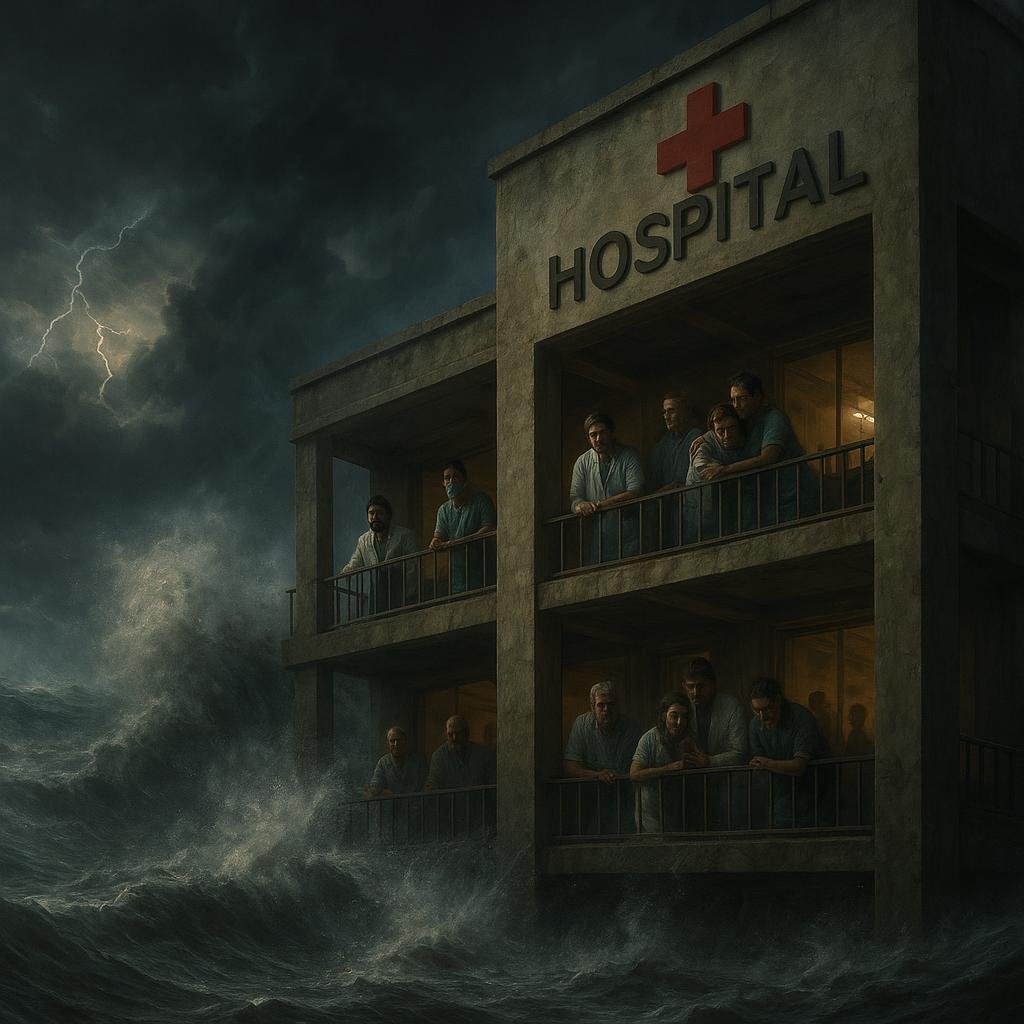
When the Ocean Entered the Hospital is the story of the 2004 Sri Lanka tsunami and the staff, patients, and families trapped inside a coastal maternity hospital when the Indian Ocean came inland. The case still matters because it shows what disaster survival really looks like when medicine, instinct, and sheer human nerve are all that remain after the structure of normal life is torn away.
Stories like this are part of why the Survival Stories Archive keeps pulling readers back: the most haunting survival stories are not always about wilderness. Sometimes they happen in the middle of a working hospital, in broad daylight, with nowhere obvious to run.
On the morning of December 26, 2004, one of the most powerful earthquakes ever recorded struck off the coast of Sumatra. The quake generated tsunami waves that tore across the Indian Ocean and slammed into Sri Lanka’s coastline. In southern cities like Galle, the force was catastrophic. Neighborhoods near the shore were hit almost without warning. Roads vanished under debris. Vehicles were rolled like toys. Buildings that looked solid one moment were gutted the next.
At the Mahamodara maternity hospital in Galle, staff were already deep into the workday. Some were checking mothers who had recently delivered. Others were dealing with newborns, preparing medications, or moving through packed wards that never had the luxury of silence for long. It was the kind of place built around procedure. Who needed medicine. Which baby had fed. Which patient needed to be moved. Which chart had to be updated next. In that kind of setting, danger usually arrives one person at a time.
This danger arrived as a wall.
Accounts from the disaster describe the first wave hitting the hospital so violently that water burst through lower areas before many people fully understood what was happening. Some staff were reportedly in the middle of deliveries or surgical work when the building began to flood. Power failed. Equipment shifted. Corridors that had been predictable a minute earlier became channels for black, debris-filled water. The hospital stopped being a hospital in the ordinary sense. It became a vertical race for survival.
Timeline of Events
- Early morning, December 26, 2004: A massive undersea earthquake strikes near Sumatra, generating tsunami waves across the Indian Ocean.
- Morning in Galle, Sri Lanka: Coastal neighborhoods begin to notice the shoreline behaving strangely as the sea pulls back.
- Shortly after: Tsunami waves hit southern Sri Lanka and surge into Galle with devastating force.
- At the maternity hospital: Floodwater pushes into the building, throwing the wards into chaos and cutting normal lines of movement and communication.
- Minutes after impact: Staff, mothers, infants, and other patients try to move upward, away from the flooding, often carrying the weakest people by hand.
- Through the day and night: Survivors remain trapped in upper areas with limited supplies, no reliable power, and no certainty that another wave will not come.
- After rescue access improves: The scale of destruction across Galle becomes clear, and the hospital’s survival story becomes part of the wider history of the 2004 tsunami in Sri Lanka.
That is one reason this story hits so hard. It combines two kinds of vulnerability at once. A tsunami is already terrifying because it moves with a speed and force most people cannot process in real time. But a hospital is supposed to be the place where the weak are protected from chaos outside. New mothers, newborns, people on beds, patients attached to lines or recovering from procedures—these are not people who can sprint for a staircase the way disaster movies imagine. Every second of delay matters more. Every choice becomes heavier.
And that is exactly where this story becomes more than a disaster headline. Survival inside a flooded hospital did not depend on one grand heroic gesture. It depended on hundreds of small decisions made under panic. Who gets lifted first. Which stairwell is still usable. Whether to stay in place or move higher. Whether the person shouting directions has the right read on what is happening. In disasters, people often imagine a single turning point. Real survival is messier. It is a chain of imperfect decisions made before the water makes them for you.
Reports from the aftermath emphasized how badly Sri Lanka’s health infrastructure was affected in coastal areas. Hospitals lost beds, equipment, records, and physical access. But the image that lingers in this particular story is more intimate than infrastructure damage. It is the image of mothers and babies trapped above floodwater in a place designed for birth, not siege.
That tension changes the emotional texture of the piece. This is not only a survival story about impact. It is also about containment. Once the water is inside, the fear changes. The first fear is being hit. The second is being stranded. People do not know if another wave is coming. They do not know which lower floors are still reachable. They do not know when clean water, electricity, medicine, or outside help will arrive. The body can adapt to shock for a few minutes. Waiting is what begins to grind people down.
What Made Survival Possible
- Height: Moving upward as quickly as possible turned the upper parts of the building into the only meaningful line between life and drowning.
- Staff discipline under collapse: Even after the hospital stopped functioning normally, trained workers still improvised triage, movement, and care.
- Human carrying power: In places where wheelchairs, beds, and equipment became useless, survival came down to hands, shoulders, and bodies moving other bodies.
- Refusal to abandon the vulnerable: Newborns, recovering mothers, and the injured could not save themselves; the people around them made their survival possible.
- Adaptation after the wave: Once the immediate surge passed, the challenge became endurance—staying alive in damaged upper areas until outside assistance could finally reach them.
What makes this story especially cinematic is that it never stops being two stories at once. On one level, it is about the raw physics of a tsunami: speed, debris, pressure, and the way seawater can turn architecture into a trap. On another, it is about care under impossible conditions. People still had to think about babies, wounds, pain, dehydration, and shock even after the building had effectively become part of the disaster zone. The normal work of protecting life did not end. It just became harsher, more primitive, and more desperate.
That is also what separates this from a generic “tsunami survival” recap. The hospital setting creates a documentary-style contradiction that stays in your head: one of the places built to preserve life had to survive first.
And the aftermath matters. The 2004 Indian Ocean tsunami killed tens of thousands in Sri Lanka alone and displaced far more. In Galle, the damage was not just structural. It was social, psychological, and deeply personal. Hospitals did not merely lose supplies. Entire communities lost the people who would have filled those beds, staffed those wards, or come through those doors in the weeks after. The building may have remained standing, but the world around it had changed shape.
That sense of prolonged survival is part of what links this story naturally to larger disaster narratives like Disaster Survival Stories: Earthquakes, Tsunamis, Fires, and Collapses Where Ordinary Days Turned Into Rescue Clocks. The worst disasters do not end when the water recedes. They continue in triage tents, damaged wards, interrupted births, contaminated supplies, and the long, grim work of counting who made it through.
There is another reason this story lasts. Birth and catastrophe are not supposed to occupy the same frame. A maternity hospital represents beginnings. The tsunami represented indiscriminate destruction. When those two realities collided inside one building, the story took on a symbolic force bigger than the event itself. It became a picture of what survival sometimes is at its most stripped down: not triumph, not certainty, not even relief at first—just the stubborn refusal to let the next life be taken too.
And if that sounds dramatic, it is because the event was dramatic. But the power of the story is that it does not need embellishment. A tsunami reached a hospital full of mothers, babies, and staff at work. Water entered the building. People climbed, carried, waited, improvised, and endured. That alone is enough.
Even now, the title feels less like metaphor than witness statement. The ocean did enter the hospital. It crossed the line where people expect some final layer of protection to begin. That is what keeps the story lodged in the mind. Not just the force of nature, but the collapse of the boundary people trust most—the belief that inside is safer than outside, that walls hold, that routine can absorb shock.
On that morning in Galle, those beliefs lasted only until the water reached the wards.
After that, survival belonged to whoever could keep moving, keep carrying, and keep thinking clearly enough to preserve the people who could not save themselves.
Why This Story Still Gets Attention
- It compresses birth, disaster, and rescue into one setting. Few survival stories contain that kind of emotional collision.
- It shows how fast normal life can disappear. A working hospital became a flood zone in minutes.
- It reveals the human side of disaster response. Survival depended on staff and families improvising long before formal rescue could fully stabilize the scene.
- It broadens what people think a tsunami story is. This is not only about waves at the beach; it is about water reaching the places people assume are protected.
FAQ
What happened at the hospital during the 2004 Sri Lanka tsunami?
During the 2004 tsunami in Galle, seawater surged into the maternity hospital and threw the building into chaos. Staff, mothers, newborns, and other patients had to move upward and improvise survival as floodwater, power loss, and confusion tore apart normal hospital routines.
Was this a real tsunami survival story?
Yes. The article is based on the real impact of the 2004 Indian Ocean tsunami on Sri Lanka’s southern coast and on accounts describing how the wave affected hospital facilities in Galle, including the maternity hospital.
Why does the story of the hospital matter so much?
It matters because hospitals are supposed to be places of protection. When a tsunami reaches a maternity ward, the disaster becomes more than physical destruction—it becomes a test of how people protect the most vulnerable when every normal system fails at once.
How did people survive inside the hospital?
Survival came from moving to higher levels, carrying those who could not move quickly, improvising care after power and equipment were disrupted, and enduring the long hours after impact until help and stability gradually returned.
Why is the 2004 Sri Lanka tsunami still remembered so strongly?
The tsunami is still remembered because of its scale, the suddenness of the destruction, and the number of ordinary places it overwhelmed. Stories like this one endure because they show the disaster not as an abstract tragedy, but as a lived moment inside a single building full of people who were trying to begin a normal day.
🔎 If this story stayed with you, the author suggests these real cases next:
- Disasters where ordinary mornings turned into brutal rescue clocks
- The garment worker who stayed alive beneath rubble for 17 days
- The man who rode a rooftop through the 2011 tsunami wreckage
- Rescues that began with faint tapping, knocking, and the smallest signs of life
Explore more Survival Stories here: