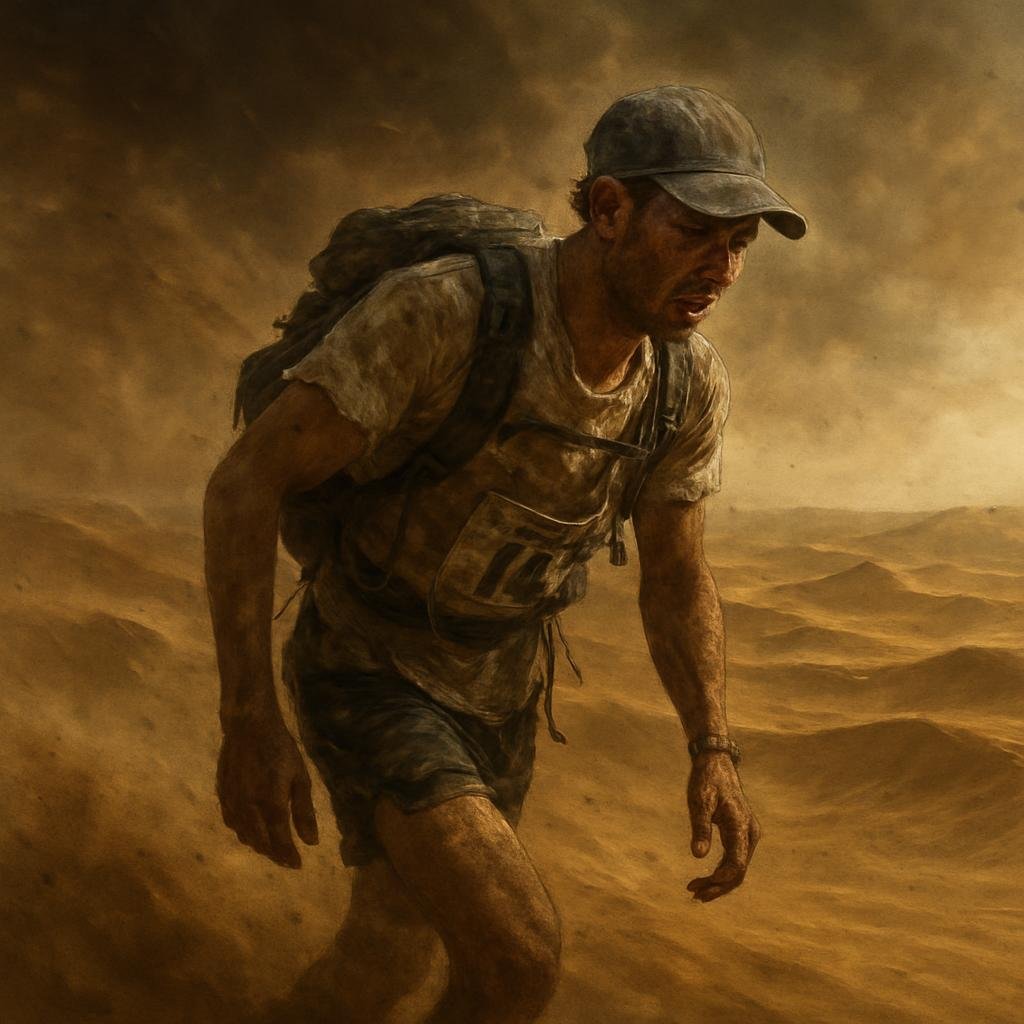
The moment Mauro Prosperi understood he was alone, the Sahara had already swallowed everything that could save him.
Minutes earlier, there had been other runners, route markers, the brutal logic of a race, and the thin comfort of knowing that if something went wrong, someone would eventually see it. Then the sandstorm closed around him. When it finally loosened, the world looked erased. No flags. No voices. No footprints that meant anything. Just heat, distance, and the sickening realization that one wrong line through the desert had turned the Marathon des Sables into a disappearance.
Mauro Prosperi’s Sahara survival story still gets searched because it sounds almost impossible even when you know it is real. During the 1994 Marathon des Sables, the Sicilian runner was blown off course in Morocco and spent roughly nine days trying to stay alive in one of the most unforgiving places on Earth. What happened next is remembered not just as an endurance feat, but as a human story about thirst, panic, hallucination, and the ugly decisions survival sometimes demands.
Long before the desert reduced life to the next mouthful of water and the next patch of shade, Mauro had entered the race believing suffering could be managed. That was the appeal of events like this one. Pain had structure. Distance had checkpoints. Even a punishing route still belonged to a system. That same harsh logic runs through other ordeals in The Survival Stories Archive, where survival often begins the moment the system breaks and the person inside it realizes nobody is coming fast enough.
On the morning he vanished, the Sahara did not look theatrical. That may be what makes the story so disturbing. Catastrophe did not arrive with a giant warning. It arrived as weather. Runners were already battered from previous stages, and Mauro, a forty-year-old police officer from Sicily, looked like exactly the kind of man built for an ordeal like this.
Then the wind shifted.
It did not simply blow. It attacked. Sand lifted off the ground in waves and then in walls, reducing distance to a blur of brown and gold. The horizon vanished. The route vanished. The race became noise, grit, and instinct. Mauro tried to protect his face and keep moving, because standing still in that kind of exposure could be dangerous too. Somewhere inside the storm, he believed he was maintaining direction. But a desert storm does not need much time to ruin a human calculation. It just needs confusion, a few wrong steps, and enough blowing sand to make every landmark useless.
When the storm thinned, he climbed to higher ground expecting relief. Instead he got silence. No route markers. No support vehicles. No nearby runners. No proof that he was even close to where he thought he was. Fear changed shape there. He checked his gear, checked his compass, scanned the ridges, and got the same emptiness back.
Night made everything worse. The same desert that had scorched him by day turned cold after sunset. He had limited food and water, but this was not a self-sufficient expedition built for long isolation. The Marathon des Sables relied on a chain of checkpoints and route structure. Once Mauro slipped outside that structure, his supplies stopped being a plan and became a countdown. He tried to shelter as best he could and waited for morning, listening for engines that never came.
Timeline of Mauro Prosperi’s Sahara Survival
- Day 1: A sandstorm during the Marathon des Sables drives Mauro Prosperi off course in the Moroccan Sahara.
- Days 2–3: He tries to reorient, rations water, follows false hope toward mirages, and reaches a small desert shrine.
- Turning point: In extreme dehydration and despair, he reaches a breaking point inside the shrine, then leaves with a new decision: keep moving.
- Days 4–8: He survives through brutal improvisation, walking, rationing, searching for shade, and enduring hallucinations, skin damage, and collapsing strength.
- Day 9: He reaches the Algerian border region, encounters people, and is brought to safety alive.
By the second day, thirst had become the main character in his life. Hunger can wait. Thirst cannot. His tongue swelled. His lips split. He rationed his water in tiny amounts because that was the only rational thing to do, but the desert kept offering lies. Buildings shimmered and disappeared. Dark patches looked like water until they turned back into heat and stone.
At some point he reached a marabout, a small white shrine sitting alone in the emptiness. It offered shade, which in that environment can feel like mercy, but not salvation. There was no hidden reserve of water inside. No rescuer waiting. No miracle tucked behind the walls. It was just enough shelter for Mauro to understand how bad the situation had become. He later described a moment there that remains one of the most painful details in the whole story: overwhelmed by dehydration and despair, he tried to end his own life. Even that failed because his body had already been drained so far. It is a horrific detail, but an important one. Survival stories are often polished after the fact into neat legends of grit. This one was not neat. It included collapse, hopelessness, and the terrible honesty of a man who thought he had reached the end.
And then something changed.
Not the desert. Not the weather. Him.
He left the shrine and went back into the heat with a simpler mission than winning a race. He just had to stay alive for one more hour, and then another. Survival narrowed into fragments: shade, direction, one careful sip, keep the feet working. That same grim economy of decision runs through other ordeals in Wilderness Survival Stories, where isolation turns every small choice into a vote for life or death.
The Decisions That Kept Him Alive
- He kept moving after the psychological break. Once he accepted that rescue was not immediate, motion became survival.
- He reduced time into short, manageable goals. Thinking only about the next stretch kept panic from swallowing him whole.
- He searched constantly for shade and usable terrain. In desert survival, exposure can kill as fast as thirst.
- He improvised when normal options were gone. His decisions were ugly and extreme, but they were decisions made inside a real emergency, not a clean textbook scenario.
- He protected direction as much as he could. Even weakened and disoriented, he kept trying to move with purpose instead of surrendering to drift.
The middle stretch of his ordeal is what makes the story feel less like sport and more like punishment. His body began shutting things down. Muscles cramped without warning. Pack straps rubbed skin raw. His feet deteriorated. Heat pounded him by day, and nights drained what little confidence he had left. He reportedly drank small amounts of his own urine when nothing else was available, proof that he had crossed out of normal life and into bare survival.
Hallucinations followed. He heard voices that were not there and imagined sounds from home. Mauro was not only physically lost. He was fighting the erosion of judgment itself, and the longer the desert kept him, the harder it became to trust what he saw or hoped.
By the later days, the race had become irrelevant. So had clocks. Time was measured in sunlight, darkness, and whether his body would keep obeying him. Reports say he lost somewhere around 30 to 40 pounds. His skin was badly burned. His feet were shredded. The desert did not care about determination. Determination simply happened to be the only thing he still owned.
Why This Ordeal Still Gets Attention
Mauro Prosperi’s story endures because it hits three fears at once: getting lost, running out of water, and realizing that nature is too large to notice you. It also carries a brutal emotional twist. He was not some unprepared tourist who wandered casually into danger. He was a trained athlete in an organized race, and even that was not enough to protect him once the environment broke the frame around him.
It also remains compelling because the ending is not simple triumph. Survival did not erase what happened in the shrine, the hallucinations, or the way the Sahara stripped his life down to pain, will, and improvisation. Like 438 Days at Sea or the high-altitude dread of The Night K2 Went Silent, this is the kind of real survival story that lingers because it shows how thin the line is between discipline and disappearance once the environment takes control.
Eventually the landscape began to change. The ground grew less loose. He noticed signs that water had once moved through parts of it. Sparse vegetation appeared. After days of heat and false promises, even a shrub could feel suspicious, like another mirage preparing to vanish. But this time it held. The change was real. Not long after, he encountered people near the Algerian border region and was brought to safety.
By then he was severely dehydrated, sunburned, and physically devastated. Only later did the larger world turn the ordeal into a headline and an endurance legend. What Mauro himself brought to the story was more interesting than simple toughness. He spoke about fear. He admitted mistakes. He did not pretend the desert had revealed some glamorous superhuman version of him.
Years later, he returned to the Marathon des Sables and finished it. That is the detail that lands hardest once the rest of the story settles. Not because it sounds cinematic, though it does. Because it suggests that the desert did not get the final word. Mauro Prosperi’s Sahara survival story is remembered for nine lost days, but it lasts because of what those days exposed: the speed with which order can vanish, the horrifying intimacy of thirst, and the stubborn human instinct to keep moving even after the mind has looked directly at surrender.
FAQ
What happened to Mauro Prosperi in the Sahara?
Mauro Prosperi was blown off course by a sandstorm during the Marathon des Sables in 1994 and became lost in the Moroccan Sahara. He spent about nine days trying to survive extreme heat, dehydration, and disorientation before reaching people near the Algerian border region.
How long was Mauro Prosperi lost?
Most accounts say Mauro Prosperi was lost for roughly nine days. During that time, he crossed open desert, sheltered where he could, and survived through a combination of rationing, improvisation, and relentless movement.
How did Mauro Prosperi survive?
He survived by continuing to move, rationing what little he had, seeking shade, and making brutal emergency decisions when normal options were gone. His survival was not clean or comfortable. It was a prolonged fight against thirst, exposure, and failing judgment.
Is Mauro Prosperi’s story true?
Yes. Mauro Prosperi’s Sahara survival story is a real endurance and desert survival case tied to the Marathon des Sables. It has been reported for years because the facts are extraordinary even without exaggeration.
Why does Mauro Prosperi’s survival story still get searched?
It still gets attention because it combines a famous race, a sandstorm disappearance, and one of the harshest survival environments on Earth. More than that, it feels emotionally real: a disciplined athlete gets reduced to thirst, fear, and the decision to keep walking.
🔎 If this story stayed with you, the author suggests these real cases next:
- A raft, a war, and the survival ordeal that refused to end
- The fisherman who drifted so long the Pacific stopped feeling real
- The mountain silence that turned a climb into a nightmare
- More wilderness ordeals where isolation became the real enemy
Explore more Survival Stories here: