
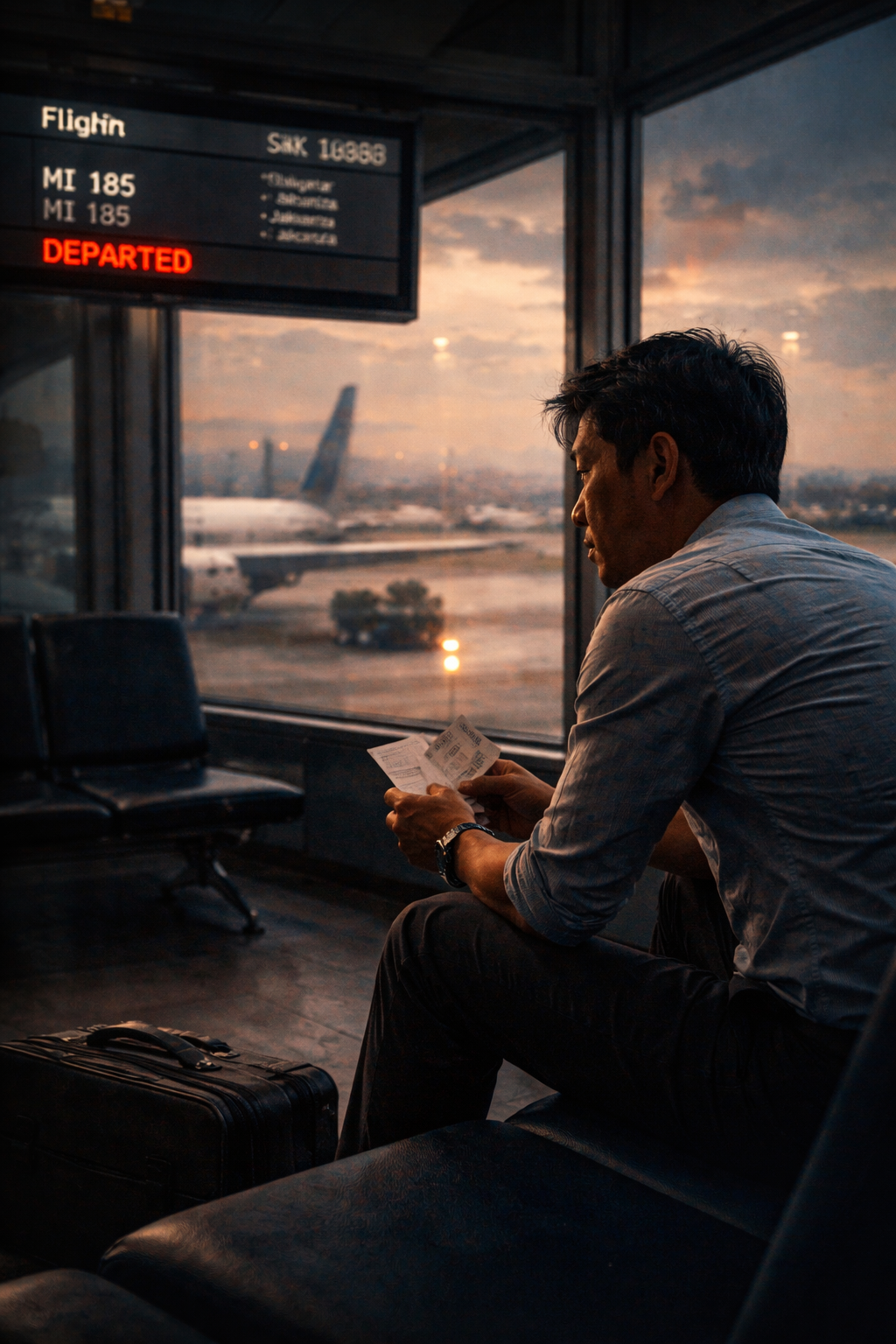
At Changi Airport, the bad news first felt small.
A man who had cut it too close reached the counter, out of breath, and was told check-in had closed. The flight was still there. The gate was not far. He had no checked luggage. He asked for an exception anyway, the way people do when they still believe a day can be forced back onto its rails if they ask hard enough.
The answer was no.
Hours later, that closed counter would stop feeling like an inconvenience and start feeling like a line between two lives.
SilkAir Flight 185 was a short regional flight from Jakarta to Singapore that crashed into the Musi River near Palembang on December 19, 1997, killing everyone on board. The story still grips people because it combines a near-miss survival story with one of aviation’s most argued-over disasters: a routine flight, two flight recorders that stopped before impact, and a final plunge that still leaves an uneasy silence behind.
Stories like this often get remembered for the crash itself. But what makes this one linger is the terrible shape of the timing. One man missed the flight by minutes. Then he sat in an airport and watched the ordinary delay he was cursing turn into the reason he was still alive. That strange survival-by-absence belongs in the same long corridor of impossible close calls as the Andes plane crash survival story, where survival also began with one moment that split the world into before and after.
Flight 185 left Jakarta at 3:37 p.m. local time for what should have been a routine trip to Singapore. It was a Boeing 737-300, relatively new, carrying 97 passengers and 7 crew members. The route was familiar. The weather, while not perfect everywhere along the region, was not the kind of thing that would have made anyone at the gate stop and stare. Nothing in the visible world around that aircraft announced that it was moving toward catastrophe.
By 3:53 p.m., the crew reported reaching cruising altitude, flight level 350. The plane was later cleared onward toward the next reporting point. Then the shape of the flight changed in ways that would haunt investigators for years. At 4:05 p.m., the cockpit voice recorder stopped recording. About six minutes later, the flight data recorder stopped too. Not at impact. Before it. Before the aircraft left the sky.
That detail still sits at the center of the story like a nail.
At 4:10 p.m., air traffic control made routine contact with the flight and received an acknowledgment. Nothing in that exchange warned of immediate disaster. Yet within minutes, radar showed the plane leaving level flight and entering a rapid, steep descent. This was not a standard emergency drop. It was violent, fast, and almost impossible to survive. The aircraft plunged toward the Musi River near Palembang and broke apart with overwhelming force on impact. No one lived.
Timeline of the Final Flight
- 3:37 p.m. — SilkAir Flight 185 departs Jakarta for Singapore.
- 3:53 p.m. — The aircraft reports reaching cruising altitude, FL350.
- 4:05 p.m. — The cockpit voice recorder stops recording.
- 4:10 p.m. — Air traffic control communicates with the flight; the response sounds routine.
- 4:11 p.m. — The flight data recorder stops.
- About 4:12 p.m. — Radar indicates the aircraft enters a sudden, steep descent.
- Less than a minute later — Flight 185 crashes into the Musi River near Palembang.
While investigators worked the wreckage and families began living through the first numb hours of grief, the man who missed the flight was still trying to understand what he was being told. That part matters, because this story is not only about a crash. It is about the emotional whiplash of near-miss survival. One moment he was frustrated with traffic and check-in policy. The next, he was in the strange category reserved for people who survived a disaster by almost being part of it.
That kind of survival is hard to narrate because it has no visible heroics. No one crawled from wreckage. No one clung to debris. No one fought through freezing water. The life-saving act was accidental: a delay, a missed window, a gate that would not reopen. But emotionally, it can be just as brutal. The mind starts replaying the same tiny choices again and again. Leave the house five minutes earlier. Catch one green light instead of one red one. Find a faster taxi. Push a little harder at the counter. In most stories, people replay those thoughts because they want to change the outcome. In this one, changing the outcome means imagining your own death.
That is what gives the story its eerie weight. Survival did not feel triumphant. It felt random.
And the crash itself did not settle into a clean explanation. That made the afterlife of the story even stranger. Indonesian investigators ultimately said they could not determine the cause. The U.S. National Transportation Safety Board, which participated in the investigation, concluded that the crash was most likely caused by deliberate flight-control inputs, most likely by the captain. The disagreement left the case suspended between official uncertainty and a theory many experts found hard to ignore.
What Doesn’t Add Up
- Both recorders stopped before impact. The cockpit voice recorder and flight data recorder did not fail at the moment of destruction. They stopped minutes earlier, which became one of the most unsettling facts in the case.
- The final radio exchange sounded normal. There was no clear distress call, no urgent warning that matched the violence that followed.
- The descent was extreme. Investigators found that the aircraft entered a very steep dive inconsistent with a routine emergency descent.
- The official conclusions split. One investigation ended in undetermined cause, while another leaned toward deliberate human action in the cockpit.
That split matters because it keeps the story from settling. If the crash had a simple mechanical answer, the horror would still be there, but the shape would be familiar. Instead, Flight 185 remains suspended in that darker territory where evidence points in hard directions without forcing universal agreement. That is one reason disaster stories like this often draw the same kind of lingering attention as other plane crash survival stories: people are not just looking for facts. They are looking for a version of events that lets the mind rest.
It also survives because the central image is so human. Somewhere in the terminal, a man was probably still carrying the embarrassment and irritation of arriving late while the plane he should have been on was already in the air. That is such an ordinary kind of bad luck. Then the meaning flips completely. What had looked like failure becomes rescue. What had felt unfair becomes the one break in the whole day that spared him.
That reversal is what keeps drawing people back to near-miss stories. One closed door, one delayed departure, one missed connection. The pattern runs through the broader Survival Stories Archive, but Flight 185 may be one of the starkest examples because the line between death and life was measured in airport minutes.
Why This Story Still Grips People
- The near-miss is easy to imagine. Almost everyone has run late, argued with a gate agent, or felt sure they could still make the flight.
- The crash remains disputed. A story with unresolved official disagreement stays alive longer in the public mind.
- The details are unnervingly precise. The stopped recorders, the calm radio contact, and the sudden dive feel less like narrative beats and more like blunt fragments that refuse to soften.
- It turns survival inside out. This was not survival through action. It was survival through absence, delay, and chance.
There is also something emotionally difficult about the aftermath that is easy to miss if the story is told too quickly. People often want survival stories to offer a lesson. Be brave. Keep moving. Never give up. Trust your instincts. But a near-miss disaster like this resists that kind of clean ending. There may be gratitude, but it is tangled with guilt. There may be relief, but it arrives carrying the knowledge that dozens of other people did not receive the same accidental mercy. The person left behind has to keep living with an answer that never feels satisfying: there was no reason. It was timing.
That is why the story sits naturally beside cases like Vesna Vulović’s survival and the Hudson River survival story, even though the outcomes are different. Those stories are also built around impossible seconds. The difference is that SilkAir Flight 185 leaves no survivor from the aircraft itself to carry the memory forward. The human thread comes from just outside the disaster, from the person who almost stepped into it and then spent the rest of his life looking back at the gate he never reached.
Maybe that is the reason this case still feels unfinished even to people who know the broad facts. The flight did not simply crash. It vanished from ordinary life in the middle of a normal day. It took with it a cabin full of unfinished plans, left behind a disputed investigation, and created one of those rare stories where missing the plane becomes the entire haunting point. Not because it is dramatic in a Hollywood way. Because it is plausible. Because it feels like something that could happen to anyone right up until the second it does.
And once that possibility gets into the mind, it stays there. Late taxis feel different. Closed counters feel different. Those small frustrations we normally forget by dinner suddenly reveal another face. Sometimes the worst thing that happens all day is still only an inconvenience. And sometimes, though mercifully rarely, it is the reason a person is still here to be angry about it.
FAQ
What happened to SilkAir Flight 185?
SilkAir Flight 185 crashed into the Musi River near Palembang, Indonesia, on December 19, 1997, during a scheduled flight from Jakarta to Singapore. All 104 people on board were killed.
Did someone really miss SilkAir Flight 185 and survive?
Yes. The story has long been remembered in part because a would-be passenger missed the flight by minutes, turning an ordinary travel delay into a near-miss survival story that still shocks readers today.
Was the cause of the SilkAir Flight 185 crash ever confirmed?
Not in a way everyone accepted. Indonesian investigators said the cause could not be determined, while the U.S. NTSB concluded the crash was most likely caused by deliberate flight-control inputs, most likely by the captain.
Why does the SilkAir Flight 185 case still get attention?
It still gets attention because the case combines disputed crash findings with a haunting human angle: a man missed the plane by minutes and lived, while everyone on board died. That mix of randomness, tragedy, and unresolved debate makes the story hard to forget.
Are there other survival stories like this?
There are other near-impossible survival stories involving aircraft, disasters, and split-second timing, but SilkAir Flight 185 stands apart because the survival happened outside the plane itself. Readers who want more can move from this case into plane crash, disaster, and rescue-clock stories across the survival archive.
🔎 If this story stayed with you, the author suggests these real cases next:
- A deeper way into the full survival archive of impossible escapes and rescue clocks
- More aircraft disasters where seconds, fire, and impact somehow did not end the story
- The woman who lived through a 33,000-foot fall after a plane exploded
- The winter flight that had only minutes to turn impact into survival
- The mountain crash where survival became a brutal countdown in the snow
Explore more Survival Stories here: