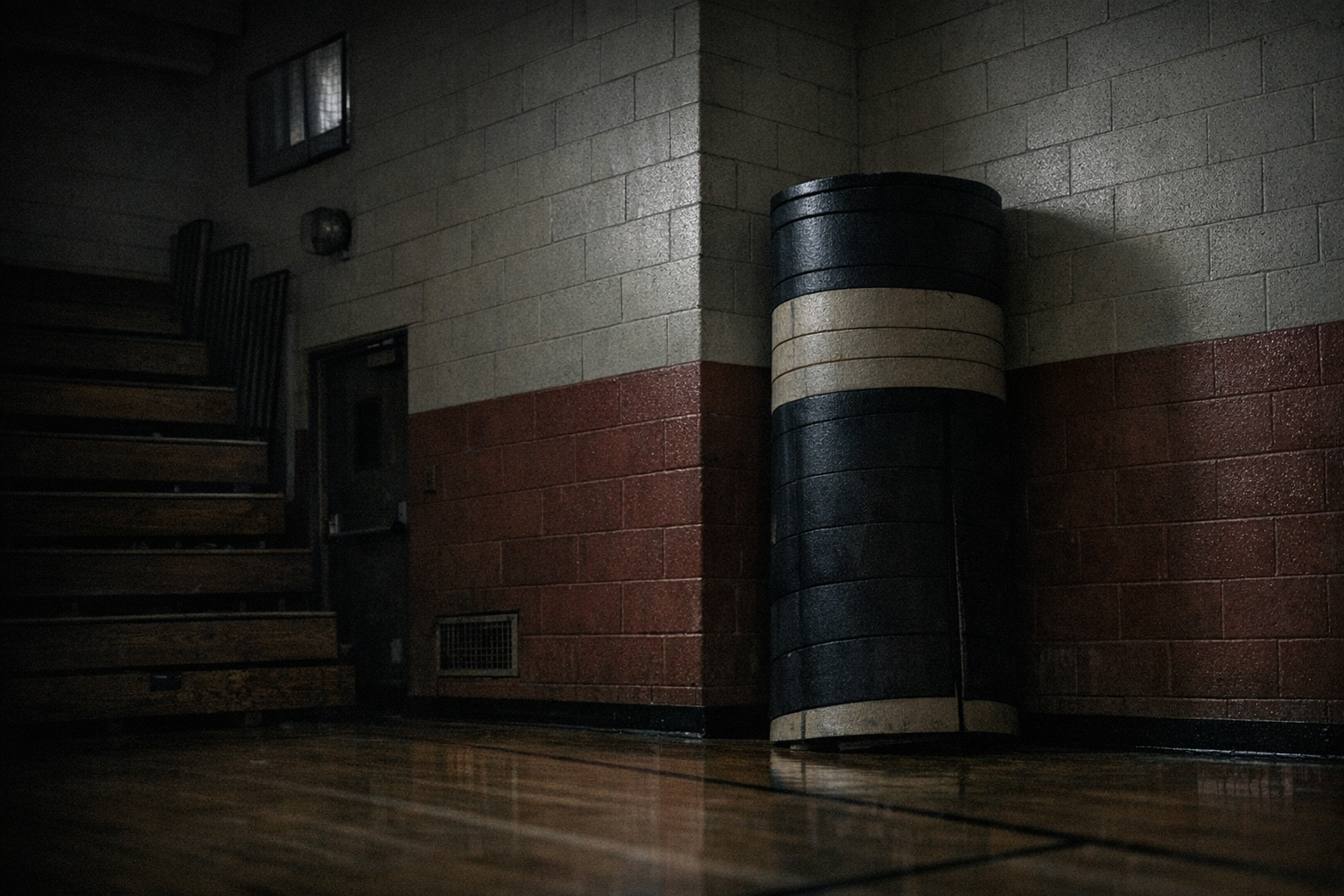
Kendrick Johnson died at Lowndes High School in January 2013. His body was discovered the following day inside a rolled wrestling mat. Investigators concluded that he had become trapped while retrieving shoes; his family disputed that conclusion.
A boy had disappeared into the space between ordinary moments.
By the next day, Kendrick Johnson would be found upside down inside one of those mats—head first, shoes off, body trapped in a position so strange that the image alone would burn itself into the public mind. And from that moment on, the case stopped belonging only to a school hallway or a sheriff’s file. It became the kind of story people revisit again and again, because the official explanation answered one question while opening a dozen more emotional ones behind it.
What happened to Kendrick Johnson?
Kendrick Johnson was a 17-year-old student whose death at Lowndes High School in Valdosta, Georgia turned into one of the internet’s most debated modern true crime cases. Officially, the Kendrick Johnson case was ruled an accidental gym mat death, but for many readers it still feels like a missing person case that transformed into something even more unsettling: a story where the scene, the timeline, and the family’s objections never stopped pulling public trust in different directions.
That’s part of why the case still matters. Like other stories in RTRS’s collection of unsolved true crime cases, it lives in the gap between what investigators concluded and what the public has never emotionally accepted.
On January 10, 2013, Kendrick never came home from school. By the next day, students discovered his body inside a vertically standing rolled wrestling mat in the school’s old gym. Investigators soon argued that he had tried to reach for a shoe stored in the mat, slipped inside head first, and died from positional asphyxia when he could not free himself.
On paper, that explanation had the neat shape authorities like. It was specific. It was physical. It did not require a hidden attacker, a complicated conspiracy, or a violent struggle witnessed by half a school. It offered a tragic accident in a place teenagers treated casually every day.
But cases do not live on paper alone.
Because the moment people heard where Kendrick had been found, the story began resisting closure. The image was too disturbing. The position of the body felt too unnatural. Questions rose immediately about how long he had been there, why he had not been found sooner, whether the surveillance footage told the full story, and why the official account seemed to settle so quickly around an answer that many people could not make peace with.
Kendrick was not a child who vanished into the wilderness or a man who disappeared after abandoning his car on some dark highway. He died inside a school gym—a place that should have been crowded, routine, visible. That is exactly why the case stayed alive. People can accept mystery in remote places. They struggle much more with mystery inside ordinary buildings, in daylight, surrounded by other lives still moving forward.
The afternoon everything broke apart
Investigators said Kendrick had likely gone to retrieve a shoe. According to accounts repeated in the early investigation, some students stored shoes in or around the rolled mats and reached for them from above. In the official version, Kendrick went in head first, became stuck, and could not pull himself back out.
That explanation leaned heavily on the physical setup of the gym. The mats were upright. They were narrow. Falling in the wrong way could be catastrophic. When the first autopsy concluded that he died of positional asphyxia, the case seemed, from the sheriff’s perspective, painfully tragic but fundamentally resolved.
For Kendrick Johnson’s family, it did not feel resolved at all.
They looked at the condition of his body, the circumstances of the discovery, and the handling of the case and saw not closure, but a wall going up too fast. They pushed back against the accident ruling almost immediately. They sought independent review. They argued that key details did not fit the official story. And once that challenge began, the case split into two competing realities that still define it now.
In one reality, this was a horrifying accident inside a rolled gym mat, made even worse by the gruesome way the body was found and by the confusion that followed. In the other, the accident ruling arrived before the deeper questions had been honestly faced, and everything after that felt like institutions defending the first story rather than testing it.
That fracture is why the case keeps resurfacing. People are not only debating what happened to Kendrick Johnson. They are debating which version of authority they trust: the official one, or the one built from doubt, grief, and the feeling that something about the whole scene never sat right.
Timeline of Events
- January 10, 2013: Kendrick Johnson attends school at Lowndes High School in Valdosta, Georgia, and later does not return home.
- January 11, 2013: Students discover Kendrick’s body inside a vertically rolled wrestling mat in the school gym.
- Early 2013: Investigators conclude the death appears accidental and later describe positional asphyxia as the cause.
- 2013: A family-commissioned independent autopsy reports blunt-force trauma, conflicting with the GBI autopsy.
- 2013–2016: Public pressure, media coverage, protests, and federal review keep the case in the national spotlight.
- 2016: The U.S. Department of Justice says it found insufficient evidence to support federal criminal charges.
- January 2022: Sheriff Ashley Paulk concludes the renewed investigation found an accidental death; the family rejects the conclusion.
- February 2025: The Eleventh Circuit partly affirms and partly vacates and remands a civil-case ruling, without deciding how Kendrick died.
- March 2026: WSB-TV reports dismissal of the family’s federal civil lawsuit and a new complaint.
- April 2026: The sheriff’s office says the death investigation remains active.
What doesn’t add up for so many people?
The most important thing about this case is not that every public question proves foul play. It’s that the same cluster of details keeps preventing emotional closure. The official explanation and public disbelief have never stopped colliding.
- The scene was instantly hard to accept. A teenager found upside down inside a gym mat does not read like an ordinary school accident, even if investigators believed the physics supported that conclusion.
- The timeline created suspicion. The longer people thought about school traffic, class changes, and how a body could remain there unnoticed, the more the ordinary setting started to feel extraordinary.
- Surveillance became part of the mystery. Questions about camera footage, time gaps, and synchronization issues fed a lasting belief that the visual record never fully settled the story.
- Conflicting autopsy interpretations deepened the divide. One side pointed to positional asphyxia. Another pointed to possible blunt force trauma. Once those narratives split, the public split with them.
- The family never stopped pushing. Their persistence kept the case active in public memory, because grieving parents refusing the official answer changes how the entire country hears a case.
And that last point may be the most powerful of all.
A closed case usually fades when people feel the ending, even if they do not like it. The Kendrick Johnson story never faded because the ending never felt socially or emotionally complete. The Johnson family kept insisting that the official version left too much unresolved. That insistence made the case bigger than the gym mat itself. It turned it into a referendum on trust.
Was this a terrible accident people simply could not emotionally process? Or was public discomfort actually picking up on real weaknesses in the official account?
That is the tension that has kept the case alive through documentaries, social media resurfacings, online debates, and renewed legal efforts. Every time the story comes back, it returns carrying the same pressure point: not just what happened, but why the answer still feels unstable.
Key evidence and the official explanation
The official account has never been vague about its central claim. Investigators said Kendrick likely tried to retrieve a shoe from inside the mat, slipped in head first, and became trapped in a way that caused positional asphyxia. That explanation depends on the physical reality of the mat and on the idea that what seems bizarre can still be accidental.
That matters, because a lot of enduring true crime debate comes from people assuming that unusual automatically means impossible. It does not. Unusual scenes happen. Freak accidents happen. Bodies can be discovered in ways that look shocking without proving homicide.
But the reason the official explanation never fully won the emotional battle is that the Johnson family and many outside observers did not see a clean accident narrative. They saw contradictions layered on top of a disturbing scene—questions about injuries, the handling of evidence, the autopsy conflict, and the school-camera record. Each issue by itself might not have sustained a decade of attention. Together, they created a case people could never stop re-arguing.
In June 2016, the Justice Department reported insufficient evidence for federal criminal charges. The sheriff’s January 2022 review concluded the death was accidental. These conclusions differ from the family’s claims; public suspicion is not evidence of homicide.
That divide makes the case feel oddly similar, in emotional terms, to stories like the Missy Bevers murder, where surveillance, physical movement, and unanswered doubt keep readers returning to the same few details over and over, hoping one more pass will make the picture hold still.
Why the Kendrick Johnson case never stopped dividing people
Some cases survive because nobody knows what happened. Others survive because too many people think they already do.
The Kendrick Johnson case belongs in the second category.
It keeps coming back because it is built on a contradiction the internet is almost designed to preserve: an official answer strong enough to exist, but not strong enough to end the argument. That is catnip for modern true crime culture. It invites viewers and readers to stare at the same evidence and come away with opposite conclusions.
The family continues to challenge the official ruling. The February 2025 appellate opinion allowed further civil proceedings on procedural grounds, not a finding of homicide. WSB-TV reported another dismissal in March 2026. In April 2026, the sheriff’s office nevertheless described the death investigation as active.
That is why Kendrick Johnson’s name keeps resurfacing years later. Not because the public forgot the answer, but because the public never agreed on whether the answer deserved to be called one.
And in true crime, that may be the most durable kind of mystery there is. Not the kind with no story—but the kind where the story exists, and some members of the public still dispute it.
If there is a final unease here, it is this: Kendrick died in a place that should have felt safe, visible, and ordinary. Yet the case he left behind still feels like a locked room people can enter but never fully explain. The mat, the missing time, the conflicting interpretations, the family’s refusal to stop pushing—it all keeps the same question alive.
What happened to Kendrick Johnson?
Officially, the answer has been on the record for years. Publicly, emotionally, and culturally, the case still sounds unfinished.
Research Sources
The following resources were consulted to verify and update this article.
- U.S. Department of Justice — Justice Department Closes Investigation Into The Death Of Kendrick Johnson
The June 2016 federal announcement explains the extensive review and insufficient evidence for federal charges. - WJHG / WCTV — Sheriff releases synopsis of Kendrick Johnson’s death investigation
January 2022 reporting describes the sheriff’s accident conclusion, disputed autopsy and surveillance explanations. - U.S. Court of Appeals for the Eleventh Circuit — Kenneth Johnson et al. v. Georgia Bureau of Investigation, No. 24-11961
The February 2025 opinion partly affirmed and partly vacated and remanded a civil case; allegations summarized there are not factual findings. - WSB-TV — Georgia student found dead in rolled up gym mat; family seeking $10 billion
March 2026 reporting documents dismissal of the family’s federal civil suit and a further complaint. - WALB — Case of teen found dead inside mat at Lowndes High School in 2013 remains active, sheriff’s office says
April 2026 reporting records the sheriff’s statement that the investigation remains active despite its accidental finding.