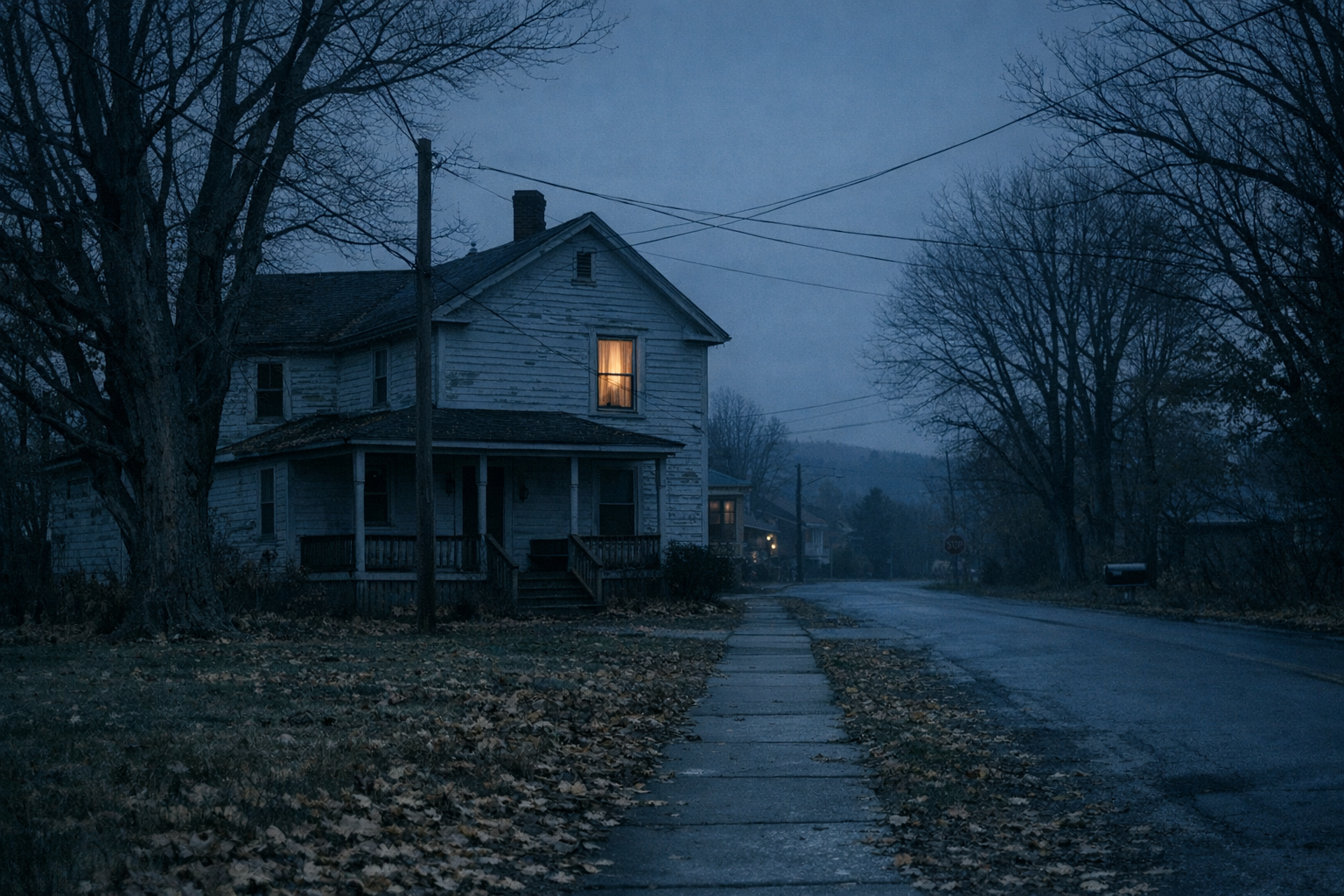
Before daylight reached the windows in that small house on Hill Street, something in the story had already gone wrong.
Kerr said Jaliek went to bed at the Hill Street house. The overnight account has not been independently established.
Jaliek Rainwalker’s unsolved disappearance still haunts New York
Jaliek Rainwalker was 12 when he was reported missing in Greenwich, New York, in November 2007. Kerr said they had spent the preceding night at Kerr’s parents’ home. Jaliek remains missing, and his fate has not been established.
Cases like Jaliek’s linger because readers have seen this pattern before: a child disappears, the timeline is narrow, and the answers seem like they should be close enough to touch. That same uneasy feeling runs through the site’s Missing Children and Teens Archive, where ordinary days break in ways families never recover from.
By the fall of 2007, Jaliek had already lived more life than most adults could handle well. He had spent years moving through foster homes before being adopted, and the people around him described him in ways that sounded both admiring and exhausted: bright, intense, difficult, troubled, unpredictable. He was the kind of child people remembered immediately, not because he blended into the room, but because he never did.
That history matters, but it can also distract from the central question. Too often, discussions about Jaliek start with his struggles, as if his behavior explains his disappearance. It doesn’t. It explains stress in the adults around him. It explains instability. It explains why the house may have felt tense long before that final night. What it does not explain is why a 12-year-old vanished and was never found.
Just over a week before he disappeared, his adoptive father, Stephen Kerr, called a crisis hotline and said Jaliek was unmanageable. According to later reporting, there were plans for respite care. Jaliek had already spent time with foster parents Elaine and Tom Person, who had cared for him before, and he was supposed to be moving again. That detail sits at the heart of the case. This was not a normal, settled week in a stable home. This was a boy being shifted between adults while the adults around him were openly saying they could no longer handle him.
The tension lives in the house, in the custody context, and in the gap between what should have happened that night and what actually did.
After respite care, Jaliek was picked up by Kerr on November 1. Kerr’s account places them at his parents’ Hill Street home that night. A last reported location must be distinguished from an independently established account of the disappearance.
By the next morning, Kerr said Jaliek was gone. He also said he found a note that read like a farewell: an apology, a line about not being a bother anymore, a goodbye. If that had truly been a spontaneous note left by a child slipping away in the dark, it would already have been haunting. But later, the story became even more troubling when people close to the case said the note may not have been a goodbye note at all. According to those accounts, Jaliek may have been told to write an apology note as part of an assignment the day before.
The note’s timing and purpose remain uncertain; staging has not been established.
Timeline of Events
- Late October 2007: Concerns about Jaliek’s behavior intensify, and respite care is arranged.
- Before November 1: Jaliek stays with foster parents Elaine and Tom Person, who had provided respite care before.
- November 1, 2007: Kerr picks Jaliek up after respite care and later says they spent the night at his parents’ Hill Street home.
- Overnight into November 2: Jaliek is reportedly alone in the house with Stephen Kerr.
- Morning of November 2: Kerr says he discovers Jaliek missing and finds the note.
- 8:57 a.m.: Jaliek is reported missing.
- Following days: Searches begin, but no trace of Jaliek is found.
- January 2008: Police name Kerr a person of interest. That designation is not a charge or a finding of guilt.
- 2012: Investigators reclassify the case as a presumed homicide; Jaliek’s fate remains unproven.
Even when you lay the timeline out cleanly, the case does not become clearer. It becomes stranger. The house is central. The night is central. And the official story still depends on a 12-year-old leaving without money, without a clear destination, and without leaving any confirmed trail strong enough to show he made it safely away from that property.
That is one reason the case keeps getting compared to other child disappearances built around a narrow last-known window, including Kyron Horman’s disappearance, where a child’s final ordinary location became the place everyone kept mentally returning to.
A bank camera recorded a van resembling Kerr’s. Aiken said it remained unidentified and described a phone-location detail as inconclusive. Neither established Kerr’s movements.
And yet, even with those suspicions, no charge ever came. No public resolution arrived. No confession closed the loop. The case stayed suspended in that terrible space between suspicion and proof, where everyone understands what the investigation seems to be pointing toward, but the legal finish line remains out of reach.
What Doesn’t Add Up
- The note: If it was really written earlier as an apology exercise, then its meaning changes completely.
- The overnight timeline: Kerr’s account places Jaliek at the house; what happened afterward remains unconfirmed.
- The van footage: A resembling van was recorded, but its identification remained unconfirmed.
- The phone records: Aiken described the disputed location detail as inconclusive.
- No clear runaway trail: There was no convincing evidence that Jaliek successfully left to begin a new life on his own.
- Age and vulnerability: A 12-year-old without cash, transportation, or support is unlikely to vanish cleanly for this long.
What keeps this case alive in people’s minds is not just that Jaliek disappeared. It is that the common alternatives never feel sturdy enough. The runaway theory depends on a child in a highly unstable emotional situation making a clean escape and then staying invisible forever. The suicide theory has been mentioned over the years, but it has never answered the same practical questions either. Where? How? And why has nothing definitive ever been found?
A presumed-homicide classification does not establish where a crime occurred or identify anyone responsible.
The reported house timeline does not establish that a fatal event occurred there.
Jaliek’s care history is part of the context, but it cannot establish how he disappeared or narrow responsibility without evidence.
And that is exactly why the case still gets attention whenever people discuss systems that fail children before they disappear. Jaliek was not invisible. Warning signs existed. Adults were talking openly about not being able to keep him at home. Care arrangements were changing. Tension was already in motion. When a child disappears under those conditions, the event does not feel random. It feels like the endpoint of a breakdown that everyone can see too clearly in hindsight.
There is also the emotional problem at the center of the story: Jaliek was a difficult child, but difficult children are still children. Cases like this reveal how easily a boy can be described as a burden before he is remembered as a person. That is part of what gives the story its staying power. People are not only asking what happened to him. They are asking whether the adults around him had already stopped imagining a future for him before he was gone.
Nearly two decades later, his disappearance remains one of New York’s most painful unresolved child cases. Searches have happened. Tips have come and gone. The investigation has evolved. But the basic shape of the mystery has never changed. If you want to understand why Jaliek Rainwalker’s name still surfaces, you do not have to look for some exotic clue or impossible twist. You only have to look at the final setup.
A child remains missing after nearly two decades. The report, the note and the disputed timeline still matter, but none establishes his fate or proves that a particular person harmed him.
That is the question the case keeps handing back to the public. Not a broad mystery. A narrow one. Not an endless field of theories. A house. A note. A van. A child who should have still been there in the morning.
Research Sources
The following resources were consulted to verify and update this article.
- National Center for Missing & Exploited Children — Have you seen this child? Jaliek L RainWalker
The current missing-child notice records Greenwich, the November 1, 2007 missing date, identification details and investigating agency. - Times Union — The Lost Boy, Part 3: The search for Jaliek Rainwalker
Original reporting distinguishes an unidentified van and inconclusive phone detail from proof, and discusses the note’s uncertain timing. - Times Union — The 17-year search for missing child Jaliek Rainwalker
A chronological account of respite care, Kerr’s account, the missing report and the person-of-interest designation. - Times Union — What happened to Jaliek Rainwalker? The case remains unsolved.
Interviews trace the reported evening and presumed-homicide classification without establishing fate or responsibility.