By 8:45 on a Friday morning, Skyline Elementary should have felt like one of the safest places in Portland. Parents were still in the halls because of the science fair. Children were standing beside posters and project boards they had built at kitchen tables the night before. Teachers were getting ready for class. Fluorescent lights hummed overhead. Backpacks bumped against lockers. It was the kind of morning that makes adults lower their guard without even realizing it. And somewhere inside that ordinary, crowded, brightly lit stretch of time, seven-year-old Kyron Horman vanished.
The Kyron Horman disappearance began at Skyline Elementary School in Portland, Oregon, on June 4, 2010, and it quickly became one of the most disturbing missing-child cases in America. What keeps the case alive is not just that Kyron disappeared, but that he disappeared from a place built around routine, supervision, and the assumption that children will still be there when the bell rings.
That same awful collapse of an ordinary routine is part of what makes cases like Asha Degree’s disappearance linger so long in the mind. In both stories, the setting feels wrong for the outcome, which makes the unanswered gap feel even wider.
The School Morning That Should Have Ended Normally
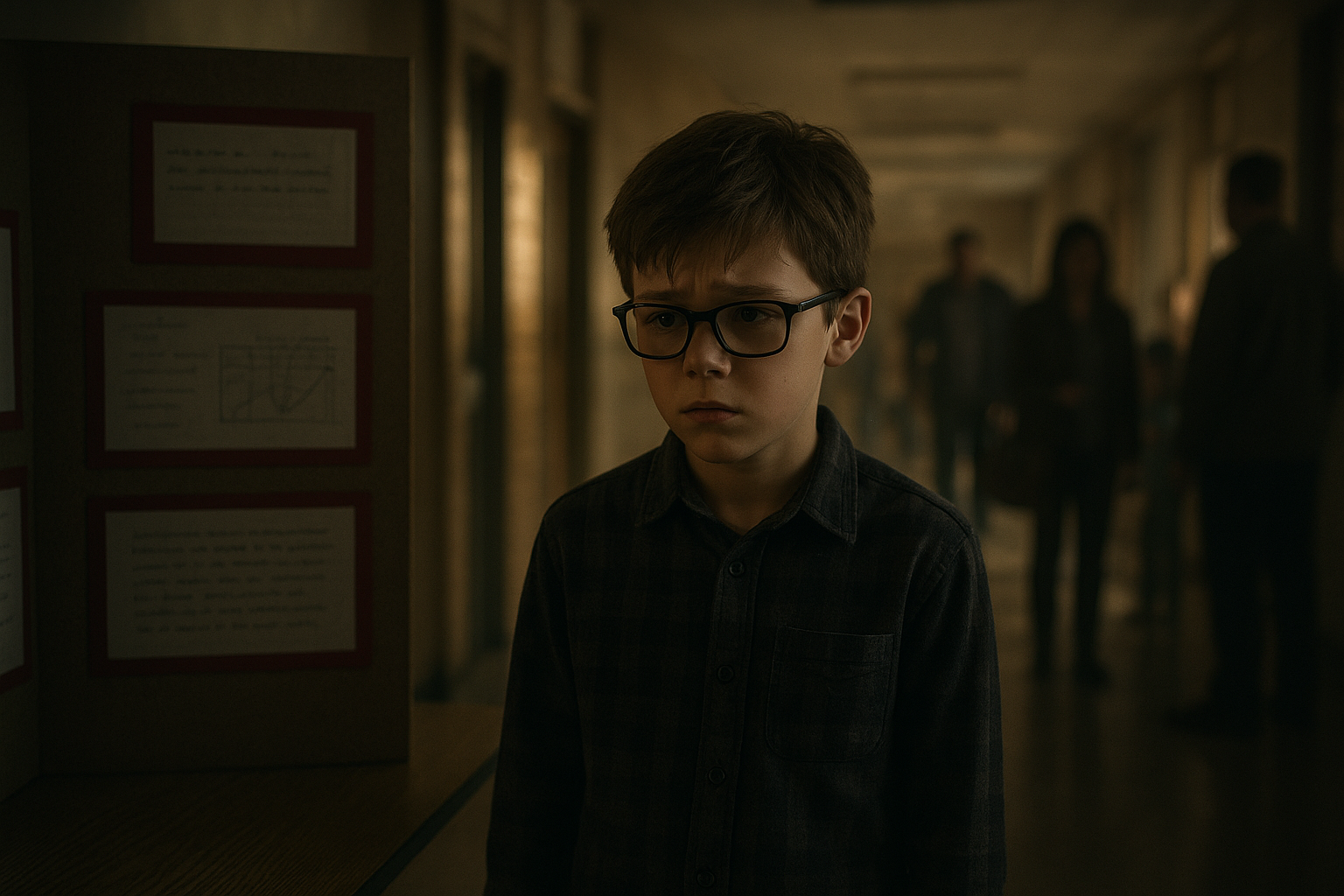
Kyron was a second grader known for loving science and animals. In the last confirmed photo of him, he is standing beside his science fair project, wearing a black T-shirt and glasses, looking exactly like what he was: a little boy in the middle of a school morning, still fully inside the life he was supposed to continue living that afternoon.
That image is one of the hardest things about this case. It freezes the last clean moment before everything broke. There is no visible fear in it. No sign of panic. No hint that adults would later study that photo like evidence from another world.
Kyron arrived at Skyline Elementary with his stepmother, Terri Horman, for the before-school science fair. According to the public timeline, she later said she stayed with him during the event and last saw him around 8:45 a.m., walking toward his classroom. On paper, nothing about that sounds dramatic. It sounds automatic. It sounds like one of those tiny goodbye moments families forget almost as soon as they happen.
Then the school day moved on without him.
Hours later, when Kyron did not come home on the school bus, the ordinary explanations probably came first. A mix-up. A misunderstanding. Maybe he went with someone else. Maybe there had been a schedule error. But once the school was contacted, the case turned cold almost instantly: Kyron had been marked absent.
That meant the boy in the science fair photo had somehow fallen out of the official school day before anyone realized it. He had been seen inside the building. He had been expected in class. But somewhere between those two facts, certainty ended.
Why the Timeline Still Feels So Frightening
Many disappearances are terrifying because of where they happen. This one is terrifying because of when it happened. Not late at night. Not on an isolated road. Not out in the wilderness. It happened during a crowded morning event at an elementary school, a setting people are trained by habit to treat as controlled.
That is why the timeline matters so much. The window appears narrow, but narrow windows can become harder to solve, not easier. A school in transition is full of motion. Parents leave. teachers shift their attention. children move from display tables to classrooms. Doors open and close. A child can still be visible in one moment and unaccounted for in the next without anyone immediately understanding that something is wrong.
That same tension around an ordinary public setting turning dangerous is part of what keeps readers moving from this case into stories like Dulce Alavez’s disappearance, where a place that should have offered safety instead becomes the center of permanent uncertainty.
Timeline of Events
- Morning of June 4, 2010: Kyron Horman arrives at Skyline Elementary School in Portland, Oregon, for a science fair before classes begin.
- Before class starts: Kyron is photographed beside his science project, creating the last widely recognized confirmed image of him.
- Around 8:45 a.m.: Terri Horman later says she last saw Kyron walking toward his classroom.
- After the school day begins: Kyron is marked absent, meaning he was not accounted for once attendance was taken.
- Afternoon: Kyron does not arrive home on the school bus, and alarm turns quickly into a missing-child emergency.
- That evening and beyond: Police, search teams, volunteers, and eventually the FBI begin a major investigation that expands far beyond the school itself.
The Search Moved Fast, but the Answers Did Not
Once it was clear Kyron was missing, the search escalated quickly. Skyline Elementary sits near wooded terrain, and that geography mattered immediately. The school itself is unsettling enough as a last known location, but the surrounding area adds another layer of dread. Roads curve through heavy green hills. Trees absorb sound. Distances that look manageable on a map can feel much larger on foot.
From early on, the case seemed to split into two equally painful possibilities. Either Kyron left the school area and became lost in nearby terrain, or he was taken during that brief morning window. Each theory explains part of the fear. Neither one has ever fully closed the gap.
As investigators rebuilt the morning, they looked at movements inside and around the school, who was present, who left, what times were remembered, and what happened after the science fair ended. But that is one of the cruel mechanics of disappearance cases: once the first critical hour passes, memory starts to turn soft. People remember fragments. They confuse sequence. They become sure about details they only half noticed. In a case this compressed, even a few uncertain minutes can become a canyon.
What Doesn’t Add Up
- He was at school, but absent on paper: That contradiction is the center of the whole mystery. Kyron was present enough to be photographed and seen, yet he still vanished before attendance anchored him in the school day.
- The setting should have increased safety: A science fair meant more adults, more activity, and more eyes in the building. Instead of protecting the timeline, that extra motion may have made the crucial moment easier to miss.
- No clear public answer emerged from the investigation: The case drew enormous attention, years of scrutiny, and major law-enforcement resources, but it still did not produce the kind of conclusive sequence that would point cleanly in one direction.
- The case became heavily focused on the inner circle without resolving there: As often happens in missing-child investigations, attention turned toward people closest to Kyron, especially Terri Horman. But public suspicion and evidentiary certainty are not the same thing, and the case has never reached a final legal resolution.
The Investigation Turned Inward
As the days passed and Kyron was not found, the emotional shape of the case changed. At first, the story was a frantic search for a missing second grader. Then it became something more tangled: a long-running investigation mixed with public suspicion, conflicting theories, legal pressure, and the painful reality that the most obvious narrative still could not be proved cleanly enough to end the story.
Terri Horman, as the last known adult publicly connected to Kyron that morning, became a central figure in that scrutiny. Investigators examined her account and her movements after leaving the school. Over time, that focus became one of the most debated parts of the case. For many people following it, the tension was immediate: if investigators believed they were looking in the right direction, why did the case still remain unresolved? And if the evidence was not strong enough to bring closure, what exactly happened inside that missing space in the timeline?
That is part of why this case still connects naturally to stories like the Sebastian Rogers disappearance and the Timmothy Pitzen disappearance. In all three, what haunts people is not just the loss itself, but the way the investigation seems to orbit family context, routine movement, and an ending that should feel closer than it does.
Why This Case Still Gets Attention
Some cases endure because the evidence is bizarre. Others endure because the setting feels too familiar. Kyron Horman’s disappearance has both. The evidence is limited in all the worst places, but the emotional setting is instantly legible to almost everyone. A school morning. A science fair. A bus ride home that never happened.
Parents trust schools in a very specific way. Not abstractly, but physically. A child enters the building, and the day is supposed to have edges. Class begins. Lunch happens. The final bell rings. When a child disappears from inside that structure, the case does more than create fear around one event. It damages the larger belief that some places hold.
That is why people still return to the image of Kyron beside his project. It is not only the last confirmed photo. It is the visual proof that the day began exactly the way it should have.
The Most Likely Explanation Remains Trapped Behind the Missing Window
There is a difference between having theories and having a story that truly closes. In the Kyron Horman case, the leading explanations have always circled the same painful questions: Did he leave the school area on his own? Was he taken? Did someone exploit the confusion of the science fair morning? Did investigators get close to the truth but never close enough to secure it?
The problem is that every explanation still runs into the same wall. The known facts establish the beginning of the morning, but not the moment it turned. That missing section is why the case remains so unnerving after all these years. It is not just unsolved. It feels interrupted.
And maybe that is the best way to describe the lasting ache of it. Kyron was not last seen in a scene already coded as dangerous. He was last seen in a hallway full of parents, projects, and school-day noise. The day did not look like a disappearance story while it was happening. It only became one after the boy in the photograph failed to come home.
FAQ
What happened to Kyron Horman?
Kyron Horman disappeared from Skyline Elementary School in Portland, Oregon, on June 4, 2010, after attending a morning science fair. He was seen at school that morning, but he was later marked absent and never came home on the bus.
Is the Kyron Horman case still unsolved?
Yes. The case remains unsolved. Despite years of investigation, major searches, and intense public scrutiny, there has been no final public resolution explaining exactly what happened to him.
Why does the Kyron Horman disappearance still get attention?
Because the setting is so disturbing. Kyron disappeared during an ordinary school morning, in a place that should have been structured and safe. That contrast between routine and disappearance is what keeps the case lodged in public memory.
Who last saw Kyron Horman?
According to the public timeline, Kyron’s stepmother, Terri Horman, later said she last saw him around 8:45 a.m. at Skyline Elementary after the school science fair.
Continue exploring:
- The playground disappearance that still feels impossible in daylight
- The campground case where the timeline never stopped splitting apart
- Short ordinary routes that somehow turned into lifelong mysteries
- Disappearances whose final moments still refuse to explain themselves
- The wider archive of last-seen timelines, witness gaps, and cases that still will not close
More Disappearances stories: