The Amy Bradley disappearance is the story of a 23-year-old woman who vanished from a Royal Caribbean cruise ship just before it docked in Curacao in March 1998. Nearly three decades later, the case still grips people because there was no clear witness to her final moment, no confirmed body, and no answer that ever managed to silence the mystery.
Just before sunrise on March 24, 1998, the Caribbean looked calm enough to trick people into trusting it.
The Royal Caribbean cruise ship Rhapsody of the Seas was moving toward Curacao after several days of music, drinking, dancing, and the strange timelessness that only happens on a ship. At sea, normal rules seem to loosen. Clocks matter less. People stay up later than they usually would. Strangers become familiar too quickly. Every deck is lit, every bar is humming, and every passenger is told, in a hundred subtle ways, that this floating world is safe.
For Amy Lynn Bradley, the trip was supposed to be exactly that. She was 23 years old, athletic, sharp, and by all accounts hard to intimidate. She was traveling with her parents, Ron and Iva, and her younger brother, Brad. It was a family vacation, the kind people take because they believe they are buying a pocket of memory that will stay warm forever. Sun on the water. Laughter over dinner. A few blurry photos. Maybe a joke that gets repeated for years.
Instead, the Bradleys got one of the most haunting disappearances of the last several decades.
On the night Amy vanished, nothing seemed dramatic at first. The family spent time together, and later Amy and Brad went to one of the ship’s nightspots, a disco where passengers stayed up drinking while the band played and the ship kept cutting through the dark. There are different accounts of the exact small details, but the broad outline has remained steady for years. Amy stayed out late. She danced. She was seen socializing. At some point, Brad returned to the family cabin while Amy remained behind for a little longer.
That decision, simple and ordinary at the time, would become the kind families torture themselves with forever. If he had stayed. If she had left with him. If someone had walked her back. If one tiny thing had shifted by ten minutes, or even by one.
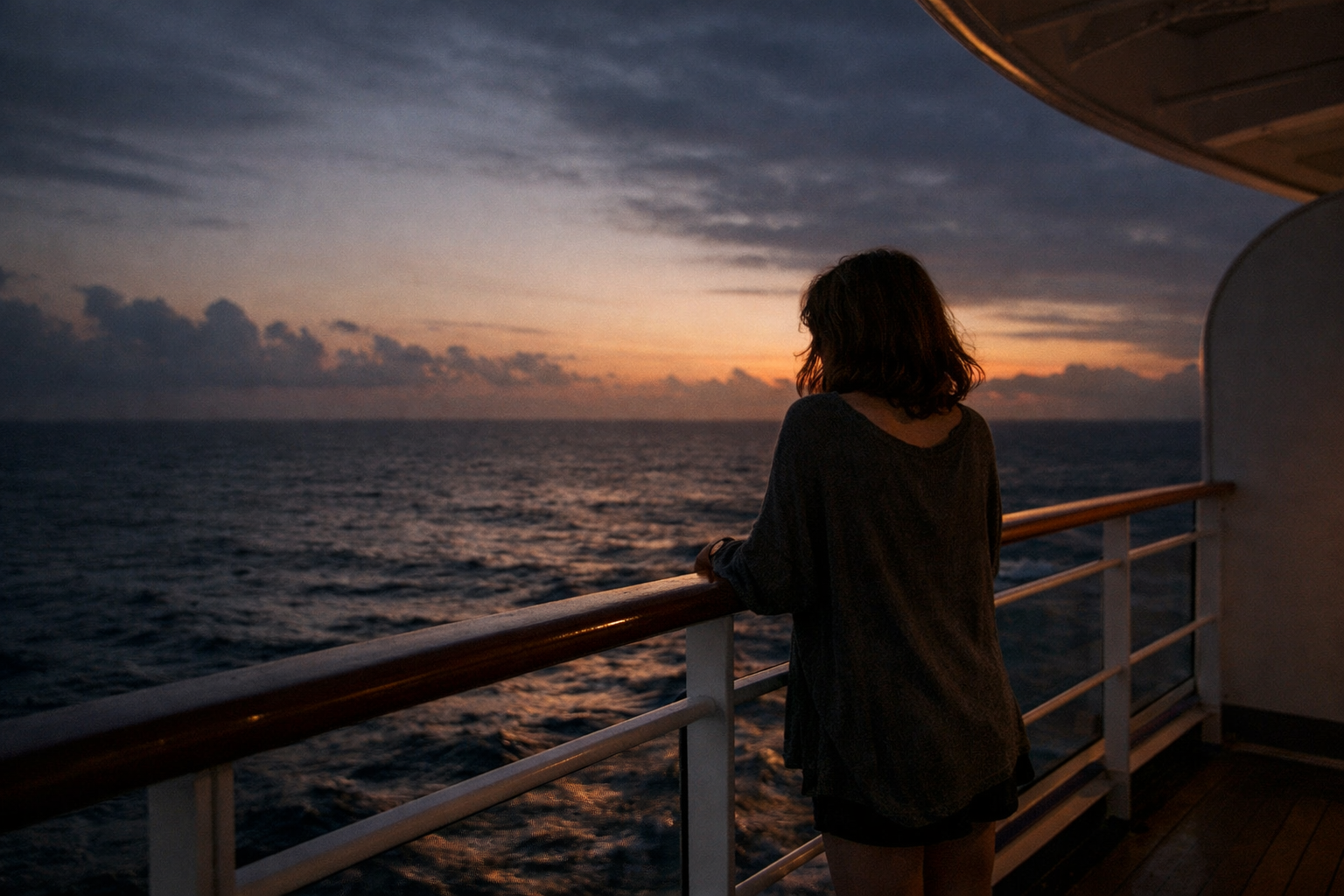
In the early hours of the morning, Amy made it back to the cabin. The family’s room had a small balcony, and sometime around dawn, Ron Bradley woke up and saw Amy resting out there. That detail is one of the reasons this case never lets people go. Her father did not imagine her missing for hours. He did not wake to a silent cabin and an empty day. According to his account, he saw her there, close enough to feel that ordinary parental relief. She was back. She was safe. She was just outside.
Then he went back to sleep.
When he woke again a short time later, Amy was gone.
At first, the disappearance did not announce itself like a disaster. That is how many real nightmares begin. Not with screaming. Not with shattered glass. Just with absence. Amy’s cigarettes were reportedly still in the room. Her shoes were there. Some personal belongings had been left behind. For a moment, the most natural explanation must have seemed harmless. Maybe she had gone upstairs for coffee. Maybe she had taken a quick walk around the deck before the ship docked. Maybe she was looking at the island as it came into view.
But then the minutes kept passing.
The family searched the cabin. Then the nearby decks. Then the ship itself began to feel wrong. Cruise ships are huge, but they are also enclosed worlds. You can only go so far before the structure starts repeating itself. Corridors, stairwells, railings, pools, bars, dining areas, crew passages hidden behind locked doors. If a passenger simply wanders off for a few minutes, there is usually some trace of that movement. A sighting. A bartender. A camera frame. A person who remembers passing them near an elevator.
With Amy, there was no clean trail that explained anything.
By then, the Rhapsody of the Seas was arriving in Curacao. That timing made everything worse. If Amy had somehow gone overboard during the night, the search needed to start immediately. If she had left the ship, intentionally or not, the chance to contain the scene was slipping away by the second. Her family pushed for urgency. They wanted the ship locked down. They wanted passengers stopped from disembarking. They wanted the staff to treat the disappearance like the emergency it clearly was.
But one of the darkest parts of this case is the feeling that the response never matched the danger fast enough.
According to the Bradley family, announcements were delayed and passengers were allowed off the ship before the full meaning of Amy’s disappearance had been acted on. Cruise lines have long disputed or softened some public criticism in cases like this, but the family’s frustration became part of the case itself. They believed precious time was lost during the most important window, the brief stretch when Amy might still have been somewhere on board or newly on shore and reachable.
That lost time became the first shadow over everything that followed.
🔎 Related Investigation:
People immediately began asking the obvious question. Did Amy fall overboard?
On paper, it sounds possible. She had been drinking. It was early morning. The sea was open and indifferent. But the theory never sat neatly with those who knew her. Amy was an experienced swimmer, physically strong, and not described as someone likely to accidentally tumble over a balcony without some evidence, sound, or disturbance. No body was ever recovered. No one reported hearing a scream. No sign ever surfaced that made an accidental fall feel conclusive.
That left another possibility, and it was the one that made the case feel colder and more sinister with every passing year.
What if Amy Bradley did not fall off the ship at all?
What if she made it to Curacao, and something happened after that?
Or worse, what if somebody on that ship saw the exact right opportunity in the last hours before docking and took it?
That theory survived because of the strange and troubling details that emerged around Amy’s final known movements. Family members later said Amy had drawn attention from people on board, including a member of the ship’s band sometimes identified in reporting by the nickname Yellow. Brad Bradley said he had seen Amy dancing with him that night. There were suggestions that Amy seemed uncomfortable with some of the male attention she was getting, though accounts vary in certainty. In a mystery this old, even the edges of behavior become charged. A glance that meant nothing. A conversation nobody remembers perfectly. A person near the disco who may or may not matter at all.
Then came the sightings.
Sightings are dangerous things in missing-person cases. They can keep hope alive, and they can also trap families in a maze with no exit. But the Amy Bradley case did not have just one stray report. It had several, spread over time, and some were disturbing enough that they refused to fade.
One of the earliest came from Curacao itself. A taxi driver later claimed he had seen a woman matching Amy’s description in a distressed state not long after the ship docked. Another widely repeated report came from a U.S. Navy sailor, who said that years later, in a brothel, a woman approached him and said her name was Amy Bradley. According to that account, she begged for help and said she could not leave. By the time the sailor reported it, too much time had passed to verify anything cleanly.
Then there was the image that hit the public like a punch. An adult website photograph surfaced showing a woman some believed resembled Amy. Her family thought the resemblance was strong enough to be deeply upsetting. Investigators examined it. The image did not produce a confirmed breakthrough, but it did something almost as powerful. It made the possibility of abduction feel real to people who had previously treated the case as a likely accident.
That is one reason the story keeps returning. It never settled into one tidy category. It was not obviously a fall. It was not clearly a voluntary disappearance. It was not a solved abduction. It stayed open, with just enough eerie detail in every direction to keep pulling people back in.
The FBI eventually added Amy Bradley to its list of major missing-person cases and publicized a reward for information. Her face kept circulating. Age-progressed images were released. Every few years, fresh media attention would drag the mystery into the light again, and each time the same central horror returned with it: a young woman vanished from one of the most controlled environments people can imagine.
That detail matters because cruise ships are sold as contained worlds. Thousands of people, yes, but bounded ones. Cameras. Crew rosters. Passenger manifests. Narrow routes in and out. Security procedures. All the things that are supposed to make chaos harder. If somebody can disappear from a place like that without a clear answer, it shakes people more than a disappearance on an empty road. It suggests that even in a sealed environment, a person can still slip into a blind spot and never come back out.
Over the years, the Bradleys have kept doing the grueling work families do when the world moves on too easily. Interviews. Appeals. documentaries. Repeating timelines. Reviewing rumors. Holding onto the parts that feel solid while trying not to be destroyed by the parts that do not. There is something brutal about families of the missing. They are forced to become archivists of their own worst day. They have to remember every hour, every outfit, every half-confirmed witness, every official response, every failure in the system, because forgetting feels like betrayal.
And the Amy Bradley disappearance is full of places where memory hurts.
Her father seeing her on the balcony. Her mother waking into confusion instead of panic, because the panic had not yet earned its shape. Her brother living with the fact that he had been with her in the final hours anyone can confidently trace. The family arriving in Curacao not as tourists, but as people suddenly fighting time on an unfamiliar island while their daughter seemed to dissolve into air.
There is also the geography of the case, which makes it feel almost impossible to hold in one’s head. Somewhere between ship and shore. Somewhere between the disco and the balcony. Somewhere between dawn and docking. The case lives in that narrow band of uncertainty, and uncertainty is where fear grows strongest. If Amy went overboard, when? If she left the cabin voluntarily, why? If someone harmed her, where did it happen without anyone clearly seeing it? If she reached Curacao alive, who was the last person with her? If one of the sightings was real, how close did help come before disappearing again?
Those questions are why the story keeps resurfacing in documentaries and news coverage. It is not just that the case is unsolved. It is unsolved in a way that feels almost deliberately cruel. There is no single moment people can point to and say, There. That was the end of safety. Instead, the known facts taper off into a blur of water, corridors, music, and dawn light.
Recent renewed attention has only sharpened that effect. New documentaries have introduced Amy’s case to audiences who were not even born when she vanished. Reward coverage and FBI appeals keep the file active in public memory. Every time that happens, people discover the same fact pattern and react the same way: how does someone disappear from a cruise ship just before it docks, with family nearby, and leave behind nothing solid enough to end the argument?
The most unsettling answer may be that every major theory contains a piece of truth and a piece of failure. The overboard theory explains the absence of later proof but not the emotional resistance of those who knew her and the lack of confirming evidence. The abduction theory explains the sightings and the timing around port but depends on fragments that have never locked together tightly enough for a charge or rescue. The voluntary-disappearance theory exists mostly because it has to exist, not because it fits the scene well. Amy left behind too much of herself for that explanation to feel comfortable.
And so the case remains suspended.
Not closed. Not solved. Not even quiet.
Just suspended, like the final minutes before sunrise when the world is brightening but still not clear.
Maybe that is why the Amy Bradley disappearance has such a grip on people. It is not only the fear of what happened to her. It is the fear of how little stands between ordinary life and total uncertainty. One family vacation. One late night on a ship. One father seeing his daughter alive and assuming morning will make sense. Then the next waking moment, and she is simply gone.
No blood in the cabin. No final message. No proven witness to a fall. No body. No confirmed rescue. Just a long corridor of possibilities, each one ending in darkness.
Some mysteries fade because time wears them down. Amy Bradley’s has done the opposite. Time has made it heavier. Every additional year adds another layer of disbelief, another generation hearing the story for the first time, another wave of people stunned that the answer still has not come. The question at the center has never changed. What happened to Amy Bradley? But the feeling around that question has deepened into something more than curiosity.
It has become a kind of dread.
Because if Amy was lost to the sea, the world never gave her family the mercy of certainty. If she was taken, then she may have been terrifyingly close to rescue in those first hours while the ship docked and the island woke up around her. And if one of those sightings was real, then somewhere inside this case is not just a disappearance, but a missed chance to bring her home.
That possibility is what makes the story so hard to shake. The Amy Bradley disappearance is not just a mystery about a missing woman on a cruise ship. It is a story about timing, blind spots, and the unbearable consequences of not knowing which minute mattered most. Somewhere between the music ending in the ship’s disco and the sun rising over Curacao, a real young woman stepped out of the world everyone around her understood.
And nearly three decades later, nobody has been able to say exactly how.
🔎 Related Investigation:
- What Likely Happened? 7 Unsolved Disappearances Where the Evidence Points in One Direction
- 10 Unsolved Disappearances Where the Timeline Still Doesn’t Add Up
🔎 Related Investigation:
If this case pulled you deeper into the mystery, continue into:
🔎 If this story stayed with you, the author suggests these real cases next:
- The stranded college student whose final phone call ended with one terrified outburst
- The vacationer who sprinted out of an airport and seemed to vanish into open daylight
- The crash on a dark New Hampshire road that turned into one of America’s most debated missing-person cases
Explore more Disappearances stories here: