Nate Fernald had bought a pin of a creature he could not identify. Then he found more of them. The sellers could offer more Geedis, but none could explain what Geedis was.
The brown, grinning monster had a name printed beneath it, as though recognition should be easy. In June 2017, Fernald, a comedian and television writer, asked Twitter for help. He had already tried Google. According to his account to Atlas Obscura, it had supplied no answer.
It was a small problem with an unusually effective trap: somewhere, somebody had drawn this thing, named it and put it on merchandise. Finding that person would take more than finding another pin.
A place called Ta
Fernald had been browsing eBay for a pin of the band the Jam when he encountered the creature. On August 1, after he posted another photograph of his growing collection, someone directed him to a sticker sheet. There was Geedis among a cast of fantasy characters. The heading supplied what looked like the missing explanation: The Land of Ta.
Now the question had expanded. A named world and a collection of named characters suggested something to look for: a cartoon, a game, perhaps a comic. But a sticker sheet was not evidence that any of those things had existed. It could also be the whole product.
The surviving sheets carried Dennison’s name. The Geedis sheet dated to 1981. This was a real piece of commercial artwork, not a creature invented for Fernald’s Twitter audience. What the internet had recovered was a product whose context had become harder to find than the product itself.
Online attention gave the search somewhere to continue. The r/Geedis community opened in September 2017. By 2019, YouTuber Justin Whang had covered the puzzle, and thousands of people were following it. Alongside the investigation, fans began making their own Land of Ta material. Know Your Meme’s chronology records a separate subreddit for that invented lore. The new stories were an expression of interest, not recovered evidence of an old franchise.
The evidence that changed everything
WBUR’s Endless Thread followed a community lead to the Framingham History Center’s Dennison collection. Curator Stacen Goldman showed hosts Amory Sivertson and Ben Brock Johnson the stickers and company catalog. The search moved from circulating scans to records that could connect a product with the people behind it.
Former Dennison art director Tom Manguso supplied the name Sam Petrucci. Manguso’s son Bill recognized something familiar in Zoltan, another character on the sheet, rather than in Geedis. Petrucci had died in 2013. The reporters contacted his family.
His daughter Linda had the original artwork. At the family’s New Hampshire house, the hosts examined pencil sketches, finished paintings and Petrucci’s signature. Their August 23, 2019, episode identified the artist. A resemblance noticed in a different monster had led to evidence a search engine could not supply.
The artist behind the packaging
Petrucci was not an unknown artist waiting for his first audience. His work had already reached children through the original G.I. Joe packaging. Heritage Auctions’ account of his surviving Action Sailor painting identifies him as the artist behind all four original boxes and the logo. He also illustrated packaging and games involving Mr. Potato Head, Superman and the Banana Splits.
That background changes the question raised by the stickers. A commercial illustrator could create memorable characters for a single assignment. A striking drawing did not require a television series behind it. Petrucci’s career involved making a package worth looking at; Geedis had done that job decades after its original sale.
In a subsequent Reddit question-and-answer session, Linda said she thought the characters had been made specifically for the sticker sheets. She did not know whether her father or Dennison had intended a larger franchise. Asked about an original contract or instructions, she said she had not yet found them. Her answers left room for missing paperwork without turning that absence into a lost cartoon.
What remains unanswered
The artist’s identity did not identify the manufacturer of the pins. Nor did it settle who drew the differently styled Women of Ta sheet. In the same discussion, Sivertson said Linda did not recognize that artwork as her father’s. Those were separate questions, not reasons to disregard the originals the family had preserved.
The reliable material reviewed for this article on November 24, 2026, did not establish a later answer to either question. Geedis should therefore be described as an artwork whose creator was found, with parts of its merchandising history still unverified.
For the family, the attention had a more immediate result. Linda told the community that it had prompted her to revisit her father’s work and consider how to archive and share it. Strangers had arrived asking for a forgotten monster. They had given his daughter a reason to look again at the rest of what he left behind.
Timeline of Events
- 1981: Dennison’s Land of Ta sticker sheet features Geedis.
- June 21, 2017: Fernald posts his identification request on Twitter.
- August 1, 2017: A sticker-sheet image gives the search the name The Land of Ta.
- September 2017: The dedicated r/Geedis community begins.
- August 23, 2019: Endless Thread publishes its identification of Sam Petrucci.
Frequently Asked Questions
Was The Land of Ta a television show?
No original television series was established by the investigation. The documented products were sticker sheets; suggestions of a broader franchise remained unconfirmed.
Does finding the artist prove he made the pins?
No. An image’s creator and a merchandise manufacturer can be different people or businesses. The artwork identification does not establish the pins’ production history.
Sources & References
- Atlas Obscura: “Join the Search for Geedis” (August 3, 2017) — contemporary interview with Fernald, including the pin purchases and discovery of the stickers.
- WBUR’s Endless Thread: the Geedis investigation (August 23, 2019) — original reporting, interviews and photographs of the surviving artwork.
- Endless Thread and Linda Petrucci’s community Q&A (2019) — firsthand answers about the family archive and unresolved questions; recollections are identified as such.
- Know Your Meme: Geedis and the Land of Ta — chronology of the online search, videos and fan communities.
- Heritage Auctions: original G.I. Joe artwork (October 21, 2024) — documentation of Petrucci’s packaging work and surviving Action Sailor painting.
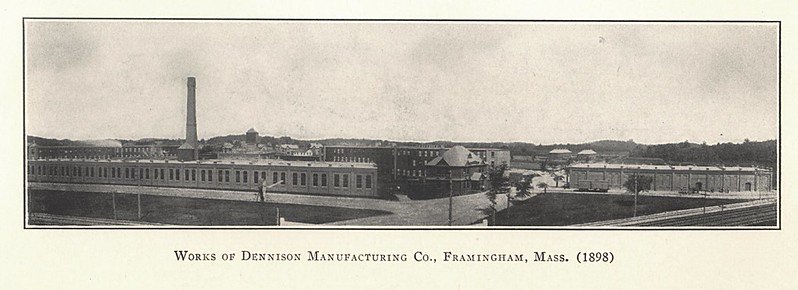
Historical image: Dennison’s Framingham works in 1898, from The Employee Industrial Partner’s Book (1921), digitized by takomabibelot; public domain. This depicts the company’s historical setting, not Geedis artwork.
Related stories
- The Backrooms: the identified photograph and the fiction it inspired — another search separating a real artifact from stories built around it.
- Cicada 3301: the clues, the solvers and the unfinished book — an online investigation with answers and limits that need to be kept distinct.