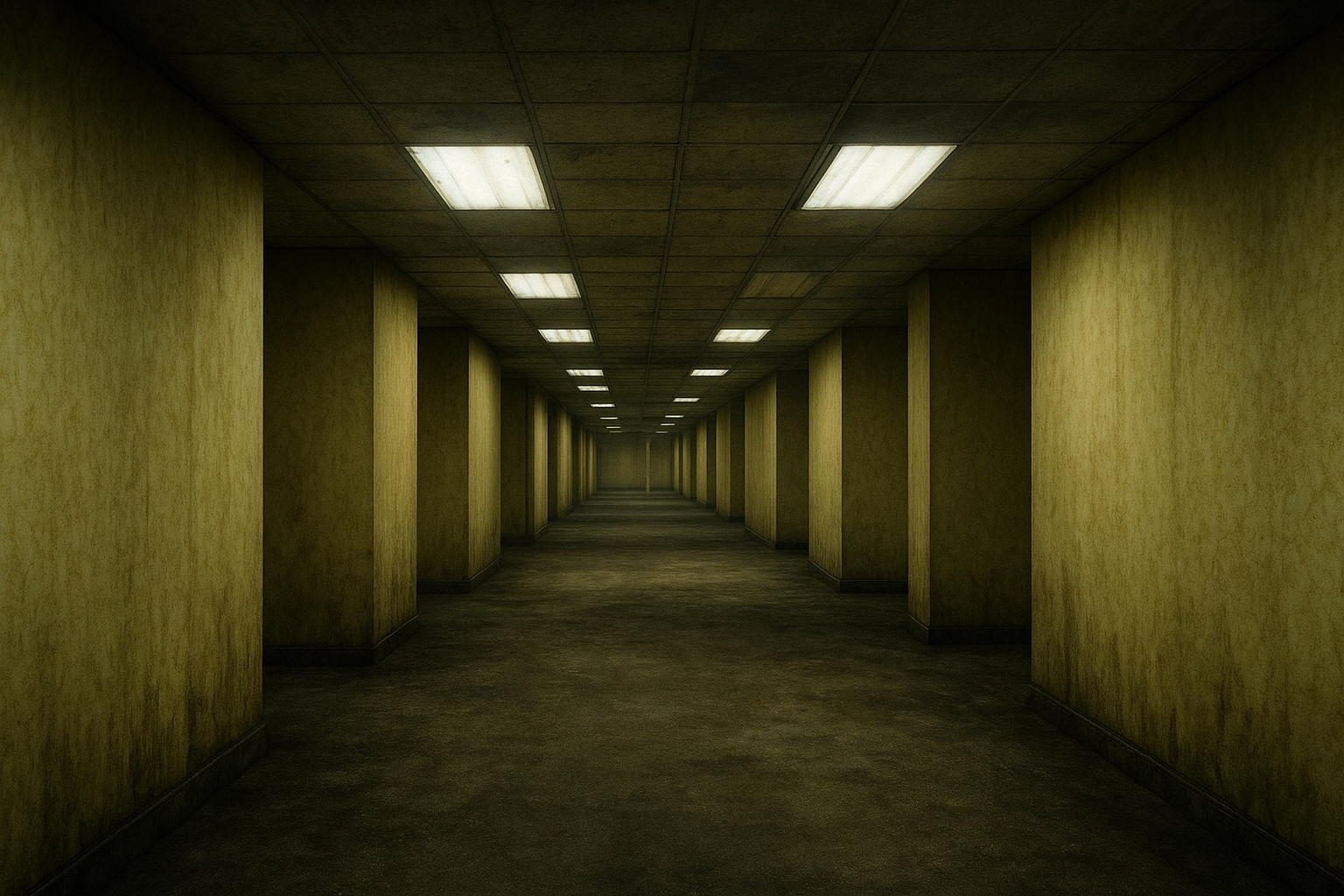
The image looked like it had been taken in the kind of place nobody remembers on purpose. Yellow walls. Cheap carpet. Fluorescent panels overhead. Empty turns that did not seem to lead anywhere important. There was no blood in the frame, no shadow at the far end, no obvious threat at all. And somehow that made it worse.
That is where the Backrooms mystery really begins. Not with a monster, but with a room that felt wrong in a way people recognized immediately and could not explain. What made the image stick was the sensation that it was showing something ordinary after reality had quietly stepped out of alignment.
The Backrooms mystery refers to the viral internet legend built around that image and the idea that a person could “noclip” out of normal life and fall into an endless maze of empty, humming rooms. It still gets attention because it sits at the intersection of digital folklore, liminal-space anxiety, and one of the internet’s favorite questions: why can one picture make millions of people feel lost before anything even happens?
If this kind of internet-born nightmare gets under your skin, the broader Internet Mysteries Archive shows how often the web turns one strange artifact into a much larger obsession.
The image that did almost nothing — and still worked
Most horror images announce themselves. They lean on distortion, violence, darkness, or the promise that something is about to rush the camera. The original Backrooms image did the opposite. It looked almost dull at first glance, like a half-finished office suite or a vacant commercial interior waiting for carpet installers to come back after lunch.
But that flatness is exactly what made it dangerous. The room did not look invented. It looked familiar enough to be real, yet empty in a way that felt chemically wrong. The yellow was too stale. The geometry repeated just enough to make the eye doubt itself. The lighting suggested not comfort, but exposure. It looked like a place built for people and then abandoned before any actual life ever moved in.
When the caption arrived with it in 2019, the image snapped into a full myth almost instantly. The now-famous text warned that if you were unlucky enough to noclip out of reality in the wrong area, you would end up in the Backrooms, trapped among the stink of old moist carpet, the madness of mono-yellow walls, and the endless background noise of fluorescent lights. Then it added the line that gave the story its teeth: if you hear something wandering around nearby, it has heard you too.
That paragraph did not just describe a place. It framed a feeling millions of people already knew. The picture had unsettled them first. The text simply told them what they were looking at.
How a forum post turned into a full internet mythology
Once the original image and caption fused together, the Backrooms spread the way the internet’s strongest legends usually spread: sideways. There was no single polished canon at first. People added maps, new “levels,” fake survival rules, diary entries, and warnings about entities waiting just out of sight.
The myth did not grow like a novel with one author controlling every corridor. It grew like folklore. One person added a detail, another swore the story matched a dream, and soon it felt less like a creepypasta and more like a place the internet had collectively discovered.
That also separated the Backrooms from colder puzzle-based rabbit holes. In mysteries like Cicada 3301, the hook comes from code, difficulty, and the possibility that someone brilliant built the maze on purpose. The Backrooms worked differently. It was emotional before it was analytical. You did not need to solve anything to understand the threat. You only needed to imagine one wrong step.
As the mythology expanded, so did the architecture of the nightmare. Level 0 remained the iconic yellow maze, but soon there were flooded hallways, hotel floors, industrial passages, empty malls, concrete service tunnels, and office spaces that looked copied and pasted by a machine trying to imitate human design.
Why the image worked when so many internet horror ideas fade
The best explanation is that the Backrooms hit a nerve older than the meme itself. Long before the term became mainstream, people already knew the feeling of a liminal space. A school hallway during summer break. A hotel corridor after midnight. An airport gate at the wrong hour. An office suite after everyone has gone home. These places are supposed to be transitional. You are not meant to live in them. You pass through them on your way to somewhere else.
Strip away the people, the motion, the noise, and the purpose, and those spaces start to feel eerie in a very modern way. They are not ruins. They are not haunted castles. They are practical rooms with the practical function removed. What remains is a shell of order that suddenly feels inhuman.
That is the emotional engine of the Backrooms. The image feels scary because it looks like a place the world forgot to finish inhabiting. It turns transition into imprisonment. The hallway no longer leads somewhere. The carpet no longer belongs to an office. The lights no longer help you work. Every ordinary feature has been stripped of its purpose and left behind as a dead texture.
From image to found footage: when the Backrooms became cinematic
The legend took another major leap when found-footage creators began visualizing it, especially through Kane Parsons’ influential videos in 2022. Those uploads gave the myth movement, sound, and scale. Suddenly the fluorescent hum was not something people imagined. They could hear it.
What made the videos work was restraint. The best moments were not the attacks but the pauses: hesitant footsteps, empty turns, and hallways that somehow felt more threatening than any obvious monster.
That found-footage layer gave the Backrooms an almost documentary feel. It started to look less like a story people told each other online and more like recovered evidence from a place nobody could explain. That same eerie media contamination is part of why stories like the Wyoming Incident broadcast hack still endure. Once a mystery feels as if it has leaked through a screen instead of being written for one, people treat it differently.
Why this image worked
- It weaponized familiarity: people have actually seen spaces that resemble it, even if only in fragments.
- It left room for imagination: the image showed no creature, which let the viewer supply the fear.
- It fit internet culture perfectly: the noclip idea borrowed video-game logic and made it existential.
- It turned emptiness into a threat: the horror was not a jump scare but endless wrongness.
- It felt shareable and expandable: anyone could add a level, memory, rule, or theory without breaking the core idea.
That last point is crucial. Many internet legends burn out because they rely on one twist. The Backrooms could keep mutating while staying emotionally intact. Whether the myth focused on creatures, endless architecture, corporate experiment theories, or pure liminal dread, the central sensation stayed the same: you are in a place that should not exist, and the place is more patient than you are.
Theories, origin hunts, and the need to pin the fear to a real room
As the legend spread, amateur researchers started chasing the most grounded question in the whole phenomenon: where did the original image come from? Was it an office? A furniture showroom? A renovated retail space? Some long-forgotten building caught at the exact angle where normal architecture becomes uncanny?
That search matters because solving the location would seem to reduce the myth. If you can point to a real address, then maybe the fear can be folded back into the physical world. The impossible room becomes a documented room. The mystery shrinks.
But the internet rarely works that neatly. Even when people get closer to identifying likely sources, the Backrooms remains larger than the image. The picture is only the ignition point. The real phenomenon is the shared response it triggered. People were not simply trying to locate carpet and drywall. They were trying to explain why the place felt preloaded into memory, as if they had nearly been there before.
That is why the Backrooms belongs less to traditional horror than to digital folklore. It behaves like a modern legend built from repetition, ambience, and collective unease. It also explains why it links naturally with pages like The Internet’s Creepiest Unsolved Mysteries, where the appeal is not just one answer but the way certain online stories keep shedding new versions of themselves.
What the Backrooms says about modern fear
Older nightmares often lived in forests, graveyards, storms, or isolated houses on distant roads. The Backrooms belongs to a different era. It is horror made out of commercial carpet, drop ceilings, fluorescent tubes, repeating wall patterns, and spaces designed to be forgettable. That makes it feel strangely contemporary. It is less about ancient evil than about depersonalization.
Underneath the creatures and the level guides, the real terror is disconnection. No signal. No map. No outside world pushing back through the walls. The fear is not just that you are trapped. It is that reality might be able to lose you without protest.
That is why the myth keeps surviving each new cycle of internet attention. The Backrooms suggests that the most ordinary spaces around us might be thin copies of something larger and emptier. And once a story teaches people to distrust hallways, office parks, hotel carpets, and quiet corners, it does not really go away.
FAQ
What is the Backrooms mystery?
The Backrooms mystery is an internet legend built around a viral image of empty yellow rooms and the idea that someone could slip out of reality and become trapped in an endless maze of unsettling liminal spaces.
Where did the Backrooms come from?
The myth took off online in 2019 when the now-famous image was paired with a short caption about “noclipping” out of reality. From there, users expanded it into a huge collaborative mythology with levels, entities, rules, and found-footage interpretations.
Was the original Backrooms image ever fully solved?
People have spent years trying to trace the location of the original photo, but the legend still outweighs the image itself. Even if the room is eventually pinned to a real place, the cultural mystery survives because the emotional reaction to the image is what made the story explode.
Why do people find the Backrooms so scary?
Because it turns familiar transitional spaces into a trap. The fear comes from emptiness, repetition, fluorescent noise, and the idea that reality could quietly fail without warning and leave you somewhere that feels almost normal but deeply wrong.
Is the Backrooms based on a real place?
The legend grew from a real-looking photograph, but the Backrooms itself is an internet myth rather than a confirmed real location. Its power comes from how convincingly it repackages ordinary architecture into a shared nightmare.
Continue exploring:
- The wider archive of internet rabbit holes, coded signals, and digital obsessions that refuse to die
- The disturbing broadcast interruption that still feels like a signal from the wrong reality
- The puzzle that made the internet wonder who was recruiting in the dark
- More online mysteries built from codes, videos, messages, and things no one ever fully explained
- The Reddit mystery that made people suspect something far more dangerous was hiding in plain sight
More Internet Mysteries stories:
Watch This Story on YouTube
Prefer to watch? See the full story on our YouTube channel.