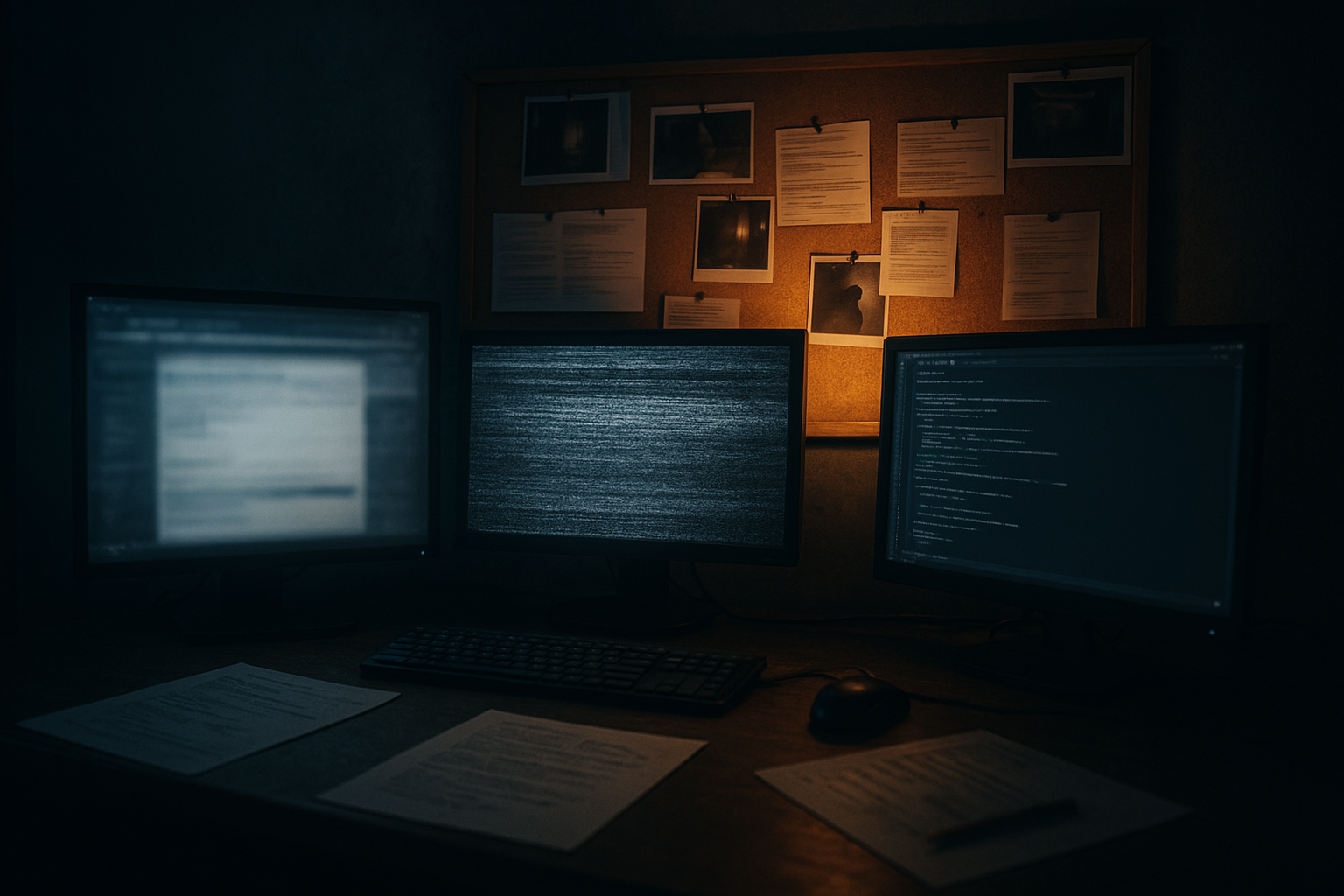
Joel Eriksson thought he had found a brainteaser. The image had appeared online in January 2012, signed with four digits: 3301. It said a message was hidden inside it. Eriksson, a Swedish security researcher, began looking.
The trail did not stay inside the picture. As he later described to Fast Company, it led through encoded messages, a telephone number in Texas and clues posted in cities around the world. Something a person could begin at a computer now required people to go outside and find what had been placed there.
Cicada 3301 made an unusually powerful invitation: follow the clues and discover who had built them. Each solved step rewarded the effort. The identity behind the invitation remained elusive.
When a File Becomes a Story
Internet mysteries often start with an object anyone can revisit: a picture, a video, a string of characters or a website. The object is there. Its context is missing. People copy it, compare it, argue about it and sometimes discover that the explanation is nothing like the story that first circulated.
The real events in this collection include puzzle solving, online collaboration, creative projects and the search for a photograph’s origin. Some apparent mysteries have clear explanations. Others survive in incomplete records. What connects them is the work of people trying to understand something they found on a screen.
The Code That Turned into Stonehenge
On Reddit in 2011, a section with the unmemorable name A858DE45F56D9BC9 filled with coded posts. Attention grew. Then its creator made it private, abruptly cutting off the people trying to decode it. A few days later it reopened, and a smaller group kept watching.
One of them, using the name fragglet, decoded a post. Behind the layers of encoding was an image made from text characters: Stonehenge. As The Daily Dot reported, another follower had already compared the page to that prehistoric monument. The new image looked like a possible response to the people studying it.
That is the distinctive pull of A858: a successful decoding can create a new question. Someone has placed an intelligible object inside the apparent noise. Is it a joke, an answer, or another step? The Stonehenge image was a result the solvers could point to, even while the overall purpose remained unclear.
The older Markovian Parallax Denigrate messages pose a different problem. Strange strings of words appeared on Usenet in 1996. Many posts were discarded as nonsense, leaving later investigators with a patchy record. Without a clear invitation or a demonstrable solution, even the assumption that there was a puzzle to solve becomes part of the argument.
Cicada’s first challenge offered a route to follow. A858 occasionally yielded recognizable material. The Usenet messages survived largely as a question about what the original flood had been. A decoded image and a missing archive leave different kinds of work for the next person who takes up the search.
The Video Was Real. The Event Was Fiction.
A fictional television interruption can be convincing when it arrives without an introduction. The Wyoming Incident used the form of a hijacked broadcast to tell an online horror story. Repeated outside that setting, its clip could be encountered as an apparent record of something that had happened. The story’s internet history is real; the purported intrusion is fiction.
I Am Sophie built its disguise around a person. Somnio Productions describes creating an apparently wealthy young vlogger with social accounts, an online shop and weekly videos. The project, made with creator Tom Ransom, gradually revealed itself as a horror series. Viewers formed a Reddit community to work through what was unfolding.
The ordinary-looking accounts mattered. They gave the character places to exist between episodes, so watching her became something broader than pressing play. The creators were constructing a world that viewers could explore. Knowing that it was made does not erase the craft that made people follow it.
Another strange channel, Webdriver Torso, had a practical explanation: Google confirmed the uploads were video tests.
The scale of Unfavorable Semicircle created a different challenge. According to its community archive, the YouTube channel began publishing in March 2015, sometimes releasing several videos within a few minutes. The uploads ranged from seconds to hours and used abstract imagery, silence, distorted voices and unusual sounds. There was too much for any casual viewer to take in.
After the original channel was terminated in February 2016, the investigation depended increasingly on what people had saved. The community assembled video lists, timelines and composites. Its archive also distinguishes later accounts believed to be genuine from possible imitators. Preserving the material became part of trying to understand it.
The Page That Asked for an Access Code
Visitors describing John.com in a Reddit discussion recalled pictures arranged into categories. Clicking led to another page asking for an access code. That small action—select a picture, meet a barrier—was enough to keep people asking what they had found.
The discussion wandered through proposed purposes, old links and guesses about the owner. It also preserved a simpler possibility: a private or playful site did not need to explain itself to everyone who arrived. The thread is a record of the search, rather than a settled account of what lay behind the page.
Mortis.com attracted similar attention around a password-protected entrance. In 2025, a Reddit user proposed that it had been a private file server and presented what they considered supporting research. That remains an individual’s claim; it should not be converted into a confirmed discovery. But it changes the range of explanations a reader encounters after years of more elaborate theories.
The story of Lake City Quiet Pills began with a more personal online event: a post announcing that another user had died. As Michael Whelan recounts in Unresolved, readers followed the accounts’ histories toward a website and began connecting fragments into a larger story. The leap to an alleged network of assassins became the famous version. The available record does not demonstrate that network.
A locked page gives visitors very little to test. Lake City Quiet Pills offered something more tempting: people’s words, left behind in public. The next group of stories turns on the difference between a character made for an audience and a real person interpreted by one.
A Person Is More Than a Persona
Sophie’s creators built a character for an audience to follow. Other people in this collection became subjects of public fascination without inventing a character at all.
Other stories arrived online after real families had already lived them. The Pollock twins became known through their father’s belief that his two older daughters had returned after death. Their mother initially rejected that belief. Accounts describe supposed recognitions and memories; critics point to the possibility of information passing within the family. It remains a story of reported belief, not demonstrated reincarnation.
June and Jennifer Gibbons were real sisters who wrote novels. June wrote The Pepsi Cola Addict; Jennifer wrote Discomania. Their unusual relationship often dominates retellings, but their creative work supplies something more substantial than an eerie label: words and worlds they made themselves. Their lives belong to human history, not to a fictional puzzle assembled for an audience.
What Doesn’t Add Up
Some projects here have known creators or practical explanations. These three still leave a gap between what people found and what they can establish about its purpose.
- Cicada 3301: who was behind the invitation? Completing stages of a puzzle shows that the trail was solvable; it does not independently identify the people who arranged it. Their identity and purpose determine whether the invitation can be understood as more than its challenges.
- A858: what was the larger purpose of the coded posts? A recognizable decoded image is a real result, but one result cannot explain the whole sequence. That gap separates successful decoding from a demonstrated account of what the creator intended.
- Unfavorable Semicircle: what connected the uploads? Volunteers preserved patterns and material after the original channel disappeared. Without a verified account of who made it and why, an observed pattern cannot by itself establish the project’s purpose.
The Room That Led Back to Wisconsin
The image behind the Backrooms shows an empty commercial interior. Online, it became the starting point for a fictional world of seemingly endless rooms. People added images, games and stories, taking the invitation far beyond a single photograph.
The photograph itself had a much smaller address. Wisconsin Public Radio traced it to an Oshkosh hobby-store website, where it had appeared in 2003. It resurfaced on 4chan in 2019. By 2026, the space where it was taken housed a radio-controlled-car track.
Visitors still came looking for it. The owner told WPR that remodeling had changed the space beyond recognition. The address could be found; the old interior could not be revisited.
An Address for the Endless Room
Cicada’s organizers planted clues for people to find. The hobby-store photograph became a trail without such an invitation: strangers wanted to know where an image had come from. In one story, the hidden identity remained the question. In the other, the search reached a building.
Inside that building, radio-controlled cars now ran where the photograph had been taken. Visitors looking for the Backrooms had reached a real place, changed by the years since someone pointed a camera at it.
Frequently Asked Questions
Was Cicada 3301 ever solved?
Solvers completed substantial parts of its puzzle trails. That is different from establishing the organizers’ identities or explaining the entire project. This collection describes the documented early trail rather than claiming a complete solution.
Was the Wyoming Incident a real television hijacking?
No. The clip belongs to a fictional online horror story presented in the style of a broadcast intrusion.
Was I Am Sophie a real person’s unexplained disappearance?
The project was an intentionally produced horror series and alternate reality game. Somnio Productions describes the character, social accounts and videos it created with Tom Ransom.
What was Webdriver Torso?
Google video testing.
Are the Backrooms real?
The shared world is fiction. The photograph that inspired it was taken in a real commercial building in Oshkosh, Wisconsin.
Is the Mortis.com mystery officially solved?
A Reddit user proposed a private-file-server explanation in 2025. That claim is included with attribution, not treated here as an independently confirmed finding.
Sources & References
Case-specific records, reporting and original project materials used for this collection.
- Fast Company — Meet the Man Who Solved the Mysterious Cicada 3301 Puzzle
Interviews a solver of Cicada’s early puzzle trail. - The Daily Dot — A code dump may reveal Stonehenge
Reports decoded A858 posts and the community investigating them. - Atlas Obscura — The Gibberish That Sparked One of the Internet’s Oldest Unsolved Mysteries
Traces the 1996 Usenet messages and competing mundane explanations. - Know Your Meme — The Wyoming Incident
Documents the fictional broadcast-hijack story’s online circulation. - Somnio Productions — I Am Sophie
The production company describes its fictional horror and ARG series. - Engadget — Google and the accidental mystery of Webdriver Torso
Confirms Google’s video testing explanation. - Unfavorable Semicircle community archive — Welcome to the Unfavorable Semicircle Wiki
Preserves the upload history and community investigation. - Reddit, r/UnresolvedMysteries — What is the website john.com? (discussion)
Records contemporary speculation; does not establish the site purpose. - Reddit, r/InternetMysteries — The mystery of the website Mortis.com is solved (August 2025 claim)
Records a later user’s proposed private-file-server explanation, not a confirmed finding. - Unresolved, Michael Whelan — Lake City Quiet Pills
Examines the forum trail and distinguishes theories from demonstrated connections. - Wisconsin Public Radio — Horror film Backrooms inspired by a meme born in Oshkosh
Reports the real photo location and the fictional world built around it. - Society for Psychical Research, Psi Encyclopedia — Pollock Twins (reincarnation case)
Summarizes reported family claims and skeptical objections. - MIT Press / Strange Attractor Press — Discomania by Jennifer Gibbons
The publisher’s description documents Jennifer’s novel and June’s The Pepsi Cola Addict.