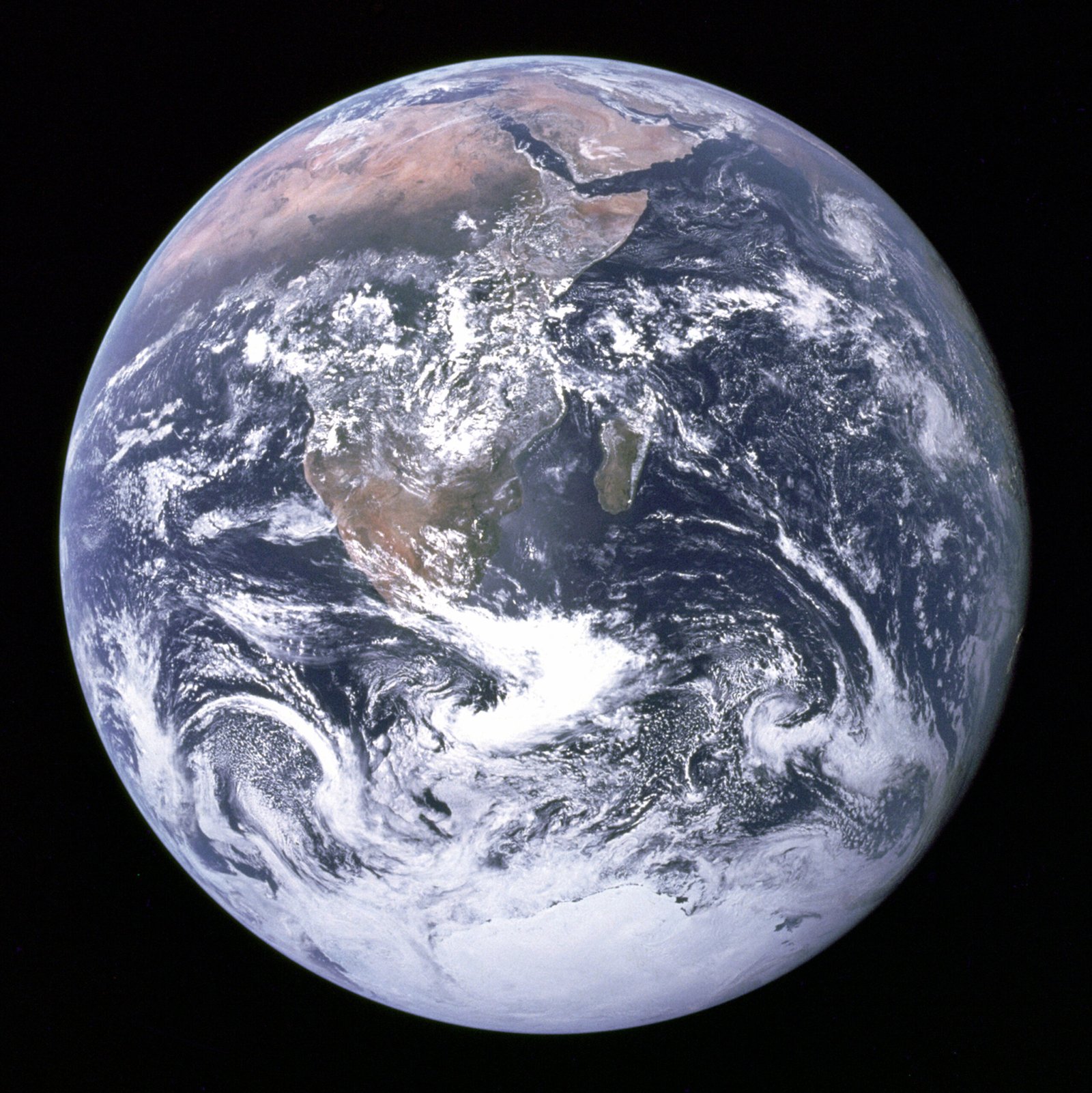
Earth photographed by the Apollo 17 crew on December 7, 1972. NASA image AS17-148-22727. Photo: NASA / Apollo 17 crew. Public domain.
Before Alfred Russel Wallace would take a telescope to the canal, he wanted the money deposited. In a letter dated January 21, 1870, he proposed that he and John Hampden each put £500 in a bank. Finding a suitable place and obtaining instruments would take time and expense. Wallace wanted to know the test would actually happen.
The wager concerned the shape of Earth. Hampden challenged the globe; Wallace agreed to demonstrate curvature over water. They could arrange a location, appoint referees and put money at stake. Agreeing on what the result meant proved harder.
The surviving correspondence preserves a dispute that began long before NASA, online videos or arguments over photographs from space. Earth’s globe-like shape was already established. What the canal experiment exposed was the difficulty of ending an argument when people disagreed about how to judge the evidence in front of them.
The measurement that did not require a spacecraft
Around 240 BCE, Eratosthenes approached Earth’s size through a difference between two places. According to the American Physical Society’s historical account, he compared the Sun’s position at Syene, now Aswan, with a shadow in Alexandria at the summer solstice. The angle in Alexandria was about one-fiftieth of a circle. With the distance between the places, geometry supplied an estimate of the full circumference.
The result depended on assumptions about location, distance and the Sun’s rays. Historians also disagree about the length of the unit he used. His manuscript is lost; later writers preserve the method. Those limits affect how precisely we can reconstruct his calculation. They do not turn it into a guess based on whether a nearby patch of ground looked level.
Earlier Greek arguments had drawn on ships disappearing hull-first, Earth’s curved shadow during lunar eclipses and changes in visible constellations with latitude. Different observations could be compared. That was the crucial move: a claim about the whole world had to explain more than the view from one place.
What “round” means to a surveyor
Modern geodesy makes the description more exact. NOAA’s National Geodetic Survey distinguishes an ellipsoid, a smooth mathematical reference shape, from the geoid, a surface defined by gravity and related to average sea level. Neither describes a flat plane. They serve different measurement needs on a planet whose surface and gravity vary.
A local level does not answer the global shape question. Builders can establish vertical with a suspended weight and horizontal with a level. Geodesists must relate those local measurements across much greater distances. NOAA describes applications that include elevations, coastal management and modeling how water can reach land.
This is work with practical consequences, not a contest between attractive pictures. A reference surface lets measurements made in different places fit together. Saying that Earth is not a perfect sphere improves that description; it does not undermine the evidence for its globe-like shape.
Two referees, two conclusions
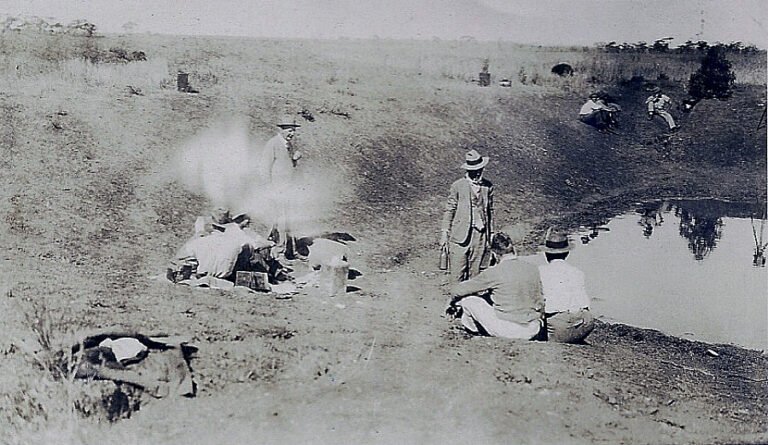
The tests took place on the Bedford Level Canal during March 3–5, 1870. Documents later reproduced in The Law Times record the outcome in unusually plain terms. Referee Martin Coulcher concluded that Wallace had demonstrated the canal’s convexity. William Carpenter, the other referee, concluded that he had not.
On March 7, Wallace wrote to Hampden about how to proceed. He proposed choosing a civil engineer to act as umpire. Each referee could submit reports and sketches. If the umpire wanted the experiment repeated, Wallace offered to do it again. The letter records a proposed way to resolve the disagreement; it does not show that Hampden accepted it.
The argument had moved beyond arranging a test. The parties now needed someone whose judgment they would both accept. Instruments could produce an observation, but the agreement had to survive the result.
From a video to a community
Flat Earth advocacy predates online video. A 2019 study by communication scholar Shaheed Mohammed places modern internet arguments in a longer history that includes Samuel Rowbotham’s nineteenth-century writings and Samuel Shenton’s twentieth-century organization. The internet supplied new ways to distribute and discuss an existing belief.
In a 2019 Texas Tech interview, researcher Alex Olshansky described attending Flat Earth conferences to speak with participants. Many distrusted institutions of power. He also reported that scientific-sounding video arguments could persuade people who had not started out committed to conspiracy theories. He did not blame the platform alone.
The conference visits addressed a question that a view count could not answer: how people understood the claims they encountered. Someone could watch a video without agreeing with it. Meeting participants let researchers hear their accounts, while leaving the physical claims open to measurement.
What the video study could measure
Mohammed examined 500 YouTube videos selected through a search-based sampling procedure. He coded features such as support for Flat Earth, references to other conspiracies and reliance on established science. In that sample, videos advocating Flat Earth outnumbered debunking videos and were longer on average. Debunking videos received more favorable viewer ratings.
Those findings describe a body of content. They do not establish how many viewers changed their minds, whether a recommendation caused a conversion or what every believer thinks. A popular video and a persuasive video are not necessarily the same thing. The study helps identify the arguments circulating; interviews address a different question about the people encountering them.
The documentary Behind the Curve follows movement leaders organizing experiments and an international conference, alongside scientific perspectives. Those activities put the physical claim and the community in the same frame. People were gathering around a belief while attempting to test it. Whether an experiment succeeds still depends on its measurements and methods, not on the number of people invested in its outcome.
What evidence can settle
A claim becomes difficult to test if every contrary result is dismissed as part of a cover-up. The difficulty lies in the rule for judging evidence: no possible observation is allowed to count against the starting position. Asking how a result would change the claim is therefore more useful than arguing over whether a question sounds suspicious.
The older dispute helps keep the modern one in proportion. Online media can distribute a claim widely, but disagreement over evidence did not begin with a recommendation algorithm. Wallace’s letters show people struggling over the terms of a test and the authority of its referees in 1870.
Wallace’s March letter offered to repeat the experiment. That proposal is more revealing than another declaration that an opponent must be foolish: bring back the apparatus, examine the reports and decide who can judge the result. The shape of Earth was not waiting to be settled. The people at the canal still had to decide what they would accept as proof.
Timeline of the Flat Earth movement
- Ancient world: Cosmologies varied; Greek thinkers developed arguments for a spherical Earth.
- Around 240 BCE: Eratosthenes estimates Earth’s circumference through geometry and observations.
- Nineteenth century: Samuel Rowbotham promotes Flat Earth arguments in Zetetic Astronomy.
- 1870: Wallace and Hampden arrange a wager and canal tests; the referees disagree about the result.
- 1956: Samuel Shenton establishes the Flat Earth Society.
- 2019: Texas Tech reports on conference research; Mohammed publishes his analysis of 500 videos.
Frequently Asked Questions
Is Earth a perfect sphere?
No. Its overall shape is approximately an oblate spheroid, wider at the equator. Geodesists use more detailed reference surfaces for precise measurements.
Did ancient people all believe Earth was flat?
No. Ancient cosmologies varied. Greek thinkers argued for a spherical Earth long before spaceflight, and Eratosthenes estimated its circumference around 240 BCE.
Does the belief depend only on rejecting NASA?
No. Historical Flat Earth advocacy predates NASA. Evidence for Earth’s shape also predates space photographs and includes terrestrial and astronomical observations.
Did the 2019 video study prove YouTube changes people’s beliefs?
No. Mohammed analyzed video content. That method describes the sampled material; it does not establish an individual viewer’s change of belief.
What does Behind the Curve contribute?
The documentary follows community leaders, experiments and a conference. It provides a view of participants and their activities, rather than replacing a repeatable scientific test.
Sources & References
Sources for the historical account, measurements and research discussed above.
- NOAA National Geodetic Survey — The Geopotential Surface
The ellipsoid, geoid and gravity measurements used to describe Earth. - American Physical Society — Eratosthenes Measures the Earth
Ancient arguments for a spherical Earth and the circumference estimate. - Texas Tech University; interviews with Alex Olshansky — “But I Saw it on YouTube!” (2019)
Conference research on distrust, video arguments and online communities. - Shaheed Mohammed; Journal of Social Media in Society — Conspiracy Theories and Flat Earth Videos on YouTube (2019)
A study of video content, with historical context for Rowbotham and Shenton. - Delta-v Productions — Behind the Curve
The documentary makers describe experiments and a Flat Earth conference. - Alfred Russel Wallace to John Hampden, January 21, 1870: Proposal for deposits and preparations for the experiment, preserved by the Wallace Correspondence Project.
- Documents Concerning the Bedford Canal Experiment: Agreement and March 7 letter, reproduced in the 1876 Law Times proceedings and transcribed by Charles H. Smith.
Related stories
- Moon landing claims and the evidence
- Roswell: the reports and their aftermath
- The JFK assassination and its investigations