Disappearances unsettle people because someone is missing. Conspiracy theories disturb people for a different reason. They suggest the world itself may be missing pieces.
That feeling is hard to shake once it takes hold. A sealed file. A contradictory witness statement. A photograph that seems to show too much. A government program that sounded impossible until declassified records proved it was real. One unanswered question becomes two. Then five. Then an entire worldview starts to rearrange itself around the suspicion that the public story was never the whole story.
That is why conspiracy archives never behave like ordinary reading lists. People do not move through them the way they move through trivia. They move through them the way they move through a building after the lights have gone out, opening one door because the last one did not close properly in their mind. Some theories collapse when you look closely. Others survive because they are built on real gaps, real betrayals, real lies, or real institutions that earned public distrust long before the wildest versions took shape.
The unresolved part is what keeps the theories alive. Not every conspiracy story has strong evidence. Many do not. But uncertainty is powerful fuel, and once a theory attaches itself to a dramatic event, a famous person, a classified project, or a symbol that looks too deliberate to be innocent, it becomes hard to leave alone. The theory may be wrong. The suspicion may be exaggerated. The leap may be far too large. Still, the friction remains.
Not blind belief. Not shallow debunking. The pull between secrecy and speculation. Between documented misconduct and imaginative expansion. Between cases where people were lied to and cases where that history of lying made later theories feel easier to believe.
This archive is organized like a documentary evidence room rather than a keyword dump. The stories below are grouped by the investigative lens that tends to pull readers deeper: state secrecy, UFO files, altered history, hidden infrastructure, reality-bending cosmologies, and the psychological patterns that make certain conspiracies spread faster than others.
Some of these pages deal with programs that were real. Some deal with beliefs that grew larger than the evidence. Some sit in the space between, where one verified secret made a hundred unverifiable claims easier to sell. That distinction matters. It changes how a reader interprets the next file they open.
This is also the room above the sub-hubs. Existing cluster pages are not competing with this archive. They are the deeper corridors branching off from it. If you want the state-secrecy angle, there is a stronger route for that. If you want the psychology of belief, there is a different one. If you want UFO-era suspicion, hidden tunnels, celebrity replacement myths, or world-model theories that rebuild reality from the ground up, those paths are here too.
What follows is not a ranking. It is a map of the rabbit holes that mattered, the stories that fed public distrust, and the theories that kept growing because closure never landed cleanly enough to shut the door.
Government Programs, Classified Secrecy, and the Conspiracies That Earned Public Distrust
Some conspiracy theories survive because reality trained people not to laugh too quickly. Once intelligence agencies, military departments, and political institutions are caught hiding the truth, even ordinary secrecy starts to feel sinister. That does not mean every theory is true. It does mean the baseline trust is already damaged before the next allegation arrives.
The clearest way into this branch of the archive is Documented Government Programs: MKUltra, Paperclip and Project Blue Book, a deeper hub that collects the cases where hidden programs, suppressed records, or delayed revelations made the public feel cheated first and suspicious afterward. It is the branch archive for readers who want the real-world backbone behind the broader paranoia.
Few examples loom larger than What Was MKUltra? The Real CIA Mind Control Program Hidden for Decades. MKUltra keeps pulling people back because it crosses a line that should never have been crossed: covert mind-control experimentation carried out under institutional cover. The reason it belongs near the front of this archive is simple. Once a government has actually run secret experiments on human beings, the public threshold for disbelief changes. The phrase “that sounds too dark to be real” loses some of its power.
Operation Paperclip: The Secret Plan That Brought Nazi Scientists to America belongs in the same room for a different reason. This was not a fringe legend invented on message boards. It was a hidden policy choice with long moral shadows: scientific utility placed above a cleaner reckoning with the past. Readers who land here are not just looking for shock value. They are tracing the moment when strategic secrecy and public ethics split apart.
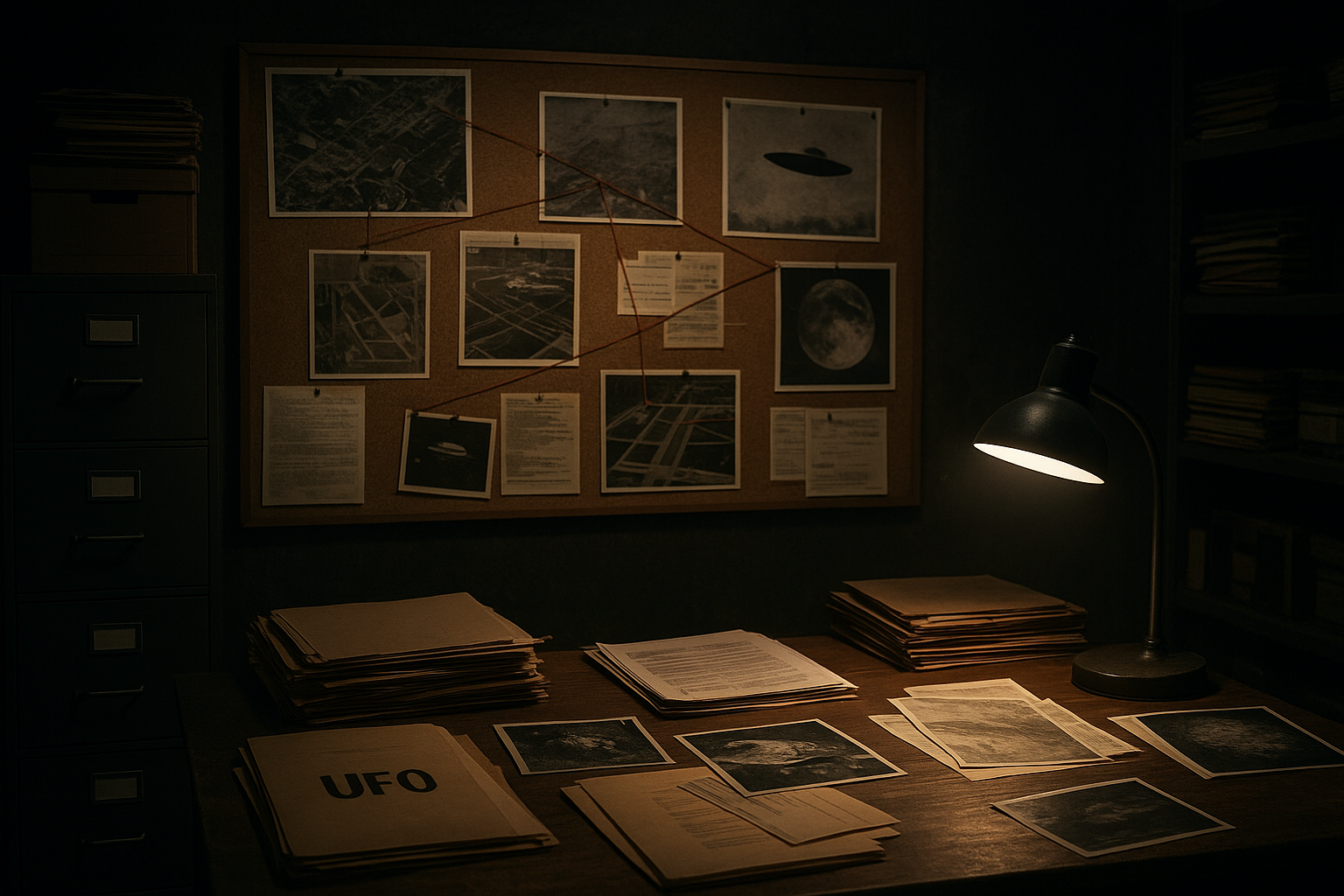
Project Blue Book was a real Air Force investigation of UFO reports. Its existence does not establish an alien cover-up. The Air Force concluded that its unidentified cases supplied no evidence of extraterrestrial vehicles; the records remain available for public examination.
Even when the facts are better documented than the folklore, the emotional afterimage is the same: if major institutions concealed this once, what else did they think the public could not handle? That question never stays in one file. It spreads.
UFO Files, Space Narratives, and the Stories That Turned the Sky Into a Suspicion Machine
The sky is perfect conspiracy terrain. It is open enough for witnesses to claim they saw something. Distant enough for uncertainty to survive. And symbolic enough that every contradiction feels bigger than itself. Once secrecy enters the frame, whether through military classification or evasive public statements, the distance between an unexplained event and a permanent theory becomes very short.
The Roswell UFO Incident became a lasting example of distrust after changing official accounts. The Air Force’s later investigation attributed recovered material to a then-classified balloon project and reported no evidence of alien bodies or extraterrestrial materials. That official finding is different from the claims that grew around it.
Project Blue Book deepens that same pattern from another angle. When unexplained sightings are gathered, categorized, and bureaucratically processed, the institution appears to be doing its job. But archives also create a second effect. They tell readers there were enough incidents to require a system in the first place. That alone keeps the appetite alive.
Moon Landing Hoax Claims and Apollo Evidence belongs here because it transforms technological triumph into cinematic suspicion. The theory survives not because the evidence is stronger than the historical record, but because the event was so monumental that some people find the official version emotionally too clean. In conspiracy culture, scale itself becomes suspect. The bigger the achievement, the easier it is for a counter-story to claim the public was staged into belief.
Hollow Moon Theory presents an engineered shell or artificial object as an alternative lunar history. NASA describes a body with a crust, mantle and core. The hollow-shell claim is not supported by that evidence, even though it makes an expansive science-fiction premise.
These stories linger because the sky does not provide emotional closure. It provides distance, official language, and just enough room for contradiction to keep echoing long after the primary evidence has been cataloged.
Infrastructure, Hidden Spaces, and the Fear That the Real Story Was Built Underground
Some conspiracy theories do not need distant stars or secret labs. They only need a place people can stand in front of and still feel excluded from. Airports, military sites, sealed tunnels, naval projects, and controlled facilities all create the same tension: visible structure above ground, invisible explanation below it.
Denver Airport Conspiracy — The Secrets Hidden Beneath the Runways thrives because it turns ordinary infrastructure into a symbolic text. Murals, construction costs, strange timelines, underground speculation — none of it would carry the same force without the setting. Denver Airport works as a conspiracy magnet because it is both public and opaque. People pass through it. Few understand it. That gap is where myth settles in.
The Philadelphia Experiment is a legend about a ship vanishing or teleporting. Naval historians report that searches of ship logs and archives have produced no documents confirming such an experiment. Its dramatic premise should not be mistaken for evidence.
The Montauk Project attaches unsubstantiated stories of time travel and mind control to the real former military installation at Camp Hero. The surviving buildings explain the setting’s appeal; they do not establish that the alleged experiments occurred.
Infrastructure conspiracies are bingeable for a simple reason. They relocate fear from the abstract to the physical. They tell readers the hidden story is not somewhere beyond reach. It is beneath a runway, behind a secured door, offshore, on a base, or folded inside a military file that someone decided the public should never open.
Rewritten History, Assassinations, and the Cases Where the Official Story Never Fully Stabilized
History becomes conspiracy fuel when an event is too consequential for people to accept a clean ending. If the stakes feel large enough, every contradiction becomes morally loaded. A missed detail is not just a missed detail. It becomes proof that the visible account cannot bear the full weight of what actually happened.
JFK Assassination Conspiracy – The Shots, the Witnesses, and Why the Case Still Splintered the Public Mind remains one of the clearest examples of that phenomenon. The case persists despite the Warren Commission’s conclusion that Oswald acted alone, because the event fused violence, politics, witness confusion, official review, and cultural trauma into one permanent fracture point. It belongs near the center of this archive because it is not just a conspiracy theory. It is one of the templates for how modern conspiratorial thinking sustains itself: a nationally shattering event followed by decades of disagreement over whether the official frame was ever emotionally or evidentially sufficient.
Did Paul McCartney Die in 1966? Inside the Beatles’ Biggest Conspiracy Theory sits on a very different shelf, but it belongs here for the same structural reason. The false “Paul is dead” rumor shows how pop culture can mimic political suspicion. Once fans start treating lyrics, album art, photographs, and public appearances as coded evidence, ordinary celebrity interpretation turns into amateur intelligence work. The stakes are smaller than an assassination file. The pattern is not.
This is also where broader historical suspicion bleeds into adjacent categories. Readers who open these files are often not asking only whether one claim is true. They are asking how often public memory is arranged after the fact — which details were elevated, which were omitted, and whether the official narrative hardened before the public had enough reason to trust it.
The emotional pull here is distinct. These are not theories people revisit only because they are strange. They revisit them because the events feel culturally unfinished. Some stories never stabilize into a single accepted meaning. They remain contested terrain.
World-Model Conspiracies, Total Systems, and the Theories That Rebuild Reality From the Ground Up
At some point, a rabbit hole stops being about one hidden act and becomes a replacement map of reality. That shift is important. It is what separates a suspicion-driven conspiracy from a worldview conspiracy. Once that threshold is crossed, every contradiction can be reinterpreted as supporting evidence, because the theory no longer lives inside the world. It explains the world.
Flat Earth Theory — Why Some People Believe the Earth Is Not Round is one of the clearest examples of this total-system logic. It is a claim contradicted by observations of Earth’s curvature. It is a theory that requires institutions, images, education, and expertise to be part of the cover story. That is why it remains culturally significant even for readers who reject it outright. It reveals the psychological mechanics of total distrust with unusual clarity.
Hollow Earth Conspiracy — Is There a Hidden World Beneath Our Feet? and Reptilian Elite Theory Explained — Why Some Believe World Leaders Aren’t Human belong here because they widen that same impulse into hidden civilizations and hidden rulers. Geophysical evidence describes a layered Earth, and the claim that leaders are secretly reptiles lacks credible support. These stories endure through speculation. It is explanatory hunger. They offer a single dramatic framework that claims to organize chaos, inequality, secrecy, and fear into one story large enough to hold everything.
Chemtrail Conspiracy — Are Planes Really Spraying Something in the Sky? sits in this section as a bridge between atmosphere and system. Aircraft contrails are ice-crystal clouds; their appearance is not evidence of a covert spraying program. The chemtrail theory turns that everyday sight into a recurring trigger. People do not have to hunt for the phenomenon. They only have to look up. That repeat exposure keeps the suspicion active, social, and visually renewable.
World-model conspiracies are powerful because they remove the burden of uncertainty. The theory does not need one perfect proof when it can reinterpret every institution as part of the pattern. That makes them harder to close, harder to debate cleanly, and nearly impossible to reduce to one missing document.
Why People Keep Going Back: Belief, Pattern Hunger, and the Need to Resolve the Gap
Every archive like this eventually leads to the same deeper question: why do some theories fade while others keep recruiting new readers across decades, platforms, and generations? The answer is not just gullibility. That explanation is too lazy and too incomplete to be useful.
Why People Believe Conspiracy Theories — The Psychology Behind the Rabbit Hole is essential reading here because it turns the camera away from the claim and toward the mechanism. Conspiracy thinking often grows where uncertainty is painful, trust is damaged, and pattern recognition feels more emotionally satisfying than unresolved ambiguity. People would often rather choose a dark explanation than sit with a blank one.
The documented misconduct associated with MKUltra and the historical controversy around Operation Paperclip help explain distrust. Blue Book belongs beside them as a documented investigation, not as proof that its most extraordinary allegations were true.
Another pattern repeats across the archive: ambiguity scales. A contradictory memo may feed a narrowly focused theory. A cultural trauma, a visible symbol, or an institutional betrayal can feed an entire ecosystem. That is why some pages lead to one more article, while others lead to weeks of reading. The theory has expanded beyond the original claim and become a way of interpreting power itself.
The final reason these stories keep pulling people back is emotional proportion. People instinctively resist endings that feel smaller than the event. If a president is shot, if a moon landing changes history, if a secret program violates basic morality, if witnesses say one thing and institutions say another, many readers do not want a plain answer. They want an answer equal in size to the unease the event created.
That desire can mislead. It can also explain a great deal. Conspiracy archives are not just collections of theories. They are records of broken trust, unfinished explanation, symbolic fear, and the human habit of reaching for larger stories when smaller ones do not feel like enough.
When the Evidence Is Thin but the Distrust Is Strong
One of the most important patterns across this archive is the gap between evidentiary strength and emotional conviction. Some theories grow from documents, hearings, witnesses, and real institutional misconduct. Others survive on repetition, symbolism, coincidence, and the feeling that powerful people are probably hiding something again. Readers often move between those categories without noticing the transition.
That is why pages like MKUltra and Operation Paperclip matter so much inside the same archive as Flat Earth or the Reptilian Elite theory. The first group proves that secrecy, manipulation, and moral compromise can be real. The second group shows how that history can become a launchpad for totalizing claims far beyond the original evidence. The archive only makes sense if both dynamics stay visible at once.
Another pattern repeats here too: bad official communication often does half the work for a conspiracy theory before believers ever arrive. Contradictory statements, delayed disclosures, overconfident dismissals, and obvious institutional self-protection all create the impression that the surface narrative was assembled for stability rather than truth. In that atmosphere, even weak claims can feel stronger than they are.
That does not mean every suspicion deserves the same weight. It means the public relationship to authority is part of the evidence environment. If people feel manipulated often enough, they stop evaluating one theory in isolation. They evaluate it against a memory of prior deception. And once that happens, a rumor is no longer competing only with facts. It is competing with history.
This is why conspiracy clusters become so addictive. Each page is not just about its own claim. It changes the reader’s threshold for the next claim. A real file makes a wild file easier to entertain. A dramatic lie makes a dramatic rumor easier to share. The archive becomes cumulative, and the cumulative effect is more powerful than any single theory on its own.
How One Verified Secret Can Keep a Hundred Theories Alive
There is a reason conspiracy culture rarely grows in a vacuum. Documented betrayals can supply material for later conspiracy narratives. One proven secret does not simply stand alone in public memory. It changes the emotional chemistry around every later denial. The records around MKUltra, the moral compromise inside Operation Paperclip, and the official handling of Project Blue Book all show how secrecy can leave damage beyond the original event. The damage is interpretive. People stop hearing reassurance as reassurance.
That is when archives like this become more than entertainment. They become case studies in the afterlife of distrust. A theory about hidden tunnels, altered history, or impossible aerospace technology may not stand on the same evidentiary ground as a documented covert program. But if the audience has already seen institutions lie, delay, redact, or protect themselves, the weaker theory enters a much friendlier climate. It does not have to prove everything from scratch. Suspicion is already waiting for it.
This pattern repeats across modern media too. A dramatic claim spreads. A partial correction arrives late. A witness goes viral. An expert response sounds too polished. Screenshots circulate without context. Old government misconduct gets dragged back into the thread as proof that ?they?ve done this before.? By that stage, the argument is no longer only about the original story. It is about whether public trust was ever deserved in the first place.
That is why the strongest conspiracy archives do not flatten every case into the same box. They separate verified secrecy from symbolic suspicion, and symbolic suspicion from total-world theories that can absorb almost any contradiction. If those distinctions disappear, the archive becomes noise. If they stay visible, the reader can move through the cluster with a sharper eye ? not less curious, but less easily swept away by the thrill of escalation alone.
Conclusion: The Archive Above the Rabbit Hole
What makes conspiracy stories endure is not simply whether they are true or false. It is whether they attach themselves to something that already feels unstable: power, secrecy, contradiction, prestige, memory, grief, war, celebrity, science, or the thin line between official explanation and public confidence.
Some files in this archive point back to verified secrecy. Some point toward folklore that outgrew the evidence. Some remain lodged in the middle, where distrust keeps the theory breathing even after the strongest facts are already on the table. That is why readers keep returning. Not every page offers certainty. Nearly all of them offer friction.
This archive is meant to route that friction productively. If one branch pulled you in through state secrecy, go deeper into the documented programs and the stories that taught the public how to doubt. If the draw was UFO-era contradiction, follow the files where official investigation never fully quieted the witnesses. If the pull was hidden infrastructure, rewritten history, or reality-scale theories that redraw the map entirely, keep moving. The cluster is stronger when the paths connect.
Because that is the real shape of this subject. Conspiracy culture is not one theory. It is an architecture of suspicion. And once someone steps inside, the next door almost always opens by itself.
🔎 If this investigation pulled you deeper into the mystery, continue with these next archive files:
- The Internet Mysteries Archive — Codes, Broadcast Intrusions, Vanishing Identities, and Rabbit Holes That Never Reached the Bottom
- Documented Government Programs: MKUltra, Paperclip and Project Blue Book
- Why People Believe Conspiracy Theories — The Psychology Behind the Rabbit Hole
Explore more Conspiracies & Theories investigations here:
Research Sources
The following resources were consulted to verify and update this article.
- U.S. Senate, hosted by CIA — Project MKULTRA: The CIA’s Program of Research in Behavioral Modification, 1977 hearing
Documents covert behavioral experiments and unwitting participants. - National Archives — Records of the Secretary of Defense, RG 330
Identifies Paperclip personnel dossiers and their historical context. - National Archives — Project BLUE BOOK: Unidentified Flying Objects
Provides the investigation’s records and the Air Force’s Roswell findings. - NASA — Moon Facts
Explains Apollo exploration and the Moon’s layered interior. - Denver International Airport — Embracing the Unbelievable: Airport Addresses Conspiracy Theories
Documents the airport’s own public response to its conspiracy folklore. - Naval History and Heritage Command — Philadelphia Experiment
Reviews ship records and finds no support for the alleged disappearance. - Long Island Guide — The Montauk Project and Camp Hero: Radar, Rumors and Pop-Culture Myth
Separates the former military site’s history from unsubstantiated experiment stories. - Warren Commission, National Archives — Report of the President’s Commission: Chapter 1
Records the commission’s conclusion and the evidence it reviewed. - The Beatles Bible — The Paul Is Dead Myth
Traces the false death rumor and supposed album clues. - NASA — How Do We Know the Earth Isn’t Flat?
Explains observational evidence for Earth’s curved shape. - U.S. Geological Survey — What Do We Know About the Interior of the Earth?
Describes Earth’s crust, mantle and core. - PolitiFact — Reptilian conspiracy theory continues after queen’s death
Examines the unsupported claim that public figures are reptiles. - U.S. Environmental Protection Agency — Information on Contrails from Aircraft
Explains ice-crystal contrails and addresses chemtrail allegations. - Psychological Bulletin — The Conspiratorial Mind: A Meta-Analytic Review
Reviews research on motivations and personality correlates of conspiracy belief.